 English
 پارسی


The Reserve Bank of New Zealand enters the week ahead facing a more complicated policy backdrop than it did just a few months ago. The most likely outcome from the April 8 meeting is that the bank leaves the Official Cash Rate unchanged at 2.25%. On the surface, that sounds straightforward. But this is not a routine hold. The significance of the meeting lies in how the central bank explains the changing balance between inflation risks and weak growth.
This matters even more because the April decision is a Monetary Policy Review, not a full Monetary Policy Statement. That means the RBNZ will not publish a full updated forecast set until May 27. Even so, the bank has already indicated that it will expand communication around this review, with the decision released at 2 p.m. and an online media conference at 3 p.m. That tells markets clearly that policymakers know investors are looking for more than a simple hold.
Inflation Risks Have Become More Difficult to Ignore
The policy conversation has changed since the February meeting. At that time, the RBNZ also kept rates unchanged at 2.25% and still suggested that policy would likely remain accommodative for some time. The bank was effectively in the middle ground: the easing cycle looked finished, but a tightening cycle had not yet begun. Since then, however, inflation expectations have moved higher, and the recent oil shock has added fresh upside risk to the inflation outlook.
That shift matters because this meeting is no longer mainly about whether inflation is declining. It is now about whether the inflation-growth trade-off has become harder to manage. Governor Anna Breman said in late March that the RBNZ would generally look through a temporary spike in energy costs, but could raise rates if inflation risk became more persistent. That is an important distinction. Central banks can tolerate a first-round energy shock for a while, but they are much less comfortable if it begins to affect expectations, broader price-setting behavior, and the medium-term inflation path.
Oil and Expectations Are Now at the Center of the Debate
New Zealand’s annual CPI rose to 3.1% in the December 2025 quarter, placing inflation just above the RBNZ’s 1%–3% target band. At the same time, the bank’s own Survey of Expectations showed one-year-ahead inflation expectations rising to 2.59% from 2.39%, while two-year-ahead expectations increased to 2.37%. These figures do not yet imply a full de-anchoring of expectations, but they do suggest that inflation psychology has become less comfortable.
The energy channel reinforces that concern. ،he fuel and transport costs are expected to push near-term inflation higher, and petrol and diesel account for about 4% of New Zealand’s CPI basket. The average price of 91-octane petrol rose to about NZ$3.29 per litre, up sharply from roughly NZ$2.50 in late February. That is a meaningful increase in a short period and helps explain why the RBNZ is likely to sound more vigilant, even if it still prefers to wait before making any policy move.
Growth Is Still Too Soft for an Aggressive Shift
The RBNZ’s problem is that inflation risks are rising while growth remains weak. New Zealand’s economy expanded by just 0.2% quarter on quarter in Q4 2025, below both market expectations and the RBNZ’s own 0.5% forecast, while annual growth stood at 1.3%. The labor market also remains soft, with the unemployment rate at 5.4% in the December quarter.
This is why the bank is unlikely to sound outright hawkish. Inflation is above target, and expectations have moved higher, but growth is not strong enough to justify an aggressive tightening response. The most likely message is therefore something close to “hold, stay vigilant, and buy time.” That would mean keeping the OCR unchanged, emphasizing that the bank can initially look through first-round oil effects, but also stressing that it will respond if inflation becomes more persistent or more deeply embedded.
Market Implications and NZD/USD Focus
For markets, the rate decision itself is not the main event. The reaction will depend on how much weight the RBNZ places on inflation persistence versus weak activity. If the bank leans more heavily on vigilance, second-round effects, and inflation entrenchment, markets are likely to interpret the outcome as mildly hawkish, which could support the New Zealand dollar and front-end yields. If the bank puts greater emphasis on weak GDP, spare capacity, and patience, the hold may be read as more dovish.
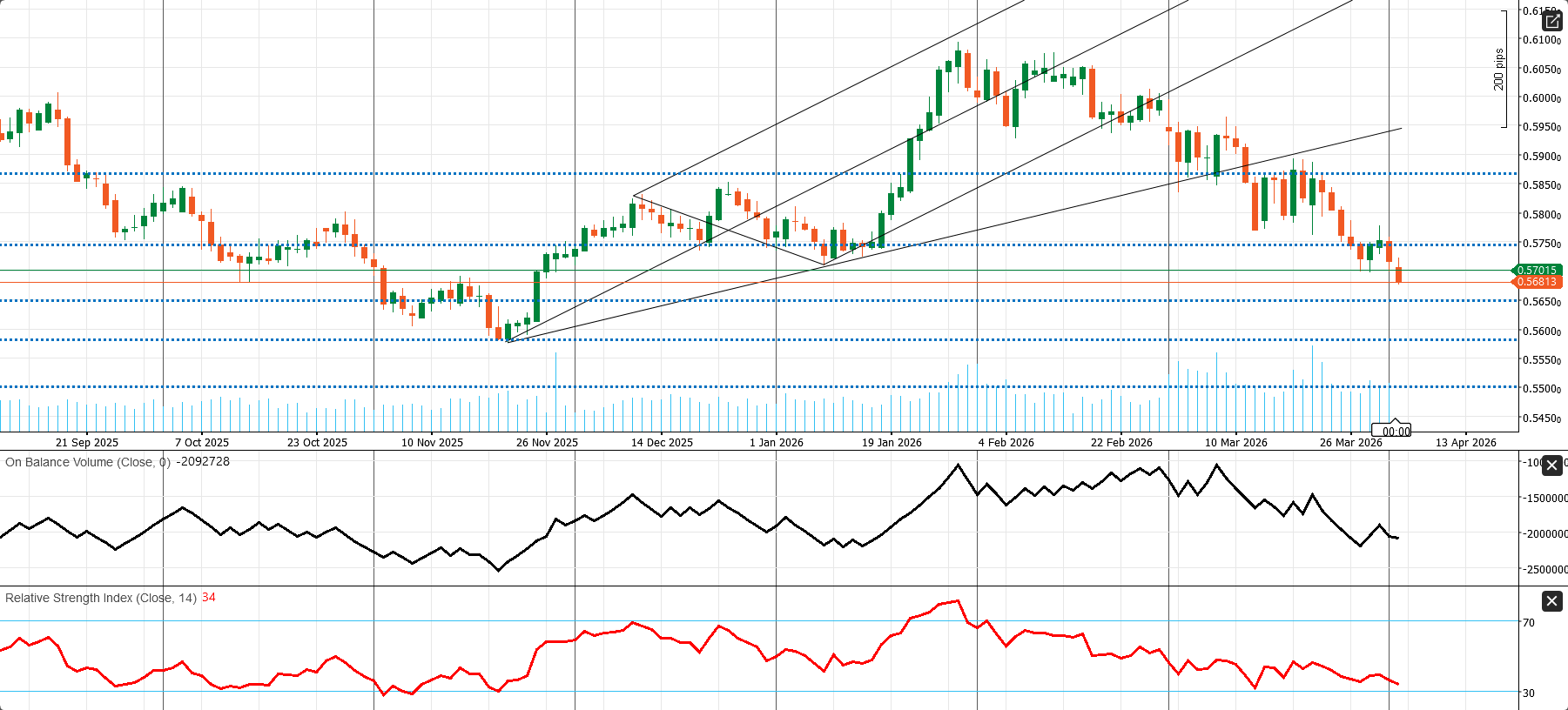
The technical backdrop for NZD/USD adds another layer. The daily bias remains bearish, with price trading near 0.5680, below the key 0.5700–0.5750 zone. Nearby support sits around 0.5650, followed by 0.5590–0.5560, while resistance is seen near 0.5700–0.5715 and then 0.5750. Momentum indicators also point to caution, although oversold conditions leave room for a short-term bounce.
Final Take
The base case for the week ahead is a rate hold at 2.25% with a firmer tone than in February. The RBNZ is probably no longer in a rate-cut conversation, but it is not yet in a full rate-hike cycle either. Instead, it sits in a narrow middle ground where inflation is above target, expectations are edging higher, oil has worsened the near-term outlook, and growth remains soft enough to argue for patience. For markets, that means tone will matter more than the decision itself.
Q&A
What is the RBNZ expected to do this week?
The RBNZ is widely expected to keep the Official Cash Rate unchanged at 2.25%.
Why does this meeting matter if rates are likely unchanged?
Because markets are focused on the bank’s guidance on inflation persistence, second-round effects, and policy flexibility.
What is the main inflation concern for the RBNZ?
The key concern is that higher oil prices and rising expectations may make inflation more persistent over time.
Why is the RBNZ unlikely to sound aggressively hawkish?
Because growth remains soft, with weak GDP and a relatively soft labor market limiting the case for an immediate tightening shift.
What could a firmer tone mean for markets?
A firmer tone could support the New Zealand dollar and keep front-end yields relatively firm.
Comments