 English
 پارسی


Key Takeaways
The latest CFTC Commitment of Traders report, released on 12 June 2026, showed a major adjustment in speculative positioning across currencies, equity indices, metals, energy and agricultural commodities.
The strongest signals came from the sharp reduction in euro longs, the continued heavy short positions in the Japanese yen and Canadian dollar, the reduction in crude oil longs, and the aggressive liquidation of corn and soybean long positions. At the same time, gold remained one of the most favored long positions among speculative traders, while wheat shorts increased despite rising crop-risk concerns.
From a trading perspective, the report points to a market that is still defensive toward several currencies, selective in commodities, cautious on oil, and structurally supportive for gold. However, positioning is not a direct trading signal by itself. It should be combined with price action, macroeconomic data, central-bank expectations, volatility and risk management.
What Is the CFTC COT Report?
The Commitment of Traders report, usually known as the COT report, is a weekly report published by the U.S. Commodity Futures Trading Commission. It shows how different groups of traders are positioned in futures markets, including commercial hedgers, non-commercial speculators and other reportable traders.
For market participants, the most watched section is often speculative net positioning. This measures the difference between long and short positions held by non-commercial traders. A positive number means speculators are net long, while a negative number means they are net short.
The latest report reviewed here was released on 12 June 2026 and compares current speculative net positions with the previous publication. Current market prices referenced in this analysis are based on prices around 14 June 2026.
CFTC Report Overview: Major Positioning Changes in June 2026
The latest CFTC data showed that speculators reduced exposure in several major markets. The most important changes were:
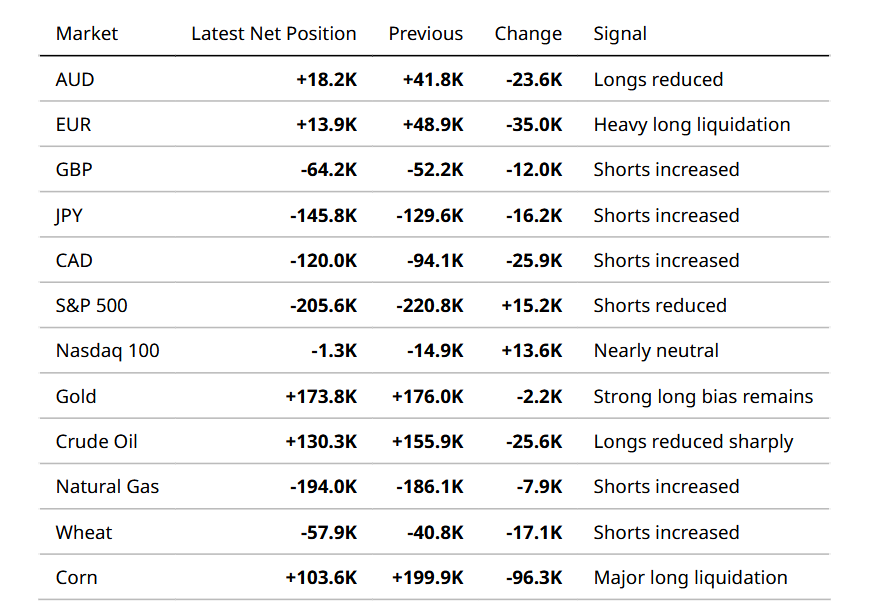
The overall message is clear: speculators became more cautious. They reduced long exposure in several risk-sensitive markets, increased short positions in selected currencies, and stayed heavily long gold.
Forex Positioning: Dollar Sentiment Remains Strong
The latest CFTC report showed strong speculative support for the U.S. dollar against several major currencies. Traders increased short positions in the Japanese yen, British pound, Canadian dollar, Swiss franc and New Zealand dollar.
The U.S. Dollar Index was trading near 99.48 around 14 June, while EUR/USD was near 1.1607, GBP/USD near 1.3451, AUD/USD near 0.7077, USD/JPY near 159.90 and USD/CAD near 1.3958.
Euro: Long Positions Were Cut Sharply
Euro speculative net longs fell from +48.9K to +13.9K, a decline of 35.0K contracts. This was one of the most important currency moves in the report.
The euro is still trading at relatively high levels near 1.1607, but the reduction in long positions shows that speculative traders are less confident about further upside. This may reflect expectations that the European Central Bank could move toward rate cuts before the Federal Reserve, especially if Eurozone growth weakens or inflation continues to ease.
For EUR/USD, the positioning signal is no longer clearly bullish. A break below the 1.1600 area could open the door for a correction toward 1.1500–1.1400, especially if U.S. data remains stronger than European data.
British Pound: Speculators Increased Short Positions
GBP net shorts rose from -52.2K to -64.2K, showing that bearish sentiment toward the pound increased.
This is notable because GBP/USD was still trading near 1.3451, which means traders are building bearish positions even while spot prices remain elevated. The market may be pricing slower UK growth, uncertainty around inflation, and possible future Bank of England policy easing.
From a trading perspective, GBP/USD may be vulnerable if price fails to hold above recent support levels. Rallies could attract sellers unless the UK data improves or the Bank of England sounds more hawkish.
Japanese Yen: The Market Remains Heavily Short
The Japanese yen remained one of the most heavily shorted currencies in the report. JPY speculative net positions moved from -129.6K to -145.8K, meaning shorts increased by 16.2K contracts.
USD/JPY was trading near 159.90, showing that the yen remains under pressure. The key driver is still the wide interest-rate gap between Japan and the United States. As long as the Bank of Japan remains cautious and U.S. yields stay elevated, traders may continue to use the yen as a funding currency.
However, the large short position also raises intervention and short-squeeze risks. If Japanese authorities intervene or the Bank of Japan sends a stronger tightening signal, USD/JPY could reverse sharply.
Canadian Dollar: Shorts Increased as Oil Weakened
CAD speculative net positions fell deeper into negative territory, moving from -94.1K to -120.0K. This means traders added 25.9K new net short contracts.
The Canadian dollar is often sensitive to oil prices, and crude oil was trading near $81.05 per barrel. The reduction in oil longs and weaker energy sentiment may have contributed to bearish CAD positioning.
USD/CAD near 1.3958 remains a key level to watch. If oil continues to weaken and the Bank of Canada maintains a dovish bias, USD/CAD could remain supported.
Equity Index Positioning: Short Covering in S&P 500 and Nasdaq
The latest CFTC data showed short covering in U.S. equity futures. S&P 500 speculative net shorts improved from -220.8K to -205.6K, while Nasdaq 100 net shorts improved from -14.9K to only -1.3K.
This means speculators are still cautious on the S&P 500, but the Nasdaq 100 positioning is almost neutral.
The S&P 500 was trading around 7,431.46, close to record-high territory. The Nasdaq Composite was near 25,888.80.
S&P 500: Still Net Short, But Less Bearish
Despite the market rally, speculators remain net short S&P 500 futures by -205.6K contracts. This suggests that many traders are still hedging or expecting a pullback.
However, the reduction in shorts shows that bearish conviction is weakening. If the index continues to hold above key support and earnings remain strong, more short covering could support further upside.
Nasdaq 100: Positioning Is Almost Neutral
Nasdaq 100 speculative positioning moved close to neutral, with net shorts falling to only -1.3K. This suggests that traders are no longer aggressively bearish on technology stocks.
A neutral positioning setup can be important because it leaves room for momentum buyers if prices break higher. However, it also means that the market may need a fresh catalyst, such as strong earnings, softer inflation or lower yields, to extend the rally.
Gold, Silver and Copper: Metals Remain Supported, But Profit-Taking Appears
Gold remains one of the strongest long positions in the latest CFTC report. Speculative net longs stood at +173.8K, only slightly below the previous +176.0K.
Gold was trading around $4,305 per ounce, while silver was near $70.02 per ounce and copper was around $6.513 per pound.
Gold: Strong Bullish Positioning Remains
Gold positioning remains clearly bullish. The small decline of 2.2K contracts looks more like mild profit-taking than a change in trend.
Gold continues to benefit from several major themes: geopolitical risk, central-bank reserve diversification, expectations of softer real yields and demand for defensive assets. As long as gold holds above major support zones, speculative positioning remains supportive.
However, because gold longs are already high, the market could become vulnerable to a correction if U.S. yields rise sharply or the dollar strengthens.
Silver: Long Bias Remains Positive
Silver net longs slipped from +23.9K to +22.2K, a modest reduction. With silver trading near $70.02, the market still has a positive speculative bias.
Silver often reacts more aggressively than gold because it has both precious-metal and industrial-metal characteristics. If gold remains strong and industrial demand improves, silver could continue to outperform.
Copper: Longs Trimmed, But the Market Remains Constructive
Copper speculative net longs declined from +78.8K to +74.5K. This shows some profit-taking, but not a bearish reversal.
Copper prices near $6.513 per pound remain supported by long-term supply concerns and demand from electrification, infrastructure and energy-transition sectors. Still, the reduction in longs suggests traders are becoming more selective after the rally.
Energy Positioning: Oil Longs Cut Sharply, Natural Gas Shorts Increase
Energy markets showed a clear loss of speculative confidence. Crude oil net longs fell from +155.9K to +130.3K, a drop of 25.6K contracts.
At the same time, natural gas net shorts increased from -186.1K to -194.0K.
Crude Oil: Bullish Conviction Is Weakening
Crude oil remains net long, but the decline in long positions is important. WTI was trading around $81.05 per barrel, down sharply on the day.
The reduction in crude longs suggests that traders are less confident about further upside. Concerns may include softer demand expectations, rising inventories, uncertainty around OPEC policy and reduced geopolitical risk premium.
For oil traders, this means rallies may face selling pressure unless price action confirms a stronger rebound. A sustained move below the $80 area could increase bearish momentum.
Natural Gas: Heavy Shorts Still Dominate
Natural gas speculative net shorts increased to -194.0K, while prices were trading near $3.07. This shows that speculators continue to expect oversupply or weak demand.
However, natural gas is vulnerable to short squeezes. If summer heat increases power demand or LNG flows tighten the market, short covering could create a sharp upside move.
Agricultural Commodities: Corn and Soybean Longs Were Cut Aggressively
Agricultural commodities showed some of the largest positioning changes in the report. Corn net longs were slashed from +199.9K to +103.6K, a huge decline of 96.3K contracts. Soybean longs also fell from +187.8K to +150.5K.
Wheat was different. Speculators increased shorts from -40.8K to -57.9K, while wheat prices fell to around 584.50 US cents per bushel.
Corn: Massive Long Liquidation
Corn saw the largest position adjustment in the report. The drop of 96.3K contracts shows that speculative traders aggressively reduced bullish exposure.
This may reflect improved planting conditions, stronger supply expectations, or reduced concern about weather risk. However, the large liquidation could also mean that the market is becoming less crowded on the long side, which may reduce downside liquidation pressure later.
Soybeans: Longs Reduced, But Still Positive
Soybean speculative net longs fell by 37.3K contracts, but the market remains net long at +150.5K.
This means sentiment is less bullish than before, but not yet bearish. Soybeans may remain sensitive to weather, South American supply, China demand and biofuel policy developments.
Wheat: Shorts Increase Despite Crop Risks
Wheat speculative net shorts increased to -57.9K, while prices traded near 584.50 US cents per bushel. This shows that traders are still bearish on wheat despite potential supply concerns.
This creates a possible short-squeeze setup. If weather risks intensify or crop forecasts deteriorate, heavily short positioning could force traders to cover, supporting a rebound in wheat prices.
Trading Ideas Based on the Latest CFTC Report
These trading ideas are educational and should not be treated as direct investment advice. The COT report is useful for understanding positioning, but it should always be combined with technical analysis, macro data, volatility conditions and strict risk management.
1. Gold: Buy Pullbacks While the Broader Bias Remains Supportive
Gold remains strongly supported by speculative positioning, with net longs at +173.8K. With spot gold near $4,305 per ounce, the market remains structurally bullish, but the high level of long exposure means traders should avoid chasing overstretched moves.
A better approach may be to wait for pullbacks toward support zones and look for bullish confirmation. The main risk is a stronger U.S. dollar or a sharp rise in real yields.
Market Sentiment: Buy on pullbacks
Risk: Crowded long positioning and dollar strength
2. GBP/USD: Watch for Selling Opportunities on Failed Rallies
GBP shorts increased to -64.2K, showing a clear bearish speculative bias. If GBP/USD fails to hold above key support levels or forms rejection near recent highs, short setups could become attractive.
A possible trade idea is to sell failed rallies with tight stops above recent resistance. The downside risk for the pound could increase if UK data weakens or the Bank of England turns more dovish.
Market Sentiment: Sell rallies
Risk: Short squeeze if UK data surprises positively
3. USD/JPY: Bullish Trend Continues, But Intervention Risk Is High
JPY net shorts increased to -145.8K, confirming that speculators remain strongly bearish on the yen. USD/JPY near 159.90 remains supported by carry-trade dynamics.
However, the position is crowded. Traders should be careful near psychologically important levels because the risk of Japanese verbal or direct intervention can increase quickly.
Market Sentiment: Buy dips with caution
Risk: Intervention or sudden Bank of Japan policy shift
4. Crude Oil: Reduce Long Exposure or Hedge Downside Risk
Crude oil longs were cut by 25.6K contracts, while WTI traded near $81.05 per barrel. This shows weakening bullish conviction.
If oil fails to regain momentum above resistance, traders may consider reducing long exposure or using options to hedge downside risk. A sustained move below $80 could invite more selling pressure.
Market Sentiment: Neutral to bearish
Risk: Geopolitical supply shock could reverse the market higher
5. Wheat: Potential Short-Squeeze Opportunity
Wheat shorts increased to -57.9K, while prices remained weak near 584.50 US cents per bushel. If weather risk or crop concerns increase, wheat could experience short covering.
A possible strategy is to monitor bullish reversal signals on wheat futures or consider relative-value trades such as long wheat versus short corn.
Market Sentiment: Contrarian buy setup
Risk: Better crop outlook or weaker demand could keep prices under pressure
6. Nasdaq 100: Watch for Breakout Confirmation
Nasdaq 100 positioning is now almost neutral at -1.3K, which means the market is no longer heavily short. If prices break above recent highs, the lack of heavy bearish positioning may allow momentum buyers to return.
However, valuation risk remains high. Traders should wait for technical confirmation rather than entering too early.
Market Sentiment: Neutral to bullish on breakout
Risk: Higher yields or weak tech earnings
Final Market Outlook
The latest CFTC COT report for June 2026 shows a market that is becoming more selective and defensive. Speculators continue to favor gold and remain heavily bearish on the Japanese yen, Canadian dollar and natural gas. At the same time, they have reduced exposure in euro, crude oil, corn and soybeans.
The strongest trading signals from this report are not simple buy or sell calls. Instead, the report highlights where market positioning is crowded, where traders are losing conviction, and where short-squeeze or long-liquidation risks may appear.
Gold remains one of the strongest bullish markets, but it is also crowded. The yen remains one of the weakest currencies, but intervention risk is elevated. Crude oil has lost some speculative support, while wheat may offer a contrarian opportunity if supply concerns return.
For traders, the key lesson is to use the CFTC report as a positioning map. It helps identify where the market is leaning, but price action and risk management must confirm the trade.
FAQ
What is the CFTC COT report?
The CFTC Commitment of Traders report is a weekly report published by the U.S. Commodity Futures Trading Commission. It shows how different trader groups are positioned in futures markets, including speculative traders, commercial hedgers and other reportable participants.
What does speculative net position mean?
Speculative net position is the difference between long and short positions held by non-commercial traders. A positive number means speculators are net long, while a negative number means they are net short.
What was the most important change in the latest CFTC report?
The most important changes were the sharp reduction in euro longs, the increase in yen and Canadian dollar shorts, the decline in crude oil longs, and the major liquidation of corn and soybean long positions.
Is the latest CFTC report bullish for gold?
Yes, the report remains broadly bullish for gold because speculative net longs stayed high at +173.8K contracts. However, because positioning is already crowded, traders should be careful about chasing gold at overextended levels.
Is the CFTC report bearish for crude oil?
The report is moderately bearish for crude oil because speculative net longs fell from +155.9K to +130.3K. This shows reduced confidence in further upside, especially with WTI trading near $81.05 per barrel.
Why are traders still short the Japanese yen?
Speculators remain heavily short the yen because Japan’s interest rates are still low compared with the United States. This makes the yen attractive as a funding currency for carry trades. However, the large short position also increases intervention and short-squeeze risks.
Can the CFTC COT report be used for trading?
Yes, but it should not be used alone. The COT report is best used as a positioning tool. Traders should combine it with technical analysis, macroeconomic data, central-bank expectations, sentiment indicators and risk management.
What is the main risk in using COT data?
The main risk is that COT data is delayed. It reflects positions held on Tuesday and is released on Friday. Market conditions may change quickly after the reporting date, so traders should always compare COT signals with current price action.
--------------
Risk Disclaimer
This article is for educational and informational purposes only. It does not constitute investment advice, financial advice, trading advice or a recommendation to buy or sell any financial instrument. Futures, forex, commodities and leveraged products involve significant risk and may not be suitable for all investors. Always conduct your own research and use proper risk management before making trading decisions.
Sources
CFTC Commitment of Traders Report
DowFutures.org World Markets Data
Trading Economics Wheat Market Data
MacroTrends Historical Commodity Data
Comments