 English
 پارسی


CFTC Weekly Positioning Report: Agriculture Strengthens as Energy Exposure Falls — July 17, 2026
How to Read the CFTC Data
The figures represent net speculative positions measured in thousands of contracts.
A positive figure indicates that speculative traders hold more long contracts than short contracts. A negative figure indicates that short positions exceed long positions.
A positive weekly change means positioning became more bullish. This can result from new long positions, closed short positions, or a combination of both. A negative weekly change indicates a shift toward more bearish positioning.
CFTC data are most useful for evaluating medium-term sentiment, market crowding, and potential positioning reversals. They should not be treated as standalone real-time trading signals.
Latest CFTC Positions Compared with the Previous Week
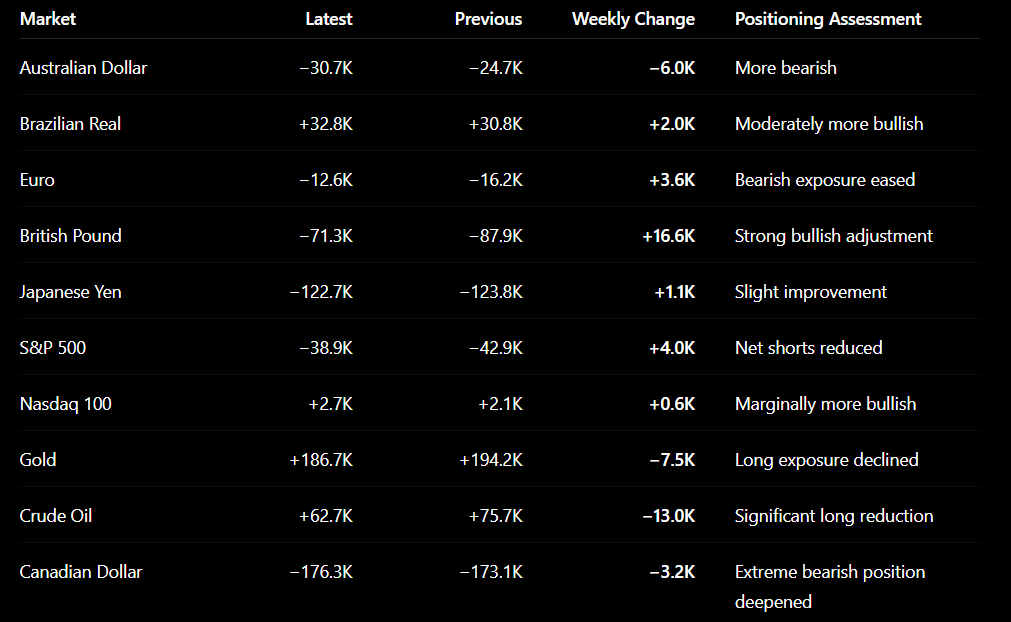
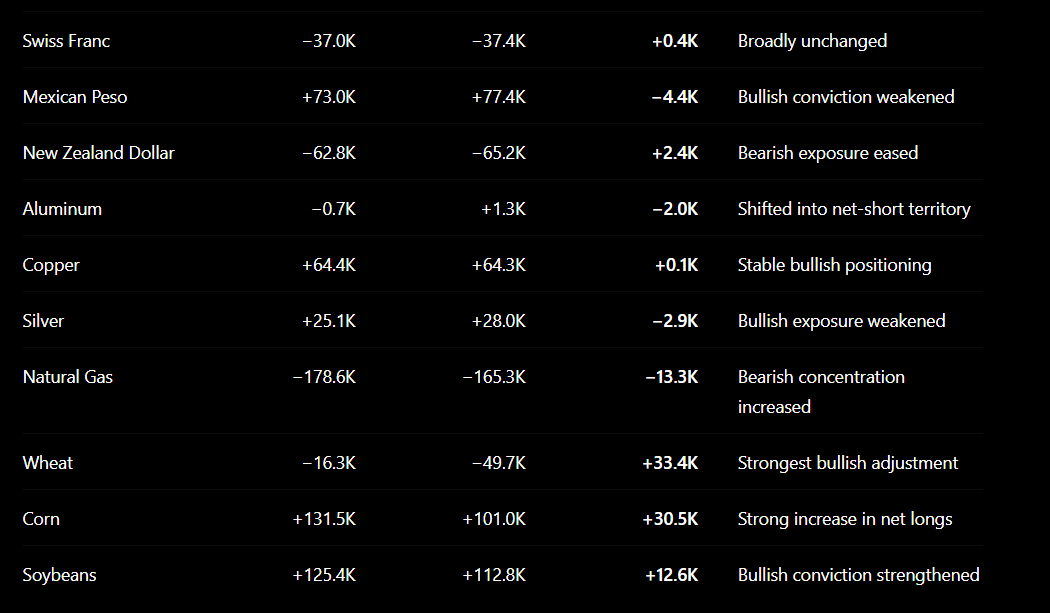
Key Findings from the Latest CFTC Report
Three major positioning themes emerged from the report.
Agricultural Commodities Recorded the Strongest Bullish Rotation
Wheat delivered the largest positive weekly shift, with its net-short position declining by 33,400 contracts. Corn net longs increased by 30,500 contracts, while soybean net longs rose by 12,600 contracts.
This coordinated increase indicates that speculative capital has rotated toward agricultural commodities. Wheat may offer the most attractive positioning structure because it remains slightly net short, while corn and soybeans already carry substantial net-long exposure.
Energy Positioning Became More Bearish
Crude-oil net longs fell by 13,000 contracts, while natural-gas net shorts increased by 13,300 contracts.
The decline in oil exposure is especially notable because crude prices subsequently strengthened. This creates a divergence between bullish price action and weakening speculative positioning.
Natural gas produced the strongest outright bearish positioning signal, although the extremely large short position also increases the probability of a short squeeze.
Currency Positioning Remained Fragmented
The British pound recorded the strongest bullish currency adjustment, but it remained significantly net short. Euro positioning moved closer to neutral, while Japanese yen positioning showed only a limited improvement.
Australian-dollar and Canadian-dollar positions became more bearish. However, recent price resilience in both currencies means technical confirmation is necessary before following the CFTC direction.
Foreign Exchange Positioning Analysis
- British Pound: Bearish Positioning Continues to Improve
GBP net shorts declined from 87,900 to 71,300 contracts, representing a bullish weekly improvement of 16,600 contracts.
The pound remains structurally net short, but the reduction shows that speculative pressure against sterling is easing. If GBP/USD continues to hold above key technical support, additional short covering could strengthen the recovery.
Positioning condition: Bearish but improving
Market sentiment: Neutral to moderately bullish
- Euro: Moving Toward Neutral Positioning
Euro net shorts fell from 16,200 to 12,600 contracts.
The relatively small negative position suggests that EUR/USD may increasingly respond to monetary-policy expectations, inflation data and U.S. dollar movements rather than heavily one-sided speculative positioning.
Positioning condition: Near neutral
Market sentiment: Neutral to moderately bullish
- Japanese Yen: Heavy Shorts Create Reversal Risk
JPY remained deeply net short at 122,700 contracts.
Although net shorts declined slightly, the improvement was not large enough to establish a meaningful bullish shift. The positioning structure still supports yen weakness under normal market conditions.
However, extreme short exposure creates substantial reversal risk if U.S. yields fall, risk sentiment deteriorates, or Japanese authorities intervene.
Positioning condition: Strongly bearish
Market sentiment: Sell JPY, with elevated short-squeeze risk
- Australian Dollar: Bearish Positioning Conflicts with Price Strength
AUD net shorts increased by 6,000 contracts to 30,700.
The positioning change is bearish, but recent AUD/USD resilience creates a price-positioning divergence. A confirmed breakdown below technical support would validate the bearish CFTC signal. Continued strength could instead force speculative short covering.
Positioning condition: Bearish
Market sentiment: Sell only after technical confirmation
- Canadian Dollar: Extreme Shorts Could Trigger a Squeeze
CAD net shorts increased to 176,300 contracts, making the Canadian dollar the most heavily shorted currency in the report.
The bearish consensus is clear, but the position is extremely crowded. Stronger oil prices may support the Canadian dollar and force traders to close short positions.
Extreme positioning alone does not confirm a reversal. A technical breakdown in USD/CAD would be required before considering a contrarian Canadian-dollar trade.
Positioning condition: Extremely bearish and crowded
Market sentiment: Contrarian Buy CAD after confirmation
- Overall U.S. Dollar Outlook
The report does not show a unified speculative view toward the U.S. dollar. Positioning shifts differed considerably among individual currencies.
Relative-value trades currently appear more attractive than broad U.S. dollar buying or selling.
Overall USD sentiment: Neutral
U.S. Stock Index Positioning
- S&P 500: Net Shorts Declined
S&P 500 net shorts fell from 42,900 to 38,900 contracts.
The reduction indicated a modest improvement in risk appetite. However, the index remained net short, suggesting that speculative investors had not fully committed to a bullish outlook.
Positioning condition: Net short but improving
Market sentiment: Neutral
- Nasdaq 100: Small Increase in Bullish Exposure
Nasdaq 100 net longs increased from 2,100 to 2,700 contracts.
The change was limited and did not indicate strong institutional conviction. If the index falls below important support, the recently added long positions may become vulnerable to liquidation.
Positioning condition: Slightly net long
Market sentiment: Neutral above support and bearish after a confirmed breakdown
Gold, Silver and Industrial Metals
- Gold: Strong Net Longs, but Bullish Exposure Is Declining
Gold remained heavily net long at 186,700 contracts, but net longs decreased by 7,500 contracts.
The large position continues to provide structural support. However, the weekly decline indicates that speculative traders are reducing exposure.
The combination of declining prices and lower net longs suggests that a corrective phase remains active. Failed rebounds may therefore offer better short opportunities than selling directly near support.
Positioning condition: Strongly bullish but weakening
Market sentiment: Neutral to Sell on failed rebounds
- Silver: Bullish Positioning Is Losing Momentum
Silver net longs declined by 2,900 contracts to 25,100.
The market remains net long, but the reduction indicates weaker speculative conviction. Silver may require renewed industrial-demand optimism or stronger precious-metal momentum before beginning another sustained advance.
Positioning condition: Bullish but weakening
Market sentiment: Neutral
- Copper: Stable Positioning without Fresh Bullish Acceleration
Copper net longs were almost unchanged at 64,400 contracts.
The market retains a bullish positioning structure, but the absence of meaningful new buying means the report does not confirm a fresh upside acceleration.
Positioning condition: Moderately bullish
Market sentiment: Neutral to moderately bullish
- Aluminum: Positioning Turns Net Short
Aluminum moved from a net long of 1,300 contracts to a net short of 700.
The shift suggests that speculative sentiment toward aluminum weakened. It also highlights a divergence between copper and aluminum within the industrial-metals complex.
Positioning condition: Slightly bearish
Market sentiment: Neutral to bearish
Energy Market Positioning
- Crude Oil: Price Strength Conflicts with Falling Net Longs
Crude-oil net longs declined from 75,700 to 62,700 contracts.
The reduction suggests that funds became less confident before the subsequent rise in oil prices. This divergence may indicate that the rally was initially driven by physical supply concerns, hedging demand, or short covering rather than aggressive speculative buying.
The next CFTC release will be important because it may show whether funds entered new long positions after the price breakout.
Positioning condition: Net long but weakening
Market sentiment: Bullish price trend but Neutral from a positioning perspective
- Natural Gas: Extremely Bearish and Crowded
Natural-gas net shorts increased to 178,600 contracts.
This is the largest bearish position in the report and supports the possibility of further downside. However, the scale of the short position creates substantial short-squeeze risk.
Any unexpected increase in cooling demand, LNG feedgas consumption, or supply disruption could produce a sharp rebound.
Positioning condition: Extremely bearish
Market sentiment: Sell rallies with reduced position size
Agricultural Commodity Positioning
- Wheat: The Strongest Bullish Weekly Change
Wheat net shorts declined from 49,700 to only 16,300 contracts.
The 33,400-contract improvement was the largest bullish shift in the report. Wheat remains slightly net short, which means further short covering may be possible without the market immediately becoming excessively crowded.
Recent gains increase the risk of a temporary pullback, making corrective declines preferable to chasing higher prices.
Positioning condition: Bearish but rapidly improving
Market sentiment: Buy on pullbacks
- Corn: Strong Bullish Conviction
Corn net longs increased by 30,500 contracts to 131,500.
The change confirms substantial speculative demand. However, the position is already large, increasing the risk of profit-taking if weather, production, or export data disappoint the market.
Positioning condition: Strongly bullish
Market sentiment: Buy pullbacks without chasing extended prices
- Soybeans: Bullish Positioning Continues to Expand
Soybean net longs increased by 12,600 contracts to 125,400.
The positioning structure remains bullish, but the large existing net-long exposure makes the market sensitive to negative weather, demand, or production developments.
Positioning condition: Strongly bullish
Market sentiment: Moderately bullish
CFTC-Based Trading Ideas
These trading ideas combine speculative positioning with the latest market-price context. The entry levels should be reassessed after the market reopens, particularly if a price gap occurs.
1. Wheat Trading Idea: Buy the Pullback
- Reference price: Approximately 684.75 cents per bushel
- Bias: Bullish
- Market sentiment: Buy
- Entry zone: 670–678
- Stop-loss: 651
- Target 1: 710
- Target 2: 735
- Extended target: 760
- Scenario violation: A daily close below 651.
Wheat produced the strongest bullish positioning change and remains only slightly net short. This leaves additional room for short covering. Because the price has already advanced, buying a controlled pullback offers a better risk-to-reward structure than chasing the market.
Conviction: High
2. AUD/USD Trading Idea: Conditional Short
- Reference price: Approximately 0.6982
- Bias: Bearish after confirmation
- Market sentiment: Neutral above 0.6960; Sell below 0.6960
- Entry trigger: Four-hour close below 0.6960 followed by a failed retest
- Alternative entry: Bearish rejection from 0.7005–0.7020
- Stop-loss: 0.7060
- Target 1: 0.6900
- Target 2: 0.6835
- Scenario violation: A daily close above 0.7060.
The CFTC report shows increasing bearish exposure to the Australian dollar. Technical confirmation is necessary because the currency has recently remained resilient despite the negative positioning shift.
Conviction: Medium to high after confirmation
3. USD/CAD Trading Idea: Contrarian Short
- Reference price: Approximately 1.4021
- Bias: Bearish USD/CAD after confirmation
- Market sentiment: Sell below 1.3980
- Entry trigger: Four-hour close and retest below 1.3980
- Stop-loss: 1.4075
- Target 1: 1.3890
- Target 2: 1.3800
- Extended target: 1.3720
- Scenario violation: A close above 1.4075 or a sharp reversal lower in crude oil.
The Canadian dollar’s extremely crowded short position creates short-squeeze potential. Strong oil prices may support CAD, but a confirmed USD/CAD breakdown is required before entering against the prevailing CFTC trend.
Conviction: Medium
4. Natural Gas Trading Idea: Sell the Rebound
- Reference price: Approximately $2.91 per MMBtu
- Bias: Bearish
- Market sentiment: Sell
- Entry zone: $2.98–$3.05
- Stop-loss: $3.16
- Target 1: $2.80
- Target 2: $2.68
- Extended target: $2.52
- Scenario violation: A daily close above $3.16.
Natural gas has the strongest bearish concentration in the report. Because the trade is crowded, position size should be reduced to account for the risk of a sudden short squeeze.
Conviction: Medium
5. Nasdaq 100 Trading Idea: Sell a Confirmed Breakdown
- Reference price: Approximately 28,593
- Bias: Bearish below support
- Market sentiment: Neutral above 28,200; Sell below 28,200
- Entry trigger: Four-hour close below 28,200 followed by an unsuccessful recovery
- Stop-loss: 28,850
- Target 1: 27,650
- Target 2: 27,000
- Extended target: 26,400
- Scenario violation: A daily close above 28,850.
Nasdaq traders added slightly to net-long positions before the index weakened. A confirmed support breakdown may force recent buyers to reduce exposure.
Conviction: Medium
6. Gold Trading Idea: Sell a Failed Rebound
- Reference price: Approximately $4,017 per ounce
- Bias: Corrective bearish
- Market sentiment: Sell below $4,125
- Entry zone: $4,045–$4,080
- Stop-loss: $4,125
- Target 1: $3,980
- Target 2: $3,920
- Extended target: $3,850
- Scenario violation: A daily close above $4,125.
Gold remains heavily net long, but the reduction in speculative exposure supports the possibility of further corrective weakness. Geopolitical risk reduces the conviction of the bearish scenario.
Conviction: Low to medium
Final Outlook
The strongest message from the latest CFTC report is the rotation into agricultural commodities. Wheat offers the cleanest positioning setup because net shorts declined sharply without the market becoming heavily net long. Corn and soybeans also retain bullish structures, but their larger long positions increase the risk of profit-taking. Energy positioning weakened. Natural gas remains fundamentally bearish from a positioning perspective, but the trade is exceptionally crowded. Crude oil presents a divergence between stronger prices and lower speculative net longs. Currency positioning favors selective trades rather than a broad U.S. dollar strategy. Sterling and euro positioning improved, while Australian-dollar positioning deteriorated. The Canadian dollar offers a potential contrarian opportunity because its net-short position has reached an extreme level.
Gold remains structurally supported, but the decline in net-long exposure suggests that the correction may not yet be complete.
Highest-Conviction CFTC Setups
- Wheat: Buy on pullbacks
- AUD/USD: Sell after confirmed support failure
- Natural Gas: Sell rebounds with reduced risk
- USD/CAD: Sell after Canadian-dollar short-squeeze confirmation
- Nasdaq 100: Sell a confirmed breakdown
Frequently Asked Questions
What does the July 17, 2026 CFTC report show?
The report shows a strong bullish rotation into wheat, corn, and soybeans, while speculative positioning weakened in crude oil, natural gas, gold, and silver.
Which market recorded the strongest bullish CFTC change?
Wheat recorded the strongest bullish weekly adjustment. Its net-short position declined by 33,400 contracts.
Is the latest CFTC positioning bullish for gold?
Gold remains strongly net long, but net-long exposure declined by 7,500 contracts. The structure is still bullish over the medium term, although short-term momentum is weakening.
What does the CFTC report indicate for crude oil?
Crude oil remained net long, but speculative exposure declined by 13,000 contracts. The reduction conflicts with the subsequent rise in oil prices and creates a price-positioning divergence.
Is natural gas a Sell based on CFTC positioning?
Natural-gas positioning is strongly bearish, with net shorts reaching 178,600 contracts. However, the position is extremely crowded, so selling rallies with reduced position size is safer than entering aggressively at current prices.
What is the CFTC outlook for AUD/USD?
Australian-dollar net shorts increased, creating a bearish positioning signal. A confirmed technical breakdown below support is still required because AUD/USD has recently shown price resilience.
Why could USD/CAD decline despite bearish CAD positioning?
CAD net shorts are extremely crowded. If oil prices remain elevated and USD/CAD breaks support, short covering could strengthen the Canadian dollar and push USD/CAD lower.
Which CFTC trading idea has the highest conviction?
The wheat buy-on-pullback setup has the highest conviction because wheat recorded the largest bullish weekly change while remaining slightly net short rather than heavily net long.
---------------------------------------------------------------------------------
Sources: CFTC Commitments of Traders report; Reuters; Trading Economics; CME market references; The Wall Street Journal.
This report is intended for analytical and educational purposes and does not constitute financial advice.
Comments