 English
 پارسی


Overview
The Reserve Bank of Australia (RBA) heads into its March 16–17 policy meeting with markets still reassessing the implications of its surprise February rate hike. The central bank raised the cash rate by 25 basis points on February 3, taking it to 3.85% from 3.60%, in a move that caught markets off guard and materially shifted expectations for the policy path ahead.
RBA Governor Michele Bullock justified the decision by pointing to persistent inflation pressure, noting that underlying inflation remains too strong and that headline inflation is still above the midpoint of the Bank’s 2%–3% target range. The move marked the RBA’s first rate increase in more than two years and reversed the market narrative that had been centered on gradual policy easing after rates had declined from the 2023 peak of 4.35% to 3.60% by late 2025.
As a result, investors have moved away from pricing rate cuts and are now increasingly focused on the risk of further tightening.
Inflation Remains the Core Policy Problem
Inflation dynamics remain the main driver of the RBA’s current policy stance. Australia’s Q4 2025 CPI rose 3.6% year-on-year, while January inflation is estimated at around 3.8%, signaling that headline price pressure has started to edge higher again. Core inflation measures also remain elevated, with the trimmed mean near 3.4%, suggesting that underlying disinflation is still incomplete.
Wage growth remains firm, although it has moderated from peak levels. Wages rose around 3.4% in Q4, while the labor market continues to show resilience, with unemployment at just 4.1% in January. This combination of sticky inflation, still-tight labor conditions, and steady wage growth reinforces the RBA’s concern that domestic price pressures may take longer to fully normalize.
Inflation expectations are also becoming more concerning. The Melbourne Institute’s inflation expectations measure rose to 5.2% in March from 5.0% previously, indicating that households are once again anticipating stronger price pressures ahead. That matters because elevated inflation expectations can complicate the central bank’s effort to anchor inflation psychology and return price growth sustainably to the target.
Growth Has Improved, but Domestic Demand Is Still Uneven
Australia’s growth backdrop has strengthened, but the composition of that growth remains mixed. The economy expanded by 0.8% quarter-on-quarter in Q4 2025, equivalent to roughly 2.6% annualized, marking the strongest quarterly pace in several years. Full-year 2025 growth was around 2.6%.
However, the details beneath that rebound suggest the economy is not uniformly strong. Growth was supported largely by inventories and government spending, while household behavior remained more cautious. Consumer spending was still soft, and the household saving rate increased, indicating that higher borrowing costs and persistent cost-of-living pressures continue to weigh on private demand.
That split matters for policy. Strong headline growth gives the RBA room to remain restrictive, but weak underlying household demand argues against an aggressively hawkish path unless inflation proves more persistent.
Market Expectations Have Shifted Sharply After the February Surprise
The February hike significantly altered the market’s policy expectations. Before that decision, investors were leaning toward the view that the RBA would eventually resume cutting rates. After the surprise tightening, pricing shifted decisively.
Futures markets now imply roughly a 30% chance of another rate hike in March, with a move by May increasingly priced in. End-2026 forward rates around 3.3% to 3.5% suggest markets now expect either at least one additional increase or a reversal of previously anticipated cuts. Bloomberg surveys also indicate that several major banks now see scope for further tightening in either March or May.
This repricing reflects a growing belief that the RBA is not yet comfortable declaring victory over inflation.
What to Expect From the March 16–17 RBA Meeting
The most likely outcome for the March meeting is a pause, given that the RBA only just tightened policy in February. However, a pause should not be interpreted as a clear pivot toward neutrality or easing. Instead, the RBA is expected to maintain a cautious and data-dependent tone in both its statement and Governor Bullock’s press conference.
The key issue for markets is not whether the Bank pauses in March, but whether it signals that policy is now on hold or that further hikes remain firmly on the table. At this stage, the RBA is likely to emphasize flexibility and avoid committing to a fixed path. If incoming inflation, wage, and labor market data remain firm, and especially if geopolitical tensions generate fresh supply-side inflation pressure, the case for another hike in May could strengthen materially.
In other words, March is likely to be a holding meeting, but not a dovish one.
External Risks and the Trade Picture Add to Policy Uncertainty
The policy backdrop has also become more complex due to external and trade-related risks. Australia recently posted a wider-than-expected Q4 current account deficit, while net exports subtracted 0.1 percentage points from growth, suggesting that trade is providing less support than might normally be expected for a commodity-heavy economy.
At the same time, Governor Bullock has warned that a prolonged conflict in the Middle East could create inflationary supply shocks, particularly through energy and transport channels. That raises the risk that imported inflation could reaccelerate even if domestic demand remains uneven.
Her remark that the March meeting will consider “all possibilities” reinforces the idea that the RBA is keeping its options open and that policy expectations will remain tightly tied to incoming data and geopolitical developments.
RBA Meeting Outlook: Neutral Hold, Hawkish Bias
The RBA is expected to leave the cash rate unchanged at 3.85% in March, but the policy tone should remain hawkish enough to keep markets alert to the risk of another move in the coming months. Inflation remains above target, inflation expectations are elevated, the labor market remains tight, and geopolitical risks could add another layer of price pressures.
For now, the most likely message from the RBA is clear: policy is on pause, but not on autopilot. March may deliver no rate change, but it is unlikely to close the door on further tightening.
Key Takeaways
- The RBA surprised markets with a 25bp hike in February, lifting the cash rate to 3.85%.
- Inflation remains too high, with headline CPI at 3.6% in Q4 2025 and around 3.8% in January.
- Underlying inflation and inflation expectations remain elevated.
- The labor market is still tight, with unemployment at 4.1%.
- Q4 growth rebounded strongly, but household demand remains cautious.
- The March meeting is likely to deliver a pause, but with a clear hawkish bias.
- If inflation stays sticky or external supply shocks intensify, another hike in May cannot be ruled out.
AUD/USD Daily Chart: Technical View
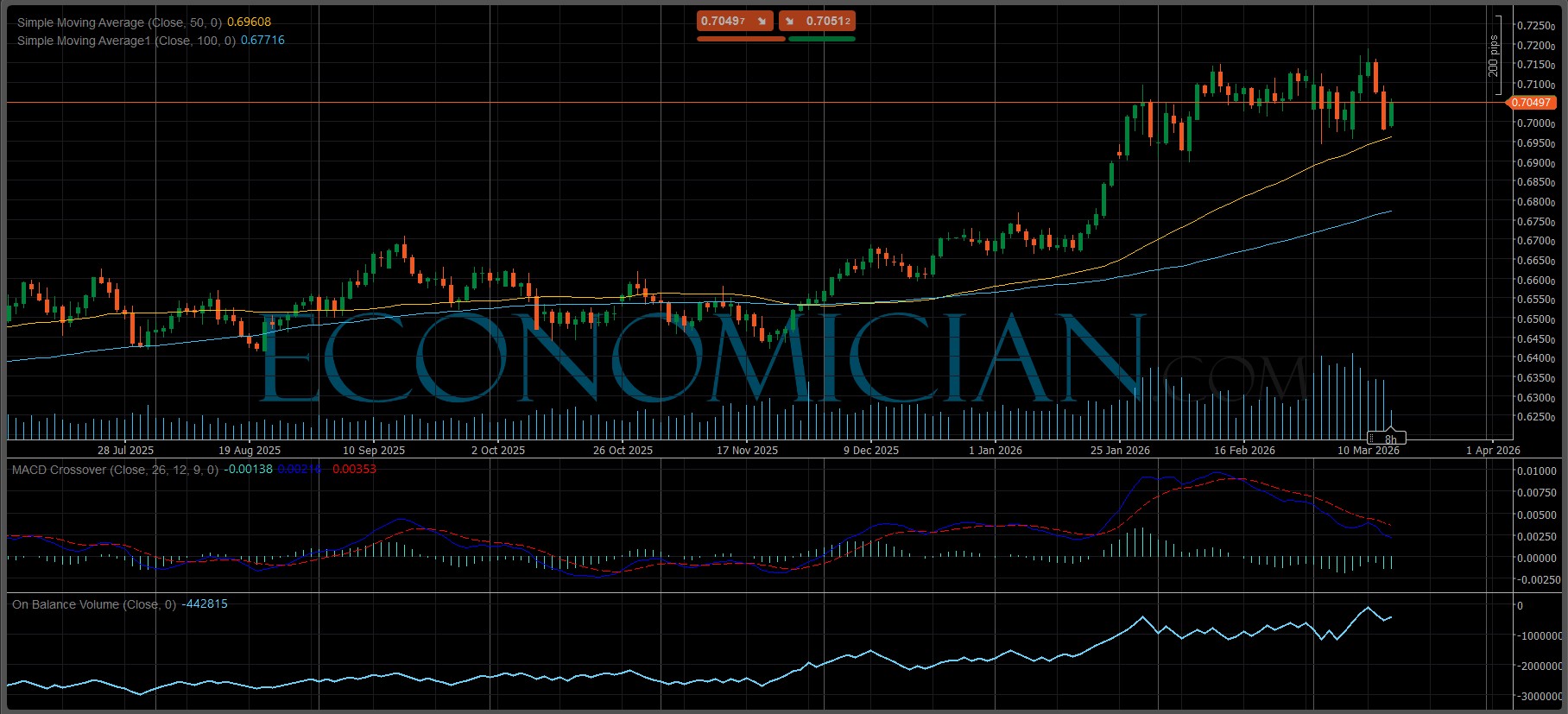
AUD/USD remains in a medium-term bullish structure, but the chart now looks more like a consolidation phase after a strong rally rather than a clean continuation move. The broader bullish trend is still intact, but short-term momentum is weakening, and the pair appears to be in a pause or corrective phase.
Price is trading around 0.7050, still above the 50-day SMA near 0.6961 and well above the 100-day SMA near 0.6772, so the broader trend remains constructive. That said, the pair has struggled to hold above the 0.7100–0.7150 zone, which is acting as a key resistance area.
From a momentum perspective, the picture has softened:
- MACD has rolled over and remains in a bearish crossover, showing that upside momentum is fading.
- OBV is still relatively firm, which suggests the broader accumulation structure has not fully broken down yet, although it is no longer accelerating.
As long as AUD/USD holds above the 0.6960–0.7000 zone, dips may still be viewed as corrective within a broader uptrend. However, a daily close below that area would likely signal a deeper pullback. On the upside, bulls need a clean break above 0.7100/0.7150 to restart the upward trend.
Key levels to watch
Resistance: 0.7050, then 0.7100–0.7150
Support: 0.7000, then 0.6960 (50-day SMA), followed by 0.6900
Comments