 English
 پارسی


Technical Analysis
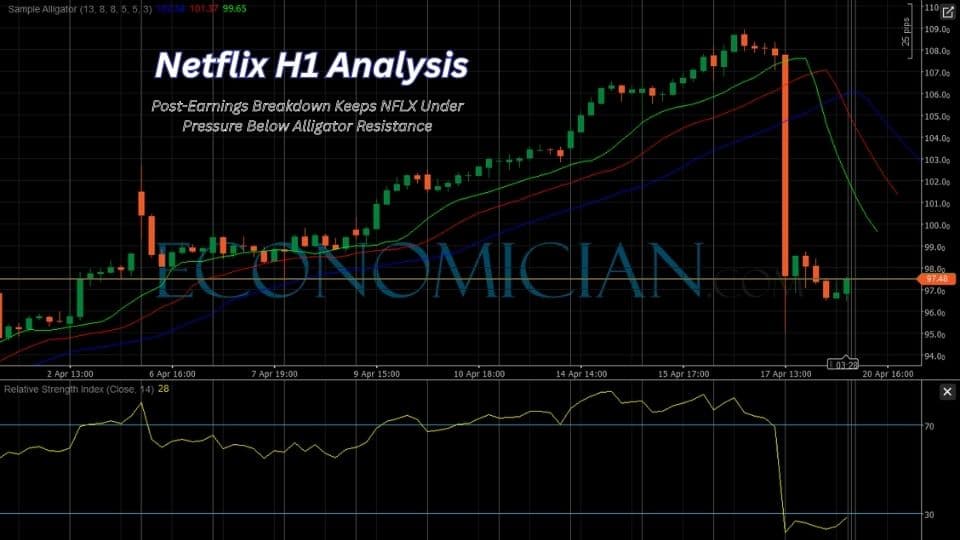
The Netflix (NFLX) H1 chart shows a sharply bearish short-term structure after a major downside break. Price is trading around 97.37, well below all three Alligator lines, with the jaw near 102.54, the teeth near 101.37, and the lips near 99.65. This alignment confirms that sellers remain in control and that the latest move is not just a mild pullback, but a strong trend reset lower.
The price action also shows a heavy impulsive selloff from the 108-109 zone toward the 97-98 area, followed by only a weak stabilization. That matters because the rebound after the drop has been shallow and price has failed to reclaim even the nearest dynamic resistance at the green Alligator line. In practical terms, 98.00-99.65 is now the first resistance band, while 101.37 and 102.54 are the next stronger recovery barriers. On the downside, 97.00 is the immediate support, and a clean break below that level would expose 96.00 first and then the 94.50 area.
Momentum is deeply weak, though short-term oversold conditions are visible. The RSI is at 28, which reflects strong downside pressure and signals that the stock is close to oversold territory on the hourly timeframe. That does not by itself create a bullish signal. It only suggests that the market may need either a brief pause or a technical bounce before any further leg lower. As long as price remains below the Alligator cluster, the short-term bias stays bearish.
Fundamental Note
The latest company news explains the sharp weakness. Netflix reported Q1 2026 revenue of $12.25 billion, up 16% year-on-year, while maintaining its full-year 2026 revenue forecast of $50.7 billion to $51.7 billion and saying advertising revenue remains on track to reach $3 billion this year. However, Reuters reported that investors focused on a weaker current-quarter earnings outlook, revenue growth expected to slow to its weakest pace in a year, and the surprise decision by co-founder and chairman Reed Hastings to step down in June. Netflix shares fell more than 10% in early Friday trading on that combination.
The broader market backdrop was actually risk-supportive, which makes the stock-specific weakness more notable. Reuters reported that the Nasdaq and S&P 500 touched all-time highs on April 17 as investors cheered the reopening of the Strait of Hormuz during the ceasefire, yet Netflix still dropped 9.6% because of its softer earnings guidance and the Hastings exit. That divergence suggests the current pressure in NFLX is being driven more by company-specific disappointment than by broad market risk aversion.
Should we buy NFLX in deep?
For NFLX, I would not buy the dip aggressively yet.
On H1 chart, the stock is still trading below all three Alligator lines, the post-gap structure is still bearish, and RSI near 28 says “oversold,” not “reversed.” In setups like this, oversold conditions can produce a bounce, but they do not by themselves confirm a durable low.
The bigger issue is that the weakness looks stock-specific, not just market-wide. Netflix reported Q1 2026 revenue of $12.25 billion, but investors focused on a softer current-quarter earnings outlook, the prospect of the weakest revenue growth in a year, and Reed Hastings’ planned June exit. Reuters also noted that the stock fell even while the broader market was strong on de-escalation headlines, which is a sign of negative relative strength.
My view: buying deep only makes sense if you treat it as a staged trade, not a conviction bottom-call.
A cleaner approach would be:
- Aggressive dip-buyer: only consider a small starter near the 96–97 area if price stops making lower lows and starts basing.
- Safer trader: wait for a reclaim of the first resistance zone, roughly 99.65–101.40 on your chart.
- Invalidation: if price loses 94.50, the dip-buy idea is likely early.
So my answer is: yes, but only very selectively and in small size. Right now, the chart still says “falling knife with bounce risk,” not “confirmed bottom.”
Trading Signal
Signal: Sell on rebound
Entry: 97.80
Stop Loss: 99.80
Take Profit 1: 96.00
Take Profit 2: 94.50
This setup favors selling strength rather than chasing weakness at the lows. The logic is straightforward: price remains below all key Alligator resistance lines, the post-earnings break is still dominant, and RSI oversold conditions increase the chance of a limited bounce into resistance before sellers reassert control.
Comments