 English
 پارسی


Summary of speculative net positions (CFTC Commitment of Traders)
The Commitment-of-Traders (CFTC) report shows net non-commercial (speculative) positions in futures and options. A positive number means speculators are net long (expecting prices to rise); a negative number means net short (expecting prices to fall). Numbers are approximate because the report groups positions by country/instrument.
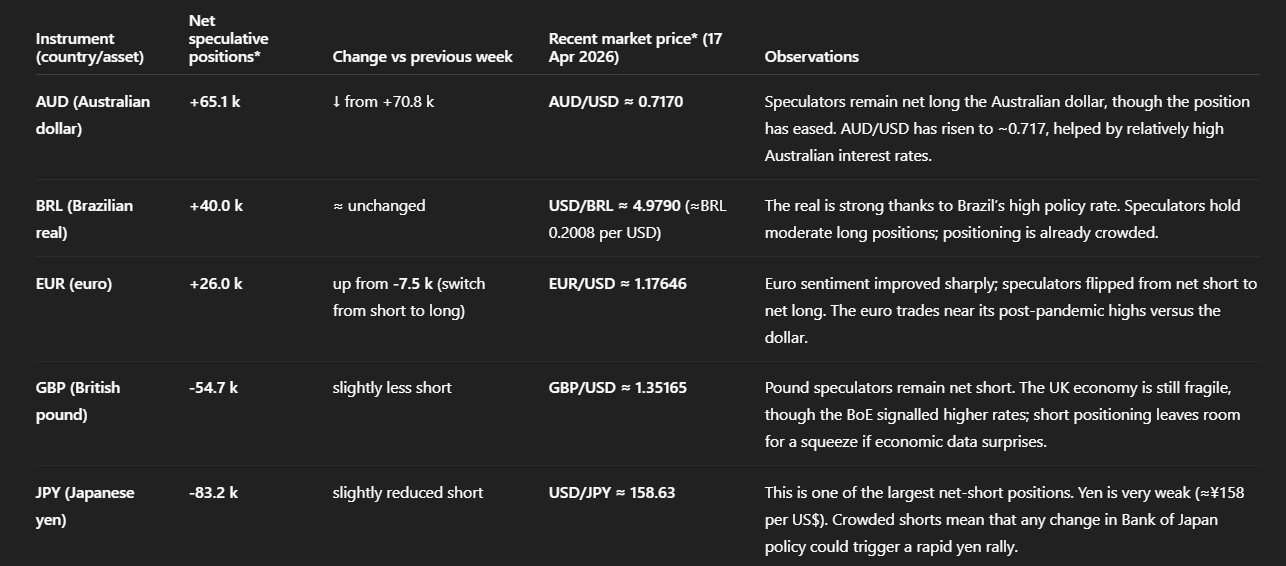
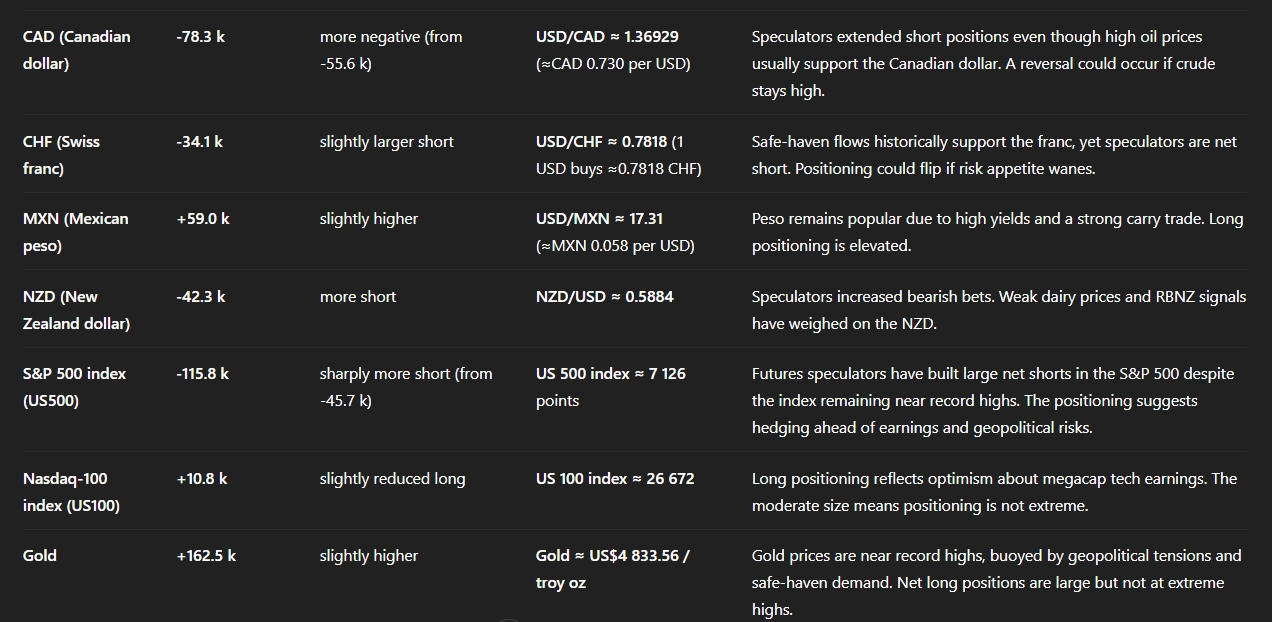
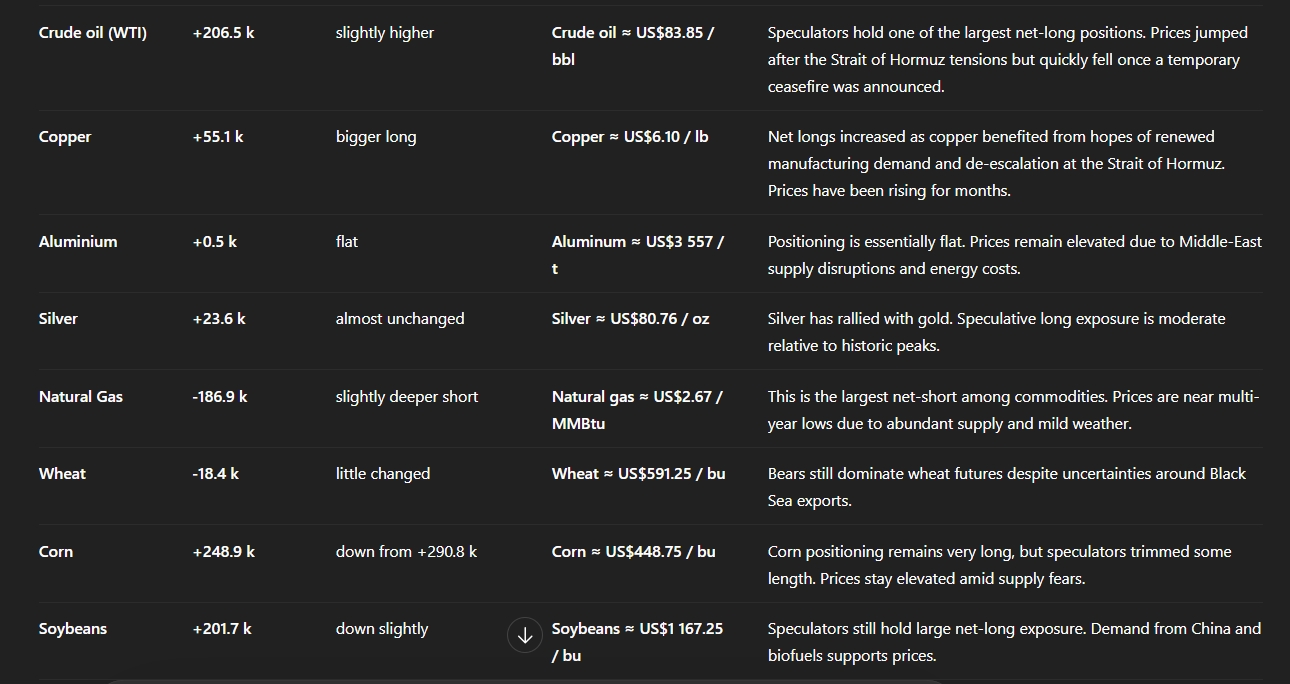
*Net positions are approximate in contracts (1 contract ≈ 100 000 units for currencies or 1 000 barrels for oil, etc.). Prices are closing values around 17 Apr 2026 from TradingEconomics. All amounts are in U.S. dollars.
Interpretation and potential trading ideas
Disclaimer: The following ideas are educational and do not constitute financial advice. Futures and currency trading involves significant risk. Always conduct your own due diligence or consult a licensed financial adviser before acting on any information.
Currencies
- Japanese yen (JPY/USD) - Hedge funds hold one of the largest net-short positions (≈ -83 k contracts), while USD/JPY trades near ¥158. With the position very crowded and the yen historically cheap, any hint that the Bank of Japan will tighten (for example, by further raising its policy rate) could produce a sharp yen rally. A contrarian long yen/short USD position could benefit from such a squeeze.
- Canadian dollar (CAD/USD) - Speculators increased short bets even though oil prices are high and Canada’s economy benefits from energy exports. Should oil prices remain elevated or the Bank of Canada sound less dovish, long CAD against USD (short USD/CAD) might be attractive.
- Swiss franc (CHF) - The franc is a traditional safe-haven currency, yet speculators are net short. In a risk-off environment (e.g., worsening geopolitical tension), the franc may strengthen, making a long CHF/short USD position a potential defensive trade.
- Euro and pound - Speculators turned long EUR and remain short GBP. The euro’s long positioning reduces the upside, but supportive economic data could lead to modest gains. The pound’s short positioning creates room for a squeeze if the UK economy surprises positively. However, both currencies have already appreciated considerably versus USD, so risk-reward is less attractive than JPY or CAD.
- AUD, MXN, and BRL - These high-yielding currencies attract carry-trade flows, which explains the sizeable long positions. Since positions are already extended, the upside may be limited, and they could quickly unwind if global risk sentiment deteriorates. Traders may consider reducing long exposure or setting tight stop losses.
Equity indexes
- S&P 500 (US500) - Speculators hold a large net-short position (≈ -115 k contracts) even though the index is near record highs. This suggests institutional investors are hedging against potential downside (e.g., earnings disappointments or geopolitical shocks). Investors with large equity exposure might consider protective puts or lightning long equity positions. Conversely, contrarian traders who believe the U.S. economy will remain resilient could view the heavy short positioning as fuel for a squeeze, but risk management is vital.
- Nasdaq-100 (US100) - The net-long position (~ +11 k) is modest, reflecting continued bullishness in large-cap tech while not being overly crowded. Momentum-oriented traders might stay long but should monitor earnings and interest-rate expectations.
Commodities
- Natural gas - The largest net-short position (≈ -187 k contracts) coincides with prices near multi-year lows of ~$2.67/MMBtu. Production cuts or hotter-than-expected summer weather could tighten supply, and a crowded short makes natural gas prone to short-squeeze rallies. Long natural-gas futures or call options offer asymmetric upside but require tolerance for volatility.
- Corn and soybeans - Speculative longs remain very large (corn +248.9 k; soybeans +201.7 k). Prices are elevated, but positioning makes these markets vulnerable if U.S. or South American crop prospects improve. Traders could look at bearish strategies (short futures or buying puts), especially if weather forecasts turn favorable.
- Crude oil - Net longs are high (≈ +206 k) while prices retreated to ~$83/bbl after a temporary ceasefire. If Middle-East tensions ease further or global demand softens, long positions could unwind. Short bias or selling rallies may make sense, but sudden supply shocks remain a risk, so hedging is important.
- Gold and silver - Bullion prices are near record highs (~$4 834/oz for gold and ~$80.8/oz for silver), and speculative net longs are sizeable but not extreme. Continued geopolitical uncertainty and real-rate expectations support precious metals, so maintaining partial exposure is reasonable. However, traders might consider tightening stops or trimming long positions if real yields rise.
- Copper and aluminum - Industrial metals have rallied on hopes of improved manufacturing activity, with copper around $6.10/lb and aluminum near $3 557/t. Speculative positioning in copper increased but is not at extremes, and aluminum positioning is tiny. Long positions may still benefit from supply disruptions or infrastructure spending. Watch Chinese demand indicators and any further de-escalation in the Strait of Hormuz.
- Wheat - Net shorts are moderate (-18.4 k) and prices remain depressed (~$591/bu). A worsening in Black Sea export conditions could prompt short covering; however, absent a supply shock, the market appears balanced.
Q&A
What does a positive net speculative position in the CFTC report mean?
A positive net speculative position means non-commercial traders, mainly hedge funds and other large speculators, are net long. In simple terms, they are positioned for prices to rise.
What does a negative net speculative position mean?
A negative number means speculators are net short. This usually points to a bearish market view or active hedging against lower prices.
Which markets look the most crowded in this report?
On the long side, corn, soybeans, crude oil, and gold stand out. On the short side, natural gas, Japanese yen, Canadian dollar, and the S&P 500 hold the most crowded positions.
Why is the Japanese yen highlighted as a contrarian trading idea?
Because speculative short positions are very large, while the yen is already trading at historically weak levels. If the Bank of Japan turns more hawkish or market risk sentiment shifts, short covering could trigger a sharp move lower in USD/JPY.
Why is natural gas one of the most interesting setups in this report?
Because it combines a very large net-short position with very depressed prices. That structure can create strong rebound potential if weather, supply, or demand conditions change.
Why should traders be cautious on corn and soybeans?
Because speculative long positioning is already very large. If crop conditions improve or weather risks fade, those long positions can unwind and pressure prices lower.
What does the S&P 500 positioning suggest?
It suggests many futures traders are taking a defensive stance even while the cash index remains near record highs. That can reflect caution ahead of earnings or macro risks, but it can also create squeeze potential if the market keeps rising.
How should traders use CFTC data in practice?
CFTC positioning data works best as a sentiment and crowding indicator, not as a stand-alone entry signal. It becomes most useful when combined with macro trends, price action, technical levels, and event risk.
Comments