 English
 پارسی


The FOMC kept the federal funds rate unchanged at 3.50%–3.75%, but the internal debate was more important than the decision itself. One member preferred a 25-basis-point rate cut, while three members supported holding rates steady but opposed keeping an easing bias in the policy statement. That combination tells me the Fed is no longer only debating when to cut. It is also discussing whether policy may need to stay restrictive for longer, or even firm again if inflation remains persistent.
Key Takeaways from the April 2026 Fed Minutes
The minutes show that the Fed sees the U.S. economy as still expanding at a solid pace, but with a more complicated inflation and labor-market mix. The most important points are:
- The Fed held rates at 3.50%–3.75%.
- Inflation moved higher, mainly because of energy prices.
- Total PCE inflation was 2.8% in February, but staff estimated it rose to 3.5% in March.
- Core PCE inflation was 3.0% in February and estimated at 3.2% in March.
- The unemployment rate was 4.3% in March.
- Job gains remained low on average.
- Market pricing showed only limited rate-cut expectations for 2026.
- Options markets implied around a 30% probability of a rate hike by early 2027.
- Several Fed participants warned that inflation could take longer to return to 2%.
- Private credit, hedge-fund leverage, high asset valuations and AI-related risks received more attention.
What Did the Fed Minutes Say Generally?
The general message is neutral-to-hawkish. The Fed is still not declaring a new tightening cycle, but it is clearly less comfortable with the inflation path than before. The minutes show a central bank that wants more data before deciding whether the next move should be a cut, a prolonged hold, or—under a more inflationary scenario—a hike.
The Fed’s problem is that inflation risk and growth risk are rising at the same time. Higher oil and commodity prices can push inflation up, while also reducing household purchasing power and hurting business confidence. This is a classic policy trade-off: cutting rates too early could worsen inflation expectations, but keeping rates high for too long could increase pressure on the labor market.
For markets, that means the Fed put is weaker. Investors should not assume that softer risk sentiment alone will force quick rate cuts unless labor-market deterioration becomes clear.
Developments in Financial Markets and Open Market Operations
The Fed noted that the Middle East conflict remained a key driver of financial markets. Equity prices recovered their earlier losses, helped by improved risk sentiment and strong earnings expectations. Technology stocks performed especially well after underperforming earlier in the year.
Treasury yields also moved higher. Both 2-year and 10-year yields rose modestly, with the short end reflecting higher inflation expectations. This is important for traders because the 2-year Treasury yield remains one of the cleanest market signals for Fed policy expectations.
The dollar retraced part of its previous appreciation as sentiment improved after a cease-fire announcement. However, the dollar remained above pre-conflict levels, supported by U.S. safe-haven demand and the country’s stronger energy position.
Oil was central to the discussion. The crude futures curve was higher than at the March meeting, although it remained steeply downward sloping. That suggests investors expected oil prices to fall in coming months, but the Fed also warned that the forecasting record of the futures curve is mixed.
Money markets remained stable. The effective federal funds rate stayed close to the interest on reserve balances rate, repo markets were orderly, and reserve conditions remained in the ample range. The Fed also renewed its dollar and foreign-currency liquidity swap arrangements with major central banks, including the Bank of Canada, Bank of England, Bank of Japan, European Central Bank and Swiss National Bank.
Staff Review of the Economic Situation
The staff review showed a U.S. economy that is still growing, but with inflation pressure becoming more uncomfortable.
Inflation was the main concern. Total PCE inflation was 2.8% in February, while core PCE inflation was 3.0%. Based on March CPI and PPI data, staff estimated total PCE inflation rose to 3.5%, while core PCE increased to 3.2%. The rise was mainly linked to energy prices, but tariffs also continued to affect core goods inflation.
The labor market looked stable but not strong. The unemployment rate was 4.3% in March and had changed little since mid-2025. Payrolls rebounded after temporary weakness caused by a health-care strike and winter weather, but average job gains remained low. Wage growth also cooled, with average hourly earnings up 3.5% over the previous year.
Growth remained positive. Real GDP growth appeared to pick up in the first quarter as the effects of the federal government shutdown faded. Real private domestic final purchases, which include consumer spending and private fixed investment, looked stronger than headline GDP and suggested that underlying demand was still solid.
Globally, the picture was mixed. China showed solid growth, supported by external demand and some domestic recovery. Asian exports benefited from strong high-tech demand, while Mexico remained weak because of pressure in the automotive sector. Foreign inflation also moved higher because of energy prices, forcing many central banks to keep policy on hold.
Staff Review of the Financial Situation
Financial conditions improved during the intermeeting period despite geopolitical uncertainty. Equity markets rose, corporate bond spreads narrowed, and S&P 500 implied volatility fell back toward historical median levels.
However, the improvement was uneven. Large companies, municipalities and AI-linked businesses still had access to financing. Small businesses, households and lower-credit-score borrowers faced tighter conditions. This matters because the U.S. economy may look resilient at the aggregate level while financial stress builds underneath the surface.
Corporate bond issuance was strong, partly because of AI-related capital expenditure financing. Private credit issuance slowed somewhat, but the sector remained a key concern. Some private credit vehicles experienced outflows, and the Fed highlighted limited transparency around balance-sheet exposures.
The Fed also described financial vulnerabilities as “notable.” Asset valuations were elevated, housing valuations were near historical highs, hedge-fund leverage remained high, and leveraged Treasury trades were specifically mentioned as a risk. For investors, this means the Fed sees financial stability risk, even though it does not yet see systemic stress.
Staff Economic Outlook
The staff outlook for growth was slightly stronger than in March. Real GDP was expected to outpace potential in coming years, supported by favorable financial conditions, AI-related capital spending and fading headwinds from earlier disruptions.
But the inflation forecast was higher than in March. The staff expected inflation to slow after the first half of the year as conflict-related effects and tariff pass-through fade. However, risks were clearly skewed to the upside.
The Fed’s staff also saw downside risks to GDP and employment. The Middle East conflict, energy prices, tariffs and AI adoption all increased uncertainty. In simple terms, the Fed sees stronger growth than before, but also more inflation risk and more potential labor-market downside.
Participants’ Views on Inflation
Fed participants agreed that inflation had moved higher and remained above the 2% target. They pointed to higher energy prices, tariffs, shipping costs, airfares, fertilizer prices and non-energy commodity prices.
Several participants also mentioned price increases in the information technology sector. Some noted that software prices were contributing to core inflation, though they may not be reliable predictors of future broad inflation.
The most important policy signal was that the vast majority of participants saw an increased risk that inflation would take longer to return to target. That is the key reason the minutes lean hawkish for markets.
Participants’ Views on the Labor Market
The labor market was described as stable, but not risk-free. The unemployment rate was little changed, and most participants believed recent low job growth could be consistent with slower labor-force growth.
However, several participants saw signs of softness. They noted that job growth was concentrated in a few sectors, job-availability surveys had weakened, and wage growth had moderated. Business contacts also suggested that firms may delay or reduce hiring because of uncertainty or expected AI adoption.
For markets, the labor market is now the main trigger for a dovish Fed shift. Inflation alone does not justify cuts. The Fed would need clearer evidence of labor-market weakness before it becomes comfortable easing policy.
Participants’ Views on Economic Activity
Participants generally believed economic activity was expanding at a solid pace. Consumer spending remained resilient, supported by household wealth and fiscal policy. Business fixed investment remained strong, especially in the technology sector.
AI-related investment was a major growth driver. Several participants believed AI investment, productivity gains and financial conditions could support real GDP growth. However, higher energy prices were creating pressure on lower-income households and the agricultural sector.
The Fed also suggested that the oil shock may have a smaller economic impact than in previous cycles because the U.S. now has higher domestic oil production and lower oil intensity in total spending.
Financial Stability Risks
The financial-stability discussion was one of the most important parts of the minutes for investors. The Fed highlighted elevated asset valuations, private credit risks, hedge-fund leverage and cybersecurity threats.
Private credit was a major focus. Some participants believed recent withdrawals from private credit funds did not yet threaten the broader system. Others worried that losses could spill over into wider credit markets, especially if firms dependent on private credit struggled to find alternative financing.
Leveraged Treasury trades were another risk. A few participants warned that forced unwinding of hedge-fund positions in the Treasury market could create broader disruption. This matters because Treasury liquidity is central to global financial stability.
Committee Policy Actions
The FOMC held the federal funds rate at 3.50%–3.75%. The decision was not fully unanimous in spirit. One member wanted a 25-basis-point cut, while three members supported holding rates steady but objected to the easing bias in the statement.
This is the key policy message: the Fed is divided not only between holding and cutting, but also between keeping an easing bias and moving to a more neutral or two-sided policy stance.
The statement kept the Fed’s commitment to supporting maximum employment and returning inflation to 2%. It also repeated that future decisions will depend on incoming data, the evolving outlook and the balance of risks.
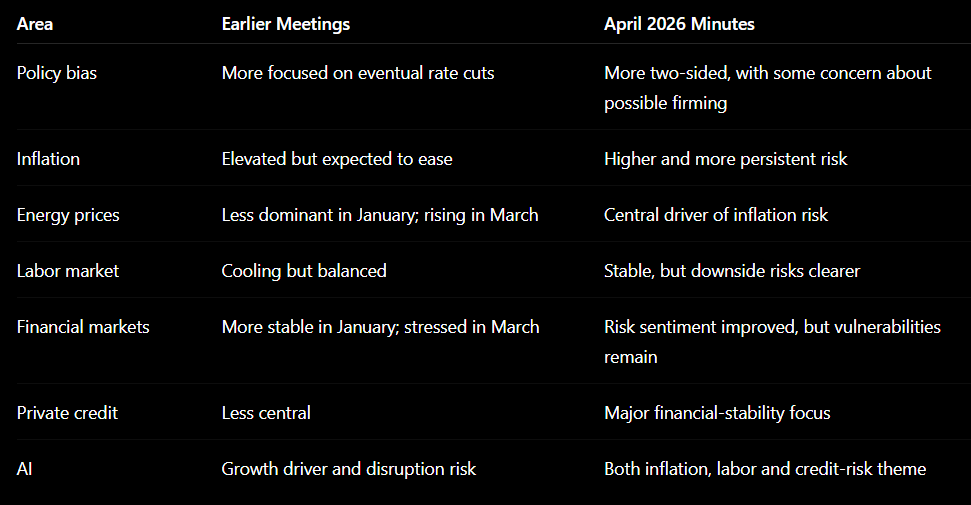
What Changed Compared with Previous Fed Meetings?
Compared with the January and March meetings, the April minutes show a more inflation-sensitive Fed.
In January, markets were still focused on potential rate cuts, lower energy prices and a gradual return to disinflation. By March, the Middle East conflict had introduced a larger energy shock and more uncertainty. By April, inflation had moved higher, policy-rate expectations had shifted up, and several participants wanted to remove the easing bias.
The biggest changes are:
Market Implications for Traders and Investors
- U.S. Dollar Outlook: Neutral-to-Buy
The Fed minutes are supportive for the U.S. dollar if incoming inflation data remain firm. A delayed rate-cut cycle usually supports the dollar, especially against currencies where central banks are closer to easing. However, if the Middle East conflict de-escalates further and global risk sentiment improves, safe-haven demand for the dollar may weaken.
USD condition: Neutral-to-Buy
Bullish trigger: Hot inflation, higher Treasury yields, renewed energy shock
Bearish trigger: Clear labor weakness, falling oil prices, dovish Fed communication
- Treasury Yields: Higher-for-Longer Risk
The minutes support a higher-for-longer yield environment. The 2-year yield should remain highly sensitive to Fed repricing, while the 10-year yield may react to inflation risk, term premium and fiscal concerns.
For bond investors, the main risk is that inflation stays above target and delays rate cuts. Duration may perform better only if labor-market data weaken or oil prices fall sharply.
- Wall Street Outlook: Constructive but Vulnerable
Equities benefited from strong earnings and AI optimism, but the Fed minutes are not fully risk-on. Higher inflation and delayed rate cuts can pressure equity multiples, especially in long-duration growth stocks.
AI-linked technology remains the strongest structural theme, but valuations are vulnerable if Treasury yields rise. Small caps and rate-sensitive sectors may struggle if financing conditions stay restrictive.
Wall Street condition: Neutral
Best setup: Strong earnings plus stable yields
Risk setup: Higher oil, higher yields, weaker consumer spending
- Gold Outlook: Neutral-to-Buy on Risk and Inflation
Gold can benefit from geopolitical risk, inflation uncertainty and concerns over financial stability. However, higher real yields and a stronger dollar may limit upside.
For gold traders, the key is whether inflation risk dominates yield pressure. If the Fed sounds hawkish and real yields rise, gold may consolidate. If geopolitical risk increases or markets price policy error risk, gold can regain support.
- Oil Market Outlook: Geopolitical Premium Remains Critical
Oil is the main macro variable in these minutes. The Fed’s inflation outlook is highly sensitive to whether energy prices remain elevated. If oil prices stay high, inflation expectations could become more difficult to control.
For traders, oil is not only a commodity story. It is now a Fed story, an inflation story and a cross-asset risk story.
- Credit Markets: Watch Private Credit and Lower-Quality Borrowers
The minutes show a clear split in credit conditions. Large companies can still borrow, while small businesses, lower-income households and weaker borrowers face tighter conditions. Private credit remains a hidden risk area because transparency is limited.
Investors should watch credit spreads, private-credit fund flows, leveraged-loan performance and commercial real estate stress.
- Crypto Market Outlook: Sensitive to Fed Cut Expectations
Crypto remains vulnerable to higher-for-longer Fed policy. If markets price fewer rate cuts, Bitcoin and high-beta crypto assets may face pressure. However, if labor-market data weaken and rate-cut expectations return, crypto could benefit from easier liquidity expectations.
Crypto condition: Neutral-to-Defensive
Bullish trigger: Softer labor data and lower yields
Bearish trigger: Sticky inflation and hawkish Fed repricing
Trading Playbook After the April Fed Minutes
The minutes create three main market scenarios:
- Scenario 1: Inflation Stays Hot
If inflation remains firm and oil prices stay elevated, the Fed is likely to keep rates higher for longer. This would support the U.S. dollar and Treasury yields, while pressuring gold, crypto and rate-sensitive equities.
- Scenario 2: Labor Market Weakens
If job growth slows sharply or unemployment rises, the Fed may regain confidence to cut rates later in 2026. This would likely support bonds, gold, equities and crypto, while weighing on the U.S. dollar.
- Scenario 3: Oil Prices Fall and Growth Holds
This is the best risk-asset scenario. If oil prices fall, inflation expectations cool and growth remains solid, the Fed can keep a patient stance without threatening markets. Equities could continue to benefit, especially technology and AI-linked sectors.
Conclusion
The April 2026 FOMC minutes show a Federal Reserve that is still patient, but less dovish than markets may want. Inflation has moved higher, energy prices are the central macro risk, and several policymakers are uncomfortable with keeping a clear easing bias while inflation remains above target.
For traders and investors, the message is simple: do not trade the Fed as if rate cuts are guaranteed. The next policy move depends on inflation, oil prices, labor-market data and financial stability conditions.
The strongest market signal from these minutes is higher uncertainty around the policy path. Rate cuts are still possible, but they require clear evidence that disinflation is back on track or that the labor market is weakening. Until then, the Fed remains in a cautious holding pattern, and markets should price a higher-for-longer risk premium.
Source: Federal Reserve, Minutes of the Federal Open Market Committee, April 28–29, 2026.
FAQ
What was the main message of the April 2026 Fed minutes?
The main message was that the Federal Reserve remains cautious because inflation is still above target and energy prices have increased. The Fed is not ready to commit to near-term rate cuts.
Did the Federal Reserve cut interest rates in April 2026?
No. The FOMC kept the federal funds target range unchanged at 3.50%–3.75%.
Why were the April 2026 Fed minutes important for traders?
The minutes showed that the Fed’s policy outlook has become more two-sided. Rate cuts are possible later, but persistent inflation could force the Fed to hold rates for longer or even consider policy firming.
What inflation numbers did the Fed highlight?
The staff noted that total PCE inflation was 2.8% in February and estimated that it rose to 3.5% in March. Core PCE was 3.0% in February and estimated at 3.2% in March.
How did oil prices affect the Fed’s outlook?
Higher oil prices were a major reason inflation moved higher. The Fed warned that sustained energy-price pressure could delay the return of inflation to the 2% target.
What did the Fed say about the U.S. labor market?
The Fed described labor-market conditions as stable, but job gains remained low. Participants also noted downside risks, including slower hiring, weaker job-availability surveys and uncertainty around AI adoption.
Are Fed rate cuts still possible in 2026?
Yes, but the bar is higher. Several participants said rate cuts would be appropriate if disinflation clearly returns or if the labor market weakens.
Could the Fed raise rates again?
The minutes showed that a majority of participants believed policy firming could become appropriate if inflation remains persistently above 2%.
What do the Fed minutes report mean for the U.S. dollar?
The minutes are generally supportive for the U.S. dollar if inflation remains sticky and rate-cut expectations are pushed further out. However, the dollar could weaken if labor-market data deteriorate and markets reprice toward rate cuts.
What do the Fed minutes report mean for Wall Street?
The minutes create a mixed outlook for equities. Strong earnings and AI investment are supportive, but higher-for-longer interest rates and inflation risk could pressure valuations.
Comments