 English
 پارسی



The core message of the week
The clearest conclusion from this earnings cycle is that EPS beats were more common than clean revenue beats, and the market treated those two things very differently. A company that beat EPS but missed revenue often delivered a lower-quality quarter in the eyes of investors, especially in banks, insurers, utilities, telecom, and parts of consumer discretionary. By contrast, the strongest winners were the companies that delivered a clean double beat, showed evidence of real operating momentum, and shifted the forward story rather than simply clearing a low bar.
This is why the week’s strongest leadership came from semiconductors, AI-linked digital infrastructure, industrial engineering, HVAC, rental, power, mining, and selected specialty insurance, while the weakest reaction function was concentrated in telecom/cable, consumer durables, selective retailers, and regional banks with soft revenue.
The week was therefore not just a “beat versus miss” week. It was a quality-of-beat week.
Overall review of companies and results
Considecring last week's report, the broad earnings picture was constructive but highly selective. Mega-cap names such as P&G, Intel, UnitedHealth, Comcast, Newmont, SLB, HCA, and Norfolk Southern mattered most for sector leadership, but much of the real alpha came from mid-cap industrials, materials, insurers, and niche financials.
Several companies delivered results strong enough to reset sentiment. Intel was the clearest example, but it was not alone. Comfort Systems, Newmont, Teck Resources, Baker Hughes, Kinsale Capital, World Fuel Services, Sensient Technologies, LSI Industries, and Goosehead Insurance all produced results that were not merely better than expected but strong enough to shift the market’s view of the quarter.
At the same time, this was also a week full of misleading beats. In banks, especially, many companies printed stronger EPS with weaker revenue, which usually means margin management, reserve behavior, or cost control mattered more than broad-based loan and fee growth. In telecom and consumer durables, even modest misses triggered very sharp price damage because investors were already worried about the forward backdrop.
The stock-market response made one thing very clear: headline EPS was not enough. Revenue quality, guidance sensitivity, and sector context mattered just as much.
Sector-based report analysis
Technology, semiconductors, and digital infrastructure
This was one of the best and most important groups of the week.
The biggest upside shock came from Intel (USA, semiconductor, market cap 335.3B). Intel reported EPS of 0.29 versus 0.02 forecast, a massive +1,350.00% EPS surprise, while revenue came in at 13.58B versus 12.41B expected, a +9.43% revenue surprise. The stock closed up +2.31% and then surged +21.77% after hours. That was not a statistical oddity in a tiny stock. It was a major large-cap rerating event.
Other strong technology and semiconductor names included:
- Texas Instruments (USA), which delivered a clean beat and rallied sharply after hours
- Lam Research (USA), which reinforced resilience in semiconductor equipment spending
- Mobileye Global (Israel, auto-tech, market cap 7.32B), with EPS 0.12 vs 0.09 forecast (+33.33%) and revenue 558M vs 519.5M (+7.41%), while the stock gained +10.13%
- Vertiv (USA-listed), which delivered one of the strongest AI-infrastructure style EPS surprises in the broader set
- AppFolio (USA, property software, market cap 5.48B), with EPS 1.61 vs 1.47 (+9.52%) and revenue 262M vs 258.08M (+1.52%), even though the stock first fell -3.86% and then rebounded +5.31% after hours
The weaker side of tech was more mixed than outright bad. ServiceNow beat slightly but sold off because expectations were too high. IBM also beat, but the market was underwhelmed. STMicroelectronics (Franco-Italian) and Renesas ADR (Japan) showed that revenue can hold up even while EPS disappoints, which usually means margins remain under pressure. Renesas reported EPS of 0.1178 versus 0.1881 forecast, a -37.37% EPS surprise, even though revenue beat at 2.38B versus 2.35B, or +1.28%.
The sector conclusion is clear: the strongest technology results came from AI infrastructure, semiconductor capital equipment, and mission-critical hardware, not from every technology subsector.
Healthcare and life sciences
Healthcare was fundamentally decent, but price action was selective.
Strong results included:
- UnitedHealth (USA), one of the week’s most important large-cap beats
- Boston Scientific (USA), which combined good numbers with a strong stock reaction
- Intuitive Surgical (USA) and Edwards Lifesciences (USA), which kept device momentum constructive
- Quest Diagnostics (USA) and Elevance (USA), which also held up well
But this sector also gave us a key lesson about expectations. HCA (USA, hospital operator, market cap 96.68B) reported EPS of 7.15 versus 7.14 forecast (+0.14%) and revenue of 19.11B versus 19.09B (+0.10%). That was basically an in-line quarter. Yet the stock fell -8.77%. In other words, a technical beat did not help because the market wanted a more convincing signal.
The same pattern appeared in Thermo Fisher (USA, market cap 173.44B), which delivered EPS 5.44 vs 5.25 forecast (+3.62%) and revenue 11.01B vs 10.87B (+1.29%), but the stock still dropped -9.20% before stabilizing slightly after hours.
Healthcare therefore looked healthy enough on the numbers, but not easy. Managed care and devices held up better than hospitals and some life-science tools where expectations had already been rich.
Financials, banks, and insurers
This was the largest group by company count in the visible earnings set, and also one of the most mixed.
The defining pattern was EPS beats with revenue misses. That is a weaker setup than a clean double beat because it suggests the quarter leaned more on spread management, reserve dynamics, cost control, or capital allocation than on broad-based top-line expansion.
Among the stronger names:
- Kinsale Capital (USA, specialty insurance, market cap 8.02B) reported EPS of 5.11 versus 4.65 forecast (+9.89%) and revenue of 466.71M versus 410.25M (+13.76%)
- Goosehead Insurance (USA, insurance brokerage, market cap 1.62B) reported EPS of 0.37 versus 0.20 (+85.00%) and revenue of 93.08M versus 85.19M (+9.26%), while the stock rose +2.04% in regular trading and +11.33% after hours
- First Citizens (USA, banking, market cap 23.05B) reported EPS of 44.86 versus 39.45 (+13.71%) and revenue of 2.24B versus 2.17B (+3.23%)
- Northern Trust (USA) and Chubb (Switzerland/USA-listed) also helped keep quality financials constructive
Among the more problematic financial results:
- Flagstar Bank (USA, market cap 5.85B) reported EPS of 0.04 versus 0.03 (+33.33%), but revenue was 498M versus 552.9M, a -9.93% revenue miss
- Republic Bancorp (USA, market cap 1.51B) reported EPS of 2.18 versus 1.88 (+15.96%), but revenue came in at 79M versus 114.55M, a huge -31.03% revenue miss
- Universal Insurance (USA, market cap 985.33M) reported EPS of 2.00 versus 1.47 (+36.05%), but revenue was 393.57M versus 481.09M, a -18.19% revenue miss
- NBT Bancorp, Meridian Bank, Amerant, Midland States, Mid Penn, and several other community/regional names showed similarly mixed quality
So the sector conclusion is straightforward: specialty insurance was stronger than mainstream banking, and many bank beats were fundamentally less clean than they first looked.
Industrials, aerospace, transport, and capital goods
Industrials were one of the strongest groups of the week, especially where companies had exposure to power, non-residential construction, engineering, rental, HVAC, and process equipment.
Some of the best industrial results included:
- Comfort Systems (USA, HVAC and mechanical services, market cap 62.31B) with EPS of 10.51 versus 6.78 (+55.01%) and revenue of 2.87B versus 2.38B (+20.59%); the stock rose +2.87% and then added +6.43% after hours
- United Rentals (USA), which posted a strong beat and one of the strongest after-hours moves in the industrial group
- Moog (USA, aerospace and defense components, market cap 9.96B) with EPS of 2.64 versus 2.36 (+11.86%) and revenue of 1.05B versus 1.03B (+1.94%)
- Gorman-Rupp (USA, pump systems, market cap 1.96B) with EPS of 0.68 versus 0.54 (+25.93%) and revenue of 176.6M versus 170.51M (+3.57%)
- LSI Industries (USA, commercial lighting/display, market cap 801.03M) with EPS of 0.28 versus 0.19 (+47.37%) and revenue of 150.5M versus 138.7M (+8.51%)
- Sensient Technologies (USA, ingredients/colors/flavors, market cap 5.24B) with EPS of 1.04 versus 0.83 (+25.30%) and revenue of 435.8M versus 411.39M (+5.93%), while the stock jumped +24.11%
Transport and travel were more mixed. American Airlines beat, but Boyd Gaming, MarineMax, and parts of the freight cohort were weaker. Norfolk Southern (USA, freight rail, market cap 71.8B) reported EPS of 2.65 versus 2.51 (+5.58%), while revenue matched forecast at 3.0B, giving the market a constructive but not explosive rail read-through.
The industrial message of the week was that capex-sensitive engineering and infrastructure names looked stronger than consumer-linked cyclicals.
Energy, utilities, and materials
This sector mix was more constructive than many would have expected.
In energy services:
- Baker Hughes (USA, market cap 63.75B) reported EPS of 0.58 versus 0.49 (+18.37%) and revenue of 6.59B versus 6.34B (+3.94%)
- Halliburton (USA) also beat cleanly
- SLB NV (global oilfield services, market cap 83.94B) reported EPS of 0.52 versus 0.52 (0.00%) and revenue of 8.72B versus 8.66B (+0.69%)
- Liberty Oilfield Services (USA, market cap 4.77B) reported EPS of 0.06 versus -0.1307, a +145.91% EPS surprise, and revenue of 1.02B versus 958.79M (+6.38%)
In materials and mining:
- Newmont (USA, gold mining, market cap 119.95B) reported EPS of 2.90 versus 2.18 (+33.03%) and revenue of 7.31B versus 6.53B (+11.94%)
- Teck Resources (Canada, mining, market cap 29.76B) reported EPS of 1.75 versus 1.17 (+49.57%) and revenue of 3.94B versus 3.15B (+25.08%)
- Kaiser Aluminum (USA, market cap 2.62B) reported EPS of 3.74 versus 1.89 (+97.88%) and revenue of 1.10B versus 986.23M (+11.54%)
- Yara International (Norway, fertilizer, market cap 14.68B) reported EPS of 0.82 versus 0.7208 (+13.76%) and revenue of 4.26B versus 3.99B (+6.77%)
- Cemex ADR (Mexico, market cap 18.11B) reported EPS of 0.16 versus 0.1059 (+51.09%) and revenue of 4.02B versus 3.86B (+4.15%)
The biggest disappointment in this broad sector mix was ENI ADR (Italy, integrated energy, market cap 79.12B), which reported EPS of 0.0462 versus 1.22, a -96.21% EPS surprise, and revenue of 23.18B versus 24.58B (-5.70%).
The conclusion here is that oilfield services and mining/materials were stronger than the weaker parts of integrated European energy.
Consumer staples, discretionary, telecom, and media
This was the most uneven category of the week.
On the staples side, the results were constructive:
- P&G (USA, market cap 344.37B) reported EPS of 1.59 versus 1.56 (+1.92%) and revenue of 21.2B versus 20.57B (+3.06%)
- Keurig Dr Pepper (USA, market cap 38.82B) reported EPS of 0.39 versus 0.37 (+5.41%) and revenue of 3.98B versus 3.83B (+3.92%)
- Heineken NV (Netherlands, market cap 42.86B) showed a +0.90% revenue beat
- Kimberly-Clark de México (Mexico, market cap 7.16B) reported EPS of 0.1962 versus 0.1932 (+1.55%) and revenue of 827.16M versus 821.33M (+0.71%)
Consumer discretionary was far less stable:
- Helen of Troy (USA, market cap 456.14M) reported EPS of 0.83 versus 0.75 (+10.67%) and revenue of 470M versus 450.8M (+4.26%), and the stock surged +20.49%
- Travelzoo (USA, market cap 103.75M) reported EPS of 0.23 versus 0.16 (+43.75%), while revenue came in at 24.3M versus 24.49M (-0.78%); the stock still jumped +26.57%
- MarineMax (USA, market cap 649.81M) reported EPS in line at 0.04, but revenue missed badly at 527.4M versus 610.11M (-13.56%)
- Boyd Gaming (USA, market cap 6.71B) missed both lines and then fell -5.99% after hours
- PENN Entertainment (USA, market cap 2.19B) beat EPS at 0.11 versus 0.05 (+120.00%), but revenue collapsed to 1.4B versus 1.75B (-20.00%), making it a very noisy quarter despite the headline stock gain
Telecom and media gave the market one of its harshest verdicts:
- Comcast (USA, market cap 113.84B) delivered a solid clean beat, with EPS of 0.79 versus 0.72 (+9.72%) and revenue of 31.46B versus 30.37B (+3.59%)
- Charter Communications (USA, market cap 25.43B) reported EPS of 9.17 versus 9.91 (-7.47%) and revenue of 13.6B versus 13.55B (+0.37%), but the stock still crashed -25.50%
- Telia ADR (Sweden, market cap 20.51B) missed both lines, with EPS of 0.0908 versus 0.1108 (-18.05%) and revenue of 2.16B versus 2.18B (-0.92%)
This sector mix showed the market’s most obvious split: staples were fine, discretionary was selective, and cable/telecom was where structural concerns dominated the quarter.
Biggest positive and negative surprises
Biggest positive EPS surprises
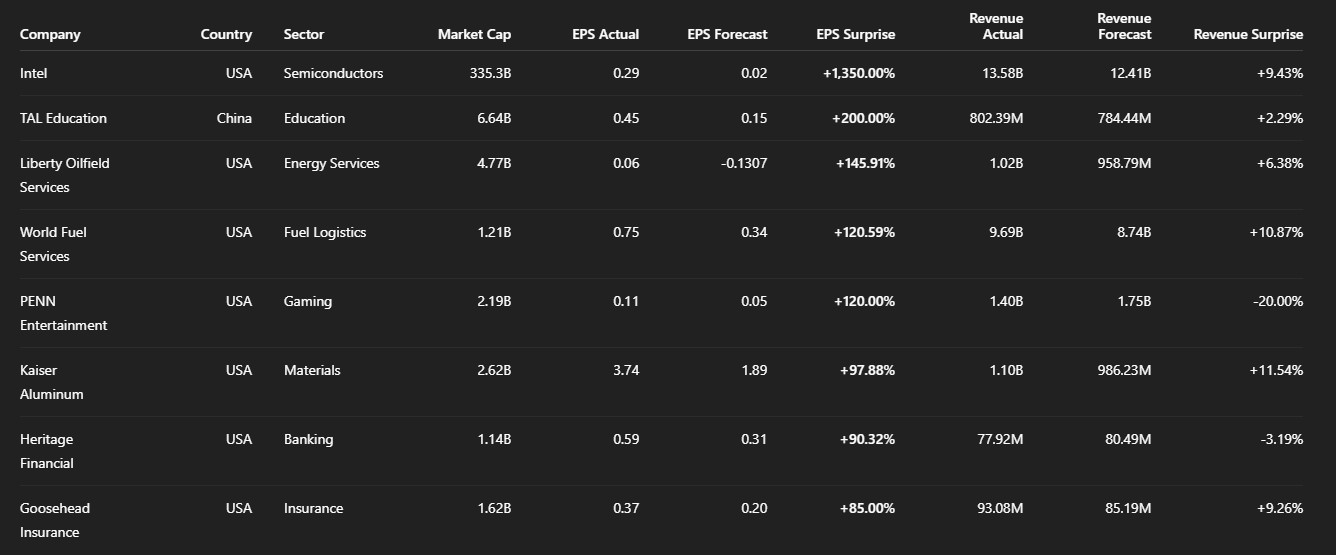
The most important positive surprise was Intel, because it combined the largest visible high-impact EPS beat with a strong revenue beat and a major market-cap footprint.
Biggest negative EPS surprises
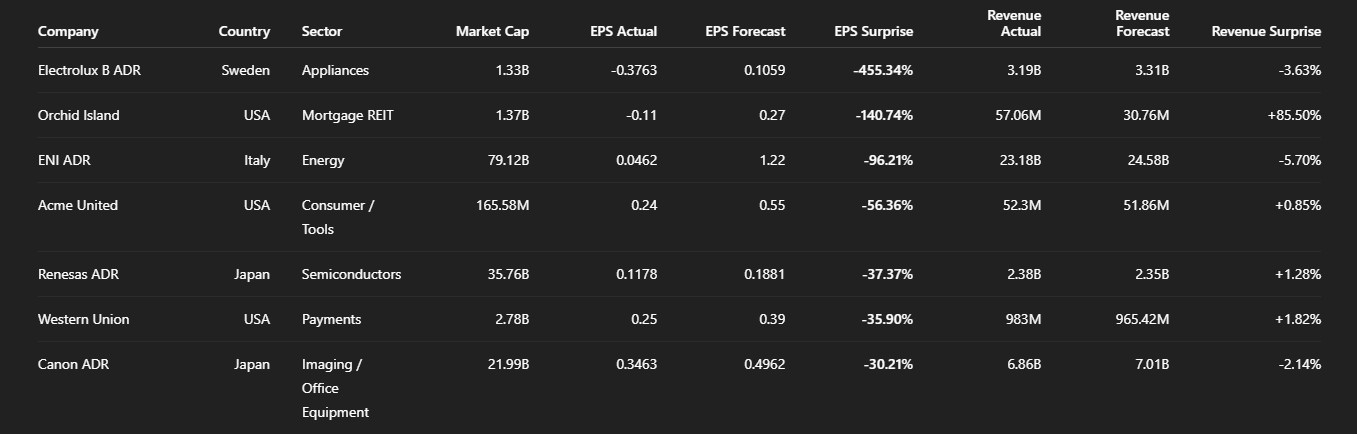
Biggest revenue beats
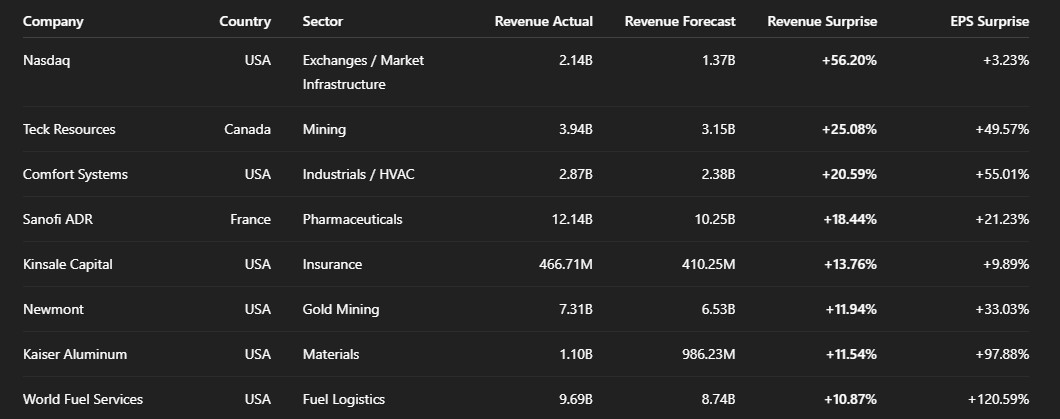
Biggest revenue misses
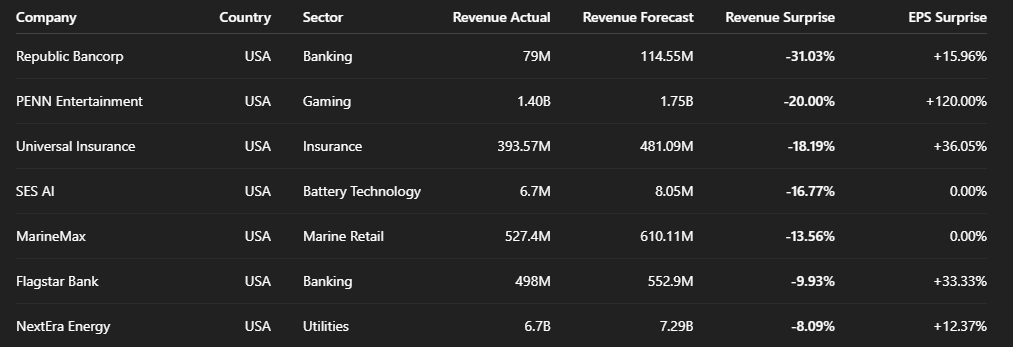
Best results and biggest stock-price changes
Best all-around results
The strongest all-around visible results, combining market relevance, EPS surprise, revenue surprise, and strategic importance, were:
- Intel: EPS 0.29 vs 0.02 (+1,350.00%); revenue 13.58B vs 12.41B (+9.43%)
- Comfort Systems: EPS 10.51 vs 6.78 (+55.01%); revenue 2.87B vs 2.38B (+20.59%)
- Teck Resources: EPS 1.75 vs 1.17 (+49.57%); revenue 3.94B vs 3.15B (+25.08%)
- Newmont: EPS 2.90 vs 2.18 (+33.03%); revenue 7.31B vs 6.53B (+11.94%)
- Sanofi ADR: EPS 2.17 vs 1.79 (+21.23%); revenue 12.14B vs 10.25B (+18.44%)
- Kinsale Capital: EPS 5.11 vs 4.65 (+9.89%); revenue 466.71M vs 410.25M (+13.76%)
- Baker Hughes: EPS 0.58 vs 0.49 (+18.37%); revenue 6.59B vs 6.34B (+3.94%)
- Yara International: EPS 0.82 vs 0.7208 (+13.76%); revenue 4.26B vs 3.99B (+6.77%)
Biggest positive stock-price changes
Regular session
- Travelzoo (USA): +26.57%
- Sensient Technologies (USA): +24.11%
- Helen of Troy (USA): +20.49%
- PENN Entertainment (USA): +16.86%
- Mobileye Global (Israel): +10.13%
- LSI Industries (USA): +9.46%
- Boston Scientific (USA): +8.99%
- Union Pacific (USA): +8.77%
- Comcast (USA): +7.73%
- Keurig Dr Pepper (USA): +7.50%
After hours
- Intel (USA): +21.77%
- SES AI (USA): +19.67%
- World Fuel Services (USA): +18.48%
- United Rentals (USA): +14.35%
- Safran ADR (France): +14.02%
- Goosehead Insurance (USA): +11.33%
- Texas Instruments (USA): +10.87%
Biggest negative stock-price changes
Regular session
- Charter Communications (USA): -25.50%
- Nano-X Imaging (Israel): -24.56%
- Strategic Education (USA): -13.67%
- Travel + Leisure (USA): -13.62%
- Electrolux ADR (Sweden): -12.67%
- Tractor Supply (USA): -11.69%
- Pega (USA): -10.30%
- TAL Education (China): -9.31%
- Thermo Fisher (USA): -9.20%
- HCA (USA): -8.77%
The most important negative read-through was Charter, because the scale of the drop in a stock with a 25.43B market cap made it much more important than a micro-cap collapse.
By EPS and revenues: what the week rewarded
The market rewarded three things:
- Large EPS beats supported by revenue beats
- Revenue acceleration in sectors already tied to capex, AI, power, or infrastructure
- Beats that changed the forward narrative
The market was skeptical of:
- EPS beats with revenue misses
- In-line quarters in expensive or expectation-heavy names
- Revenue misses in sectors already facing structural pressure
That is why Intel, Comfort Systems, Kinsale, Teck, Newmont, Sanofi, Baker Hughes, and Yara looked much stronger than many financials that technically beat EPS but did not deliver strong top-line confirmation.
Market cap and country-of-origin perspective
The country split mattered.
United States
The U.S. dominated the sample and the most important leadership came from:
- Intel (335.3B)
- P&G (344.37B)
- Newmont (119.95B)
- Comcast (113.84B)
- SLB NV (83.94B, global listing context but U.S.-traded)
- Comfort Systems (62.31B)
- Baker Hughes (63.75B)
- Charter (25.43B)
The U.S. was strongest in:
- semiconductors
- industrial infrastructure
- power/HVAC/engineering
- specialty insurance
- selected mining/materials
The U.S. was weaker in:
- cable/telecom
- some discretionary retail
- many lower-quality regional bank beats
Europe
Europe was mixed.
- Stronger names: Sanofi (France), Safran (France), Yara (Norway), Heineken (Netherlands), Holcim ADR (Switzerland)
- Weaker names: ENI (Italy), Telia (Sweden), Electrolux (Sweden), Castellum ADR (Sweden)
Canada
Canada looked constructive because of Teck Resources and FirstService.
Japan
Japan was mixed-to-soft because Canon and Renesas disappointed on EPS.
Israel
Israel was helped by Mobileye.
China
China had one of the largest EPS surprises through TAL Education, but the stock reaction stayed negative, which tells you the market still discounts regulatory and visibility risk.
Valuation multiples: P/E, EV/EBITDA, and price-to-sales versus peers
In semiconductors, Intel now screens far richer than a classic turnaround after the post-earnings surge, at roughly 7.94x EV/sales and 30.11x EV/EBITDA, while Texas Instruments trades even richer at about 14.16x EV/sales and 30.14x EV/EBITDA. Intel still looks cheaper than a premium analog peer on sales, but after the rally it no longer looks optically cheap on EBITDA.
In defensive consumer staples, P&G trades around 21.66x trailing P/E, 3.98x price-to-sales, and roughly 14.46x EV/EBITDA, while Philip Morris trades around 23.13x trailing P/E, 6.17x price-to-sales, and 16.26x EV/EBITDA. That means P&G’s mild beat landed on a valuation that is full but not extreme, while Philip Morris still carries a richer premium for pricing power and cash-flow durability.
In healthcare, UnitedHealth trades around 26.79x trailing P/E, 0.72x price-to-sales, and 17.34x EV/EBITDA, while HCA screens much cheaper on enterprise cash-flow metrics at roughly 1.91x EV/sales and 9.35x EV/EBITDA. The market is still paying a premium multiple for managed care versus hospitals, even in a week when HCA’s stock reaction was weaker than the quarter itself.
In insurance, Kinsale Capital trades around 15.19x trailing P/E, 4.15x price-to-sales, and 11.72x EV/EBITDA, versus Chubb at about 11.52x trailing P/E, 2.08x price-to-sales, and 8.53x EV/EBITDA. Kinsale clearly carries a growth premium to a larger global insurer, and this week’s clean beat is exactly the kind of result needed to support that premium.
In energy services, SLB is around 24.77x trailing P/E, 2.34x price-to-sales, and 12.54x EV/EBITDA, while Halliburton trades around 22.28x trailing P/E, 1.52x price-to-sales, and 9.65x EV/EBITDA. Halliburton screens cheaper on operating multiple, while SLB still holds a premium for scale and mix. That broadly matches the quality gap the market usually assigns inside oilfield services.
In materials and mining, Newmont trades around 15.69x trailing P/E, 5.16x price-to-sales, and 7.67x EV/EBITDA, while Teck Resources is around 22.20x trailing P/E, 3.31x price-to-sales, and roughly 9.03x EV/EBITDA. Newmont looks cheaper on earnings and EBITDA, while Teck retains a higher earnings multiple despite also delivering one of the week’s strongest cyclical beats.
Then there is Charter Communications, which after the collapse screens optically cheap at around 4.87x trailing P/E, 0.47x price-to-sales, and 5.48x EV/EBITDA. But this is a classic case of a stock being cheap because the market is discounting structural business pressure. That is why the low multiple did not protect the stock after the report.
Final conclusion
The final takeaway from the Apr. 20–24, 2026 earnings week is that this was a week of clear market discrimination.
The strongest leadership came from:
- semiconductors and AI-linked digital infrastructure
- industrial engineering, HVAC, rental, and power
- selected materials and mining
- specialty insurance and the cleaner part of healthcare
The weakest pockets were:
- telecom/cable
- consumer durables and parts of discretionary retail
- regional banks where EPS beat but revenue quality disappointed
- selected European cyclicals and appliance names
The most important upside event was Intel, with EPS of 0.29 versus 0.02 forecast (+1,350.00%) and revenue of 13.58B versus 12.41B (+9.43%), followed by a +21.77% after-hours move.
The most important downside stock event was Charter, which delivered EPS of 9.17 versus 9.91 (-7.47%) and revenue of 13.6B versus 13.55B (+0.37%), then still lost -25.50%.
That is the essence of the week. It was not enough to beat. Companies had to beat cleanly, credibly, and by enough to change the forward narrative.
FAQ
What was the biggest positive EPS surprise in the Apr. 20–24 earnings week?
The largest visible high-impact EPS surprise came from Intel, which reported 0.29 EPS versus 0.02 forecast, a +1,350.00% surprise, along with a +9.43% revenue beat.
What was the biggest negative EPS surprise in the visible earnings set?
Among the readable entries, the biggest negative EPS surprise came from Electrolux B ADR, which reported -0.3763 EPS versus 0.1059 forecast, a -455.34% surprise.
Which company had the biggest positive revenue surprise?
The biggest visible revenue surprise came from Nasdaq, with 2.14B revenue versus 1.37B forecast, a +56.20% surprise.
Which company had the biggest negative stock-price reaction?
The biggest visible negative regular-session move came from Charter Communications, which fell -25.50% after its report.
Which sectors looked strongest?
The strongest sectors were technology/semiconductors, industrials, and selected materials/mining.
Which sectors looked weakest?
The weakest areas were telecom/cable, consumer durables, and the lower-quality end of regional banking.
Comments