 English
 پارسی


Summary of net positions
The U.S. Commodity Futures Trading Commission (CFTC) publishes weekly Commitments of Traders (COT) reports that reveal how large speculators (money managers and funds) are positioned in futures markets. The table below summarises the speculative net positions (long minus short contracts) for major assets as of the week ending Feb 27 2026 (released Mar 1, 2026). Positive numbers mean speculators are net long (expecting prices to rise), while negative numbers mean they are net short. The “change vs previous week” column shows how positioning changed from the prior week.
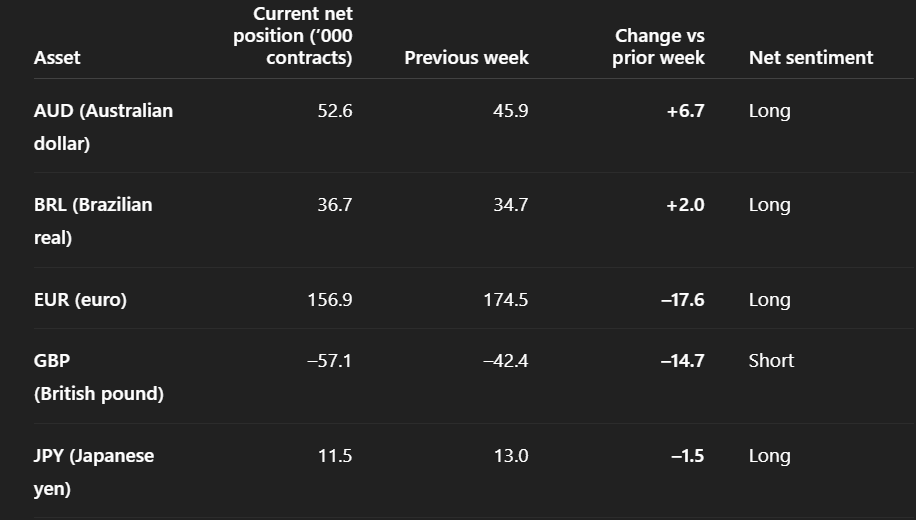
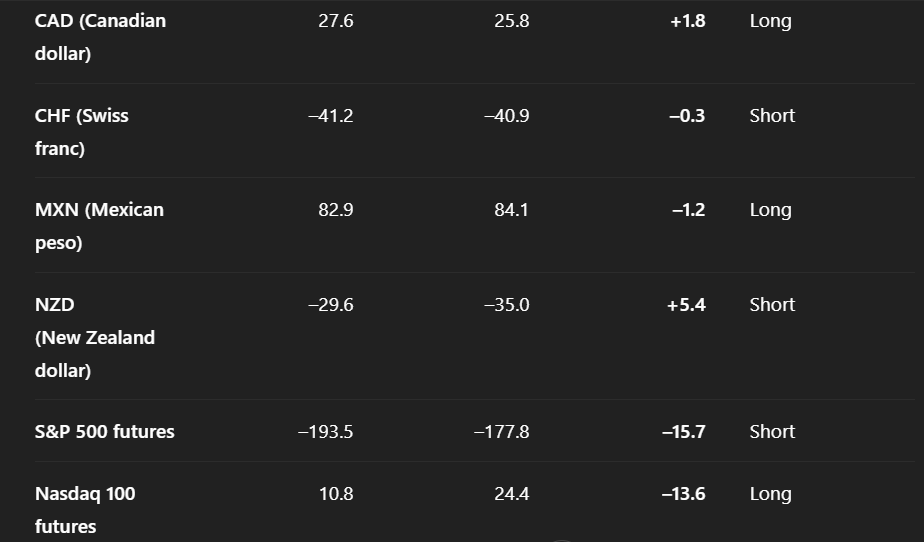
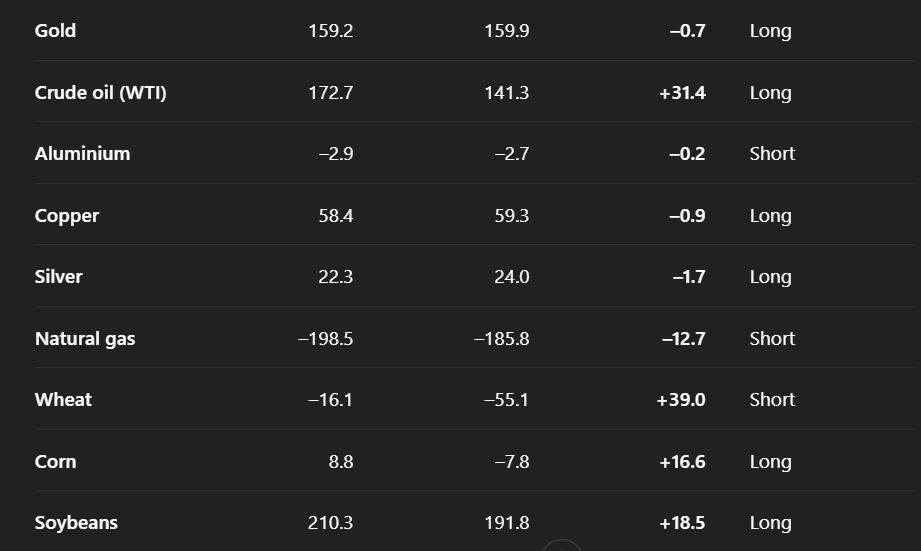
The data show that speculators held large net-long positions in crude oil, gold, soybeans, the euro and copper, while holding pronounced net‑short positions in natural gas, S&P 500 futures, GBP, CHF and wheat. Wheat and corn experienced the largest positive shifts, moving from sizeable net shorts to much smaller shorts or net longs.
Macro‑economic context
Global interest‑rate environment
United States – The Federal Reserve cut rates several times in 2025 and left the federal funds target range unchanged at 3.5 %–3.75 % during its January 2026 meeting. The benchmark rate remains 3.75 %, and policy makers signalled they would be data‑dependent in considering future cuts. This moderately restrictive stance keeps U.S. real yields positive.
Euro area – On 5 February 2026 the European Central Bank (ECB) left its three key interest rates unchanged; the deposit facility remained at 2.00 %, the main refinancing rate at 2.15 % and the marginal lending rate at 2.40 %. The ECB noted that inflation should converge toward its 2 % target but warned of uncertainties from global trade tensions.
United Kingdom – The Bank of England’s Monetary Policy Committee voted 5–4 on 4 February 2026 to maintain the Bank Rate at 3.75 %, though four members supported a cut to 3.50 %. The minutes highlighted that inflation was expected to fall near the 2 % target by April and that additional policy easing was likely later this year. The split vote underscores growing dovishness as the UK economy shows signs of slack and softer wage growth.
Commodity supply‑demand backdrop
Wheat and corn – The U.S. Department of Agriculture’s (USDA) Agricultural Outlook Forum projects lower U.S. wheat production for 2026/27 because harvested area and yields are expected to decline; winter wheat seeded area is down and planted area is projected at 45 million acres. Despite lower supplies, exports are forecast to fall as global competition increases, leaving ending stocks roughly unchanged and a season‑average farm price of $5.00 per bushel. For corn, the USDA expects the 2026/27 crop at 15.8 billion bushels, down 7 % from the prior year, with total supplies declining and season‑average price projected at $4.20 per bushel, up 10 cents from 2025/26. Soybean production is forecast to increase because higher planted area and yields more than offset beginning‑stock drawdowns. These fundamental shifts help explain why speculators reduced their wheat shorts and moved to modest longs in corn and soybeans.
Energy – Crude‑oil fundamentals tightened through early 2026. OPEC+ continued to extend supply cuts while geopolitical tensions limited output from some producers. Meanwhile, global demand remained resilient amid steady economic growth and low inventory levels. These factors contributed to a surge of +31.4 k contracts in net‑long crude‑oil positions. Natural gas, however, saw net shorts deepen to –198.5 k contracts as a mild northern‑hemisphere winter and high storage levels depressed prices.
Precious metals – Speculative net longs in gold remained elevated at 159.2 k contracts, only slightly below the previous week. Large speculators held approximately 211,649 long contracts and 52,472 short contracts as of Feb 27 2026, producing a net long of about 159 k. Silver positioning was modestly long at 22.3 k contracts. The safe‑haven appeal of precious metals was supported by uncertain macro conditions, central‑bank gold buying and stable real rates.
Equity indices – Futures on the S&P 500 showed the largest net short (–193.5 k) among all assets, with speculative shorts increasing by ~15 k contracts. This reflects growing caution as U.S. equity indices hover near record highs in early 2026 and earnings growth slows. Net longs in the Nasdaq 100 fell from 24.4 k to 10.8 k contracts, indicating profit taking.
FX – The euro maintained a large net long (156.9 k) despite a notable reduction from the prior week; robust euro‑zone growth and the ECB’s cautious approach to further easing support the currency. The pound’s net short increased to –57.1 k contracts as speculators anticipate rate cuts by the Bank of England later in 2026. Australian and Canadian dollars saw moderate increases in net longs, likely reflecting strong commodity exports and expectations that the Reserve Bank of Australia and the Bank of Canada may delay cutting rates. The Swiss franc’s net short remained small but persistent.
Analysis of positioning and market implications
Biggest week‑over‑week shifts
- Wheat: Net positioning rose by +39 k contracts, trimming short exposure significantly. USDA projections of lower U.S. wheat output and a slight rise in farm prices, along with improved export prospects due to drought concerns in other countries, likely spurred short covering.
- Crude oil: Net longs increased by +31.4 k contracts. Traders are betting that supply deficits will persist given OPEC+ restraint and geopolitical risks. A supportive macro backdrop (robust global growth and relatively low inventories) underpins the bullish sentiment.
- Soybeans: Net longs jumped +18.5 k contracts. Higher planted acreage and crush demand are projected, and concerns about South‑American weather have added speculative interest. The large existing long (210.3 k) suggests optimism about demand and the bio‑fuels narrative.
- Corn: Net positions flipped from a small short to a long (+16.6 k). Expectations of lower U.S. production and firming prices have attracted speculative buyers.
- Euro & GBP: The euro saw the largest decline (–17.6 k) in absolute positioning, but it remains net long. The ECB’s pause may have prompted some profit taking. The pound’s net short deepened as market participants anticipate UK rate cuts.
- Equity indices: The S&P 500’s net short increased (–15.7 k) while Nasdaq longs shrank (–13.6 k). This highlights mounting hedging ahead of potential equity corrections.
Sector‑level themes
Currencies – Diverging monetary policies continue to drive FX positioning. The euro is supported by the ECB’s reluctance to cut rates quickly, while the pound is weighed down by expectations of BoE easing. Commodity currencies (AUD, CAD, BRL) benefit from strong commodity demand and relatively higher yields.
Equities – The large net‑short S&P 500 position suggests hedge funds are positioning defensively, perhaps anticipating earnings disappointments or valuation headwinds after a prolonged rally. Conversely, modest long exposure in the Nasdaq hints at interest in mega‑cap tech, but the reduction implies profit taking.
Precious metals – Persistently high net longs in gold and moderate longs in silver show continued investor demand for safe havens amid policy uncertainty and geopolitical risks. However, the slight decline in gold positioning warns of potential profit taking if real yields rise.
Energy – Speculators have increased bullish bets on crude oil and deepened bearish positions on natural gas. Tight oil supply and resilient demand support the bullish crude narrative, whereas natural‑gas oversupply and mild winter weather depress prices. Extreme short positioning in natural gas raises the risk of a short squeeze if weather or supply shocks materialise.
Agriculture – The sharp reduction in wheat shorts and the swing to longs in corn signal that speculators expect grain prices to strengthen. USDA projections show lower wheat supplies and higher corn prices, justifying the positioning shift. Soybeans remain heavily long, reflecting expectations of strong crush demand and supportive bio‑fuel policies.
Trading ideas and considerations
Disclaimer: The ideas below are for educational purposes and not financial advice. Futures trading involves significant risk, and readers should conduct their own research and consult a financial professional before taking any position.
1. Long crude oil with risk management
Rationale: Net‑long positions in crude oil jumped markedly (+31.4 k contracts). OPEC+ continues to restrict supply, inventories are tight and global demand remains firm. With the U.S. Fed holding rates steady and central banks signalling they will lower rates only gradually, real yields may decline, supporting commodity demand. If geopolitical tensions disrupt supply, prices could spike.
Trade idea: Consider a long position in WTI crude‑oil futures or related ETFs. Use a stop loss below a recent support level (e.g., the 50‑day moving average) and size the position modestly to account for volatility. Upside targets could be previous highs near $100 per barrel if supply deficits persist.
Risks: A sharp slowdown in global growth or a rapid unwind of OPEC+ cuts could undermine prices. A rebound in U.S. shale output or a resolution of geopolitical tensions could increase supply and push prices lower.
2. Long wheat or corn via futures or ETFs
Rationale: Wheat net shorts decreased dramatically as speculators covered positions (+39 k) amid the USDA’s projection of lower 2026/27 wheat supplies and a higher farm price. Corn positioning flipped to a net long, supported by a forecast decline in production and an expected price rise. The sentiment shift suggests that grain markets may be bottoming.
Trade idea: Initiate small long positions in wheat and/or corn futures (or grain ETFs) to benefit from potential price appreciation. A long wheat–short corn spread could also be considered if one expects wheat to outperform. Set stop losses below recent lows and monitor weather developments.
Risks: Grain markets are sensitive to weather, policy (e.g., export restrictions) and currency movements. A favourable growing season or an unexpected increase in global supply could cause prices to fall.
3. Tactical long position in gold with trailing stop
Rationale: Gold net longs remain high at 159 k contracts, showing strong investor interest in safe‑haven assets. With central banks (including the ECB and BoE) pausing or moving toward easing, real yields are likely to stay subdued. Persistent geopolitical risks and ongoing central‑bank gold purchases support the gold price.
Trade idea: Maintain or initiate a long gold position via futures, bullion or gold‑backed ETFs. Because positioning is already elevated, use a trailing stop to lock in gains if momentum reverses. Consider diversifying with silver, which has a smaller net long and could benefit if industrial demand improves.
Risks: A sharp rise in real yields or unexpected tightening by major central banks could pressure gold. A strengthening U.S. dollar may also weigh on precious metals.
4. Cautious on equities – hedge with puts or short positions
Rationale: Speculators are heavily short the S&P 500, and net longs in the Nasdaq 100 have shrunk. After a multi‑year rally, U.S. equities look expensive, while earnings momentum is slowing. Monetary policy remains restrictive and central banks signal that cuts will be gradual. Macro uncertainties (softening global demand, geopolitical tensions) could trigger a correction.
Trade idea: Hedge existing equity exposure using put options on the S&P 500 or by taking short positions in futures. Alternatively, rotate into sectors with defensive characteristics (utilities, consumer staples). Avoid over‑leveraging short positions; use spreads or risk‑defined strategies to limit losses.
Risks: Equities could continue higher if economic growth remains resilient or if central banks cut rates sooner than expected. A melt‑up driven by FOMO (fear of missing out) could force shorts to cover.
5. Contrarian opportunity in natural gas
Rationale: Net shorts in natural gas have grown to –198.5 k contracts, one of the largest speculative short positions. While fundamentals are bearish (mild weather, abundant storage), extreme negativity can set the stage for a sharp short‑covering rally if cold weather emerges or supply disruptions occur.
Trade idea: Risk‑tolerant traders might take a small long position in natural‑gas futures or call options, aiming to capture a quick spike. Limit the trade size and consider using options to cap downside risk.
Risks: Natural‑gas markets are notoriously volatile. If mild weather persists or LNG exports decline, prices could stay depressed and the large short may be justified.
Conclusion
The CFTC’s latest speculative positioning data show meaningful shifts across asset classes ahead of spring 2026. Large speculators added to long crude‑oil, corn and soybean positions and reduced shorts in wheat, while trimming longs in the euro, Nasdaq and gold. Macro‑economic context—including paused rate cuts by the Fed, ECB and BoE—helps explain currency moves and reinforces the case for selective commodity longs. Traders should monitor economic data, weather conditions and central‑bank communications for signals that could validate or negate these positioning trends. Proper risk management and diversification remain crucial in navigating the volatile futures markets.
FAQ
What are CFTC speculative net positions?
CFTC speculative net positions show the difference between long and short futures contracts held by non-commercial traders such as hedge funds and large speculators.
Why do CFTC net positions matter for traders?
They help traders understand market sentiment, identify crowded trades, and spot possible reversals or trend continuation setups.
How often is the CFTC COT report released?
The CFTC publishes the Commitments of Traders report weekly, typically on Friday, using positioning data as of Tuesday’s close.
Can CFTC positioning be used for trading ideas?
Yes. Traders often use it to confirm trends, detect extreme positioning, and build macro, commodity, or FX trade setups.
Comments