 English
 پارسی


Introduction
The U.S. Commodity Futures Trading Commission publishes the weekly Commitments of Traders (COT) report, which shows the aggregate long and short positions held by different classes of futures-market participants, including commercial hedgers, swap dealers, managed money, and other groups. The net position, calculated as long minus short, is widely monitored because it offers a useful read on speculative sentiment. A positive net position means speculators hold more long than short contracts and therefore have a bullish bias, while a negative net position means they are net short and carry a bearish bias.
Large and persistent extremes in positioning can also matter because once sentiment becomes crowded, markets often become more vulnerable to reversals. For that reason, CFTC positioning is not just a directional signal. It is also a sentiment, a crowding, and a risk-management signal.
Summary of CFTC Speculative Positioning
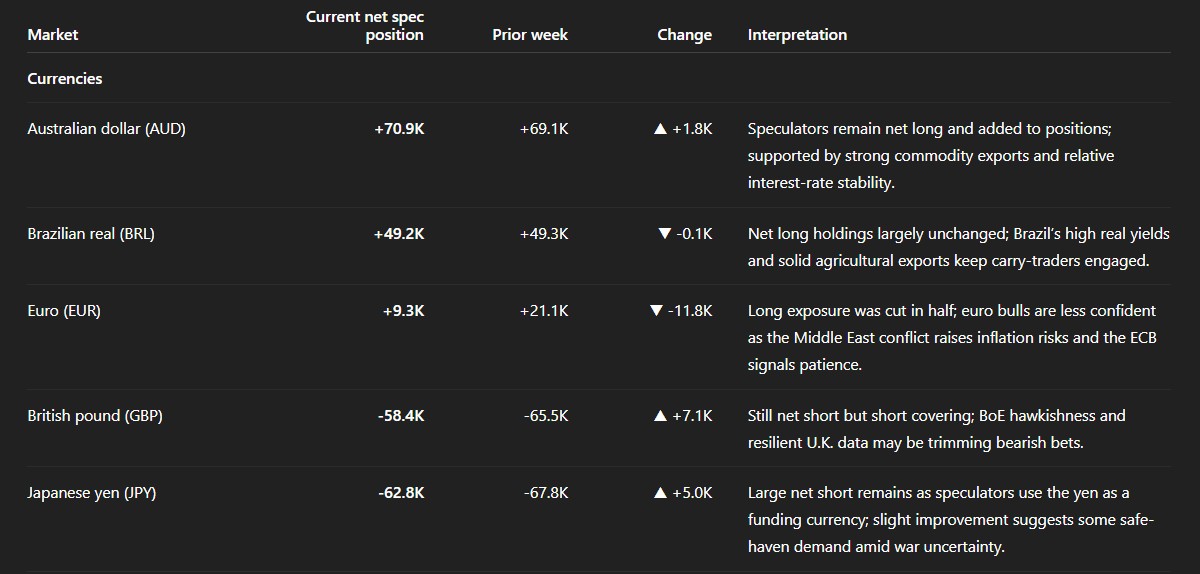
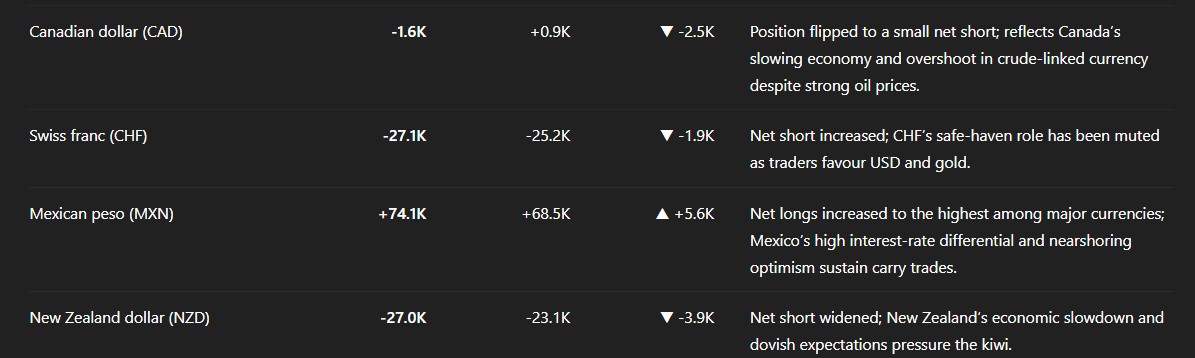
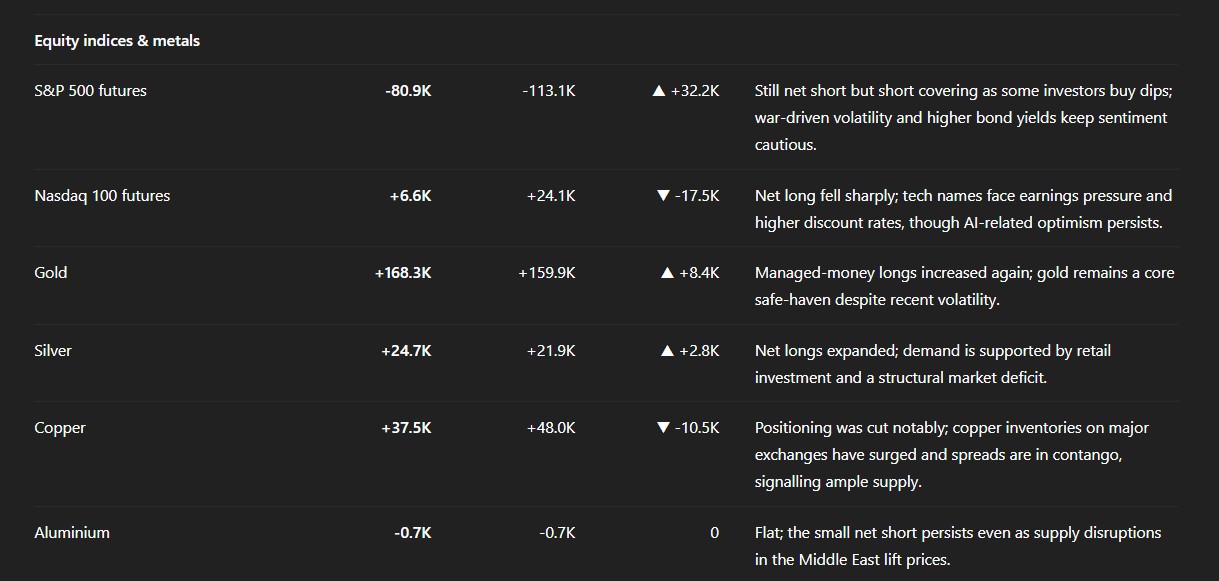
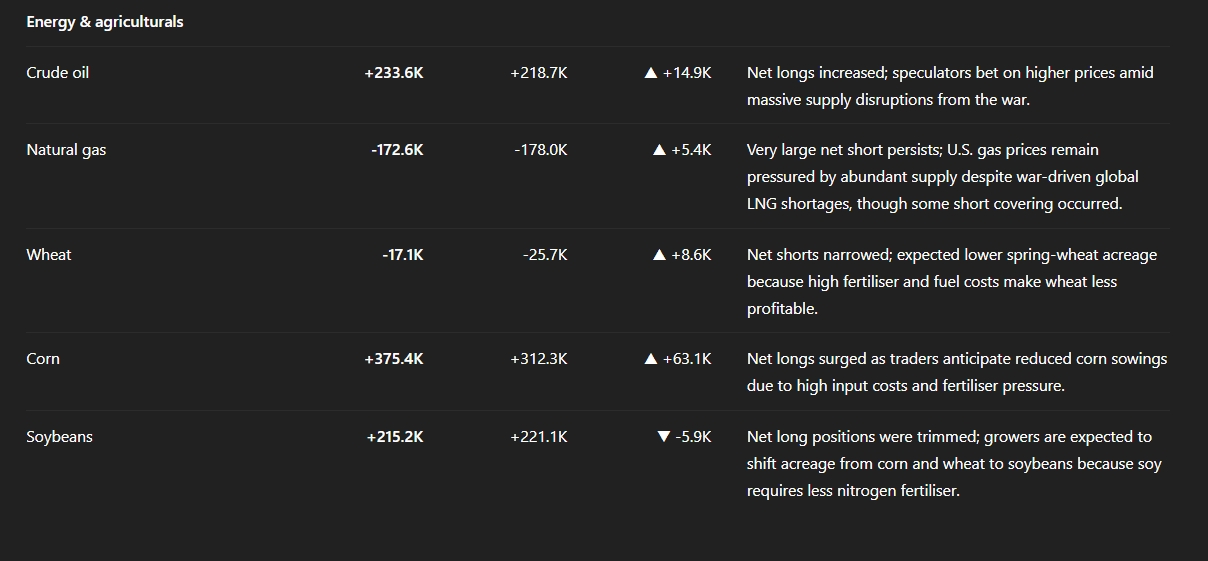
The table below summarises the latest speculative net positions in thousands of contracts and compares them with the prior report. An increase in net longs generally suggests growing bullish sentiment, while a rise in net shorts suggests rising bearishness.
How to Read This CFTC Report
For traders and investors, the CFTC report is most useful when read in three layers:
1. Direction
Is the market net long or net short?
2. Change
Did the position increase or decrease versus the previous week?
3. Crowding
Is positioning becoming so one-sided that the market may be vulnerable to a reversal?
That framework is especially important now because macro markets are being driven not only by growth and central banks, but also by the ongoing Middle East conflict, energy disruption, inflation sensitivity, and policy uncertainty.
Currency Positioning Analysis and Possible Market Reaction
- Australian Dollar (AUD)
Speculators remain net long AUD and added another 1.8K contracts, taking total net longs to +70.9K. This signals that bullish sentiment remains intact.
The market still sees support from Australia’s commodity-export profile and relatively stable rate expectations. As long as commodity demand holds and global risk sentiment does not deteriorate sharply, AUD can continue to find support.
Possible market reaction:
AUD may stay relatively firm against weaker low-yielders, especially if commodity prices stay supported.
Trading and investment idea:
Buying dips in AUD/JPY or AUD/NZD may remain attractive, but traders should keep stops tight because commodity-linked currencies can reverse quickly if global growth concerns intensify.
- Brazilian Real (BRL)
The BRL remained strongly net long at +49.2K, essentially unchanged from +49.3K. That tells us speculative conviction remains high.
Brazil continues to benefit from a still-attractive carry backdrop and solid agricultural-export support. Stable positioning here suggests the market remains comfortable holding BRL exposure.
Possible market reaction:
The BRL can remain supported as long as carry demand stays intact and commodity-export conditions do not deteriorate.
Trading and investment idea:
BRL may still work as part of a selective carry basket, but crowded positioning means position sizing should stay conservative.
- Euro (EUR)
The euro’s speculative net long position dropped sharply to +9.3K from +21.1K, a decline of 11.8K. This is one of the more important sentiment changes in the report.
That cut in long exposure suggests euro bulls are losing conviction. The macro reason is straightforward: Europe remains sensitive to energy prices, and the Middle East conflict raises both inflation and growth risks for the region.
Possible market reaction:
The euro may struggle if oil stays elevated and if the European Central Bank remains cautious.
Trading and investment idea:
Selling EUR/USD rallies or using euro weakness against stronger carry currencies could remain attractive while the market keeps repricing Europe’s energy vulnerability.
- British Pound (GBP)
The pound remains net short, but the short was reduced from -65.5K to -58.4K. That 7.1K improvement points to short covering rather than outright bullish conviction.
The market may be responding to a still-hawkish Bank of England backdrop and a U.K. economy that has held up better than some feared.
Possible market reaction:
The pound could stabilise or rise higher if short covering continues.
Trading and investment idea:
Rather than aggressively chasing the pound lower, traders may want to look for reversal signals and then fade overly bearish sentiment.
- Japanese Yen (JPY)
The yen remains heavily net short at -62.8K, though that is modestly improved from -67.8K.
The broader story has not changed: the yen continues to be used as a funding currency. Still, the reduction in shorts suggests some investors are starting to respect the possibility of safe-haven inflows if geopolitical risk escalates further.
Possible market reaction:
The yen remains vulnerable to sharp squeezes during risk-off episodes.
Trading and investment idea:
Options or tightly risk-managed tactical longs in JPY can make sense because the upside in a safe-haven shock can be fast and asymmetric.
- Canadian Dollar (CAD)
CAD moved from a tiny net long (+0.9K) to a small net short (-1.6K). That is not an extreme move, but it does signal caution.
This reflects a market that is not fully convinced that stronger oil alone can offset domestic growth softness.
Possible market reaction:
CAD may remain range-bound, especially if crude stays high, but Canada-specific growth concerns linger.
Trading and investment idea:
CAD may be better traded tactically rather than structurally until the market gains a clearer direction from both oil and Bank of Canada expectations.
- Swiss Franc (CHF)
The CHF net short widened slightly to -27.1K from -25.2K.
This tells us that even in a geopolitical-risk environment, traders are not prioritising CHF as a primary safe haven. Instead, capital appears to be flowing more toward the USD and gold.
Possible market reaction:
CHF may continue to underperform classic safe-haven expectations unless regional risk intensifies materially.
Trading and investment idea:
Short CHF positions may continue to work versus stronger macro currencies, but traders should remain cautious because CHF can still move abruptly during severe risk-off episodes.
- Mexican Peso (MXN)
MXN net longs rose to +74.1K from +68.5K, making it one of the most crowded bullish positions in the report.
That reflects a powerful carry story, supported by Mexico’s rate differential and nearshoring optimism.
Possible market reaction:
The peso can stay supported, but this is now a crowded trade.
Trading and investment idea:
Long MXN positions still make sense in a stable-risk backdrop, but because positioning is crowded, hedging or trailing stops becomes more important than usual.
- New Zealand Dollar (NZD)
NZD net shorts deepened from -23.1K to -27.0K.
The market remains negative on the kiwi as growth slows and policy expectations turn softer.
Possible market reaction:
NZD may continue to underperform, especially in broader risk-off conditions.
Trading and investment idea:
Short NZD against stronger commodity or carry currencies can still work if macro conditions remain fragile.
Equity Index Positioning and Possible Market Reaction
- S&P 500 Futures
The S&P 500 speculative net short improved from -113.1K to -80.9K, a sizeable 32.2K move. That is still bearish positioning, but not as aggressively bearish as before.
This looks like short covering rather than full bullish conviction. Investors remain cautious because higher oil prices, inflation pressure, and bond-yield risk continue to challenge equity valuations.
Possible market reaction:
Equities may remain volatile, with rebounds vulnerable to macro headlines and war-related oil shocks.
Trading and investment idea:
Rather than broad aggressive index chasing, investors may prefer selective exposure to high-quality cash-flow names and sectors that benefit from the current macro environment, while hedging with options.
- Nasdaq 100 Futures
Nasdaq net longs fell from +24.1K to +6.6K, a drop of 17.5K. That is a meaningful deterioration in sentiment.
The market is still not outright bearish on tech, but conviction has been reduced sharply. Higher discount rates, macro uncertainty, and earnings sensitivity are all weighing on positioning.
Possible market reaction:
The Nasdaq remains more fragile than broad indices if yields and oil stay elevated.
Trading and investment idea:
Tech exposure may still work selectively, especially in AI-linked names, but broad Nasdaq bullishness needs more caution until rate and inflation fears ease.
Precious Metals Positioning and Possible Market Reaction
- Gold
Gold net longs increased from +159.9K to +168.3K, another 8.4K rise.
This reinforces the idea that gold remains a core macro hedge even during highly volatile phases. The important nuance is that gold can still suffer short-term liquidation if inflation fears push rate expectations higher, but structurally the positioning still signals medium-term support.
Possible market reaction:
Gold can stay volatile in the short term, but the underlying bid remains strong as a hedge against inflation, war risk, and fiscal concerns.
Trading and investment idea:
Accumulating gold on pullbacks may still be the cleaner medium-term approach than chasing short-term spikes.
- Silver
Silver net longs rose from +21.9K to +24.7K.
That increase aligns with a market that still sees silver as supported by both investment demand and its structural supply-demand backdrop.
Possible market reaction:
Silver can remain more explosive than gold because it combines precious-metal and industrial-metal characteristics.
Trading and investment idea:
Silver may outperform in strong momentum phases, but it requires tighter risk controls because volatility is usually much higher than gold.
Industrial Metals Positioning and Possible Market Reaction
- Copper
Copper net longs dropped from +48.0K to +37.5K, a 10.5K reduction.
This is important because it suggests less confidence in the bullish copper narrative. Despite long-term energy-transition optimism, near-term supply conditions appear more comfortable, and inventory trends do not currently support an aggressive scarcity story.
Possible market reaction:
Copper may remain vulnerable to consolidation or pullback if macro growth questions intensify further.
Trading and investment idea:
Copper longs may be better rebuilt after deeper pullbacks rather than at current elevated sentiment levels.
- Aluminium
Aluminium remained flat at -0.7K, unchanged from the previous report.
That flat positioning stands out because fundamentals in aluminium have tightened. In other words, speculative positioning has not yet fully reflected the supply disruption story.
Possible market reaction:
Aluminium may have room to catch up if supply concerns persist and more speculative money enters the trade.
Trading and investment idea:
Aluminium-related exposure may offer an interesting opportunity because positioning is not yet crowded, but the fundamental backdrop remains supportive.
Energy Positioning and Possible Market Reaction
- Crude Oil
Crude oil net longs increased from +218.7K to +233.6K, a rise of 14.9K.
This is one of the clearest bullish signals in the report. Speculators are still leaning into supply-disruption risk and betting that the geopolitical premium in oil remains justified.
Possible market reaction:
Oil can remain structurally supported while supply disruption risk stays unresolved, but volatility is likely to stay very high because diplomatic headlines can move the market sharply in both directions.
Trading and investment idea:
Buying oil on dips remains the directional trade, but positions should be actively managed because any credible de-escalation can trigger very fast long liquidation.
- Natural Gas
Natural gas remains deeply net short at -172.6K, though that improved slightly from -178.0K.
This is still an extreme bearish speculative stance. The market remains focused on abundant U.S. supply, even though global LNG disruption has created tighter conditions elsewhere.
Possible market reaction:
Natural gas remains vulnerable to sudden short squeezes if weather, storage, or export conditions shift more aggressively than expected.
Trading and investment idea:
For tactical traders, natural gas may be more interesting from a contrarian squeeze perspective than from a clean trend-following short perspective at these already-heavy short levels.
Agriculture Positioning and Possible Market Reaction
- Wheat
Wheat net shorts narrowed from -25.7K to -17.1K.
That shift matters because it suggests the bearish wheat view is softening. High fertiliser and fuel costs have started to alter production expectations, which can tighten the balance later.
Possible market reaction:
Wheat may become more responsive to weather and acreage risks from here because the market is less heavily short than before, but not yet crowded long.
Trading and investment idea:
Wheat is increasingly interesting on the long side if acreage concerns deepen or if new supply shocks emerge.
- Corn
Corn net longs surged from +312.3K to +375.4K, a very large 63.1K jump.
This is one of the most aggressive positioning shifts in the entire report. Traders are clearly leaning into the idea that high input costs will reduce planting and support prices.
Possible market reaction:
Corn can remain supported, but the trade is getting crowded.
Trading and investment idea:
Corn still has bullish momentum, but with such large net longs already in place, traders should be careful not to chase extension without a disciplined stop framework.
- Soybeans
Soybean net longs dipped from +221.1K to +215.2K.
This is only a modest reduction, but it suggests the market is becoming slightly less enthusiastic as higher expected soybean acreage starts to enter the supply story.
Possible market reaction:
Soybeans may trade more two-way than corn because supportive acreage rotation may also mean more supply later.
Trading and investment idea:
Soybeans may be better suited to tactical range trading or relative-value trades rather than an aggressive, outright bullish view at this stage.
Best Cross-Market Read From This CFTC Report
This report points to several broader macro conclusions:
1. Energy remains the central macro driver
Crude oil positioning continues to build bullishly, while natural gas remains deeply short but vulnerable to squeeze conditions.
2. Carry still works, but the crowding risk is rising
MXN and AUD positioning show the market still likes yield and commodity support, but crowded carry trades can reverse sharply during risk-off phases.
3. Equities are cautious, not fully capitulated
The S&P 500 remains net short, but the scale of the short is smaller than before. That means sentiment is negative, but not at outright panic extremes.
4. Precious metals remain strategic hedges
Gold and silver positioning continue to support the broader inflation-risk and geopolitical-hedge narrative.
5. Agriculture is increasingly input-cost driven
Corn, wheat, and soybeans are being shaped not just by demand, but by fertiliser, fuel, acreage, and war-linked cost dynamics.
Trading and Investment Ideas Based on the Current CFTC Data
1. Gold on weakness
Gold positioning remains constructive. The cleaner strategy may be to build exposure on pullbacks rather than chase spikes.
2. Oil buy-the-dip approach
Crude positioning still supports upside bias, but the trade must be actively managed because geopolitical headlines can reverse it quickly.
3. Tactical yen hedge
The yen remains heavily short. That creates the potential for fast squeezes if risk sentiment suddenly breaks lower.
4. Selective carry, not blind carry
MXN and AUD still look supported, but these are increasingly crowded trades. Risk management matters more now than directional conviction alone.
5. Corn bullish, but crowded
Corn has one of the strongest bullish positioning signals in the report, but traders should respect crowding risk.
6. Watch aluminium versus copper
Aluminium fundamentals look tighter while copper positioning has been reduced. That relative divergence can create interesting pair-trade opportunities.
7. Equity exposure should stay selective
Instead of broad index aggression, quality companies in energy, defense, infrastructure, and selected AI-linked areas may offer better risk-adjusted setups.
Risk Management Note
The CFTC report is a lagging indicator because it reflects positions as of the previous Tuesday, not the release date. That means price action may already have moved by the time traders see the data.
So while this report is highly useful for identifying sentiment, positioning shifts, and crowding, it should always be used together with:
- price action
- macro data
- central bank expectations
- geopolitical headlines
- technical levels
- volatility conditions
Final Takeaway
For traders and investors, the key message is not just where the market is positioned, but where positioning is changing fastest. That is often where the next price reaction starts.
Comments