 English
 پارسی


Overview of the latest CFTC positioning data
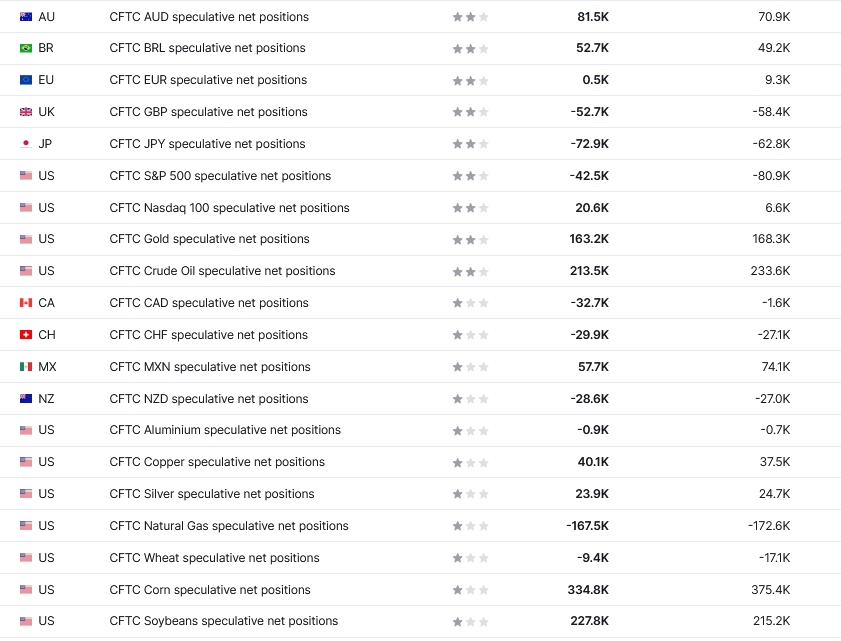
The U.S. Commodity Futures Trading Commission (CFTC) publishes the Commitment of Traders (COT) report weekly. It shows how different groups of market participants (commercial hedgers, non‑commercial traders and small traders) are positioned in futures markets. The “speculative net positions” report represents the difference between the number of long and short contracts held by non‑commercial traders (e.g., hedge funds). A positive value means speculators are net long (bullish), while a negative value means they are net short (bearish). The report also lists the change from the previous week.
Below is a table summarizing the latest non‑commercial net positions with the change from the previous week and the current market price for each instrument as of 6 April 2026. Commodity and index prices come from Trading Economics or Fortune. Currency rates are quoted as USD‑based pairs from Trading Economics (e.g., USD/JPY = 159.748). For currency analysis, positive net positions indicate that speculators are long the quoted currency relative to the U.S. dollar (e.g., long AUD and short USD). Negative values imply net long USD versus the currency.
Interpreting the positioning shifts
Currencies
- Dollar vs. commodity currencies. Net long positions in AUD and BRL increased, reflecting optimism about a ceasefire in the Middle East and strong commodity demand. Prices for copper and iron ore (Australia’s key exports) have risen sharply, supporting the Aussie. The Brazilian real benefits from high interest rates and robust agricultural exports.
- Euro and pound. Speculators reduced long EUR positions, bringing the euro position near neutral, while trimming their net short GBP positions. The euro’s under‑performance may reflect concerns about persistent inflation and energy costs in the eurozone. Meanwhile, U.K. data (services PMI, wage growth) have surprised on the upside, helping sterling.
- Safe‑haven currencies. Net short JPY and CHF positions increased. Even though geopolitical risks remain, markets anticipate the Bank of Japan and Swiss National Bank will be among the last to tighten policy significantly. The U.S. dollar has remained strong against these currencies; USD/JPY trades around 160, and USD/CHF ~0.798.
- CAD and NZD. The Canadian dollar saw a huge swing to net short after weak economic data and hints of future rate cuts. Lower oil prices relative to March highs may also weigh on CAD. Net shorts in NZD increased slightly as the market expects the Reserve Bank of New Zealand to pause or cut rates.
Equities
- S&P 500. Although the S&P 500 trades near record highs (~6 600 points), speculative traders remain net short but have covered nearly half of their bearish bets. The rally is fuelled by strong corporate earnings (especially large‑cap tech) and expectations that the Federal Reserve’s next move may be a rate cut later in 2026. A net short position may reflect hedging demand or caution after a strong run.
- Nasdaq‑100. Speculators increased net long positions to about 20.6 k contracts. Investors are bullish on technology and AI‑related stocks, expecting strong revenue growth. Nasdaq 100 has outperformed the broader market (up 38 % y/y).
Commodities and energies
- Energy. Net long crude‑oil positions remain very large but decreased for a second week. Oil near $112 per barrel suggests that traders are trimming longs due to potential ceasefire negotiations and OPEC+’s willingness to raise output. Natural gas remains heavily shorted; prices are around $2.83 per MMBtu as mild weather reduces demand.
- Metals. Net long positions in copper increased, aligning with hopes that any de‑escalation will spur manufacturing demand. Copper trades around $5.57 per lb. Gold and silver still have large speculative longs, reflecting ongoing geopolitical risk and inflation hedging, but both positions were slightly reduced.
- Agriculture. Soybeans and corn are the most heavily held longs among agricultural contracts. Corn net longs declined despite prices edging higher, possibly because planting intentions remain uncertain and supply is ample. Soybeans saw additional long positioning as biofuel demand and weather risks support prices. Wheat net shorts decreased as supply risks (weather, fertiliser shortages) persist; wheat prices are near 594 US cents/bu.
Trading ideas (for educational purposes only)
Disclaimer: The following ideas are for informational and educational purposes and do not constitute financial advice. Trading involves risk, and positions should be sized appropriately.
Currency trades
- Long AUD/USD with defined risk. Net speculative longs in AUD increased and risk appetite has improved. With copper prices rising and hopes of a ceasefire, AUD/USD around 0.6914 could climb toward the 0.70–0.72 area. A stop could be placed below 0.68 to manage downside.
- Short USD/JPY. Speculators are heavily short JPY, suggesting a crowded trade. The pair is near 160. Any sign of hawkishness from the Bank of Japan or a drop in U.S. yields could trigger a sharp yen rally. A contrarian short USD/JPY position with a target around 155 and a stop above 161 could offer favourable risk/reward.
- Long MXN/JPY or long Mexican peso vs. USD. Despite a reduction in longs, the Mexican peso still offers one of the highest real yields. USD/MXN is around 17.79. Holding MXN against a low‑yielding currency like JPY might benefit from the interest‑rate differential.
- Long EUR/GBP. Net long EUR positions fell sharply while net short GBP positions were reduced but remain negative. EUR/GBP near 0.87 could move higher if the eurozone’s inflation slows less than the U.K.’s.
Equity index trades
- Long Nasdaq‑100, short S&P 500 (pairs trade). Speculators are net long the Nasdaq and net short the S&P 500. Betting on continued out‑performance of technology stocks relative to the broader market could be expressed by going long US100 (~24 175) and short US500 (~6 602). This strategy hedges overall market risk while focusing on tech momentum.
- Contrarian short Nasdaq‑100. The Nasdaq is up 38 % y/y, and positioning has turned more bullish. A reversal in interest‑rate expectations or disappointment in AI earnings could trigger a pullback. Traders could short around 24 200 with a stop above 24 700 and a target near 23 000.
- S&P 500 call spread. If you expect continued upside but want limited risk, buying a call option on the S&P 500 while selling a higher‑strike call can provide leveraged exposure. Ensure option expiries cover the next FOMC meeting.
Commodity trades
- Long copper on dips. Speculative longs increased and the price is in an uptrend around $5.57/lb. Demand for electric vehicles and renewable energy, plus hopes of a ceasefire, support copper. Buying on pullbacks toward $5.40 with a stop near $5.20 could be considered.
- Short crude oil with tight stops. Even though geopolitical risk remains, speculators reduced longs and OPEC+ raised output quotas. Oil near $112/bbl may face resistance if a ceasefire reduces supply risk. A short position with a stop above $115 and a target near $105 might capture a pullback.
- Long gold for hedge, but watch positioning. Gold is near record highs (~$4 672/oz), and net longs are elevated. Instead of chasing, consider accumulating gold on dips around $4 600 as insurance against geopolitical shocks. Hedging with options (e.g., buying out‑of‑the‑money puts) can mitigate downside if yields rise.
- Long wheat, short corn. Corn net longs remain huge while wheat net shorts decreased. A relative trade going long wheat (594.76 USd/bu) and short corn (453.22 USd/bu) could benefit if grain markets rebalance due to shifting acreage and fertiliser constraints.
- Short natural gas volatility. Net shorts in gas are very large and prices are near multi‑month lows (~$2.83/MMBtu). Selling high‑volatility options or using a short strangle could capture premium if prices stay range‑bound (consult margin requirements and risk controls).
Key risks to consider
- Geopolitical uncertainty. The positions reflect speculation about a possible ceasefire in the Persian Gulf. If negotiations fail and conflict escalates, crude oil and safe‑haven assets (gold, USD) could spike sharply.
- Central‑bank policy shifts. Surprise rate cuts or hikes can quickly change currency and equity trends. Watch upcoming Federal Reserve, ECB and Bank of Japan meetings.
- Economic data surprises. Payrolls, inflation prints and PMIs may alter market expectations. For example, stronger U.S. data could strengthen the dollar and pressure commodities.
- Extreme positioning. Several markets show crowded trades (e.g., short JPY, long oil, long corn). Crowded trades can unwind violently on contrary news. Position sizing and stop‑losses are critical.
Q&A
Q: What does the latest CFTC report show overall?
A: It shows that speculators remain broadly long commodities and Nasdaq-100, while staying heavily short the Japanese yen, Canadian dollar, and, to a lesser extent, the S&P 500.
Q: Which markets look the most crowded?
A: The most crowded positions appear to be short JPY, long crude oil, long corn, and long gold.
Q: What is one key takeaway for forex traders?
A: AUD and BRL still show bullish speculative interest, while JPY remains heavily sold, which raises the risk of a sharp reversal if macro conditions change.
Q: What is one key takeaway for commodity traders?
A: Oil longs are still large but have been reduced, while copper positioning remains constructive, suggesting more selective bullishness across commodities.
Q: What is one key takeaway for equity traders?
A: Nasdaq positioning is getting more bullish, while S&P 500 shorts have been reduced sharply, pointing to a less defensive but still cautious equity backdrop.
Comments