 English
 پارسی


Latest COT Data Shows a Clear Shift in Market Sentiment
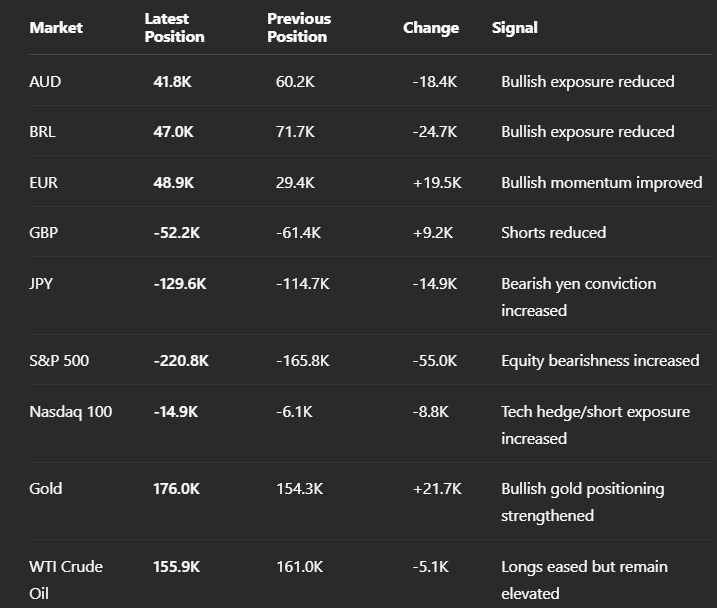
The latest CFTC speculative positioning report points to a more defensive and selective global market environment. Large non-commercial traders increased bearish exposure in several important markets, including the Japanese yen, Canadian dollar, S&P 500, Nasdaq 100, and wheat. At the same time, they added bullish exposure to gold, silver, copper, and the euro.
This combination shows that investors are not simply moving into a broad risk-on or risk-off structure. Instead, positioning is becoming more fragmented. Traders are selling currencies exposed to weaker domestic fundamentals or unfavorable interest-rate differentials, hedging U.S. equity indices, and maintaining exposure to safe-haven and inflation-sensitive commodities.
The most important message from the latest CFTC data is that speculative capital is becoming more cautious on risk assets, more bearish on low-yielding currencies, and more supportive of precious metals. For traders, this creates several useful signals, but also requires careful risk management because crowded positions can reverse quickly.
What Is the CFTC COT Report?
The Commitments of Traders report, published by the U.S. Commodity Futures Trading Commission, tracks positioning across futures and options markets. For traders, the most watched part is non-commercial positioning, which reflects the activity of speculators such as hedge funds, leveraged funds, and large trading accounts.
A positive net position means speculators are net long. A negative net position means they are net short. The weekly change is often more important than the absolute number because it shows whether conviction is strengthening or weakening.
The latest report covers positions for the week ending June 2, 2026, published on June 5, 2026.
Key Takeaways From the Latest CFTC Report
The biggest changes came from currencies, equity indices, and agricultural commodities.
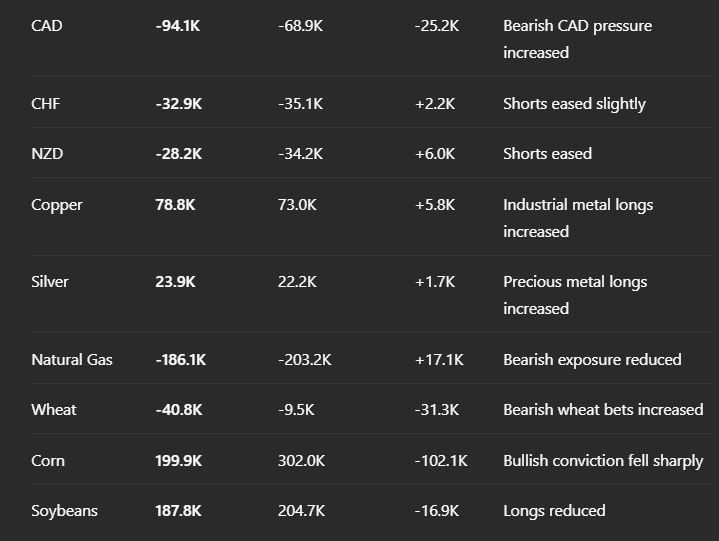
The Japanese yen saw deeper net shorts, falling to -129.6K from -114.7K, showing that traders continue to favor carry trades against the yen. The Canadian dollar also weakened in positioning terms, with net shorts expanding to -94.1K from -68.9K.
In U.S. equity futures, speculative sentiment became more defensive. S&P 500 net shorts widened to -220.8K from -165.8K, while Nasdaq 100 net shorts deepened to -14.9K from -6.1K. This suggests that large traders are increasingly hedging or betting against U.S. equity indices.
In commodities, gold net longs increased to 176.0K from 154.3K, while silver and copper also gained speculative support. By contrast, agriculture saw a sharp reduction in bullish conviction. Corn net longs dropped to 199.9K from 302.0K, while wheat shorts expanded sharply to -40.8K from -9.5K.
CFTC Positioning Snapshot
Currency Market Analysis: Euro Improves, Yen and CAD Stay Under Pressure
Japanese Yen: Bearish Carry Trade Remains Crowded
The yen remains one of the clearest bearish positioning stories in the CFTC report. Net speculative positions fell to -129.6K, deepening from -114.7K in the previous report.
The main driver is still the wide interest-rate gap between Japan and the United States. With the Bank of Japan still operating with much lower rates than the Federal Reserve, the yen remains vulnerable to carry-trade pressure. Traders continue to borrow low-yielding yen and move into higher-yielding currencies, especially the U.S. dollar.
However, this is also a crowded trade. When net shorts become too large, the market becomes vulnerable to sharp reversals. Any signal from Japanese authorities about currency intervention, or any hawkish surprise from the Bank of Japan, could trigger a violent yen short squeeze.
Market Sentiment: JPY Sell / USDJPY Buy, but crowded
Euro: Speculators Add Long Exposure
The euro showed one of the greatest positive changes in the currency section. EUR net positions increased to 48.9K from 29.4K, showing that speculative money is rebuilding confidence in the euro.
This positioning suggests that traders are less convinced about aggressive European Central Bank easing, or at least believe that euro downside has become more limited. In relative terms, the euro now looks better positioned than AUD, CAD and JPY.
Market Sentiment: EUR Buy
British Pound: Shorts Are Being Covered
Sterling positioning improved as GBP net shorts narrowed to -52.2K from -61.4K. This is not yet a fully bullish signal, because speculators remain net short. But the direction of change matters: bearish conviction is fading.
Short-covering in sterling usually means traders are reducing exposure to downside scenarios. If UK economic data continues to stabilize, GBP/USD and GBP/JPY may have room to recover, especially if the next CFTC reports confirm another reduction in shorts.
Market Sentiment: GBP Neutral to Buy
Australian Dollar and Canadian Dollar: Commodity FX Loses Momentum
AUD net longs fell to 41.8K from 60.2K, while CAD net shorts expanded to -94.1K from -68.9K. Both moves show weaker sentiment toward commodity-linked currencies.
For AUD, the decline in long exposure reflects concern about China-linked demand and weaker commodity momentum. For CAD, the expansion in shorts suggests traders are worried about domestic growth, rate expectations, and oil-market volatility.
The Canadian dollar may find some support if WTI remains high, but the positioning signal is clearly bearish for now.
Market Sentiment: AUD Neutral to Sell, CAD Sell
Equity Market Analysis: S&P 500 and Nasdaq Shorts Deepen
S&P 500: Bears Increase Exposure
The S&P 500 positioning shift is one of the most important signals in the report. Net speculative positions fell to -220.8K from -165.8K, meaning traders added around 55K contracts in net bearish exposure.
This does not automatically mean the index must fall. However, it shows that large traders are more cautious about U.S. equities. Possible reasons include high valuations, stronger Treasury yields, inflation concerns, and the risk that the Federal Reserve remains tighter for longer.
A key point for traders is that very bearish positioning can create two different outcomes. If prices break support, short sellers may press the market lower. But if the index holds key levels and rallies, bearish positioning can fuel a short squeeze.
Market Sentiment: S&P 500 Neutral to Sell, but short-squeeze risk is rising
Nasdaq 100: Tech Shorts Increase Despite Strong Long-Term AI Theme
Nasdaq 100 speculative net positions fell to -14.9K from -6.1K. The move shows that traders are becoming more cautious on high-duration growth and technology exposure.
The Nasdaq remains sensitive to interest-rate expectations. When yields rise, technology valuations face pressure because future earnings are discounted at higher rates. Even if the AI and semiconductor themes remain structurally strong, short-term positioning is more defensive.
Still, the bearish position is not extreme compared with the S&P 500. This means Nasdaq could recover quickly if bond yields ease or mega-cap technology stocks regain momentum.
Market Sentiment: Nasdaq 100 Neutral, tactical Buy on pullbacks only with protection
Precious Metals: Gold and Silver Attract Fresh Longs
Gold: Long Positions Increase Despite Strong U.S. Data
Gold speculative net longs increased to 176.0K from 154.3K, showing renewed bullish conviction. This comes as gold trades near $4,300/oz, supported by geopolitical risks, inflation hedging, and safe-haven demand.
The important point is that gold positioning strengthened even though stronger U.S. data and higher rate expectations normally create pressure on bullion. This means geopolitical and inflation risks are still strong enough to keep traders interested in gold.
However, gold is not without risk. If U.S. yields rise further and the dollar strengthens, gold may face resistance. The best setup is not necessarily chasing gold after a rally, but buying controlled pullbacks near important support zones.
Market Sentiment: Gold Buy on dips
Silver: Bullish, but More Volatile Than Gold
Silver net longs increased slightly to 23.9K from 22.2K. Silver also trades with a precious-metal component and an industrial-demand component, which makes it more volatile than gold.
With silver trading near $67/oz, the metal remains elevated, but the sharp monthly correction shows that risk is high. If precious metals recover, silver can outperform gold. But if global growth concerns deepen, silver may underperform because of its industrial exposure.
Market Sentiment: Silver Neutral to Buy, higher risk than gold
Copper: Industrial Demand Still Has Support
Copper net longs increased to 78.8K from 73.0K. This suggests speculators still see upside in industrial metals, likely linked to expectations for infrastructure spending, electrification demand, and potential Chinese stimulus.
However, copper’s direction depends heavily on global manufacturing data. If Chinese and European industrial indicators weaken further, copper longs may be vulnerable.
Market Sentiment: Copper Neutral to Buy
Energy Market Analysis: Oil Longs Ease but Geopolitical Risk Supports Prices
WTI Crude Oil: Still Net Long, but Conviction Softens
WTI crude oil net longs slipped to 155.9K from 161.0K. This is not a bearish signal by itself because speculative positioning remains strongly net long. But the direction shows that some traders are reducing exposure after a strong oil move.
At the same time, live market context matters. WTI is trading near $94/bbl, supported by renewed Middle East tension and supply-risk premium. This creates a mixed signal: positioning is slightly less bullish, but price action and geopolitics are still supportive.
For traders, the key is whether oil can hold above important support after the geopolitical spike. If it does, call spreads or controlled long exposure may still work. If inventory data weakens or OPEC+ supply increases become more important, oil may face a correction.
Market Sentiment: WTI Buy on pullbacks, but avoid over-leverage
Natural Gas: Shorts Ease as Summer Demand Builds
Natural gas remains heavily net short at -186.1K, but the short position improved from -203.2K. This means traders are still bearish, but less bearish than before.
Natural gas trades near $3.15/MMBtu, with inventories still comfortable. However, hotter weather and summer cooling demand could create upside risk. Because short positioning is still large, any strong demand surprise may trigger short-covering.
Market Sentiment: Natural Gas Neutral, possible short-covering risk
Agriculture: Traders Cut Corn and Soybean Longs, Build Wheat Shorts
Wheat: Bearish Positioning Expands Sharply
Wheat positioning was one of the most bearish moves in the report. Net shorts expanded to -40.8K from -9.5K, showing a major change in speculative sentiment.
The driver appears to be expectations of strong global supply. Improved crop prospects in Ukraine, Russia, Australia, and parts of the United States have reduced concern about shortages. Wheat futures are trading near 580 cents/bu, reflecting pressure from supply optimism.
The risk is that the short position is now much larger. If weather risks return or crop-quality concerns increase, wheat could rebound sharply as short sellers cover.
Market Sentiment: Wheat Sell, but short-squeeze risk is rising
Corn: Bullish Conviction Drops Hard
Corn net longs fell to 199.9K from 302.0K, a large reduction in bullish positioning. The market is still net long, but traders are clearly reducing exposure.
Favorable U.S. weather, strong planting progress, and weak Chinese demand have reduced the bullish case. Corn prices near 418 cents/bu show that supply expectations are weighing on the market.
Market Sentiment: Corn Neutral to Sell
Soybeans: Still Net Long, but Momentum Weakens
Soybeans remain net long at 187.8K, but the figure fell from 204.7K. This indicates that traders are still constructive but less confident.
Good U.S. growing conditions and weak export demand have reduced upside expectations. Unless Chinese buying improves or weather conditions deteriorate, soybeans may stay under pressure.
Market Sentiment: Soybeans Neutral
Trading Ideas Based on the Latest CFTC Positioning
- 1. Long EUR/JPY or EUR/AUD
The euro is gaining speculative support, while the yen and Australian dollar are losing momentum. This creates a relative-strength setup.
EUR/JPY may continue to benefit from carry-trade pressure, but traders must watch intervention risk. EUR/AUD may offer a cleaner relative-value opportunity because AUD longs are being reduced while EUR longs are increasing.
Trading Bias: Buy EUR/JPY or Buy EUR/AUD on pullbacks
- 2. Bullish GBP Call Spread
Sterling remains net short, but shorts are being reduced. This creates a potential early recovery signal.
A GBP/USD call spread could benefit from further short-covering while controlling risk. This is more attractive than an outright long position because the overall CFTC positioning is still negative.
Trading Bias: GBP Buy through limited-risk options
- 3. USD/CAD Long Setup
The sharp increase in CAD shorts suggests that traders are bearish on the Canadian dollar. USD/CAD may continue higher if Canadian data weakens or if oil fails to provide enough support.
However, because WTI is still elevated, this trade should be managed carefully. A sustained oil rally could support CAD and limit USD/CAD upside.
Trading Bias: USD/CAD Buy, but watch oil
- 4. Contrarian Nasdaq 100 Long With Protection
Nasdaq 100 shorts increased, but the position is not extreme. If tech stocks stabilize and yields pull back, short-covering could support a rebound.
A long Nasdaq position with a protective put may offer a balanced setup. This works best if price action confirms support.
Trading Bias: Nasdaq 100 tactical Buy with hedge
- 5. Gold Buy on Dips
Gold net longs increased, and the macro backdrop still includes geopolitical risk, inflation concerns, and defensive demand. The preferred setup is buying dips rather than chasing strength.
A gold long position near support, or a bull call spread, may provide exposure while limiting risk.
Trading Bias: Gold Buy on dips
- 6. WTI Oil Call Spread
WTI remains supported by geopolitical risk, but speculative long exposure has softened slightly. This favors options structures rather than aggressive outright longs.
A bull call spread allows traders to participate in upside while limiting downside if oil reverses after the geopolitical premium fades.
Trading Bias: WTI Buy through call spreads
- 7. Wheat Short-Covering Watch
Wheat shorts increased sharply. The market is bearish, but the size of the move creates reversal risk.
A contrarian trader may watch for a technical breakout or weather-related catalyst to enter a tactical long wheat trade. Until then, the main trend remains bearish.
Trading Bias: Wheat Sell, but prepare for short-covering reversal
Risk Management: Why CFTC Data Should Not Be Used Alone
CFTC positioning is useful, but it is not a timing tool by itself. The report is published with a delay, and market conditions can change quickly after major economic data, central-bank comments or geopolitical news.
Traders should combine CFTC data with:
- Price action and technical levels
- Volatility conditions
- Macroeconomic data
- Central-bank expectations
- Geopolitical risk
- Liquidity and positioning extremes
The best use of the CFTC report is to identify where the market is crowded, where conviction is changing, and where a reversal or continuation trade may have better risk-reward.
Final Outlook: Defensive Positioning, Stronger Metals and Crowded FX Trades
The latest CFTC positioning report shows that speculative traders are becoming more defensive across several major markets. Equity index shorts increased, yen and CAD shorts deepened, and agricultural longs were reduced. Meanwhile, gold, silver, and copper attracted more bullish exposure.
For the week ahead, the most important themes are:
- Whether yen shorts become too crowded and trigger intervention risk
- Whether S&P 500 and Nasdaq 100 shorts create downside continuation or short-squeeze conditions
- Whether gold can hold support despite stronger U.S. yields
- Whether WTI oil can maintain geopolitical risk premium
- Whether wheat shorts become vulnerable to a weather-driven reversal
Overall, the CFTC data does not show a simple risk-on or risk-off market. It shows a market where traders are selective, defensive, and highly sensitive to rates, inflation, geopolitics, and supply conditions.
For active traders, the best approach is to focus on relative strength, avoid overcrowded one-way trades, and use options or defined-risk structures where volatility risk is elevated.
FAQ
What does the latest CFTC positioning report show?
The latest CFTC positioning report shows deeper speculative shorts in the Japanese yen, Canadian dollar, S&P 500, Nasdaq 100 and wheat. It also shows stronger long positioning in gold, silver, copper and the euro.
Is the latest CFTC data bullish or bearish for the U.S. dollar?
The data is mixed for the U.S. dollar. Yen and CAD positioning supports a stronger dollar against JPY and CAD, but increased euro longs suggest EUR/USD may be more resilient.
Why are Japanese yen shorts increasing?
Yen shorts are increasing because the interest-rate gap between Japan and the United States remains wide. Traders continue to favor carry trades that involve selling low-yielding yen and buying higher-yielding currencies.
What does the CFTC report mean for gold?
Gold positioning is bullish. Speculative net longs increased to 176.0K, showing stronger demand for gold exposure. Geopolitical risk and inflation concerns support the market, although higher U.S. yields can limit upside.
Is the S&P 500 positioning bearish?
Yes. S&P 500 speculative net shorts widened to -220.8K, showing that traders are more defensive on U.S. equities. However, heavy short positioning can also increase the risk of a short squeeze if the index rallies.
What is the main trading idea from the latest CFTC data?
The strongest ideas are long EUR/JPY or EUR/AUD, gold buy-on-dips, USD/CAD upside with oil-risk monitoring, and tactical Nasdaq 100 longs with protection if price action confirms support.
Why did corn longs fall sharply?
Corn net longs fell because favorable U.S. weather, strong planting progress, and weak Chinese demand reduced bullish conviction. Traders are still net long, but the position is much smaller than the previous report.
Is wheat now oversold based on CFTC positioning?
Wheat positioning is bearish, with net shorts expanding sharply. That supports a bearish view, but it also increases short-covering risk if weather or supply conditions change.
How should traders use the CFTC COT report?
Traders should use the CFTC COT report as a sentiment and positioning tool, not a direct trade signal. It works best when combined with price action, macro data, volatility, and risk-management rules.
Is this CFTC report enough to open trades?
No. CFTC positioning helps identify market sentiment and crowded trades, but it should not be used alone. Traders should confirm setups with technical levels, macro catalysts, and clear risk management.
Disclaimer:
This article is for market analysis and educational purposes only. It does not constitute investment advice, financial advice, or a recommendation to buy or sell any asset. Trading involves risk, and all decisions should be based on independent analysis and proper risk management.
Comments