 English
 پارسی



Report Overview
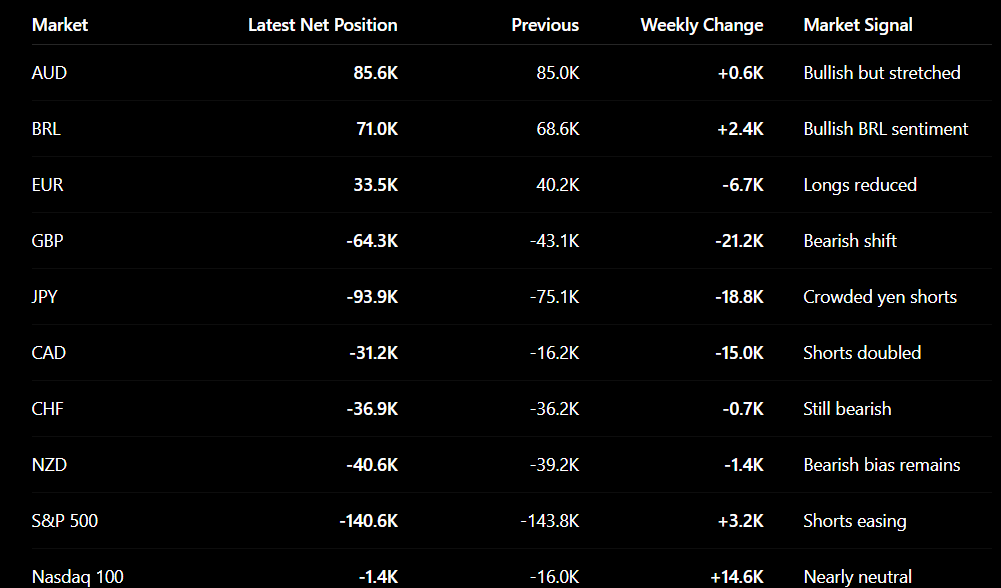
The latest CFTC Commitments of Traders report shows a market still divided between risk appetite, geopolitical sensitivity and macro uncertainty. Speculators remain heavily long selected commodities such as gold, crude oil, corn and soybeans, while they are increasingly short several major currencies, especially the Japanese yen, British pound, Canadian dollar and New Zealand dollar.
The most important message from this report is that positioning is becoming more crowded in some areas. The JPY net short position widened to -93.9K contracts, the GBP net short position deepened to -64.3K, and the CAD net short position expanded to -31.2K. These shifts show that speculative money is still positioned for U.S. dollar strength against several major currencies.
At the same time, the equity market picture is more complex. Speculators remain net short S&P 500 futures at -140.6K contracts, but the short position was slightly smaller than the previous week’s -143.8K. Nasdaq 100 positioning improved much more sharply, moving from -16.0K to only -1.4K, leaving speculative exposure almost neutral. This suggests that traders are no longer aggressively fighting the technology-led equity rally.
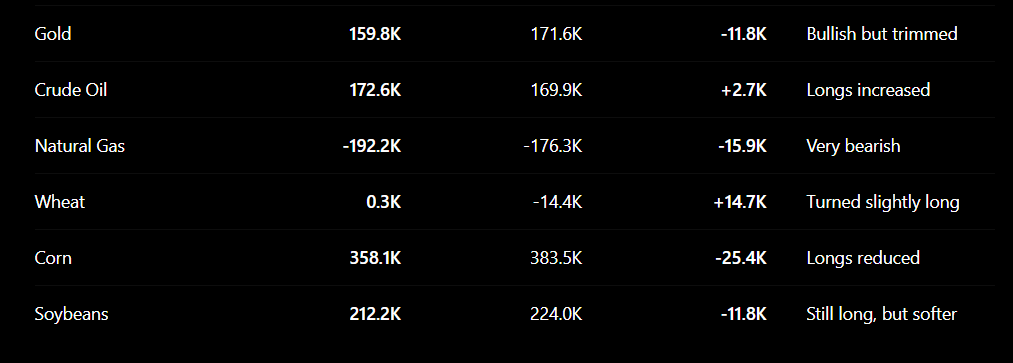
In commodities, the report shows a clear divergence. Speculators increased crude oil net longs to 172.6K contracts, but live WTI crude prices fell sharply toward $90.80 per barrel. That mismatch creates liquidation risk if oil prices continue to fall. Gold positioning remains positive at 159.8K net long contracts, although longs were reduced from 171.6K, suggesting profit-taking rather than a full bearish reversal.
Latest CFTC Positioning: Key Changes vs Previous Report
Forex Positioning: JPY, GBP and CAD Shorts Are the Main Warning Signals
The strongest signal in the currency section is the expansion of speculative shorts in JPY, GBP and CAD. The Japanese yen remains the most aggressively shorted major currency in this report, with net speculative positions falling to -93.9K contracts from -75.1K.
With USD/JPY near 158.87, the market is still positioned for yen weakness. However, this is now a crowded trade. Any hawkish signal from the Bank of Japan, weaker U.S. yields, or a risk-off move could create a sharp yen short squeeze.
GBP positioning also weakened sharply. Net speculative GBP positions moved to -64.3K, compared with -43.1K previously. With GBP/USD near 1.3486, the currency is not collapsing in price, but the positioning shift shows that speculators are preparing for more downside risk.
CAD positioning is also important. Net shorts widened to -31.2K from -16.2K, while USD/CAD trades near 1.3806. This suggests that traders are increasingly bearish on the Canadian dollar, likely because lower oil prices and weaker commodity sentiment reduce support for CAD.
Market Condition / Sentiment:
USD: Neutral-to-Buy
The data supports a stronger dollar bias against JPY, GBP, CAD and NZD, but crowded positioning increases reversal risk.
Equity Positioning: S&P 500 Shorts Remain Heavy, Nasdaq Shorts Almost Disappear
The equity market signal is mixed but important. Speculators remain heavily short S&P 500 futures at -140.6K contracts, only slightly better than the previous -143.8K. This means many traders are still positioned defensively despite the S&P 500 trading around 7,545.
The Nasdaq 100 signal is more constructive. Speculative net positions improved from -16.0K to -1.4K, meaning the market is now almost neutral. This is important because it shows that bearish pressure against the Nasdaq 100 has faded sharply.
With the Nasdaq 100 near 29,815, the positioning data suggests that traders are no longer willing to aggressively short technology and AI-linked stocks. If the index continues to rise, remaining shorts could be forced to cover, adding more upside pressure.
Market Condition / Sentiment:
S&P 500: Neutral-to-Buy
Nasdaq 100: Buy on dips
The CFTC data suggests that equity shorts are vulnerable if price action remains positive.
Gold Positioning: Longs Trimmed, but Bullish Bias Remains
Gold remains one of the strongest long positions in the CFTC report. Speculative net longs stand at 159.8K contracts, down from 171.6K. This is not a bearish reversal. It looks more like profit-taking after a strong move.
With gold trading near $4,563 per ounce, the market still shows safe-haven demand, but traders are reducing some exposure. The key point is that gold positioning remains positive even as long positions decline.
If geopolitical risk remains high, inflation expectations stay elevated, or real yields fall, gold may continue to attract buyers. However, because net longs are still large, any stronger U.S. dollar or hawkish Fed repricing could trigger more liquidation.
Market Condition / Sentiment:
Gold: Neutral-to-Buy
Buying dips remains reasonable while gold holds above key support zones, but traders should avoid chasing extended rallies.
Crude Oil Positioning: Bullish CFTC Data Conflicts With Falling WTI Prices
Crude oil is one of the most important divergences in this report. Speculators increased net long positions to 172.6K contracts from 169.9K, yet WTI crude fell sharply toward $90.80 per barrel.
This is a bearish warning. When positioning is long but price falls, it often means the market is vulnerable to forced liquidation. If crude oil fails to recover quickly, some speculative longs may exit, adding more downside pressure.
The market is still sensitive to U.S.-Iran diplomacy, Persian Gulf shipping risk, and Strait of Hormuz headlines. If geopolitical risk premium fades further, WTI could test lower support zones. If tensions return, the large long positioning may help oil rebound quickly.
Market Condition / Sentiment:
WTI Crude Oil: Sell on rallies below resistance
The CFTC data is bullish, but live price action is bearish. Price should lead positioning here.
Natural Gas Positioning: Shorts Become Extremely Crowded
Natural gas has the clearest bearish speculative profile in the report. Net speculative positions fell to -192.2K contracts, compared with -176.3K previously. This means shorts increased by 15.9K contracts in one week.
With natural gas near $2.87 per MMBtu, traders are clearly positioned for continued weakness. However, the position is now extremely crowded. That creates two possible trading conclusions.
The trend-following view remains bearish while price stays below $3.00. But from a contrarian perspective, this market is vulnerable to a sharp short squeeze if weather demand strengthens, LNG exports rise, or inventory data surprises bullishly.
Market Condition / Sentiment:
Natural Gas: Neutral-to-Sell, but short-squeeze risk is high
Agricultural Commodities: Wheat Turns Positive, Corn and Soybean Longs Are Reduced
The agricultural section shows a shift in speculative appetite. Wheat moved from -14.4K net short to +0.3K net long, marking a clear sentiment improvement. With wheat near 647 cents per bushel, traders are no longer bearish.
Corn remains heavily long at 358.1K contracts, but positions were cut from 383.5K. Soybean longs also declined to 212.2K from 224.0K. These are still large bullish positions, but the weekly change shows profit-taking.
This means grains remain supported, but positioning is less aggressive than before. For traders, wheat may offer the cleaner bullish shift, while corn and soybeans need confirmation from price action, crop conditions, and trade headlines.
Market Condition / Sentiment:
Wheat: Neutral-to-Buy
Corn and Soybeans: Neutral after long liquidation
Trading Ideas Based on CFTC Positioning and Live Prices
1. USD/JPY: Watch for a Yen Short Squeeze
Bias: Conditional Sell USD/JPY
Live Price Area: Around 158.87
Idea: The yen short is very crowded at -93.9K contracts. If USD/JPY fails to extend higher and drops below near-term support, a short squeeze could begin.
Trading Plan:
Sell USD/JPY only after bearish confirmation below support.
Potential target: 156.50–155.00
Invalidation: sustained move above recent highs.
2. GBP/USD: Bearish Positioning Supports Selling Rallies
Bias: Sell rallies
Live Price Area: Around 1.3486
Idea: GBP shorts increased sharply to -64.3K, showing worsening sentiment.
Trading Plan:
Look for selling opportunities if GBP/USD rejects resistance.
Potential target: 1.3350–1.3280
Invalidation: strong daily close above resistance.
3. S&P 500: Short Squeeze Risk Supports Buy-on-Dip Strategy
Bias: Buy on dips
Live Price Area: Around 7,545
Idea: Speculators remain heavily short S&P 500 futures, but price remains strong. This creates squeeze risk.
Trading Plan:
Buy pullbacks while price holds above major support.
Potential target: new highs above 7,600
Invalidation: daily close below key support.
4. WTI Crude Oil: Positioning and Price Are in Conflict
Bias: Sell rallies
Live Price Area: Around $90.80
Idea: Speculators increased crude longs, but price dropped sharply. This creates long-liquidation risk.
Trading Plan:
Sell failed rebounds below resistance.
Potential target: $88.00–$85.00
Invalidation: strong recovery above $95.00–$96.00.
5. Natural Gas: Crowded Shorts Create Optionality
Bias: Neutral-to-Sell, but watch for squeeze
Live Price Area: Around $2.87
Idea: Net shorts are extremely large at -192.2K contracts. Trend remains bearish, but short squeeze risk is rising.
Trading Plan:
Trend traders can sell failed moves below $3.00.
Contrarian traders can watch for a breakout above $3.00 for a possible squeeze.
Potential upside target on squeeze: $3.20–$3.35
Invalidation for longs: failure back below $2.80.
Final Market View
The latest CFTC report shows that speculative positioning is becoming increasingly concentrated. The most crowded bearish trades are in JPY, GBP, CAD and natural gas. The most important bullish exposures remain in gold, crude oil, corn and soybeans, although gold and grains saw some long reduction.
For traders, the cleanest message is not simply to follow the CFTC data blindly. The better approach is to combine positioning with live price action. When positioning and price confirm each other, the signal is stronger. When they diverge, as in crude oil, the risk of liquidation increases.
The most important trading themes from this report are:
USD remains supported, but crowded shorts in JPY and CAD create reversal risk.
Equities remain vulnerable to short squeezes, especially as Nasdaq 100 shorts nearly disappear.
Gold remains structurally supported, but long exposure has been trimmed.
Crude oil has bearish price action despite bullish positioning, making it one of the most important markets to watch.
Natural gas shorts are very crowded, creating risk of a violent rebound if fundamentals improve.
Overall Market Condition:
Neutral-to-Buy for USD and equities, Neutral-to-Buy for gold, Sell-on-rallies for WTI crude, and Neutral-to-Sell for natural gas with short-squeeze risk.
FAQ
What does the latest CFTC COT report show?
The latest CFTC COT report shows speculators increasing bearish positions in JPY, GBP, CAD and natural gas, while remaining net long gold, crude oil, corn and soybeans. Equity futures remain net short, but bearish positioning in the Nasdaq 100 has almost disappeared.
Is the latest CFTC report bullish or bearish for the U.S. dollar?
The report is generally bullish for the U.S. dollar, especially against JPY, GBP, CAD and NZD. However, some of these trades are now crowded, which means the risk of a short squeeze in currencies like the Japanese yen is increasing.
Why is USD/JPY important after the latest CFTC data?
USD/JPY is important because speculators increased JPY shorts to -93.9K contracts. With USD/JPY near 158.87, the trend still supports yen weakness, but the crowded short position raises the risk of a sharp reversal if market conditions change.
What does the CFTC report mean for gold?
Gold positioning remains bullish, with speculators holding 159.8K net long contracts. However, longs were reduced from 171.6K, showing some profit-taking. Gold remains supported while geopolitical risk and inflation concerns stay active.
Why is crude oil a warning signal in this CFTC report?
Crude oil is a warning signal because speculators increased net longs to 172.6K contracts, but WTI crude fell sharply toward $90.80 per barrel. When price falls while speculative longs rise, it can create liquidation risk.
Is the S&P 500 positioning bullish or bearish?
CFTC positioning is still bearish because speculators remain net short -140.6K S&P 500 futures contracts. However, because the S&P 500 is trading near 7,545, the heavy short position can become bullish if price keeps rising and short sellers are forced to cover.
What is the best trading idea from this CFTC report?
The clearest ideas are to watch for a yen short squeeze, sell failed rebounds in WTI crude oil, and buy dips in S&P 500 or Nasdaq 100 if equity price action remains strong. Natural gas also deserves attention because shorts are extremely crowded.
Should traders use CFTC data alone for trading decisions?
No. CFTC data is useful for understanding market positioning, but it should not be used alone. Traders should combine CFTC positioning with price action, macro data, technical levels, central bank policy, and risk management.
Comments