 English
 پارسی


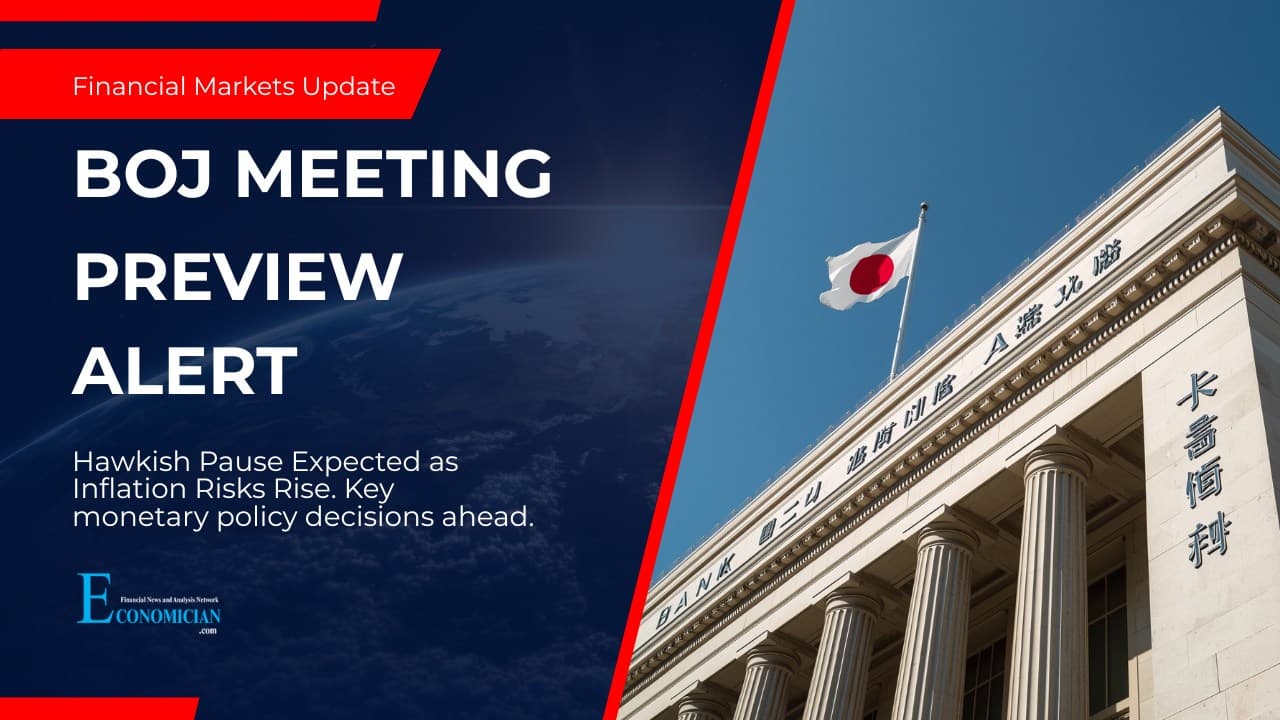
Bank of Japan Set for a Crucial April Policy Meeting
The Bank of Japan’s April 27–28 policy meeting is expected to end with the benchmark policy rate unchanged at 0.75%, but the decision itself may not be the most important part of the event. Markets will focus closely on the updated Outlook for Economic Activity and Prices, scheduled for release on April 28, and the Summary of Opinions, which will be published on May 12. Governor Kazuo Ueda is also expected to brief the media at 06:30 GMT on Tuesday.
This is the BoJ’s second monetary policy meeting of 2026, and it comes at a difficult moment for policymakers. Inflation remains close to or above the central bank’s 2% target, the yen remains vulnerable, and the Iran war has pushed energy prices higher. At the same time, higher fuel costs threaten corporate profits, household purchasing power, and Japan’s growth outlook.
The clean base case is a hawkish pause: no rate hike in April, but a clear signal that another move remains possible in June or July.
BoJ Policy Rate Expected to Stay at 0.75%
The BoJ is widely expected to keep its short-term policy rate at 0.75%. In December 2025, the central bank raised its short-term policy rate to 0.75%, the highest since 2007, while signaling that future policy adjustments would be gradual.
Markets had initially considered the possibility of another April hike, but expectations shifted after recent BoJ communication emphasized uncertainty around the Iran war, higher oil prices, and downside risks to growth. As a result, markets have largely priced out an April hike and moved their attention to the likelihood of a move in June or July.
The BoJ is likely to maintain its data-dependent stance and continue to signal that further tightening remains possible if economic and price conditions evolve as expected. However, the central bank is unlikely to pre-commit to a specific meeting.
The Core Message: Hold Now, Prepare for June
The most likely message from the BoJ is that it is not ready to raise rates immediately, but it is also not ready to abandon its tightening bias. That makes this meeting more of a communication event than a pure rate-decision event.
The BoJ faces a complicated policy trade-off. Inflation pressure argues for higher rates, especially if energy costs are passed through to consumers and wages. But the Iran war and energy-price shock create a negative supply shock, which can raise inflation while also damaging growth.
Governor Ueda has already indicated that dealing with negative supply shocks through monetary policy is extremely difficult because monetary policy mainly affects demand. This supports the case for a cautious pause in April, while keeping the door open for a June or July hike.
Outlook Report: Growth Forecasts Likely Lower, Inflation Forecasts Higher
The most important part of the April meeting will be the updated quarterly Outlook Report. The BoJ is expected to make two major revisions.
First, the central bank is likely to cut its fiscal 2026 growth forecast, reflecting the drag from higher fuel costs, weaker corporate profits, and disruption linked to the Strait of Hormuz risk scenario.
Second, the BoJ is expected to revise inflation forecasts higher, as oil-related input costs, shipping pressures, and imported inflation feed through the economy.
The previous baseline projected 1.0% growth in fiscal 2026, slowing to 0.8% in fiscal 2027. Core inflation was projected at 1.9% in fiscal 2026 and 2.0% in fiscal 2027. Those assumptions now look outdated given the latest energy shock and imported inflation risks.
The April report will also include fiscal 2028 forecasts for the first time, giving markets a fresh view of the BoJ’s longer-term inflation and growth assumptions.
Inflation Data Supports the BoJ’s Tightening Bias
Recent Japanese inflation data give the BoJ enough justification to maintain a hawkish bias.
Japan’s Corporate Services Price Index rose 3.1% YoY in March, above the 3.0% forecast and higher than the previous 2.7%. This suggests that price pressure is not limited to goods and is becoming more visible at the corporate service level.
Consumer inflation also firmed in March. National Core CPI rose 1.8% YoY, above the 1.7% forecast and higher than the previous 1.6%. National CPI increased to 1.5% YoY, up from 1.3% previously. On a monthly basis, the National CPI rose 0.4%, reversing from -0.2%. CPI, n.s.a also rose 0.4% MoM, compared with -0.6% previously.
The overall inflation picture shows renewed momentum, with both annual and monthly readings moving higher.
Wages and Core-Core CPI: Still Important for the BoJ
Japan has seen a third consecutive year of wage growth above 5%, but this should indicate that inflation has not yet shown a clear wage-price spiral.
The core-core CPI, which excludes food and energy, remains above the BoJ’s 2% target at around 2.4%, but it has been slowing. This gives the BoJ room to argue that an immediate April hike is not urgent.
Still, policymakers remain concerned about second-round inflation effects. If companies continue to pass higher energy and input costs to consumers, and if workers demand higher wages in response, the BoJ could face pressure to tighten more aggressively later.
PMI Data: Manufacturing Strength, Softer Services
Japan’s preliminary April PMI data showed a mixed but still expansionary picture.
The S&P Global Manufacturing PMI jumped to 54.9, far above the 51.1 forecast and higher than the previous 51.6. This points to a strong acceleration in factory activity.
However, the services side was softer. The S&P Global Services PMI eased to 51.2 from 53.4, while the Manufacturing & Services PMI slipped to 52.40 from 53.00.
The message is clear: manufacturing is strengthening sharply, while services and broader private-sector momentum remain in expansion territory but have lost some speed.
Trade Data: Stronger Exports, Higher Import Pressure
Japan’s March trade data showed a much stronger external balance than the previous month, although the surplus missed expectations.
The trade balance came in at 667.0B, below the 1,106.0B forecast, but sharply better than the previous 44.3B. The adjusted trade balance improved to 0.09T, recovering from -0.37T, though still below the 0.23T forecast.
Exports rose 11.7% YoY, beating the 11.0% forecast and improving strongly from 4.0%. Imports rose 10.9% YoY, above the 7.1% forecast and slightly higher than the previous 10.3%.
The data show stronger trade activity overall, led by a notable rebound in exports. However, higher imports also underline Japan’s vulnerability to energy and commodity cost pressures.
Capital Flows: Foreign Interest Remains Positive but Slower
Japan’s latest flow data show that foreign investor interest in Japanese assets remained positive, but the pace cooled.
Foreign investment in Japanese stocks came in at 2,380.9B, down from 3,941.4B previously. Foreign bond buying turned negative at -12.8B, compared with 698.2B previously.
This suggests overseas investors continued to buy Japanese equities heavily, but demand slowed, while bond flows slipped back into negative territory.
Yen Outlook: USD/JPY Reaction Will Be Critical
The yen is one of the most important market channels for this BoJ meeting. Increasing expectations for an April hold have weighed on the Japanese currency in recent weeks, although USD/JPY has managed to stay below the 160 level.
That level matters because previous breaches have drawn government intervention in currency markets. A weaker yen adds to imported inflation pressure, especially during an energy shock, and could increase pressure on the BoJ to sound hawkish even if it keeps rates unchanged.
A hawkish message from Governor Ueda would likely support the yen and reduce the risk of renewed depreciation. A neutral or dovish message, however, could put fresh pressure on the currency and raise concerns about intervention.
JGB Market Outlook: Short-End Yields Remain Sensitive
For Japanese government bonds, a hawkish hold would likely keep upward pressure on the short end of the yield curve. If the BoJ signals that a move to 1.0% remains possible by June or July, short-term JGB yields could rise further.
According to the Reuters poll summary, nearly two-thirds of economists expect the policy rate to reach 1.0% by the end of June. Market pricing also suggests around a 50% probability of a June hike and roughly 45 bps of total tightening in 2026.
That means the market is not only watching whether the BoJ holds in April, but also whether it validates expectations for another hike in the coming months.
Nikkei 225 Outlook: Record Highs Create Profit-Taking Risk
Japanese equities have performed strongly into the BoJ decision. The Nikkei 225 has hit a series of record highs, supported by local technology, banking, and industrial shares.
Some speculation over de-escalation in the Iran war also helped risk sentiment, although uncertainty around the conflict remains high.
The risk is that record-high valuations leave the Nikkei vulnerable to profit-taking if the BoJ sounds more hawkish than expected. Higher rate expectations could pressure equity valuations, especially in growth-sensitive sectors. However, Japanese banks may benefit from a higher domestic rate path.
Main BoJ Scenarios for Markets
1. Base Case: Hawkish Hold
The BoJ keeps rates unchanged at 0.75%, lowers growth forecasts, raises inflation projections, and keeps the door open to a June or July hike.
This would likely support the yen, push short-end JGB yields higher, and create some profit-taking risk for the Nikkei 225.
2. Hawkish Surprise: April Rate Hike
A surprise 25 bps hike would likely trigger a stronger yen rally, sharper upward pressure on Japanese yields, and a negative reaction in Japanese equities.
This is not the base case, but it remains a risk if the BoJ prioritizes inflation expectations and yen stability.
3. Dovish Surprise: Hold With Weak Guidance
If the BoJ holds rates but avoids signaling a possible June move, USD/JPY could rise again, yen weakness could deepen, and markets may test the authorities’ tolerance for depreciation.
Japanese equities may initially like the softer policy tone, but the benefit could fade if yen weakness revives imported inflation and intervention concerns.
Final Takeaway: The BoJ Is Pausing, Not Turning Dovish
The April BoJ meeting is best understood as a test of communication. The most likely outcome is not an immediate rate hike, but a hawkish hold that prepares markets for a possible move in June or July.
The BoJ must balance inflation risks, yen weakness, energy-price shocks, and growth uncertainty. Holding rates at 0.75% gives policymakers time to assess the economic impact of the Iran war, but maintaining hawkish guidance helps prevent inflation expectations and yen depreciation from becoming harder to control.
For markets, the key phrase is simple: hold now, prepare for June.
FAQ
Will the Bank of Japan raise rates at the April 27–28 meeting?
The base case is no. The BoJ is widely expected to keep its policy rate unchanged at 0.75%. However, it is likely to maintain a hawkish tone and keep the possibility of a June or July hike open.
Why is the BoJ expected to pause instead of hike?
The BoJ faces uncertainty from the Iran war, higher oil prices, and the risk that energy-driven inflation could also weaken growth. This makes an immediate hike less likely, even though inflation pressure remains important.
What is the most important part of the BoJ meeting?
The most important part is the updated Outlook for Economic Activity and Prices, released on April 28, along with Governor Kazuo Ueda’s press conference at 06:30 GMT. Markets will focus on changes to growth and inflation forecasts.
What will happen to the yen if the BoJ sounds hawkish?
A hawkish BoJ message would likely support the yen, especially if Governor Ueda signals that a move to 1.0% remains possible by June or July.
What happens if the BoJ sounds dovish?
A dovish message could weaken the yen and push USD/JPY higher. If USD/JPY moves back toward or above 160, markets may start to price a higher risk of currency intervention.
How could the BoJ decision affect the Nikkei 225?
A hawkish message could create profit-taking risk in the Nikkei 225, especially after recent record highs. However, banks may benefit from expectations of higher domestic interest rates.
Why does the Iran war matter for the BoJ?
The Iran war has increased energy and shipping risks, which can raise Japan’s import costs and inflation pressure. At the same time, higher fuel costs can hurt growth, corporate profits, and household purchasing power.
Comments