 English
 پارسی


Overview
The Bank of Canada (BoC) is widely expected to leave its policy rate unchanged at 2.25% at its March 18, 2026, meeting, as policymakers balance easing inflation against softening domestic growth. After cutting rates from 2.50% to 2.25% in late 2025, the BoC kept policy steady at its January 28, 2026, meeting, signaling that the current stance remains appropriate unless the economic outlook changes materially.
With inflation hovering close to target and economic momentum showing signs of weakness, the central bank is likely to maintain a patient and data-dependent approach.
BoC Interest Rate Background
The Bank Rate has remained at 2.25% since late 2025, following the BoC’s last rate cut from 2.50%. At its January meeting, the central bank acknowledged that inflation was running only slightly above its 2% target, with December CPI near 2.4%, and indicated that current policy settings were appropriate for the time being.
This guidance suggests that the BoC does not see an urgent need to adjust rates unless incoming data materially shifts the inflation or growth outlook.
Canadian Economic Growth Is Losing Momentum
Canada’s economy has started to show clearer signs of slowing, particularly on the consumer side.
In Q4 2025, the economy unexpectedly contracted by 0.2% quarter-on-quarter, equivalent to an annualized decline of 0.6%, while full-year GDP growth came in at 1.7%. The weakness was driven by a combination of factors, including:
- softer inventory activity,
- pressure from U.S. tariffs on goods,
- and continued housing market headwinds.
Domestic demand has also become less supportive. Consumer spending rose only around 0.4% in Q4, and momentum appeared to weaken further in January and February 2026, as reflected in both retail sales and wholesale trade data. Although exports posted modest growth, that strength was not enough to offset broader weakness in overall output.
Labour Market Is Cooling Gradually
Canada’s labour market is also showing signs of moderation.
In February 2026, employment fell by 84,000, while the unemployment rate rose to 6.7%, its highest level in 17 months. The participation rate edged lower to 64.9%, and Statistics Canada noted that the decline was concentrated in full-time employment, which dropped by 108,000.
This softer labour market backdrop adds to the case for caution from the BoC, particularly if weaker hiring trends begin to weigh more heavily on household spending and business confidence.
Inflation Is Moving Closer to Target
At the same time, inflation continues to ease.
Canada’s January CPI rose 2.3% year-over-year, down from 2.4% in December, while the BoC’s preferred core inflation measures remained around 2.4% to 2.5%. With energy prices stabilizing and headline inflation moving closer to the central bank’s target, the recent inflation trend supports the view that price pressures are becoming more manageable.
The combination of softer headline inflation and the BoC’s earlier comments about policy being near the “mid-point” of an appropriate range suggests inflation is no longer forcing the central bank into a more restrictive stance.
Market Expectations for the March 2026 BoC Meeting
Financial markets and most economists expect the Bank of Canada to remain on hold through much of 2026.
Following the latest economic data, rate futures have continued to price in a low probability of additional cuts this year. Market pricing suggests that investors see little near-term policy change, with only a modest chance of a rate cut later in the year. Overnight index swaps for the end of 2026 remain in the low-2% range, implying that markets expect, at most, one additional 25-basis-point cut by year-end.
In other words, investors currently expect the BoC to stay cautious rather than move aggressively in either direction.
BoC March 18 Decision: What to Expect
The most likely outcome at the March 18, 2026, BoC meeting is a hold at 2.25%.
With inflation close to target and growth losing momentum, the central bank is likely to repeat a patient, data-driven message. Policymakers will probably want more evidence before considering either a renewed easing cycle or a longer hold with firmer language.
A dovish shift could emerge if downside risks intensify, especially through:
- a deeper global slowdown,
- Further weakness in Canadian housing,
- or continued deterioration in labour market conditions.
By contrast, a hawkish surprise appears unlikely unless inflation unexpectedly reaccelerates or underlying price pressures prove more persistent than current data suggest.
Market Implications
For markets, a steady BoC decision is largely priced in, meaning the focus will be on the policy statement, tone, and any signals about the future path of rates.
- A neutral-to-dovish statement could weigh modestly on the Canadian dollar and support rate-sensitive sectors.
- A more confident tone on inflation stability may help reinforce expectations that the BoC is comfortable keeping policy unchanged for an extended period.
- Any explicit discussion of downside growth risks would likely strengthen expectations for a possible late-2026 rate cut.
Conclusion
The Bank of Canada enters its March meeting in a delicate balancing phase. Inflation is gradually moving back toward target, but economic growth and labour market conditions are softening enough to prevent a more confident policy stance. Unless incoming data materially changes the picture, the BoC is likely to hold rates at 2.25% and maintain a wait-and-see approach.
For now, the central bank appears comfortable staying patient, with the next major shift likely to depend on whether Canada’s slowdown deepens or inflation proves more resilient than expected.
USDCAD – Technical Analysis
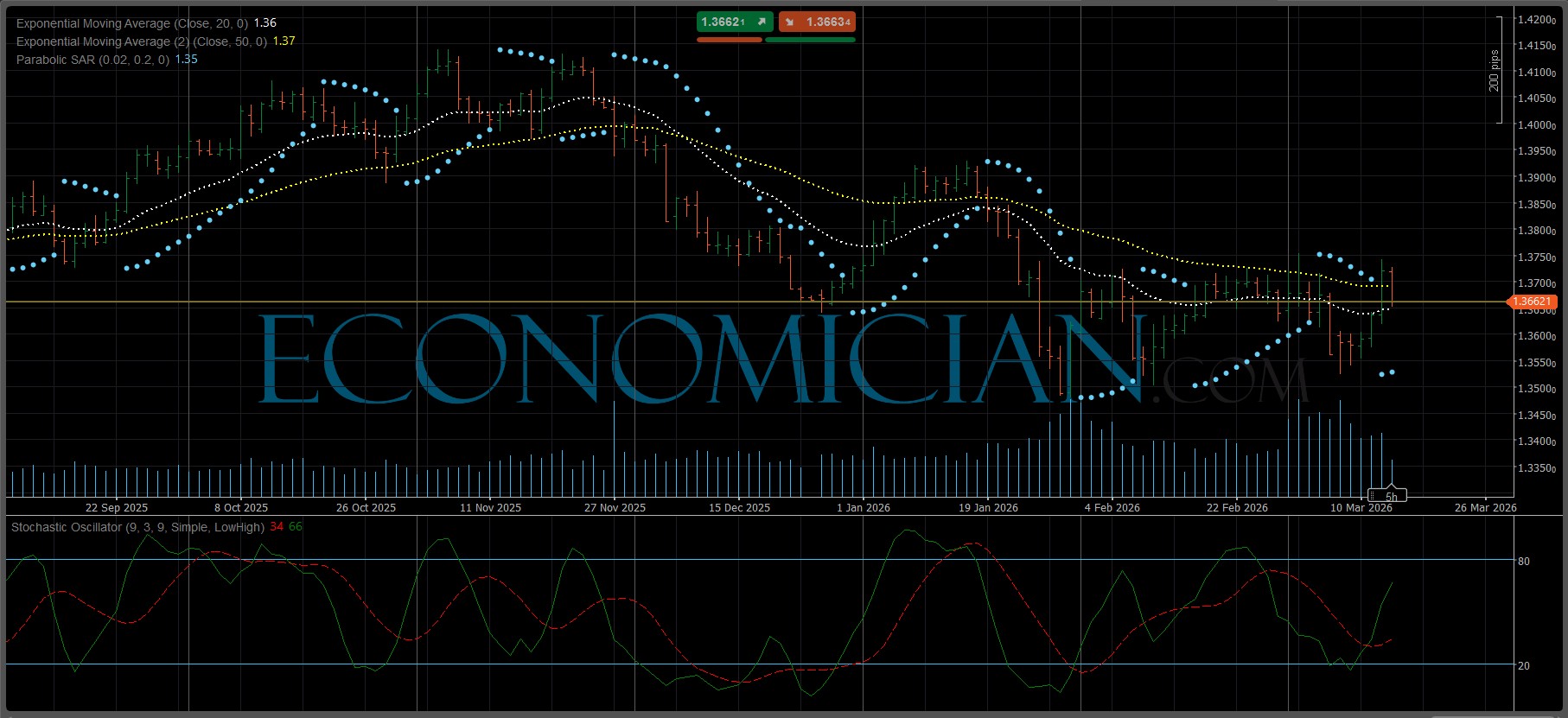
USDCAD looks neutral to slightly bullish in the short term, but the broader structure is still more range-bound than strongly trending. Price has rebounded from the 1.3530–1.3550 area and is now testing the 1.3660–1.3670 zone, where both the 20-day and 50-day EMAs are clustered. That makes this area an important short-term decision point.
The stochastic oscillator is turning up from lower levels, which supports near-term upside momentum, and the Parabolic SAR has flipped below price, also suggesting short-term bullish pressure. Still, the pair needs a clear break and daily close above 1.3670 to confirm stronger upside.
Key levels to watch:
- Resistance: 1.3670, then 1.3700, and 1.3740–1.3750
- Support: 1.3600, then 1.3550, and 1.3500
Trading view:
As long as USDCAD holds above 1.3600, the bias favors a push toward 1.3700/1.3750. But if it fails again around 1.3660–1.3670 and drops back below 1.3600, that would suggest the pair remains stuck in consolidation with downside risk returning.
Q&A
1. What is expected from the Bank of Canada at the March 18, 2026, meeting?
The Bank of Canada is widely expected to keep its policy rate unchanged at 2.25%. Markets and economists generally believe the BoC will prefer to wait for more economic data before making another move.
2. Why is the BoC likely to hold rates steady?
The main reason is that inflation is moving closer to target, while economic growth is slowing. This combination reduces the urgency for either a rate hike or an immediate rate cut.
3. How is inflation shaping the BoC’s decision?
Inflation has eased in recent months, with headline CPI near the BoC’s target range and core measures also showing more stability. That gives policymakers more room to stay patient rather than react aggressively.
4. What does recent GDP data say about the Canadian economy?
Canada’s economy weakened in late 2025, with Q4 GDP contracting unexpectedly. Slower consumer spending, softer domestic demand, housing weakness, and external trade pressures all contributed to the softer growth picture.
5. How is the labor market affecting policy expectations?
The labor market has cooled, with employment falling and the unemployment rate rising to 6.7%. A softer jobs backdrop supports the case for caution and reduces the likelihood of a hawkish BoC surprise.
6. Could the BoC still cut rates later in 2026?
Yes, but only if growth weakens further or labor market conditions deteriorate more clearly. For now, markets see only a limited chance of one additional 25-basis-point cut by the end of the year.
7. What would be the biggest surprise from this meeting?
A clearly hawkish tone would be the biggest surprise, especially if the BoC signals concern about inflation reaccelerating. Most investors instead expect a neutral or slightly cautious message.
8. What should investors watch in the BoC statement?
Investors should focus on the BoC’s language around inflation, growth, consumer demand, employment, and housing risks. The tone of the statement may matter more than the rate decision itself.
9. How could the BoC decision affect the Canadian dollar?
If the BoC sounds neutral to slightly dovish, the Canadian dollar could face modest pressure. If the central bank sounds more confident about inflation and growth stability, the currency may find support.
10. What is the key takeaway from this BoC meeting preview?
The BoC appears to be in a wait-and-see phase. Inflation is no longer the main problem it was before, but growth is not strong enough to justify a confident policy shift, making a hold at 2.25% the most likely outcome.
Comments