 English
 پارسی


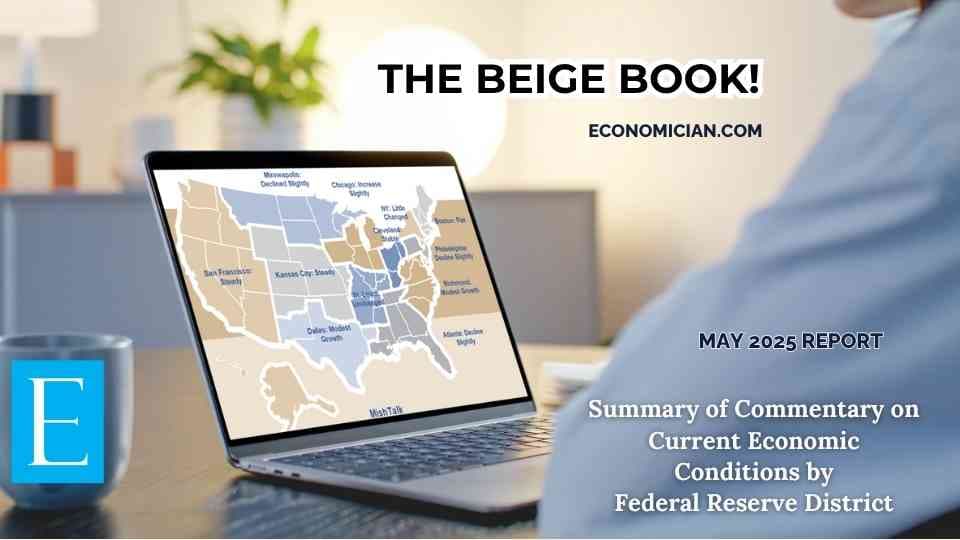
National Summary of Overall Economic Activity
Manufacturing activity declined slightly. Consumer spending reports were mixed, with most Districts reporting slight declines or no change; however, some Districts reported increases in spending on items expected to be affected by tariffs. Residential real estate sales were little changed, and most District reports on new home construction indicate flat or slowing construction activity. Reports on bank loan demand and capital spending plans were mixed. Activity at ports was robust, while reports on transportation and warehouse activity in other areas were mixed. On balance, the outlook remains slightly pessimistic and uncertain, unchanged relative to the previous report. However, a few District reports indicate the outlook has deteriorated while a few others indicate the outlook has improved.
Labor Markets
Employment has been little changed since the previous report. Most Districts described employment as flat, three Districts reported slight-to-modest increases, and two Districts reported slight declines. Many Districts reported lower employee turnover rates and more applicants for open positions. Comments about uncertainty delaying hiring were widespread. All Districts described lower labor demand, citing declining hours worked and overtime, hiring pauses, and staff reduction plans. Some Districts reported layoffs in certain sectors, but these layoffs were not pervasive. Two Districts noted that, for many of their contacts, hiring plans had not changed since the start of the year. Wages continued to grow at a modest pace, although many Districts reported a general easing in wage pressures. A few Districts indicated that higher costs of living continued to put upward pressure on wages.
Note: This report was prepared at the Federal Reserve Bank of St. Louis based on information collected on or before May 23, 2025. This document summarizes comments received from contacts outside the Federal Reserve System and is not a commentary on the views of Federal Reserve officials.
Prices
Prices have increased at a moderate pace since the previous report. There were widespread reports of contacts expecting costs and prices to rise at a faster rate going forward. A few Districts described these expected cost increases as strong, significant, or substantial. All District reports indicated that higher tariff rates were putting upward pressure on costs and prices. However, contacts’ responses to these higher costs varied, including increasing prices on affected items, increasing prices on all items, reducing profit margins, and adding temporary fees or surcharges. Contacts that plan to pass along tariff-related costs expect to do so within three months.
Highlights by Federal Reserve District
Boston
- Economic activity decreased slightly overall. Consumer spending at retail stores and restaurants slowed modestly. Employers paused hiring because of heightened uncertainty, with employment declining slightly and wages increasing just barely. Prices increased only slightly, but larger price increases were expected for the summer. Contacts expressed mixed views concerning the outlook.
New York
- Economic activity in the Second District continued to decline modestly amid heightened uncertainty. Employment held steady, though demand for workers softened and wage growth slowed to a modest pace. Selling price increases remained moderate, but input prices grew strongly with tariff-induced cost increases. Capital spending plans declined, and the outlook was quite pessimistic.
Philadelphia
- Business activity declined modestly in the current Beige Book period, as it did in the last period. Employment declined slightly, despite an uptick in manufacturing sector jobs. Wages increased slightly, and firm price inflation was up moderately. Existing home sales grew slightly, and new home sales declined moderately. Expectations for future growth rose moderately for manufacturers and slightly for nonmanufacturers.
Cleveland
- District business activity continued to be flat in recent weeks, and contacts expected activity to remain flat in the months ahead. Retailers noted a pullback in consumer spending, and manufacturers reported softer orders. Many contacts attributed robust cost increases to tariffs and said that their selling prices increased moderately.
Richmond
- The regional economy continued to grow mildly in recent weeks. Consumer spending and nonfinancial services demand picked up slightly, financial services demand and real estate activity were little changed, and manufacturing activity contracted slightly. Port volumes increased strongly due to a surge in import activity. Employment rose slightly, wage growth was modest, and overall price growth remained moderate.
Atlanta
- The economy of the Sixth District grew slightly. Employment was steady, and wage pressure decreased. Prices increased moderately. Consumer spending was flat, and travel and tourism declined modestly. Home sales rose slightly. Transportation activity grew at a modest pace. Loan growth slowed. Manufacturing fell, but energy activity rose slowly.
Chicago
- Economic activity increased slightly. Consumer spending and employment increased modestly; business spending and construction and real estate activity were flat; manufacturing declined slightly; and nonbusiness contacts saw a slight decline in activity. Prices and wages rose modestly, and financial conditions loosened slightly. Prospects for 2025 farm income increased some.
St. Louis
- Economic activity has remained unchanged, but the outlook has slightly deteriorated. Employment levels were unchanged, and wage growth has been modest. Contacts expressed elevated uncertainty and concern that tariffs would result in further cost increases.
Minneapolis
- The district economy contracted slightly overall. Employment was flat and wages grew moderately. Some employers were preparing contingency plans for potential layoffs. Prices increased moderately overall; some contacts were adding or considering tariff surcharges. Manufacturing increased moderately and consumer spending fell. Agricultural conditions remained weak, but crop progress was solid.
Kansas City
- Overall activity declined moderately, driven by lower retail spending, a decline in the demand for single-family homes, and a slight contraction in manufacturing. Businesses indicated they were increasingly cautious about hiring plans and capital expenditures, but employment levels were steady.
Dallas
- Economic activity in the Eleventh District economy was little changed over the reporting period. Nonfinancial services activity held steady and growth in the manufacturing sector slowed. Loan volumes grew slightly, and the housing market remained subdued. Employment was flat and price pressures held steady except for the tariff-related increases seen in the manufacturing sector. Outlooks generally deteriorated, and tariff uncertainty was making it hard for businesses to plan for the future.
San Francisco
- Economic activity slowed slightly. Employment levels were generally stable. Wages rose slightly and prices increased modestly. Retail sales and consumer and business services demand eased. Conditions in manufacturing, agriculture, and real estate markets softened slightly. Activity in the financial services sector was stable.
----------------
About This Publication
The Beige Book is a Federal Reserve System publication about current economic conditions across the 12 Federal Reserve Districts. It characterizes regional economic conditions and prospects based on a variety of mostly qualitative information, gathered directly from each District’s sources. Reports are published eight times per year.
What is the purpose of the Beige Book?
The Beige Book is intended to characterize the change in economic conditions since the last report. Outreach for the Beige Book is one of many ways the Federal Reserve System engages with businesses and other organizations about economic developments in their communities. Because this information is collected from a wide range of contacts through a variety of formal and informal methods, the Beige Book can complement other forms of regional information gathering. The Beige Book is not a commentary on the views of Federal Reserve officials.
How is the information collected?
Each Federal Reserve Bank gathers information on current economic conditions in its District through reports from Bank and Branch directors, plus interviews and online questionnaires completed by businesses, community organizations, economists, market experts, and other sources. Contacts are not selected at random; rather, Banks strive to curate a diverse set of sources that can provide accurate and objective information about a broad range of economic activities. The Beige Book serves as a regular summary of this information for the public.
How is the information used?
The information from contacts supplements the data and analysis used by Federal Reserve economists and staff to assess economic conditions in the Federal Reserve Districts. The qualitative nature of the Beige Book creates an opportunity to characterize dynamics and identify emerging trends in the economy that may not be readily apparent in the available economic data. This information enables comparison of economic conditions in different parts of the country, which can be helpful for assessing the outlook for the national economy.
The Beige Book does not have the type of information I’m looking for. What other information is available?
The Federal Reserve System conducts a wide array of recurring surveys of businesses, households, and community organizations. A list of statistical releases compiled by the Federal Reserve Board is available here, links to each of the Federal Reserve Banks are available here, and a summary of the System’s community outreach is available here. In addition, Fed Listens events have been held around the country to hear about how monetary policy affects people’s daily lives and livelihoods. The System also relies on a variety of advisory councils—whose members are drawn from a wide array of businesses, non-profit organizations, and community groups—to hear diverse perspectives on the economy in carrying out its responsibilities.
Note: The Federal Reserve officially identifies Districts by number and Reserve Bank city. In the 12th District, the Seattle Branch serves Alaska, and the San Francisco Bank serves Hawaii. The System serves commonwealths and territories as follows: the New York Bank serves the Commonwealth of Puerto Rico and the U.S. Virgin Islands; the San Francisco Bank serves American Samoa, Guam, and the Commonwealth of the Northern Mariana Islands. The Board of Governors revised the branch boundaries of the System in February 1996.
Comments