 English
 پارسی


EIA July 2026 STEO: Oil Price Forecast Falls as Hormuz Risk Eases
The July 2026 Short-Term Energy Outlook from the U.S. Energy Information Administration signals a major shift in the global energy market narrative. After months of disruption linked to the Strait of Hormuz conflict, the EIA now expects oil flows to normalize faster than previously assumed, global inventory draws to moderate, and crude oil prices to move lower through 2027. The central change is geopolitical: the United States and Iran signed a memorandum of understanding on June 18 to end the conflict and reopen the Strait of Hormuz, a critical oil transit chokepoint.
This new assumption sharply changes the outlook compared with the June report. Instead of a prolonged supply shock, the July STEO now points to a gradual return to oversupply as Middle East production and tanker traffic recover. For markets, the message is clear: the near-term oil risk premium has weakened, gasoline inflation pressure should ease, and natural gas remains structurally important for U.S. power generation.
Key Takeaways from the EIA July 2026 STEO
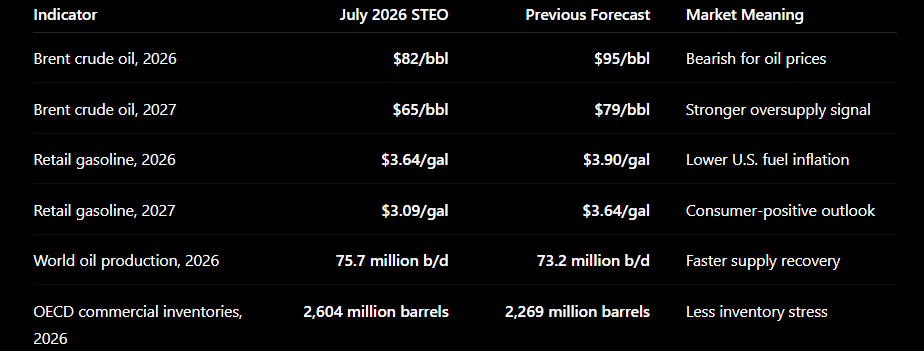
The July report forecasts Brent crude oil at $82 per barrel in 2026 and $65 per barrel in 2027, compared with the previous forecast of $95 in 2026 and $79 in 2027. That means the EIA cut its Brent forecast by 14% for 2026 and 18% for 2027. Retail gasoline prices were also revised lower to $3.64 per gallon in 2026 and $3.09 per gallon in 2027, down from the June forecast of $3.90 and $3.64, respectively.
Global Oil Market Outlook: From Supply Shock to Oversupply
The biggest change in the July STEO is the expected recovery of oil flows through the Strait of Hormuz. The EIA now expects most crude oil production to return near pre-conflict averages by the end of 2026, with the majority of shut-in production back online in 1Q 2027. This is a major reversal from the June outlook, which assumed a more prolonged disruption.
The July STEO estimates that global oil inventories will fall by 2.2 million barrels per day in 3Q 2026, compared with more than 7 million barrels per day in the June forecast. After the adjustment period, the EIA expects inventories to build by 2.7 million barrels per day in 4Q 2026 and 5.0 million barrels per day in 2027, pushing the market back toward oversupply.
Possible Market Effect:
This is bearish for Brent and WTI crude oil. A faster recovery in Middle East production reduces geopolitical risk premium, increases available supply, and weakens the case for sustained prices above $80–$90 per barrel. However, strategic reserve restocking and any renewed tension around Hormuz could limit the downside.
Brent Crude Oil Forecast: Lower Prices Ahead
Brent averaged $85 per barrel in June, down $22 from May and $32 from the April 2026 peak. The EIA now expects Brent to average $74 per barrel in 3Q 2026, which is $27 per barrel lower than last month’s outlook. By 2027, Brent is forecast to average $65 per barrel.
This means the EIA has moved from a shortage-driven price scenario to a supply-normalization scenario. The oil market is still not risk-free, but the July outlook clearly reduces the probability of a prolonged high-price shock.
Market Sentiment for Oil: Sell / Bearish Bias
The July STEO is negative for crude oil prices because it raises expected supply, lowers expected inventory draws, and forecasts inventory builds from late 2026 into 2027.
U.S. Gasoline Outlook: Prices Fall, but Margins Stay Sticky
Lower crude oil prices are expected to pull U.S. gasoline prices down in the second half of 2026. The EIA forecasts gasoline prices to average just under $3.80 per gallon in 3Q 2026, down from more than $4.20 per gallon in 2Q 2026. Prices are expected to fall further to around $3.40 per gallon in 4Q 2026, and then close to $3.10 per gallon in 2027.
However, the decline may not be immediate at the retail level. Gasoline inventories remain tight, and crack spreads are expected to stay elevated in the near term. The EIA notes that gasoline prices often fall more slowly than crude oil prices because of retail-market structure, regional inventory conditions, and uncertainty in the petroleum market.
Possible Market Effect:
Lower gasoline prices should reduce U.S. consumer inflation pressure and support discretionary spending. Refiners may still benefit temporarily from elevated margins, but margins are expected to narrow as inventories rebuild.
Global Oil Demand: Weak in 2026, Rebound Expected in 2027
The July STEO forecasts global oil consumption to decline by 1.2 million barrels per day in 2026, with 0.8 million barrels per day of that decline coming from non-OECD economies. The weakness reflects high fuel prices during the conflict, shortages, and government efforts to reduce fuel use. In 2027, the EIA expects demand to rebound by 2.0 million barrels per day to 104.8 million barrels per day.
This creates a mixed demand picture. The 2026 outlook remains weak, especially in Asia and non-OECD markets, but lower prices and restored supply flows are expected to revive consumption next year.
Natural Gas Outlook: Record Power-Sector Demand
The natural gas section of the July STEO is more constructive. The EIA expects U.S. natural gas consumption in the electric power sector to rise in both 2026 and 2027, reaching a record next year. Power-sector gas demand is forecast to rise 2% in 2026 and another 4% in 2027, reaching 38.1 billion cubic feet per day. Monthly consumption is expected to hit 50.6 Bcf/d in July 2027, which would be the highest monthly level on record.
The main drivers are stronger electricity demand, expansion of the natural gas generation fleet, and relatively low gas prices. The EIA expects U.S. natural gas-fired capacity to reach 508 gigawatts by the end of 2027, up 3% from 2025.
Market Sentiment for Natural Gas: Neutral to Slightly Bullish
Demand is rising, especially from power generation and LNG exports, but record production and above-average storage limit upside pressure on Henry Hub prices.
Henry Hub Price Forecast: Supply Keeps Prices Controlled
The EIA forecasts Henry Hub natural gas prices to average close to $3.70/MMBtu in 2026 before declining below $3.50/MMBtu in 2027. Storage remains above the five-year average for much of the forecast period, helped by record production and strong growth from the Permian region.
This keeps the natural gas outlook balanced. Demand is expanding, but supply is large enough to prevent a major price spike unless weather risk intensifies.
Electricity Prices: Lower This Summer, but Heatwaves Remain a Risk
The July STEO expects U.S. wholesale electricity prices to be lower this summer than last year. The national average is forecast near $45/MWh, mainly because natural gas delivered to power plants is cheaper. The largest declines are expected in western hubs and the Midcontinent ISO region.
However, the EIA warns that summer heatwaves could still cause temporary price spikes. Natural gas-fired plants often set marginal power prices, so any surge in cooling demand can quickly increase gas burn and electricity costs.
Possible Market Effect:
Lower wholesale power prices are positive for consumers and energy-intensive industries. But weather volatility remains an upside risk for short-term power and natural gas prices.
Coal Outlook: Structural Decline Continues
Coal remains under pressure. The July STEO forecasts coal’s share of U.S. electricity generation at 15% in 2026 and 15% in 2027, down from 17% in 2025. Coal-fired generation is expected to decline as natural gas and renewables take more market share.
The report also expects U.S. electric power-sector coal consumption to fall 9% in 2026 and another 3% in 2027. This confirms that coal’s decline is not only cyclical but structural, driven by low gas prices, renewable growth, and weaker coal-fired dispatch.
Renewables Outlook: Solar and Wind Keep Gaining Share
Renewables remain one of the strongest growth areas in the July STEO. Solar’s share of U.S. electricity generation is expected to rise from 7% in 2025 to 8% in 2026 and 9% in 2027. Wind is forecast to rise from 11% in 2025 to 12% in 2027.
The growth in renewables helps offset coal demand, but natural gas remains essential for peak demand and periods when renewable output is lower. This creates a dual-market structure: renewables dominate incremental generation growth, while gas remains the key balancing fuel.
Economy, CO₂ and Weather
The July STEO assumes U.S. GDP growth of 2.1% in 2026 and 2.3% in 2027. Lower oil and gasoline prices should support consumers and reduce energy-related inflation pressure. U.S. energy-related CO₂ emissions are forecast at 4.8 billion metric tons in both 2026 and 2027, after 4.9 billion metric tons in 2025.
Weather remains a major uncertainty. The EIA assumes 1,210 cooling degree days for summer 2026, about 2% more than both last summer and the 10-year average. A stronger-than-expected heatwave could raise electricity demand, natural gas consumption, and short-term power prices.
Final Market Analysis
The July 2026 STEO is broadly bearish for crude oil, positive for consumers, neutral to slightly bullish for natural gas demand, and negative for coal. The biggest change from the previous report is the removal of a major geopolitical supply-risk assumption. With the Strait of Hormuz reopening, the EIA no longer sees a sustained oil shortage. Instead, it expects production recovery, lower inventory draws, and a return to oversupply.
For financial markets, the main implications are:
Oil prices may remain under pressure unless geopolitical risk returns. Gasoline inflation should ease in the second half of 2026. Natural gas demand is structurally supported by electricity generation and LNG exports, but strong production limits price upside. Coal remains in decline, while solar and wind continue to gain share. Energy-sensitive sectors, transport companies, airlines, and consumers should benefit from lower fuel prices, while oil producers may face weaker margins and lower revenue expectations.
Source: U.S. Energy Information Administration, Short-Term Energy Outlook, July 2026.
FAQ
Q: What is the main message of the EIA July 2026 Short-Term Energy Outlook?
A: The main message is that global oil market risk has eased significantly after the U.S.–Iran memorandum to reopen the Strait of Hormuz. The EIA now expects faster oil supply recovery, smaller inventory draws, and lower Brent and gasoline prices.
Q: Why did the EIA lower its Brent crude oil forecast?
A: The EIA lowered its Brent forecast because oil flows through the Strait of Hormuz are expected to recover faster than previously assumed. More available supply and smaller inventory draws reduce the need for high oil prices.
Q: What is the new Brent crude oil forecast for 2026 and 2027?
A: The July STEO forecasts Brent crude oil at $82 per barrel in 2026 and $65 per barrel in 2027, down from the previous forecast of $95 and $79.
Q: What is the market effect of the July STEO on oil?
A: The report is bearish for oil prices because it raises expected supply and signals a return to oversupply by late 2026 and 2027.
Q: What does the July STEO say about U.S. gasoline prices?
A: The EIA expects U.S. gasoline prices to fall from more than $4.20 per gallon in 2Q 2026 to just under $3.80 in 3Q 2026, around $3.40 in 4Q 2026, and close to $3.10 in 2027.
Q: Is the July STEO bullish or bearish for natural gas?
A: It is neutral to slightly bullish for demand but not strongly bullish for prices. Natural gas consumption in the power sector is expected to reach a record in 2027, but record production and high storage levels keep Henry Hub prices controlled.
Q: What is the Henry Hub natural gas price forecast?
A: The EIA expects Henry Hub to average close to $3.70/MMBtu in 2026 before declining below $3.50/MMBtu in 2027.
Q: What does the report mean for coal?
A: The outlook is negative for coal. Coal’s share of U.S. electricity generation is expected to fall from 17% in 2025 to 15% in 2026 and 2027, while coal consumption and production continue to decline.
Q: What does the July STEO say about renewables?
A: Renewables continue to grow, especially solar. Solar’s share of U.S. electricity generation is forecast to rise from 7% in 2025 to 9% in 2027, while wind rises to 12% in 2027.
Q: What are the biggest risks to the July 2026 energy outlook?
A: The biggest risks are renewed geopolitical tension around the Strait of Hormuz, stronger-than-expected oil demand recovery, slower production normalization, extreme summer heat, and weather-driven spikes in electricity and natural gas demand.
Comments