 English
 پارسی


Fed June 2026 Minutes Analysis: Warsh’s First Meeting Signals a Hawkish Communication Reset
The June 16–17, 2026 Federal Open Market Committee minutes marked a major turning point in U.S. monetary policy communication. It was Kevin Warsh’s first meeting as Federal Reserve Chair, and while the FOMC kept the federal funds target range unchanged at 3.50%–3.75%, the tone of the minutes was clearly more hawkish than the rate decision alone suggested. The most important change was not the hold itself, but the Fed’s decision to remove language that had previously suggested an easing bias.
The meeting produced a unanimous 12–0 vote, showing that the Committee reached consensus around a shorter and more inflation-focused message. The official June statement said economic activity was expanding at a solid pace, productivity growth and capital investment were strong, job gains had kept pace with the workforce, and inflation remained elevated relative to the Fed’s 2% goal. The statement ended with a direct message: the Committee would deliver price stability.
Key Takeaways from the June 2026 FOMC Minutes
The June minutes show a Fed that is no longer preparing markets for near-term rate cuts. Instead, the Committee has moved to a stricter data-dependent framework where inflation persistence, AI-related demand, energy prices, tariffs, and labor-market resilience will determine the next policy move.
The most important points were:
- The Fed kept interest rates unchanged at 3.50%–3.75%.
- The decision was approved by a unanimous 12–0 vote.
- The Fed removed the previous easing-bias language.
- Inflation had moved higher, with staff estimating May headline PCE inflation at 4.1% and core PCE inflation at 3.4%.
- The labor market remained stable, with the unemployment rate at 4.3% in May.
- AI-related investment became a central macro theme, supporting growth but also adding demand-side inflation pressure.
- Several participants saw a case for raising rates, although all supported holding rates at this meeting.
- Many participants believed policy may need to remain at or above the current range if inflation stays elevated.
What Happened at the June 2026 Fed Meeting?
The FOMC voted to maintain the federal funds target range at 3.50%–3.75%. The Fed also maintained the interest rate paid on reserve balances at 3.65% and kept the primary credit rate at 3.75%. In addition, the Committee reaffirmed its policy of maintaining ample reserves in the banking system.
This was not a dovish hold. It was a hawkish hold. The Committee did not raise rates because uncertainty remained high, but the minutes show that upside inflation risks had become more important while downside employment risks had moderated. That shift gave policymakers more room to prioritize price stability.
The Biggest Change: The Fed Removed the Easing Bias
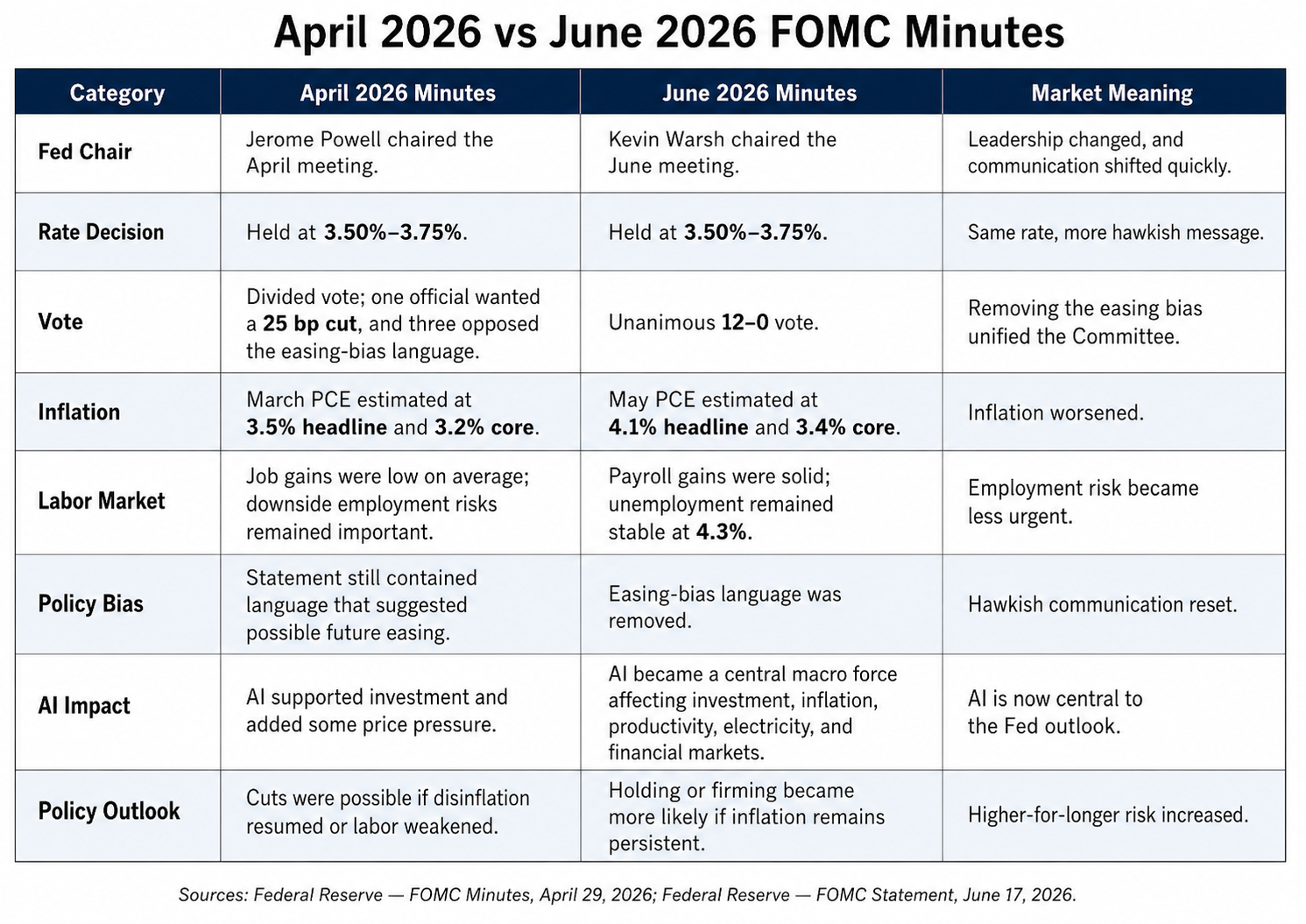
The most important communication change was the removal of the previous language that had suggested an easing bias. In the April minutes, several participants wanted to remove that language, and three officials voted against the April statement because they supported holding rates but did not support including an easing bias. One member also preferred a 25 bp rate cut at the April meeting.
By June, the Fed had resolved that communication split. The new statement was shorter, more direct, and more focused on inflation. Instead of guiding markets toward eventual cuts, the Fed emphasized that inflation remained elevated and that the Committee would deliver price stability.
This is the clearest signal from Warsh’s first meeting: the Fed wants more flexibility, less forward guidance, and stronger inflation credibility.
Inflation Analysis: The Fed’s Main Concern Became Stronger
Inflation was the dominant issue in the June minutes. The staff reported that headline PCE inflation was 3.8% in April, while core PCE inflation was 3.3%. Based on CPI and PPI data, staff estimated that headline PCE inflation rose to 4.1% in May, while core PCE inflation rose to 3.4%.
This represented a clear deterioration from the April minutes. In April, staff estimated that March headline PCE inflation was 3.5% and core PCE inflation was 3.2%.
The Fed linked the inflation pressure to four main sources:
- Past tariff increases
- Higher energy and input costs
- Middle East-related supply disruptions
- Strong demand from AI-related investment
Participants also noted that price increases had become more broad-based, affecting transportation, airfares, petrochemical products, agricultural inputs, technology products, and electricity. This matters because the Fed is no longer looking at inflation as only an energy shock. The concern is that cost pressures may spread into broader wage- and price-setting behavior.
Labor Market: Stable Enough for the Fed to Stay Focused on Inflation
The labor market did not give the Fed a strong reason to cut rates. The unemployment rate stood at 4.3% in May, and payroll employment increased at a solid pace in the three months through May. Wage growth also looked more consistent with eventual disinflation, with average hourly earnings rising 3.4% over the 12 months ending in May.
This was an important change from April. In the April minutes, job gains were described as low on average, and most participants still judged employment risks to be tilted to the downside.
By June, those concerns had eased. Participants still saw some risks from geopolitical uncertainty and possible AI-related labor displacement, but the current labor-market picture looked balanced enough for the Fed to keep inflation as the main policy priority.
AI Investment: Growth Driver and Inflation Risk
AI was one of the most important themes in the June 2026 Fed minutes. The Fed noted that AI-related capital spending continued to support investment in data centers, high-tech equipment, and software. Participants said AI investment showed no signs of slowing and could raise productivity and potential output over time.
However, the near-term policy problem is that AI is also acting like a demand shock. It is supporting corporate earnings, lifting equity prices, increasing demand for technology products, raising electricity demand, and strengthening business investment. That can keep the economy running above potential and make inflation more persistent.
The Fed’s AI view can be summarized in one sentence: AI may be disinflationary in the long run, but inflationary in the short run if demand rises faster than productivity.
Financial Markets: Higher Yields, Stronger Dollar, Stronger Equities
Financial markets moved in a complex but important way during the intermeeting period. The minutes showed that optimism around the Middle East conflict and a U.S.-Iran memorandum of understanding pushed oil futures and near-term inflation compensation lower compared with the April meeting. However, expected policy rates, Treasury yields, the U.S. dollar, and U.S. equities all rose.
The 10-year Treasury yield rose around 20 basis points since the April FOMC meeting and around 50 basis points since the start of the Middle East conflict. The S&P 500 increased by nearly 6%, led by the technology sector, as stronger earnings expectations and AI optimism supported risk appetite.
This creates a mixed market backdrop. Equities are supported by earnings and AI investment, but higher yields and a less dovish Fed can pressure valuations. The dollar benefits from a stronger-for-longer Fed narrative, while gold faces pressure from higher real yields unless geopolitical or inflation risks rise again.
Comparison: June 2026 Minutes vs April 2026 Minutes
Market Impact of the Fed June 2026 Minutes
- U.S. Dollar Outlook
The June minutes are supportive for the U.S. dollar. The Fed removed its easing bias, inflation remained elevated, and U.S. rate expectations moved higher relative to other advanced economies. Unless upcoming inflation data weakens clearly, the dollar may remain supported by policy-rate divergence.
Market sentiment for USD: Bullish to neutral.
- Treasury Yields Outlook
The minutes are bearish for short-term Treasuries and supportive of higher front-end yields. Several participants saw a case for raising rates, and the Committee is now less willing to signal future cuts without clear disinflation evidence.
Market sentiment for Treasury yields: Higher-for-longer.
- U.S. Equity Market Outlook
The equity signal is mixed. AI-related earnings and investment remain strong supports for the technology sector and broader risk appetite. However, higher real yields and the possibility of additional Fed firming create valuation risk.
Market sentiment for U.S. equities: Selectively bullish for AI-linked sectors, cautious for rate-sensitive sectors.
- Gold Outlook
Gold may face near-term pressure from higher yields and a stronger dollar. However, persistent inflation, Middle East uncertainty, and term-premium concerns could keep strategic demand alive.
Market sentiment for gold: Neutral to mildly bearish in the short term.
- Oil Outlook
Oil remains a key policy variable. The U.S.-Iran memorandum of understanding and optimism around the Strait of Hormuz helped reduce near-term inflation compensation, but the Fed still views energy and supply disruptions as major inflation risks.
Market sentiment for oil: Event-driven and volatile.
Policy Scenarios After the June Minutes
Base Case: Longer Hold
The Fed keeps rates at 3.50%–3.75% for longer while waiting for clearer evidence that inflation is moving back toward 2%. This is the most consistent reading of the June minutes.
Hawkish Scenario: One More Rate Hike
If core inflation stays sticky, AI-related demand continues to lift investment and electricity prices, and the labor market remains stable, the Fed could raise rates later in 2026. The minutes clearly show that several participants already saw a case for policy firming.
Dovish Scenario: Cuts Delayed to 2027
If energy prices decline, tariff effects fade, housing services inflation continues to cool, and labor-market data weakens, the Fed could eventually return to a rate-cut path. However, the June minutes show that cuts now require evidence, not just forecasts.
Final Analysis
The June 2026 FOMC minutes were more important than a normal hold decision. They marked the first major communication reset under Kevin Warsh’s leadership. The Fed kept rates unchanged, but it removed the easing bias, emphasized price stability, and showed greater concern about persistent inflation.
Compared with April, the Fed is now less worried about labor-market deterioration and more worried about inflation persistence. AI investment has become a central macro variable, supporting growth and productivity expectations while also increasing near-term demand and price pressure.
The market message is clear: the Fed has not adopted a fixed hiking bias, but it has removed the assumption that cuts are the natural next step. The next move will depend on inflation, labor-market stability, energy prices, tariff effects, and whether AI-driven demand continues to keep the economy running hot.
FAQ
Q1: What was the most important message from the Fed June 2026 minutes?
The most important message was that the Fed removed its previous easing bias and shifted toward a more inflation-focused policy stance. The Committee kept rates unchanged but made clear that persistent inflation could require further policy firming.
Q2: Did the Fed raise interest rates in June 2026?
No. The Fed kept the federal funds target range unchanged at 3.50%–3.75% with a unanimous 12–0 vote.
Q3: Why were the June minutes considered hawkish?
The minutes were hawkish because inflation had moved higher, labor-market risks had moderated, several participants saw a case for raising rates, and the Committee removed language that had previously suggested an easing bias.
Q4: How did the June minutes compare with the April minutes?
The June minutes were more hawkish than the April minutes. In April, one official preferred a 25 bp cut, and three officials opposed the easing-bias language. In June, the easing bias was removed and the vote became unanimous.
Q5: What did the Fed say about inflation?
The Fed said inflation remained elevated relative to its 2% goal. Staff estimated that headline PCE inflation rose to 4.1% in May, while core PCE inflation rose to 3.4%.
Q6: What role did AI play in the Fed’s outlook?
AI was a major theme. The Fed saw AI-related investment as a support for growth, productivity, capital spending, and corporate earnings. However, it also saw AI as a source of near-term inflation pressure through stronger demand for technology products, electricity, data centers, and high-tech equipment.
Q7: Are Fed rate cuts still possible in 2026?
Rate cuts are still possible, but the June minutes make them less likely without clear evidence of disinflation or labor-market weakness. The Fed now appears more focused on keeping policy restrictive until inflation convincingly moves toward 2%.
Q8: What is the market impact of the Fed June 2026 minutes?
The minutes are generally supportive for the U.S. dollar and Treasury yields, mixed for equities, mildly negative for gold in the short term, and indirectly important for oil because energy prices remain a key inflation risk.
Q9: What should markets watch next?
Markets should watch core PCE inflation, wage growth, unemployment, payrolls, energy prices, AI-related capital spending, electricity-price pressure, and Fed speeches. These factors will determine whether the Fed holds rates steady, cuts later, or considers another hike.
Q10: What is the main risk after the June minutes?
The main risk is that inflation remains above target for longer than expected while the labor market stays stable. In that scenario, the Fed may conclude that additional policy firming is needed to restore price stability.
Comments