
 English
 پارسی

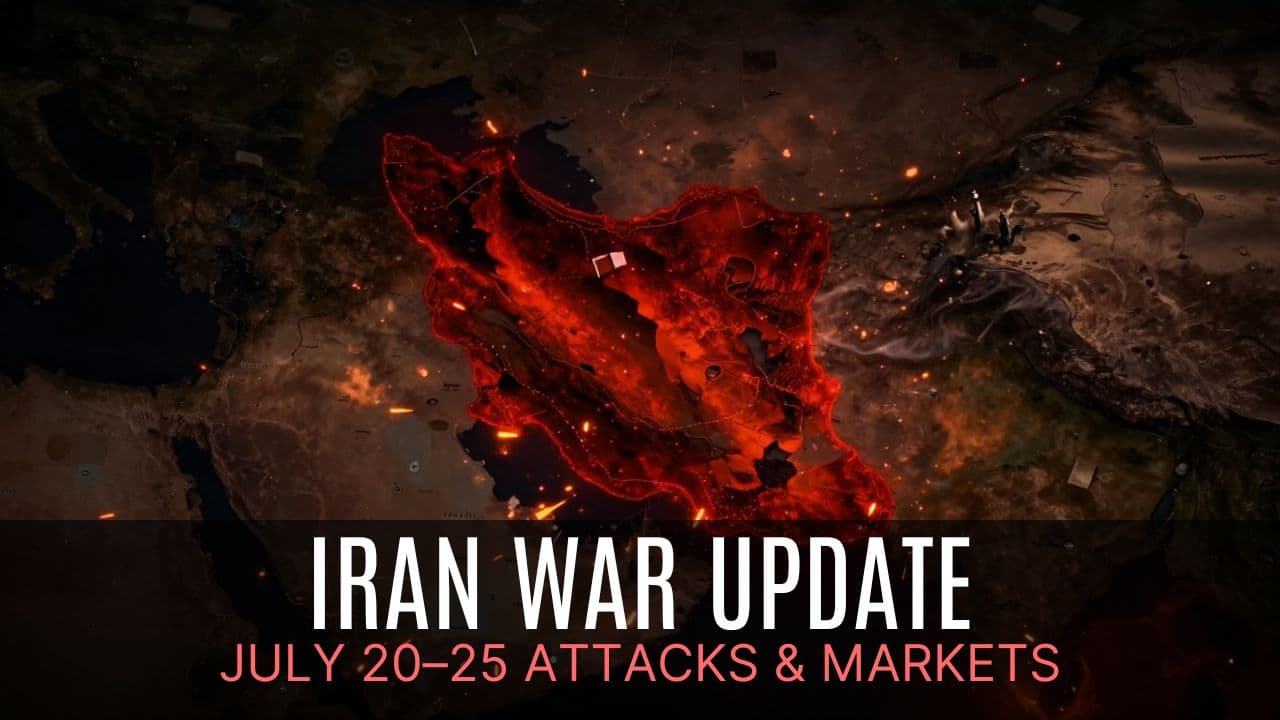
Iran War Weekly Update: U.S. Strikes Pause as the Conflict Expands into the Red Sea
The Iran war entered a more dangerous regional phase during the week of July 20–25, 2026. The United States conducted repeated strikes across Iran, Tehran continued missile and drone attacks against U.S. military positions in neighbouring countries, and the Iran-aligned Houthis opened a second maritime front against Saudi Arabia. For the first time in almost two weeks, no new U.S. strikes were reported inside Iran overnight into Saturday, July 25. Iran also refrained from launching another overnight attack against Gulf countries. However, this was an operational pause rather than an announced ceasefire.
At the same time, the conflict expanded into Yemen and the Red Sea. Houthi forces attacked Saudi oil facilities and shipping, while Saudi-backed forces resumed airstrikes against Houthi positions. The expansion raised the possibility that both the Strait of Hormuz and Bab el-Mandeb—two of the world’s most important energy and trade chokepoints—could face simultaneous disruption.
Key Developments in the Iran War This Week
The most important developments between July 20 and July 25 included:
- Thirteen consecutive nights of U.S. attacks inside Iran before the overnight pause.
- An expansion of American targets from coastal military facilities to bridges, tunnels, communications systems and transport infrastructure.
- Continued Iranian attacks against U.S. military facilities in Kuwait, Bahrain and Jordan.
- Further attacks and incidents involving tankers in the Strait of Hormuz.
- A Houthi declaration of a maritime blockade against Saudi Arabia.
- Houthi attacks on Saudi tankers and oil facilities in Jizan and Yanbu.
- Renewed Saudi and Saudi-backed airstrikes against Houthi targets in Yemen.
- A China-supported Pakistani initiative to restart U.S.-Iran negotiations.
- A sharp rise in oil prices, bond yields and inflation expectations.
- Weekly declines in major U.S. equity indexes, particularly the technology-heavy Nasdaq.
July 20: Houthis Announce a Maritime Blockade Against Saudi Arabia
The week began with Yemen’s Iran-aligned Houthis declaring a maritime blockade against Saudi Arabia. The group threatened to attack vessels carrying or handling Saudi oil through the Bab el-Mandeb Strait.
Saudi Arabia said it would implement measures to protect its vessels and respond with force if necessary.
The Red Sea had become increasingly important to Saudi Arabia because the kingdom had been diverting oil through pipelines to its western port of Yanbu, bypassing the heavily disrupted Strait of Hormuz. A successful Houthi blockade would therefore threaten Saudi Arabia’s most important alternative export route.
At the same time, explosions were reported in several Iranian locations, including Tabriz, Chabahar, Konarak, Bandar Mahshahr and Bandar Imam Khomeini. Iran claimed retaliatory attacks against U.S. assets in Jordan, Kuwait and Syria.
Kuwait also reported another attack affecting an electricity and desalination facility. Such attacks are particularly sensitive because Gulf countries depend heavily on desalination plants for drinking water.
The IRGC reported explosions involving tankers attempting to cross the Strait of Hormuz, although some details could not be independently verified.
Despite the escalating attacks, mediators reportedly presented Iran with a possible 10-day ceasefire proposal. Tehran acknowledged that diplomatic messages were being exchanged but did not accept the proposal publicly.
July 21–22: U.S. Strikes Expand and Iran Attacks Gulf Bases
The United States carried out its 11th and subsequently 12th consecutive nights of attacks against Iran.
U.S. Central Command said the campaign targeted Iranian military command centres, missile and drone launch facilities, air-defence systems, maritime capabilities and coastal radar installations. Explosions were reported around Tehran, Bushehr, Chabahar, Konarak and other locations. An American strike on the Iranian side of the Shalamcheh border crossing with Iraq reportedly killed two people and wounded 11.
Iran retaliated with attacks against U.S. military facilities and other targets in Kuwait, Bahrain and Jordan. Kuwait reported damage to facilities connected to power generation and freshwater production. Iran also claimed that it had targeted infrastructure belonging to American technology company Amazon in Bahrain. Amazon did not confirm the claim, and Reuters was unable to verify it independently.
Meanwhile, a tanker in the Strait of Hormuz reported being struck by a projectile. The crew abandoned the vessel and entered a lifeboat. The IRGC separately said other tankers had caught fire after attempting to use a route that Tehran considered unauthorised. The acknowledged number of American military deaths in the war reached 18, including personnel killed in recent Iranian attacks in Jordan and Iraq.
July 23: Houthis Attack Saudi Oil Tankers
The Houthis claimed missile and drone attacks against two Saudi oil tankers in the Red Sea, identifying the vessels as Encelia and Layla. Encelia reportedly issued a distress call after being struck near the Saudi city of Jizan. A maritime security source confirmed that the vessel had reported an attack, but the claimed strike against Layla remained unconfirmed.
Several tankers carrying Saudi crude for buyers in China and India reversed course or avoided the Bab el-Mandeb Strait. Some vessels began broadcasting information about their ownership, flag, crew and cargo in an attempt to obtain safe passage. The developments increased shipping costs and insurance premiums. Vessels avoiding Bab el-Mandeb may need to travel north through the Suez Canal before sailing around Africa to reach Asian destinations, substantially increasing travel time and fuel consumption.
U.S. President Donald Trump threatened to strike an Iranian bridge or power facility whenever Iran attacked a commercial vessel. Iran responded that attacks against its infrastructure would be answered with attacks against regional oil, gas, electricity and economic facilities. Iran warned that it could prevent the export of “even a single drop of oil” from the region if its infrastructure and exports were systematically targeted.
American attacks were also reported near Bushehr. The reported targets were military facilities rather than the nearby commercial nuclear reactor, but strikes close to nuclear infrastructure added another level of risk.
July 24: U.S. Attacks Move Deeper Inside Iran
The United States expanded its operations from Iran’s southern coastline to targets deeper inside the country. The latest phase of the American campaign reportedly damaged at least six bridges, a tunnel and a railway junction around Bandar Abbas. Communications towers, transport infrastructure, an agricultural water-pumping station and a desalination plant were also damaged.
Iranian officials said the damaged desalination facility affected the water supply of approximately 10,000 residents. The United States describes these sites as logistics infrastructure supporting the IRGC and Iran’s military operations. Nevertheless, attacks on bridges, water systems and communications facilities have increasingly direct consequences for civilians.
The latest U.S. attacks have focused on:
- Iranian naval and coastal facilities
- Missile and drone factories
- Launching positions
- Air-defence systems
- Military communications towers
- Transport links connecting IRGC bases
- Military installations near Tehran
- Infrastructure around Bandar Abbas, Bushehr and Khuzestan
The U.S. campaign reportedly reached areas near central Iran, Tehran’s outskirts and the Caspian Sea.
Iran continued missile and drone operations against U.S. positions in Bahrain, Kuwait and Jordan. Tehran also claimed that it had damaged military storage facilities and surveillance equipment used by the U.S. Fifth Fleet.
Trump Considers a Larger Attack but Confirms Negotiations
President Trump said American forces were “locked and loaded” and that he continued to consider a larger attack against Iran. Potential targets mentioned by Trump or reported in connection with American planning included:
- Iranian energy and electricity infrastructure
- Bridges and transport links
- Kharg Island, Iran’s primary oil-export centre
- Nuclear-related facilities
- The underground Pickaxe Mountain site
- Additional missile and drone production facilities
Trump simultaneously confirmed that the United States and Iran were communicating.
He said Iranian officials appeared more serious about negotiations than before, although he did not believe Tehran was ready to agree. This combination of military threats and diplomatic engagement suggests that Washington is attempting to negotiate while maintaining maximum military and economic pressure.
July 25: Direct U.S.-Iran Strikes Pause as Yemen Escalates
No new American attacks were reported inside Iran overnight into Saturday, July 25. It was the first night without reported U.S. airstrikes in almost two weeks. Iran also did not launch another overnight attack against Bahrain, Kuwait, Jordan or other Gulf countries.
Neither side announced a ceasefire, and U.S. Central Command did not explain whether the pause resulted from negotiations, operational considerations or a temporary decision by the White House.
While direct U.S.-Iran exchanges paused, the Red Sea conflict intensified.
The Houthis launched missiles and drones at Saudi Aramco facilities in Jizan and Yanbu. Verified video showed smoke rising near the Jizan refinery, while trading sources reported possible damage to fuel and oil-storage facilities. Two ballistic missiles aimed at installations in Yanbu were intercepted by a U.S.-made Patriot system operated by Greek military personnel under an agreement with Saudi Arabia.
Yanbu is particularly important because it has become Saudi Arabia’s main alternative oil-export route while Hormuz remains largely blocked. Jizan also contains a refinery with a capacity of approximately 400,000 barrels per day. Saudi-backed Yemeni forces responded by attacking Houthi missile launchers, drone sites and weapons depots in Marib and al-Jawf. The Saudi-led coalition separately struck Houthi military positions around Hodeidah.
Both sides of Yemen’s civil war reportedly began mobilising forces, raising concerns that the truce in place since 2022 could collapse completely.
What Is Happening in the Strait of Hormuz?
The Strait of Hormuz remains at the centre of the U.S.-Iran confrontation.
Normal commercial traffic has fallen dramatically. Ship-tracking data showed only around three commodity-vessel transits per day during part of the week. Tanker traffic was even lower on certain days. Iran says commercial vessels must coordinate with Iranian authorities and use designated northern routes. Tehran eventually wants to create a formal transit system that may include fees and preferential access.
The United States rejects Iran’s claim of authority over international shipping and has encouraged vessels to use a southern route. Iran argues that the June memorandum with Washington gave it the right to establish transit arrangements. The United States disputes that interpretation. Consequently, the Hormuz disagreement is no longer simply a military issue. It has become one of the principal obstacles to a permanent peace agreement.
Why the Red Sea Front Is So Dangerous
The Strait of Hormuz and Bab el-Mandeb serve different geographical areas but are both critical to global energy and merchandise trade.
Saudi Arabia had partially reduced its dependence on Hormuz by moving oil through an east-west pipeline to Yanbu on the Red Sea. Houthi threats against Saudi shipping now place that alternative route at risk. A serious disruption at both chokepoints could:
- Reduce the availability of Middle Eastern oil and LNG.
- Increase tanker and shipping insurance costs.
- Force vessels to use substantially longer routes.
- Raise global transport, manufacturing and food costs.
- Increase inflation in energy-importing economies.
- Pressure central banks to maintain or raise interest rates.
- Weaken global economic growth.
Bab el-Mandeb is not completely closed. However, attacks and threats have already changed tanker routes and increased operating costs.
Israel and Lebanon’s Position in the War
Israel participated in the original February attacks against Iran but has not joined the latest phase of American strikes. Iran has also not targeted Israel during the latest round of fighting. Tehran’s recent operations have concentrated on the Strait of Hormuz, commercial vessels and U.S. positions in Gulf countries.
Nevertheless, the Israel-Hezbollah conflict in Lebanon remains connected to the wider Iran war.
More than 4,000 people have reportedly been killed in Lebanon, while 38 Israeli soldiers have been reported killed. Israel continues to maintain forces inside southern Lebanon. Diplomatic discussions are focusing on a possible arrangement involving the disarmament of Hezbollah and an Israeli withdrawal from Lebanese territory. Failure to reach such an agreement could allow the Lebanon front to escalate again.
Iran War Casualties and Economic Costs
Casualty figures remain incomplete, disputed and politically sensitive.
Iran’s Health Ministry says approximately 3,434 people have been killed since the war began on February 28, including 55 people during the latest escalation. The United States has acknowledged 18 military deaths and more than 450 wounded personnel. However, discrepancies in the Pentagon’s public database have raised questions about official transparency.
The Pentagon database temporarily reduced the reported death toll from 18 to 14 and the number of wounded from 482 to 420. Defence officials attributed the changes to technical problems. Members of Congress have demanded a complete accounting of all American casualties.
The U.S. government estimates that the war has already cost approximately $37.5 billion. The Pentagon has requested another $70 billion, partly to replenish missiles and other military supplies. The conflict’s wider human cost includes civilian deaths, displacement, damaged water and power infrastructure, interrupted transport and economic hardship across Iran, Lebanon and Gulf countries.
International Reactions and Diplomatic Efforts
Pakistan and China
China has initiated a new effort to revive stalled U.S.-Iran negotiations, with Pakistan acting as a potential mediator. Iranian Interior Minister Eskandar Momeni visited Islamabad twice within ten days and met Pakistani political and military leaders.
Pakistan has informed Iran that stopping attacks against Saudi Arabia and other Gulf states is now a prerequisite for restarting negotiations. China supports the mediation because disruptions in Hormuz and the Red Sea threaten Chinese energy supplies and trade routes. China is Iran’s largest trading partner and the principal buyer of discounted Iranian crude.
Iran’s Position
Iran says the United States caused the latest escalation by attempting to establish a new Hormuz shipping route without consulting Tehran. Foreign Minister Abbas Araghchi has confirmed that diplomatic proposals and messages are being exchanged. However, Iranian officials say significant differences and deep mistrust remain. Iran wants recognition of its security and economic interests in Hormuz. Washington insists on unrestricted international navigation.
Russia and China
Trump said Chinese President Xi Jinping and Russian President Vladimir Putin had assured him that they would not supply Iran with weapons. U.S. intelligence officials are nevertheless examining whether Russian technology, targeting information or military experience may have assisted Iranian operations. No conclusive public evidence has established direct Russian participation.
United Kingdom
The IRGC warned that British military bases used by American bombers could become legitimate targets.
Britain responded that its armed forces were prepared to defend British territory. The British government confirmed that an existing agreement allows U.S. aircraft to use British bases for operations described as supporting regional self-defence and protecting shipping.
Reported Gulf-State Attacks on Iran
The Wall Street Journal reported that Bahrain and Kuwait secretly conducted airstrikes against Iranian missile and drone depots earlier in July, with intelligence and defensive support from the UAE. Kuwait has denied conducting offensive operations against Iran, while Bahrain has not confirmed the report. The information should therefore be treated as a significant but disputed claim.
Iran War Market Reaction
Financial markets increasingly treated the war as an inflationary or stagflationary shock.
The combination of higher energy prices, disrupted shipping and rising defence expenditure pushed oil prices and government bond yields higher. Technology shares and other interest-rate-sensitive assets came under pressure.
Oil Prices
Brent crude ended the week at $96.78 per barrel, gaining approximately 9.9%. It briefly traded above $100 and reached approximately $102 before retreating on reports of the Chinese-Pakistani diplomatic initiative.
WTI crude settled at $89.31, rising approximately 8.27% for the week.
Oil fell sharply on Friday because markets reacted to the possibility of renewed negotiations. Nevertheless, the weekly gains showed that a substantial geopolitical risk premium remains in the market.
Gold and Silver
Gold futures ended the week around $4,067.60 per ounce, gaining approximately 1.37%.
Silver rose more strongly, gaining approximately 4.67% to $58.656. Safe-haven demand supported precious metals, but rising Treasury yields and expectations of tighter monetary policy limited gold’s advance.
U.S. Dollar and Foreign Exchange
The U.S. Dollar Index traded around 101.46 and gained approximately 0.69% over five days.
USD/JPY reached approximately 163.81 after touching 163.98, the dollar’s strongest level against the Japanese yen since 1986. USD/JPY gained approximately 0.9% during the week. The euro fell approximately 0.6% to around $1.1369.
The dollar benefited because the U.S. economy is relatively less dependent on imported energy than Europe and Japan. Higher U.S. yields also increased demand for dollar-denominated assets.
Bonds and Federal Reserve Expectations
The U.S. 10-year Treasury yield reached approximately 4.71%, its highest level since January 2025, before ending the week near 4.69%. The probability of a Federal Reserve rate increase at the upcoming meeting rose from approximately 12.8% to 35.8% during the week.
Investors are concerned that sustained oil prices near or above $100 could increase inflation and force the Federal Reserve to maintain higher rates or resume tightening. A move above 4.75% in the 10-year yield could create stronger downward pressure on equity valuations.
U.S. Stock Markets
Major U.S. stock indexes ended the week lower:
- The S&P 500 fell approximately 0.6%.
- The Nasdaq Composite lost approximately 2%.
- The Dow Jones Industrial Average declined approximately 0.4%.
The Nasdaq experienced the largest decline because rising yields reduce the present value of future technology-sector earnings. However, the war was not the only reason for the technology sell-off. Investors were also concerned about extremely high artificial-intelligence spending and the ability of major technology companies to generate sufficient returns from that investment.
Energy and defence shares generally performed better than the broader market.
Bitcoin and Cryptocurrency
Bitcoin traded around $64,000–$65,000 at the end of the week.
The cryptocurrency showed relative resilience despite the surge in oil and bond yields. However, it continued to behave primarily as a risk asset rather than a dependable geopolitical safe-haven.
A stronger dollar, higher interest rates, and weaker equity sentiment remain important risks for Bitcoin and the broader cryptocurrency market.
Possible Market Effect
- The dominant market theme is a developing stagflation trade. Oil remains fundamentally bullish while Hormuz and Red Sea shipping are disrupted, although prices are extremely sensitive to diplomatic headlines.
- The U.S. dollar maintains a bullish advantage against currencies belonging to energy-importing economies. The Japanese yen remains particularly vulnerable unless Japanese authorities intervene or the conflict de-escalates substantially.
- Gold maintains a moderately bullish outlook, but rising real yields could prevent an immediate major breakout.
- Equities have a neutral-to-bearish outlook, with expensive technology shares more vulnerable than energy, defence and selected commodity companies.
- Bitcoin’s outlook remains neutral. It has shown resilience, but a move below approximately $63,000 could signal renewed risk aversion. A recovery above $67,000 would improve the short-term picture.
Iran War Scenarios and Probabilities
Scenario One: Limited Conflict Continues — Estimated Probability 50%
Under the most likely scenario, the United States resumes selective attacks if Iran or the Houthis target another ship, military base, or major energy installation.
Iran would continue calibrated missile and drone attacks without deliberately creating an event that guarantees a full American invasion.
Diplomatic messages would continue alongside the fighting, producing temporary operational pauses but no comprehensive settlement.
Scenario Two: Temporary Pause and Renewed Negotiations — Estimated Probability 30%
Pakistan, China, Qatar or Oman could broker a limited arrangement covering Gulf-state attacks, commercial shipping and temporary rules for Hormuz.
Such an agreement could reduce attacks without resolving the nuclear dispute, sanctions or the long-term question of control over the strait.
Oil would probably surrender a significant portion of its war premium under this scenario, while equities and risk assets could recover.
Scenario Three: Broader Regional War — Estimated Probability 20%
A major escalation could follow a deadly attack against a U.S. base, serious damage to Yanbu or another Saudi energy installation, an attack on Kharg Island or a strike against an Iranian nuclear-related facility.
Direct Saudi or Gulf-state involvement would further expand the conflict. A simultaneous closure of Hormuz and Bab el-Mandeb could drive oil sharply higher and create a severe global inflation shock.
What to Watch Next
The most important indicators over the coming days are:
- Whether the United States resumes attacks after the overnight pause.
- Whether Iran launches new attacks against Bahrain, Kuwait or Jordan.
- The confirmed operational condition of the Jizan and Yanbu oil facilities.
- The scale of Saudi attacks against Houthi positions.
- Houthi and Saudi-backed military mobilisation inside Yemen.
- Daily tanker traffic through Hormuz and Bab el-Mandeb.
- Any attack involving Kharg Island, Pickaxe Mountain or nuclear infrastructure.
- The announcement of a date or location for U.S.-Iran negotiations.
- Whether China, Pakistan, Qatar or Oman can produce a temporary agreement.
- Whether Israel joins the latest American campaign.
- Whether Brent can hold above $100–102 or retreats below $95.
- Whether the U.S. 10-year yield breaks above 4.75%.
Iran War Outlook
The absence of direct U.S.-Iran attacks overnight into July 25 is an encouraging but limited development. It may indicate that both governments want to create space for diplomacy, or it may simply reflect a temporary operational pause.
Strategically, the war became more dangerous this week because it expanded into Yemen and the Red Sea.
Iran has not prevented the United States from striking its military and transport infrastructure, but Washington has also failed to eliminate Tehran’s ability to attack U.S. bases, commercial shipping and Gulf infrastructure.
The conflict has therefore developed into a contest of endurance and economic leverage. The United States is attempting to degrade Iranian military capabilities, while Iran and its allies are using shipping disruption and energy-market pressure to increase the political and economic cost of continuing the war.
A diplomatic solution remains possible, but it will require an agreement on Hormuz, attacks against Gulf states, commercial shipping and Iran’s wider security demands. Until those issues are addressed, temporary pauses will remain vulnerable to another attack and immediate retaliation.
Frequently Asked Questions
Is there currently a ceasefire between the United States and Iran?
No. There were no reported direct U.S. strikes inside Iran overnight into July 25, and Iran did not launch another overnight attack against Gulf countries. However, neither side announced a ceasefire or a formal suspension of military operations.
Why did U.S. attacks on Iran pause?
The United States has not provided a definitive explanation. The pause may be connected to diplomatic messages exchanged through Pakistan, China and other mediators, but it could also reflect operational planning. American forces remain prepared to resume attacks.
What is the most dangerous new development in the Iran war?
The expansion of the conflict into the Red Sea and Yemen is the most dangerous development. Houthi attacks now threaten Saudi Arabia’s alternative oil-export route while the Strait of Hormuz remains heavily disrupted.
Is the Strait of Hormuz completely closed?
It is not physically closed to every vessel, but normal commercial traffic has fallen dramatically. Iran is attempting to control routes and require coordination, while the United States rejects Tehran’s claimed authority.
Are the Houthis blocking all Red Sea shipping?
The Houthis say their blockade targets Saudi-linked vessels and ships handling Saudi oil. Bab el-Mandeb remains partially operational, but vessels have reversed course and insurance and transportation costs have increased.
Has Saudi Arabia entered the Iran war?
Saudi Arabia has not declared war on Iran. However, Saudi-backed forces and the Saudi-led coalition have resumed attacks against Houthi positions following attacks on Saudi shipping and oil infrastructure.
Is Israel participating in the latest U.S. strikes?
Israel participated in the original February campaign but has not joined the latest phase of U.S. attacks. Iran has also not directly targeted Israel during the latest round.
How many people have been killed in the Iran war?
Iran’s Health Ministry reports approximately 3,434 deaths inside Iran since February 28. The United States acknowledges 18 military deaths, while more than 4,000 people have reportedly died in the connected Lebanon conflict. All casualty figures remain incomplete and disputed.
Why did oil prices rise this week?
Oil prices increased because of disrupted shipping in Hormuz, Houthi attacks in the Red Sea, threats against Saudi oil facilities and fears that the war could affect a larger share of global energy supplies.
Could Brent crude rise above $100 again?
Yes. Brent already moved above $100 during the week. Another serious tanker attack, damage to Yanbu, an attack on Kharg Island or further reductions in Hormuz traffic could push Brent back above $100 and potentially toward $110–114.
How is the Iran war affecting gold?
Geopolitical risk is supporting gold, but higher Treasury yields and expectations of tighter Federal Reserve policy are limiting gains. Gold therefore has a moderately bullish rather than aggressively bullish outlook.
Is Bitcoin acting as a safe-haven during the Iran war?
Not consistently. Bitcoin has demonstrated relative resilience, but it remains sensitive to the dollar, interest rates, technology shares and general risk sentiment. It is still behaving more like a high-risk financial asset than a traditional safe-haven.
What could produce a temporary peace agreement?
A temporary agreement would probably need to stop attacks against Gulf states and commercial vessels, create provisional shipping rules for Hormuz and prevent attacks on Iranian energy and civilian infrastructure.
What could trigger a broader regional war?
A major attack causing numerous U.S. deaths, serious damage to Saudi or UAE energy infrastructure, an attack on Kharg Island, direct Gulf-state attacks against Iran, or new strikes on nuclear facilities could trigger a broader war.
What is the most likely Iran war scenario?
The most likely scenario is continued limited fighting accompanied by intermittent diplomatic efforts. Selective attacks may continue while mediators attempt to establish another temporary pause.
 IEA Oil Market Report August 2026: Full Analysis
 EIA Short-Term Energy Outlook August 2026: Oil and Gas Forecast
 Fed Holds Rates in July 2026 as Warsh Reinforces 2% Inflation Target
 Iran War Weekly Update: U.S. Strikes Pause as the Conflict Expands into the Red Sea
 Third Round of US–Iran Hostilities: Military Escalation, Strait of Hormuz Risks and Market Impact
 OPEC July 2026 Oil Market Report: Demand Outlook, Supply Recovery and Comparison with June
 Federal Reserve Beige Book July 2026: U.S. Growth Broadens as Inflation Pressures Ease
 Iran War Review: U.S. Strikes Intensify as the Strait of Hormuz Crisis Deepens, July 14–16, 2026
 IEA Oil Market Report July 2026: Hormuz Flows Recover as Product Markets Stay Tight
 Fed June 2026 Minutes: Warsh Signals Hawkish Policy Reset
 EIA July 2026 STEO: Oil Price Forecast Falls as Hormuz Risk Eases
 U.S.-Iran conflict, Strait of Hormuz, oil prices, Persian Gulf markets, Bitcoin, global markets, Middle East crisis