 English
 پارسی


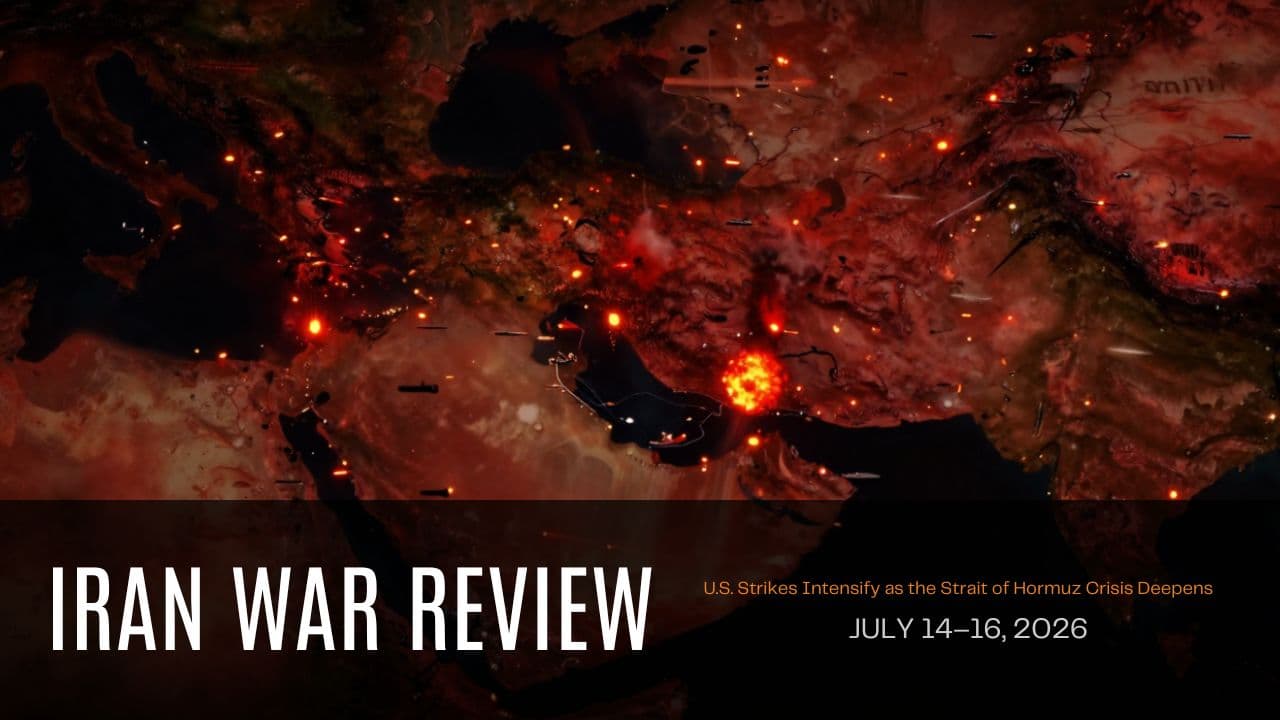
Iran War Review: U.S. Expands Strikes and Naval Blockade as the Hormuz Crisis Deepens, July 14–16, 2026
Executive Summary
The past 48 hours have marked a significant renewed escalation in the Iran war. The United States has resumed its naval blockade of Iranian ports and conducted repeated strikes against Iran’s coastal-defence systems, radars, cruise-missile facilities, drone sites and maritime capabilities. Iran has responded with missile and drone attacks against regional locations hosting American forces while insisting that the Strait of Hormuz will not reopen under unrestricted international rules.
The conflict is now centred on a strategic question: who controls access to the Strait of Hormuz? Washington is trying to reopen and secure the waterway through military pressure. Tehran is using the strait, commercial shipping and its remaining missile and drone arsenal as leverage to force implementation of the June memorandum and obtain political, economic and security concessions.
Although both governments continue to mention negotiations, their military actions indicate that neither side currently believes diplomacy alone will produce acceptable terms.
What Happened During the Past 48 Hours?
New U.S. strikes targeted Iran’s southern military infrastructure
On Wednesday, July 15, U.S. Central Command announced two new waves of strikes. The first targeted coastal-defence systems and cruise-missile storage and launch sites on Greater Tunb Island and reportedly lasted around 90 minutes. A second wave began approximately nine hours later.
Iranian and international reporting indicated that attacks or explosions were also recorded around Bandar Abbas, Hengam, Qeshm, Sirik, Konarak and Ahvaz. Iranian state television said an attack near a hospital containing a paediatric cancer centre in Ahvaz forced a temporary evacuation, although the United States described its targets as military facilities used to threaten shipping.
These operations followed a five-hour U.S. mission completed late on July 13 that struck targets in Bushehr, Chabahar, Jask, Konarak, Abu Musa and Bandar Abbas. CENTCOM said precision weapons were used against coastal-defence systems, missile and drone sites and maritime capabilities. More than 50,000 U.S. personnel are currently deployed across the wider Middle East, according to CENTCOM.
The naval blockade has been reactivated
The United States reimposed its blockade against Iranian ports and Iran-linked shipping on Tuesday. CENTCOM subsequently said it redirected two vessels and disabled an empty tanker that attempted to approach Kharg Island after allegedly ignoring repeated warnings. The ship’s smokestack was reportedly struck with Hellfire missiles.
The blockade is therefore more than a political declaration. Washington is actively inspecting, redirecting, or disabling vessels that it says are entering or departing Iranian ports.
However, enforcing the blockade carries substantial risks. Kharg Island handles the overwhelming majority of Iran’s oil exports, and U.S. officials have discussed possible operations connected to the island. Officials described the latest strikes as “shaping operations” designed to weaken Iranian defences before any more complex military action.
Iran retaliated against regional American positions
The سپاه پاسداران said it attacked American military targets in Bahrain, Kuwait and Jordan. Kuwait reported intercepting four missiles and 21 drones on July 15, with material damage but no reported injuries. These figures and the identification of individual targets remain partly dependent on claims made by the governments involved and cannot all be independently verified in real time.
Iran’s strategy appears designed to demonstrate that military pressure on Iranian territory will create costs throughout the Persian Gulf rather than remaining a bilateral U.S.–Iran confrontation. That strategy is also increasing tensions between Tehran and neighbouring Arab governments, many of which say they did not authorise offensive operations against Iran from their territory.
The Strait of Hormuz Is Not Functioning Normally
The United States maintains that the Strait of Hormuz remains open to non-Iranian traffic. Operational evidence presents a more complicated picture.
At least five commercial ships—three crude supertankers, one LNG tanker and one container vessel—have been attacked in Omani waters since July 7. Several shipping companies are refusing to use the U.S.-guided transit programme because they do not consider the protection adequate. Around nine Greek-operated LNG tankers were reportedly stranded inside the Persian Gulf because of the security situation.
A U.S. defence official said more than 100 vessels had coordinated directly with the American military during the preceding week and more than 300 had passed through the wider region. Nevertheless, shipping volumes remain well below pre-war levels, and the U.S. Navy-led Joint Maritime Information Center has raised the threat rating to “severe.” Maritime-security companies have advised operators that there is no assurance Hormuz transits can currently be completed at an acceptable level of safety.
Therefore, the strait is not completely sealed, but it cannot accurately be described as operating freely or normally.
Diplomacy Continues—but Under Military Pressure
Donald Trump said Iran wanted to “settle” and suggested the United States would either reach an agreement or “finish” the military campaign. He also confirmed that American negotiators had communicated with Iranian representatives and urged them to make a deal.
Vice President JD Vance has described Washington’s fundamental objectives as preventing Iran from obtaining a nuclear weapon and ensuring the free flow of oil and gas. Previous negotiations also covered inspections of Iran’s nuclear programme, restrictions on long-range missiles, frozen assets and mechanisms for reopening Hormuz.
Tehran’s position remains incompatible with Washington’s current demands. Mohammad Bagher Ghalibaf described the confrontation as an “essential and existential war” and said Iran’s armed forces had complete freedom of action. Iranian officials maintain that reopening Hormuz requires American compliance with the June memorandum and acceptance of Iranian regulations governing maritime traffic.
One limited diplomatic signal was Iran’s decision to allow detained U.S. citizen Dena Karari to leave the country. Trump publicly called the release a goodwill gesture. It suggests that backchannel communication has not completely collapsed, even while military operations are intensifying.
Britain’s Action Against the IRGC
Britain designated the سپاه پاسداران and a related organisation as security threats under new powers intended to counter foreign-state surveillance, sabotage and proxy operations. Iran summoned the British ambassador and warned that the measure would not go unanswered.
This should be described carefully. The action was taken under Britain’s new state-threat framework rather than simply through the traditional terrorist-organisation proscription mechanism. In practical terms, however, it substantially restricts support for and cooperation with the IRGC inside Britain.
New U.S. Sanctions
The sanctions information requires a correction. The largest July 14 Treasury action against the network connected to the Shamkhani family covered more than 50 individuals, companies and vessels, not only four individuals and three companies. The U.S. Treasury says it has now sanctioned more than 200 persons, entities and vessels operating under Shamkhani-linked networks.
A separate July 15 package targeted Iranian and foreign individuals and companies accused of helping Iran procure weapons through aviation, transport, financial and travel networks. The separate sanctions packages may explain the different numbers appearing in initial reports.
Domestic Repression and Executions
Iranian authorities executed Aref Khoshkar at Ghezel Hesar Prison on July 15. HRANA and Hengaw identified him as a detainee from the 2022 Woman, Life, Freedom protests. He had been convicted on charges including moharebeh and involvement in the killing of a Basij member; his legal representatives and rights organisations questioned the evidence and judicial process.
Mohammad Amini Dahaghani was also executed in Isfahan Province. Iranian judiciary-linked media accused him of using a stolen weapon, attacking a police station and setting fire to government property during the January 2026 protests. Opposition and human-rights sources describe him as an executed protest detainee and dispute the fairness of the proceedings.
The executions indicate that the external war has not reduced domestic repression. On the contrary, authorities appear to be applying severe security measures while international attention is concentrated on the military conflict.
Economic and Market Consequences
Brent crude settled at $84.95 per barrel on July 15, while WTI closed at $79.60. Spot gold traded near $4,059 per ounce.
Despite the military escalation, global equities rose: the S&P 500 gained 0.38%, the Nasdaq Composite increased 0.62%, and the Dow Jones rose 0.29%. Softer U.S. inflation data and strong corporate earnings temporarily outweighed geopolitical concerns.
This market resilience should not be interpreted as confidence that the war is ending. Investors appear to believe that much of the present disruption is already reflected in oil prices. A direct attack on Kharg Island, Persian Gulf oil infrastructure, major LNG facilities or the Bab el-Mandeb route could cause another abrupt repricing.
Claims that the war’s verified final cost is already between $80 billion and $100 billion should also be treated cautiously. The Pentagon previously reported approximately $29 billion in direct costs by May, while later reports concerned an approximately $80 billion additional funding requirement. A new $95 billion congressional plan includes military spending as well as agricultural and election-related provisions, so it is not a clean estimate of the war’s accumulated cost.
What Is Actually Going On Now?
The conflict is currently a military-diplomatic contest for coercive leverage, rather than a straightforward campaign aimed only at Iran’s nuclear facilities.
The United States is attempting to:
- Destroy Iran’s coastal missiles, drones, radars and air defences.
- reduce Tehran’s ability to attack commercial vessels.
- enforce a blockade against Iranian ports and exports.
- force Iran to accept nuclear and maritime terms from a weaker position.
Iran is attempting to:
- preserve control or veto power over Hormuz traffic.
- demonstrate that it can still strike ships and regional U.S. facilities.
- raise the economic and political cost of continued American operations.
- force Washington back to the June memorandum on terms more favourable to Tehran.
Militarily, the United States retains overwhelming conventional superiority. Strategically, however, Washington has not yet converted its battlefield advantage into Iranian concessions. Iran’s conventional naval and air capabilities have suffered heavily, but its dispersed drones, missiles, mines and small maritime systems remain sufficient to keep commercial shipping under threat.
Outlook for the Coming Days
The most probable near-term scenario is continued U.S. strikes against southern Iranian military infrastructure, combined with limited Iranian missile, drone and maritime retaliation. Diplomatic contacts may continue privately, but an immediate comprehensive agreement appears unlikely because the two sides disagree fundamentally over Hormuz, sanctions, nuclear restrictions and implementation of the June memorandum.
The highest escalation risks are:
- A U.S. operation against Kharg Island.
- Strikes against Iran’s power or civilian-linked infrastructure.
- A successful Iranian attack causing large numbers of American or Persian Gulf Arab casualties.
- Attacks on major Persian Gulf oil or LNG facilities.
- An expansion of maritime disruption toward Bab el-Mandeb.
The clearest de-escalation signal would be a verifiable maritime arrangement allowing commercial shipping to transit safely, accompanied by a pause in American strikes and Iranian attacks. Until that happens, the war should be regarded as active, regionally expanding and highly vulnerable to miscalculation.
Overall geopolitical condition: High-risk escalation
Oil sentiment: Bullish but highly volatile
Gold sentiment: Moderately bullish
Global equity sentiment: Neutral, with substantial downside event risk
Frequently Asked Questions
What happened in the Iran war during July 14–16, 2026?
The United States launched new waves of attacks against Iranian coastal-defence systems, cruise-missile facilities, drone sites, radars and maritime capabilities. Washington also resumed its naval blockade of Iranian ports. Iran responded with missile and drone attacks against regional locations associated with American forces.
Why is the Strait of Hormuz central to the Iran war?
The Strait of Hormuz is one of the world’s most important energy-shipping routes. Iran is using its ability to threaten or restrict maritime traffic as strategic leverage, while the United States is attempting to restore unrestricted commercial navigation through military pressure and naval protection.
Is the Strait of Hormuz currently open?
The strait is not completely closed, but it is not operating normally. Some vessels continue to pass through the region under military coordination, while other shipping companies are delaying voyages or refusing to use U.S.-supported transit arrangements because of the severe security risks.
What military targets has the United States attacked in Iran?
Recent American operations have reportedly focused on coastal-defence systems, radars, missile storage and launch facilities, drone sites and maritime capabilities in southern Iran and on strategically important islands.
Why has the United States resumed its blockade of Iranian ports?
Washington says the blockade is intended to restrict Iran’s military and oil-related maritime activity, prevent weapons and military equipment from moving through Iranian ports and pressure Tehran to accept American nuclear and maritime conditions.
How has Iran responded to the latest U.S. attacks?
Iran has continued missile, drone and maritime operations designed to threaten American forces, regional military facilities and shipping interests. Tehran has also warned that its armed forces have the freedom to respond if the terms of previous understandings are not implemented.
Are Iran and the United States still negotiating?
Indirect and private contacts appear to be continuing. However, the two sides remain divided over Iran’s nuclear programme, missile capabilities, sanctions, oil exports and the rules governing maritime traffic through the Strait of Hormuz.
What does Donald Trump want from Iran?
The Trump administration has identified preventing Iran from obtaining a nuclear weapon and maintaining the free flow of oil and gas as central objectives. Washington is also seeking restrictions on Iran’s missile capabilities and stronger security guarantees for international shipping.
What is Iran trying to achieve?
Iran is trying to retain influence over maritime traffic through the Strait of Hormuz, protect its oil exports, preserve its remaining missile and drone capabilities, and force the United States to negotiate on terms more favourable to Tehran.
Could the Iran war expand across the Middle East?
Yes. The greatest escalation risks include attacks on American bases, Persian Gulf oil and LNG infrastructure, Kharg Island, commercial vessels or regional maritime routes such as Bab el-Mandeb. A high-casualty attack could rapidly broaden the conflict.
How is the Iran war affecting oil prices?
The conflict is supporting a geopolitical risk premium in oil because disruption in the Strait of Hormuz could restrict crude oil and LNG exports. Oil prices could rise sharply if major energy facilities, tankers, or export terminals are successfully attacked.
How is the Iran war affecting gold and global equities?
Gold remains supported by safe-haven demand, although movements depend on the U.S. dollar and bond yields. Global equities have shown temporary resilience, but they remain exposed to sharp losses if the conflict disrupts energy supplies or causes a wider regional confrontation.
What would indicate that the Iran war is de-escalating?
The clearest signs would include a verified halt in American and Iranian attacks, the suspension of the naval blockade, a safe-shipping agreement for the Strait of Hormuz and formal progress in nuclear and sanctions negotiations.
What is the most likely short-term scenario?
The most likely scenario is continued American attacks against Iranian military infrastructure, accompanied by limited Iranian missile, drone and maritime retaliation. Diplomatic contacts may continue, but a comprehensive agreement remains difficult while military pressure is increasing.
Comments