 English
 پارسی


IEA Oil Market Report July 2026: Hormuz Flows Recover as Product Markets Stay Tight
IEA Oil Market Report July 2026: Key Takeaways
The global oil market entered July 2026 with a widening disconnect between improving crude oil availability and persistent shortages in refined products.
Oil flows through the Strait of Hormuz recovered significantly during June following an interim ceasefire agreement between the United States and Iran. The recovery helped global oil supply rebound by 4.1 million barrels per day, while benchmark crude prices erased their wartime gains.
However, the broader market remains far from normal.
Global output is still 9.4 million barrels per day below pre-war levels, key Middle Eastern export refineries have not fully restarted, Russian refining operations remain under pressure from attacks, and gasoline and diesel markets have tightened.
The IEA expects global oil demand to decline by 1 million barrels per day in 2026 before growing by 2 million barrels per day in 2027. Nevertheless, this forecast depends heavily on a lasting de-escalation of hostilities and the continued normalisation of tanker traffic through the Strait of Hormuz.
Key Oil Market Figures
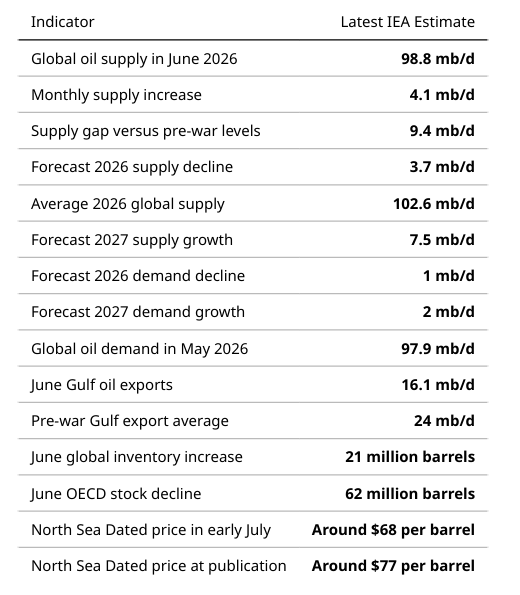
A recovery in global oil consumption is underway after demand reached a low point of 97.9 million barrels per day in May 2026.
At that level, demand was 5.3 million barrels per day lower than a year earlier. The IEA now expects consumption to rise as seasonal demand strengthens, product supplies improve and previously suppressed demand is released.
Annual oil-demand contractions are forecast to moderate significantly during the remainder of the year:
- Global demand contracted by 4.8 million barrels per day in the second quarter of 2026.
- The contraction is expected to narrow to 1.7 million barrels per day in the third quarter.
- Demand is then forecast to grow by 1.2 million barrels per day in the fourth quarter.
By October 2026, global demand could be more than 8 million barrels per day above its May low, taking consumption above 2025 levels for the first time since February.
Peak summer travel should support gasoline and jet-fuel consumption, while improved product availability may release pent-up demand in markets where fuel shortages or supply disruptions previously limited consumption.
Despite the expected second-half recovery, global oil demand is still projected to decline by 1 million barrels per day across 2026 as a whole.
Demand is forecast to rebound by 2 million barrels per day in 2027, but the two-year pace of expansion would remain well below historical trends.
Oil Supply Rebounds as Hormuz Traffic Improves
Global oil supply increased sharply by 4.1 million barrels per day in June, reaching 98.8 million barrels per day.
The rebound was primarily driven by the partial resumption of Persian Gulf production and tanker traffic through the Strait of Hormuz.
The United States temporarily lifted restrictions on Iranian oil exports and provided security support for non-Iranian shipments. These measures allowed tankers that had been trapped or delayed around the Strait to resume their journeys.
Total Persian Gulf oil exports, including shipments using routes that bypass the Strait, increased by 6.5 million barrels per day in June, reaching 16.1 million barrels per day.
Although this represented a substantial recovery, exports remained well below the pre-war average of approximately 24 million barrels per day.
Crude oil and condensates accounted for around 85% of the monthly export increase. The recovery was supported by withdrawals from floating storage and onshore inventories that had accumulated during the disruption.
Persian Gulf production rose by a more moderate 3.5 million barrels per day, leaving regional output 11.4 million barrels per day below pre-war levels.
On a global basis, total oil supply remained approximately 9.4 million barrels per day below its pre-war level.
Global Oil Supply Outlook for 2026 and 2027
The IEA expects global oil production to decline by an average of 3.7 million barrels per day in 2026, resulting in average supply of approximately 102.6 million barrels per day.
However, this forecast depends on a swift de-escalation of renewed hostilities.
If transit volumes through the Strait of Hormuz continue to improve and disrupted production facilities restart, global oil supply could increase by 7.5 million barrels per day in 2027.
Such a recovery would create the conditions for the global oil market to move into surplus, potentially beginning toward the end of 2026 and becoming more pronounced during 2027.
Nevertheless, this outlook remains highly conditional. Renewed military exchanges in the Persian Gulf on July 7–8 demonstrated that the market’s transition toward surplus could be interrupted or reversed if a lasting peace agreement is not reached.
Crude Oil Prices Erase Their Wartime Gains
Benchmark crude prices continued falling during June as Persian Gulf tanker traffic improved and concerns about immediate supply shortages eased.
North Sea Dated crude declined by approximately $22 per barrel month on month, reaching around $68 per barrel.
Measured from its higher level at the beginning of June, the benchmark fell by approximately $31 per barrel over the course of the month, reaching its lowest level since January 2026.
At approximately $68 per barrel, North Sea Dated was around $2 per barrel below its pre-war level.
The decline erased the benchmark’s wartime gains and reflected a significant shift in market expectations. Traders increasingly moved their attention away from immediate physical shortages and toward the possibility of excess crude supply.
Prompt oil-market time spreads also moved back into contango, meaning future crude prices traded above near-term prices. This structure normally indicates that immediate supply conditions have become less tight and that the market is providing an incentive to store oil.
However, prices rebounded after the ceasefire agreement was breached on July 7–8. At the time of the IEA report, North Sea Dated crude was trading near $77 per barrel.
The approximately $9 recovery from its early-July low demonstrated that a substantial geopolitical risk premium remains embedded in the market.
Crude Markets Improve but Refined Products Remain Tight
The recovery in crude oil exports has not been matched by an equivalent recovery in refined fuels.
Persian Gulf exports of refined products and liquefied petroleum gas remained at less than half their pre-war levels during June. In comparison, crude oil flows had recovered to nearly three-quarters of their February rates.
Loadings from several major Gulf export refineries had yet to resume, indicating that refinery operations continued to face significant constraints.
The slower recovery in refinery activity has created a clear divergence:
- Crude oil supplies have increased.
- Crude benchmark prices have fallen.
- Gasoline, diesel and other product markets remain tight.
- Refining margins have risen sharply.
This divergence pushed refined-product cracks and refinery margins to their highest levels in approximately four years by early July.
A crack spread measures the difference between the price of crude oil and the value of the refined products produced from it. Higher cracks generally indicate stronger refinery economics and tighter availability of fuels such as gasoline and diesel.
Gasoline and Diesel Tightness Drives Refining Margins Higher
Concerns about jet-fuel shortages have eased in recent weeks as refiners increased jet-fuel production to new highs.
However, gasoline and diesel markets have tightened.
Gasoline cracks moved sharply higher, reflecting limited refined-product supply during the peak summer travel period. Diesel markets also remained constrained by disrupted refining activity in the Middle East and Russia.
Refineries able to operate and access crude oil may benefit from exceptionally strong margins. However, physical bottlenecks, damaged infrastructure and security risks could prevent the industry from responding quickly enough to eliminate product shortages.
Consequently, lower crude oil prices may not immediately translate into proportionally lower retail fuel prices.
Russian Refinery Disruptions Add Pressure to Fuel Markets
The refined-product shortage is not limited to the Persian Gulf.
Intensifying Ukrainian attacks on Russian refineries and export infrastructure have further reduced product availability in Russia and international markets.
The attacks have significantly affected both Russian fuel exports and domestic deliveries.
Reduced Russian refining capacity compounds the disruption in the Middle East, leaving global diesel and gasoline markets more vulnerable to supply shocks.
Even if crude production continues to recover, persistent refinery outages could keep product prices and refining margins elevated.
Global Refinery Runs Increase but Remain Depressed
Global refinery runs increased by 1.5 million barrels per day in June as some operations began recovering.
Nevertheless, total refinery throughput remained approximately 6 million barrels per day below its level one year earlier.
Several factors continue to restrict the recovery:
- Major Middle Eastern export refineries have not fully restarted.
- Russian refinery throughput has been curtailed by attacks.
- Asian refineries continue operating at reduced rates.
- Security and shipping disruptions remain unresolved.
The IEA expects global refinery runs to decline by 2.4 million barrels per day in 2026.
Refinery activity is then projected to rebound by 3.1 million barrels per day in 2027, assuming Middle Eastern facilities restart, Russian disruptions ease and international product trade normalises.
Global Oil Inventories Rise for the First Time in Four Months
Global observed oil inventories increased by 21 million barrels in June, marking their first monthly rise in four months and their first increase since the outbreak of the war.
However, the headline increase does not indicate a broad rebuilding of accessible onshore inventories.
Oil stored or transported on water increased by 117 million barrels, as a large fleet of tankers carrying newly released Persian Gulf crude departed for distant refining centres.
This increase more than offset an estimated 96-million-barrel decline in onshore inventories.
The figures indicate that much of the newly available oil was still in transit rather than immediately accessible to refiners and consumers.
OECD Inventories Continue to Fall
After declining by 73 million barrels in May, total OECD oil stocks fell by another 62 million barrels in June.
Approximately 44 million barrels of the June decline were attributed to releases from government-controlled reserves.
Continued reliance on government inventories shows that commercial and physical supply conditions remained strained despite the recovery in tanker traffic.
Government stock releases may provide temporary relief, but they cannot substitute indefinitely for normal production, refining and transportation operations.
China Leads the Decline in Non-OECD Crude Stocks
Non-OECD crude oil inventories declined by 37 million barrels in June.
China accounted for most of the reduction, recording a crude inventory draw of approximately 41 million barrels.
The decline in Chinese stocks may reflect efforts to maintain refinery operations and domestic fuel availability during a period of disrupted international flows.
The inventory draw also means that China and other major consuming countries may need to rebuild stocks once supply conditions normalise, potentially creating additional crude demand later in the year.
Why the Oil Market Is Not Yet Straightforward
The July 2026 oil market cannot be described simply as tight or oversupplied.
Crude oil availability has improved, but product markets remain constrained. Oil is moving out of the Persian Gulf again, yet much of it remains on tankers rather than in onshore storage. Benchmark prices have fallen, but refining margins and fuel cracks have surged.
This creates several competing forces.
Bearish Forces for Crude Oil
The improving movement of tankers through the Strait of Hormuz is releasing stored oil and allowing Persian Gulf producers to restore some production.
If the recovery continues, global supply could rise rapidly and push the market toward surplus. The return of contango in prompt crude spreads also suggests that the immediate shortage of physical crude has eased.
Slower two-year demand growth may add to the risk of excess supply in 2027.
Bullish Forces for Oil and Fuel Prices
Global production remains far below pre-war levels, while onshore inventories continue to decline.
Government stock releases cannot continue indefinitely, and major export refineries remain disrupted. Renewed military activity could once again restrict tanker movements, halt production restarts or delay refinery recovery.
Gasoline and diesel markets are especially exposed because refinery capacity and product exports have recovered much more slowly than crude production.
Oil Market Outlook for the Rest of 2026
The IEA expects the global oil balance to move toward surplus near the end of 2026.
The central forecast assumes that tanker traffic through the Strait of Hormuz will gradually recover, Gulf producers will restart fields, Middle Eastern refineries will resume operations and international refined-product shipments will normalise.
Under this scenario, crude supply may recover more rapidly than demand, placing renewed downward pressure on benchmark oil prices.
However, the projected surplus is not guaranteed.
The renewed exchange of fire on July 7–8 highlights the possibility that the ceasefire may not develop into a lasting peace agreement.
Any significant interruption to the Strait of Hormuz could rapidly reverse the recent supply recovery. It could also restore a substantial geopolitical premium to crude oil, widen fuel shortages and push refining margins even higher.
The outlook therefore depends less on underground oil availability than on security, infrastructure and the ability to transport and refine crude safely.
Market Implications
- Crude Oil
Crude prices could remain under downward pressure if Persian Gulf exports and production continue recovering. A sustained transition toward surplus would be particularly bearish for longer-dated oil prices.
Nevertheless, the market remains highly sensitive to Persian Gulf security developments. Renewed disruption around the Strait of Hormuz could produce sudden price spikes and extreme volatility.
- Gasoline and Diesel
Gasoline and diesel may remain comparatively stronger than crude oil because refined-product supply has not recovered at the same pace.
Peak summer travel demand, limited Persian Gulf refinery exports and disrupted Russian refining activity could continue supporting fuel cracks.
- Refining Companies
Operational refiners may benefit from four-year-high margins, particularly when they can access lower-priced crude while selling products into tight gasoline and diesel markets.
The benefit will vary substantially according to location, feedstock access, infrastructure and exposure to disrupted trade routes.
- Oil-Producing Countries
Producers able to restore exports may regain revenue volumes, although lower benchmark prices could offset part of the benefit.
Countries unable to restart production or secure tanker access may continue losing market share and export income.
- Oil-Importing Economies
Lower crude prices could reduce import costs, but the benefit may be limited if gasoline, diesel and other refined-product prices remain elevated.
Countries dependent on imported fuels rather than imported crude may face continued inflationary pressure.
Conclusion
The IEA Oil Market Report for July 2026 describes a global oil market in transition but not yet in balance.
The reopening of Persian Gulf export routes helped global supply rise by 4.1 million barrels per day in June, while Persian Gulf exports increased by 6.5 million barrels per day. This recovery pushed North Sea Dated crude down to approximately $68 per barrel, erasing its wartime gains.
However, the recovery remains incomplete.
Global supply is still 9.4 million barrels per day below pre-war levels, onshore inventories continue to decline, Middle Eastern product exports remain severely restricted and Russian refining disruptions have tightened gasoline and diesel markets.
The IEA expects global oil demand to decline by 1 million barrels per day in 2026 before rebounding by 2 million barrels per day in 2027. Supply could increase by 7.5 million barrels per day next year, potentially creating a significant surplus.
That outlook depends on sustained tanker flows, successful production restarts, the recovery of refinery operations and, most importantly, a lasting peace agreement.
Without durable de-escalation, the apparent improvement in crude availability could prove temporary, leaving the oil market vulnerable to renewed supply shocks and sharp price volatility.
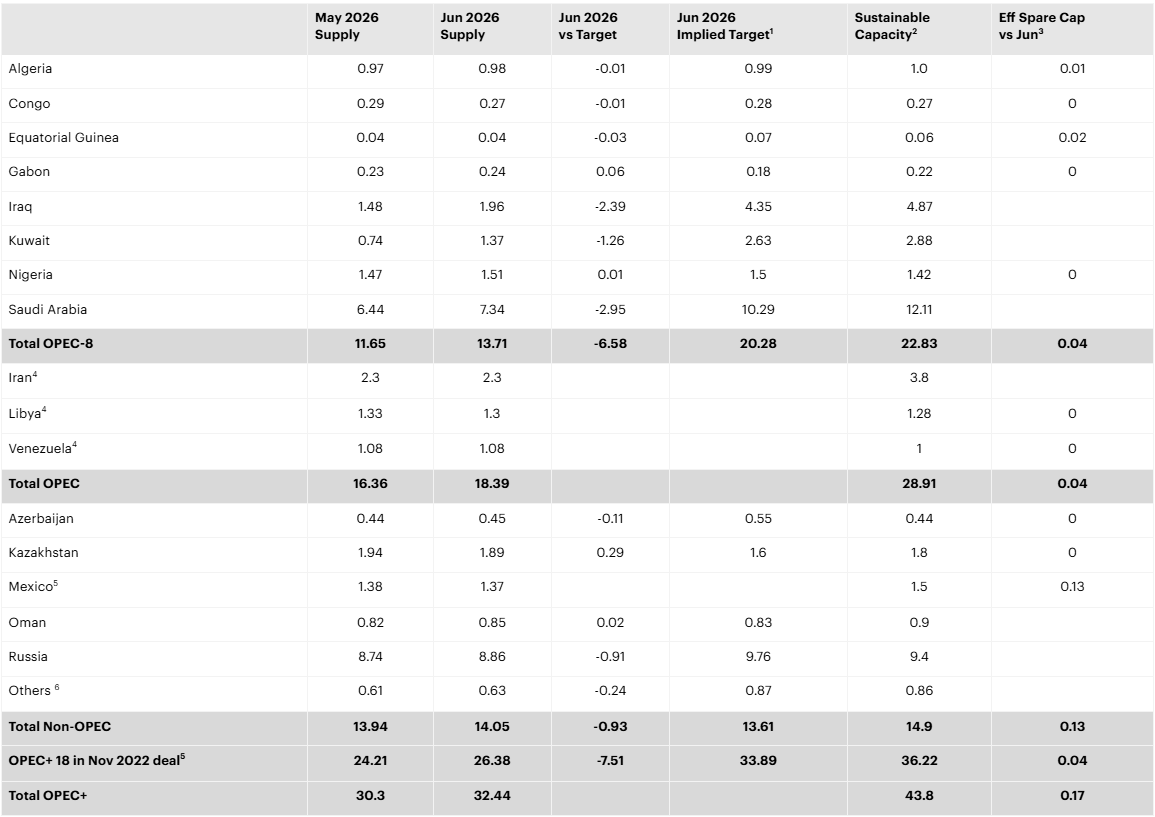
OPEC+ crude oil production1
million barrels per day
Frequently Asked Questions
What is the IEA Oil Market Report?
The IEA Oil Market Report is a widely followed source of data, forecasts and analysis covering global oil demand, supply, prices, inventories, refining activity and international oil trade. It includes information on both IEA and selected non-IEA countries.
When was the July 2026 IEA Oil Market Report published?
The report was published on July 10, 2026.
How much did global oil supply increase in June 2026?
Global oil supply increased by 4.1 million barrels per day in June, reaching 98.8 million barrels per day.
Why did global oil supply recover in June?
Supply recovered primarily because tanker traffic through the Strait of Hormuz improved, allowing some Persian Gulf exports and production to resume. Temporary changes to restrictions on Iranian exports and security support for non-Iranian shipments also helped increase oil flows.
How far is global oil production below pre-war levels?
According to the IEA, global oil production remained approximately 9.4 million barrels per day below pre-war levels in June 2026.
How much oil was exported from the Persian Gulf in June 2026?
Total Persian Gulf oil exports reached 16.1 million barrels per day, increasing by 6.5 million barrels per day from the previous month.
What was the pre-war level of Persian Gulf oil exports?
Persian Gulf oil exports averaged approximately 24 million barrels per day before the war.
What is the IEA’s oil-demand forecast for 2026?
The IEA expects global oil demand to decline by 1 million barrels per day in 2026.
What is the IEA’s oil-demand forecast for 2027?
Global oil demand is forecast to grow by 2 million barrels per day in 2027.
Why are refinery margins rising while crude prices are falling?
Crude supplies have recovered more quickly than refinery activity and refined-product exports. This has lowered crude prices while keeping gasoline and diesel supplies tight, pushing product cracks and refinery margins to four-year highs.
How much did North Sea Dated crude fall in June?
North Sea Dated crude declined by approximately $22 per barrel month on month. Measured over the course of the month, it fell by around $31 per barrel, reaching approximately $68 per barrel in early July.
Why did oil prices rebound in July?
Prices increased after renewed hostilities on July 7–8 raised concerns that the ceasefire could fail and oil flows through the Strait of Hormuz could face renewed disruption. North Sea Dated was trading near $77 per barrel when the report was prepared.
Did global oil inventories increase in June?
Yes. Global observed oil inventories increased by 21 million barrels, their first rise in four months.
Why did inventories rise if onshore stocks were falling?
Oil on water increased by 117 million barrels as tankers carried recovered Persian Gulf exports toward distant refineries. This increase outweighed an estimated 96-million-barrel decline in onshore stocks.
How much did OECD oil inventories fall in June?
OECD oil stocks declined by 62 million barrels, including an estimated 44 million barrels released from government reserves.
What happened to China’s crude oil inventories?
China’s crude inventories declined by approximately 41 million barrels in June, leading the broader reduction in non-OECD crude stocks.
Will the global oil market move into surplus?
The IEA expects the market to move toward surplus near the end of 2026, provided tanker flows recover, Persian Gulf production and refining operations restart, and product exports normalise.
What is the biggest risk to the IEA oil forecast?
The largest risk is renewed conflict in the Persian Gulf. Further disruption around the Strait of Hormuz could restrict tanker traffic, delay production and refinery restarts, and prevent the expected oil-market surplus from emerging.
Could crude oil and fuel prices move in different directions?
Yes. Crude prices could weaken as supply recovers, while gasoline and diesel prices remain supported by refinery outages and limited product exports. This divergence is already visible in elevated refining margins and product cracks.
What does contango mean for the oil market?
Contango occurs when future oil prices trade above near-term prices. It generally indicates that immediate crude supplies are less constrained and creates a financial incentive to store oil for later delivery.
------------------------------------------------------------------------------------
Source: International Energy Agency, Oil Market Report, published July 10, 2026.
Editorial Note: This article is based on the figures, forecasts and analysis contained in the July 2026 IEA Oil Market Report. Forecasts remain conditional on geopolitical developments, tanker movements and the restoration of production and refining activity.
Comments