 English
 پارسی


RBA June 2026 Rate Decision: Cash Rate Held at 4.35% as Inflation Risks Remain High
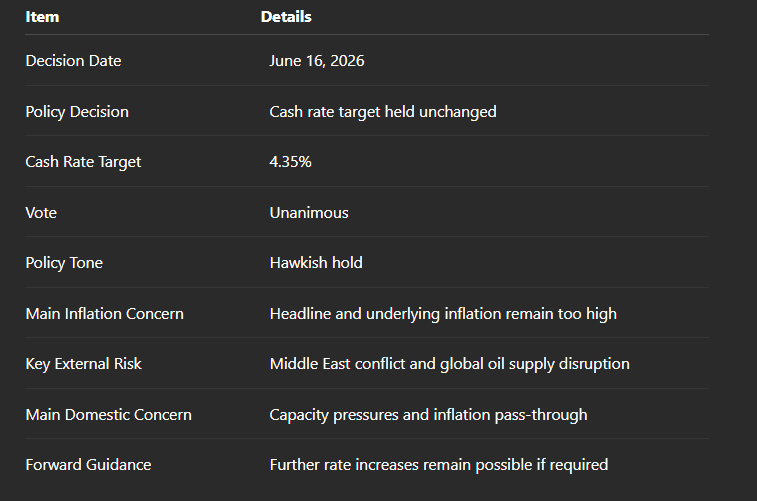
The Reserve Bank of Australia kept the cash rate target unchanged at 4.35% at its June 16, 2026 monetary policy meeting, choosing to pause after three earlier rate increases this year. However, the decision carried a clearly hawkish tone. The RBA said inflation remains too high, oil-related price pressures are still affecting the economy, and the Board is ready to raise rates further if needed.
The decision shows that the RBA has not ended its tightening cycle. Instead, the central bank is waiting to assess how previous rate increases and the global oil supply shock are affecting inflation, consumer spending, the labour market, and broader economic activity.
Key Points from the RBA June 2026 Meeting
What Did the RBA Decide in June 2026?
The RBA Monetary Policy Board decided to leave the cash rate target unchanged at 4.35%. This followed three earlier increases in 2026, which had already tightened financial conditions across money markets, government bond yields, the exchange rate, housing, and consumer credit conditions.
The June decision was therefore a pause, not a policy pivot. The Board judged that it was appropriate to wait and assess the impact of previous rate rises while monitoring the inflationary effects of the global oil supply disruption.
The decision was unanimous, suggesting that Board members broadly agreed that another immediate rate hike was not necessary, but that policy should remain restrictive and flexible.
Why Did the RBA Hold Rates at 4.35%?
The RBA held rates because financial conditions had already tightened significantly after three previous increases. However, the central bank also made clear that inflation remains the main policy problem.
The Board highlighted three major reasons behind the decision:
- Inflation is still too high.
- Oil-related price pressures are passing through the economy.
- Previous rate increases are starting to slow demand.
This combination created a difficult policy balance. Raising rates again could increase pressure on households and the housing market, but cutting or sounding dovish would risk weakening the inflation fight.
Inflation Remains the RBA’s Main Concern
The RBA said headline and underlying inflation remain too high. Inflation had already picked up materially in the second half of 2025, and recent data showed that part of the increase reflected stronger capacity pressures in the Australian economy.
The central bank also warned that higher fuel prices are adding directly to inflation and may be passing through to the prices of other goods and services. This means inflation could stay elevated for longer, even if oil prices ease from recent highs.
For the RBA, the key risk is not only a short-term increase in fuel costs. The larger concern is that businesses may continue raising prices and that inflation expectations may stay above earlier levels. If inflation becomes embedded, the RBA may need to keep policy tighter for longer.
Middle East Conflict and Oil Prices Add to Inflation Risk
The June statement placed strong emphasis on the Middle East conflict and global oil supply disruption. Although oil prices had eased in recent weeks, the RBA noted that energy and related commodity prices remained higher than before the conflict.
This matters for Australia because higher global fuel prices affect transport, production, logistics, household costs, and business margins. If firms pass these higher costs to consumers, inflation becomes broader and more persistent.
The RBA warned that global oil supply issues may take time to resolve. This keeps upward pressure on global energy prices and inflation, while also increasing uncertainty around global growth.
Australian Demand Is Slowing, but Not Enough Yet
The RBA said there are signs that the economy is slowing as expected. Consumer spending growth is weakening, and momentum in the housing market has shifted, with prices falling in some capital cities.
These signs suggest that previous rate increases are working. Higher borrowing costs are reducing household spending power, cooling housing demand, and gradually easing demand pressures.
However, the RBA does not yet appear convinced that demand has slowed enough to bring inflation sustainably back to target. Business investment remains strong, and credit is still readily available to households and businesses. This means domestic demand may remain more resilient than needed to reduce inflation quickly.
Labour Market Signals Are Mixed
The labour market remains an important part of the RBA outlook. The Board noted that the unemployment rate was higher than expected in April, but other labour market indicators were more resilient.
This mixed labour market picture gives the RBA a reason to pause, but not a reason to turn dovish. A higher unemployment rate may suggest that policy tightening is starting to affect the economy. At the same time, resilient labour market indicators could mean wage and demand pressures remain strong enough to keep inflation elevated.
For future meetings, labour market data will be central. If unemployment rises faster than expected, the RBA may become more cautious. If labour demand remains strong and inflation stays high, the case for another rate hike could strengthen.
Comparison with the May 2026 RBA Decision
The June decision was different from the May meeting, when the RBA raised the cash rate by 25 basis points to 4.35%. In May, the Board judged that inflation was likely to remain above target for some time and that risks were tilted to the upside.
The May decision was made by majority, with eight members voting to raise rates and one member preferring to keep the rate unchanged at 4.10%. In June, by contrast, the decision to hold was unanimous.
This shift from a rate hike in May to a hold in June does not mean the RBA became dovish. Instead, it suggests the Board wanted time to assess the cumulative effect of earlier tightening while keeping a strong anti-inflation stance.
RBA Forward Guidance: Further Rate Hikes Still Possible
The most important part of the June statement was the RBA’s forward guidance. The Board said monetary policy is well placed to respond to developments and that it will do what is necessary to deliver price stability and full employment.
Most importantly, the RBA explicitly stated that it could increase the cash rate target further if required.
This wording keeps a tightening bias in place. The RBA is not promising another hike, but it is clearly warning markets and households that another rate increase remains possible if inflation does not slow enough.
Market Impact: AUD, ASX, Bonds, and Housing
The June decision can be interpreted as a hawkish hold. The cash rate was unchanged, but the statement did not give markets a clear signal that the tightening cycle is over.
Australian Dollar
For the Australian dollar, the decision is mildly supportive if markets continue to price the risk of another rate hike. A hawkish RBA can support AUD by keeping Australian interest rate expectations elevated. However, the currency may remain sensitive to global risk sentiment, commodity prices, China-related demand expectations, and U.S. dollar movements.
Market Sentiment for AUD: Neutral to Buy
The RBA’s hawkish tone supports the Australian dollar, but global risk uncertainty and commodity volatility may limit upside momentum.
Australian Equities
For Australian equities, the decision is mixed. A rate hold can reduce immediate pressure on rate-sensitive sectors, but the possibility of further tightening may weigh on banks, property, consumer discretionary stocks, and housing-linked sectors.
Market Sentiment for ASX: Neutral
The pause is supportive, but the RBA’s inflation warning and tightening bias limit the bullish impact.
Australian Bonds
Australian bond yields may remain sensitive to inflation data and RBA communication. If inflation stays high, short-end yields could remain elevated as markets price the possibility of another hike. If demand slows faster than expected, yields may ease.
Market Sentiment for Australian Bonds: Neutral to Sell
A hawkish RBA limits the scope for a strong bond rally unless inflation data clearly weakens.
Housing Market
The housing market remains under pressure from higher borrowing costs. The RBA noted that housing momentum has shifted and prices are falling in some capital cities. If rates remain restrictive or increase further, housing activity could weaken further.
Market Sentiment for Australian Housing: Neutral to Sell
Higher rates and tighter financial conditions remain a headwind for housing demand.
What Should Markets Watch Next?
Markets should focus on the next inflation, labour market, consumer spending, and housing data. These indicators will determine whether the RBA can remain on hold or needs to raise rates again.
The most important indicators to watch are:
- Australia CPI and trimmed mean inflation
- Monthly inflation indicator
- Unemployment rate and employment growth
- Wage growth
- Retail sales and household spending
- Housing prices and mortgage activity
- Oil prices and energy costs
- China growth and commodity demand
- AUD/USD and Australian bond yields
RBA June 2026 Decision: Final Outlook
The RBA’s June 2026 decision was a pause, but not a softening of policy. The central bank held the cash rate at 4.35% because earlier rate hikes are already tightening financial conditions and slowing parts of the economy. However, inflation remains too high, energy prices remain a major risk, and domestic capacity pressures have not fully eased.
The key message is that the RBA wants more evidence before making its next move. If inflation begins to moderate and demand slows further, the Board may keep rates unchanged. But if inflation remains persistent, fuel costs continue to pass through, or inflation expectations rise again, another rate increase remains possible.
For markets, this means the Australian policy outlook remains data-dependent, restrictive, and potentially hawkish.
FAQ
What did the RBA decide in June 2026?
The RBA kept the cash rate target unchanged at 4.35% at its June 16, 2026 monetary policy meeting.
Why did the RBA hold the cash rate at 4.35%?
The RBA held rates because financial conditions had already tightened after three earlier rate increases, and the Board wanted to assess the impact of previous hikes and the global oil supply disruption.
Was the RBA June 2026 decision dovish?
No. The decision was a hawkish hold. The cash rate was unchanged, but the RBA warned that inflation remains too high and said it could raise rates further if required.
What is the main inflation risk for Australia?
The main inflation risks are domestic capacity pressures, higher fuel prices, and the pass-through of energy costs into broader goods and services prices.
How did the June decision compare with the May RBA meeting?
In May 2026, the RBA raised the cash rate by 25 basis points to 4.35%. In June, it held the rate steady, but maintained a hawkish tone and kept further hikes on the table.
Could the RBA raise interest rates again in 2026?
Yes. The RBA said it is prepared to increase the cash rate further if required to achieve price stability and full employment.
What does the RBA decision mean for the Australian dollar?
The decision may be mildly supportive for the Australian dollar because the RBA maintained a hawkish bias. However, AUD will also depend on global risk sentiment, commodity prices, China demand, and U.S. dollar trends.
What data should traders watch after the RBA June 2026 meeting?
Traders should watch Australian CPI, trimmed mean inflation, unemployment, wage growth, retail sales, housing data, oil prices, and AUD/USD reaction.
-----------------
Risk Disclaimer
This article is for informational and educational purposes only. It does not provide investment advice, financial advice, or trading recommendations. Market conditions can change quickly, and traders should use independent research and proper risk management before making financial decisions.
Comments