 English
 پارسی


Iran Conflict Update
Executive Summary: In the past 36 hours the Iran–Israel–US war has continued its relentless course. On March 8, 2026, Iran’s Assembly of Experts formally appointed Supreme Leader Ali Khamenei’s son, Ayatollah Seyyed Mojtaba Khamenei, as the new Supreme Leader, a move ratified amid mass pro-regime rallies. Meanwhile, Israeli–US strikes on Iranian soil have targeted key military and energy infrastructure (notably oil depots in Tehran and Karaj), while Iran has launched retaliatory missile and drone strikes at U.S. bases and Gulf Arab states (killing personnel in Kuwait, injuring others in the UAE and Qatar, and being intercepted over Saudi Arabia). The U.S. and its allies emphasize narrowly defined military objectives: U.S. officials stress that operations “will not lead to an endless war” but aim to destroy Iran’s missile and drone capabilities. At the same time, global powers have urged restraint: the UN High Commissioner for Human Rights called for the protection of civilians and an immediate end to hostilities, the EU’s foreign policy chief Kaja Kallas demanded “maximum restraint” and civilian protection, and Russia and China warned against further escalation. Domestically in Iran, security forces have been mobilized and no large anti-war protests have emerged; state media show Iranians rallying behind the new leader. Tensions remain high: Turkey’s air defenses (NATO-backed) recently shot down an Iranian missile heading toward its airspace, and many governments have pulled non-essential personnel from Gulf embassies. In sum, the war continues to spread across the region with no ceasefire in sight. Key factual claims (strike locations, casualty counts, statements) are drawn from official and reputable sources below, with unresolved or unverified details noted as such.
Timeline of Key Events (Mar 7–9, 2026)
- 2026-03-07 12:00 IRST: Iran’s Foreign Ministry reports an attack (denied by the U.S.) on a desalination plant on Qeshm Island, supplying water to ~30 villages.
- 2026-03-07 23:59 IRST: Iran’s Assembly of Experts (88 clerics) votes Ayatollah Mojtaba Khamenei as new Supreme Leader.
- 2026-03-08 00:05 IRST: Iranian state media report that the IRGC and armed forces have pledged loyalty to Mojtaba Khamenei.
- 2026-03-08 01:00 IRST: Israeli airstrikes hit oil depots in Tehran and Karaj (including Shahran and Aghdasieh facilities), igniting huge fires and killing at least four tanker drivers.
- 2026-03-08 04:00 IRST: Saudi Arabia shoots down an Iranian UAV/ballistic missile aimed at Riyadh’s U.S. Diplomatic Quarter.
- 2026-03-08 07:27 IRST: Kuwait’s Interior Ministry announces 2 officers killed by shrapnel from intercepted Iranian missiles/drone attacks.
- 2026-03-08 10:00 IRST: US State Department orders non-essential staff to leave Saudi Arabia (and warns Gulf allies) in face of continued Iranian strikes.
- 2026-03-09 10:00 IRST: Massive pro-government rallies take place in Tehran and other cities, with crowds waving flags and posters of Ali Khamenei, declaring loyalty to the new leader.
Strikes and Targets in Iran
Within Iran, recent strikes have focused on oil and military infrastructure. Oil facilities in Tehran/Alborz were hit for the first time since the war began. On March 7 (Tehran local night), joint Israeli–US strikes struck four fuel storage depots and one transfer centre – including Tehran’s Aghdasieh warehouse, the Shahran depot, the south-Tehran refinery, and a Karaj (Alborz) oil depot. Massive fires and toxic plumes ensued. Iranian media reported at least four tanker drivers killed in those strikes; official tallies of civilian casualties in Iran now exceed 1,300 (a number still rising with ongoing bombing).
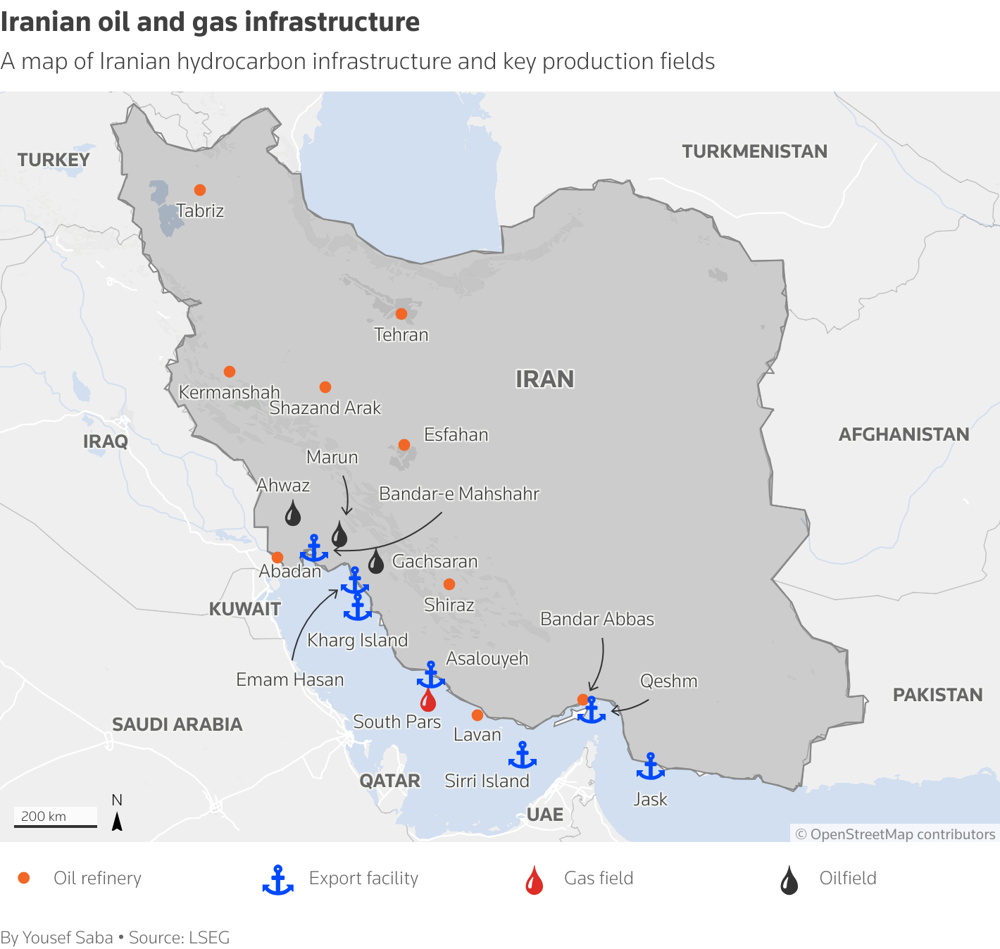
Map: Iran’s major oil and gas infrastructure (oilfields ⚫, gas fields 🔥, refineries ⛽, and export terminals ⚓). Recent strikes have hit several of Tehran’s fuel depots and refineries (west and northeast Tehran) as well as the Karaj (Alborz) depot, as shown. No shortage of fuel was reported, but environmental and transportation disruption is serious..
Other documented Iranian targets:
- Cultural site: On March 7 U.S./Israeli strikes damaged the UNESCO-listed Golestan Palace in Tehran. Iran’s Cultural Heritage Minister reported damage to mosaics and walls, calling it an attack on national identity. (No casualties were reported there.)
- School in Minab: UN officials cite reports that a primary school in Minab (Hormozgan province) was hit during class, killing dozens of schoolgirls and injuring many. Iran’s Red Crescent counted 787 Iranian dead (as of early March), including such civilian tragedies. Investigations into the Minab strike are demanded by rights groups.
- Other sites: Various military and radar installations in northern Iran were reportedly hit earlier in the war, and Iran has alleged attacks on a desalination plant on Qeshm Island (U.S. denies any strike there).
- A detailed summary of the confirmed strikes (with times, locations, targets, sources, casualties) is given below.
- 2026-03-07 ~12:00 — Qeshm Island, Iran: The reported target was a desalination plant, described as a claimed U.S. strike on water infrastructure. The cited source is an Iranian foreign minister statement. No casualties were reported, and the claim is noted as disputed.
- 2026-03-07 23:59 — Tehran/Alborz, Iran: The reported target was oil fuel storage infrastructure, including Shahran, Aghdasieh, a refinery, and Karaj. The cited source is Al Jazeera. Reported impact: at least 4 killed, described as tanker drivers.
- 2026-03-08 04:00 — Riyadh, Saudi Arabia: The reported target was the U.S. Diplomatic Quarter, described as the target of an Iranian drone. The cited source is the Saudi Defense Ministry. Reported impact: 0 casualties, with the drone reportedly shot down.
- 2026-03-08 07:27 — Kuwait City, Kuwait: The reported target involved the Interior Ministry / security personnel, attributed to an Iranian missile/drone attack. The cited source is the Kuwait Interior Ministry (via Reuters). Reported impact: 2 killed.
- 2026-03-09 ~10:00 — Tehran, Iran: The event is described as public squares / pro-Mojtaba rallies (a political event rather than a strike). The cited source is Reuters. No casualties/damage are listed (N/A).
Iranian Retaliatory Attacks
Iran has fired hundreds of missiles and drones into the region. Recent incidents include:
Israel:
- Iran’s retaliatory strikes (missiles and drones) continued to pour into Israel (e.g. Beit Shemesh, Petah Tikva) over the past week, causing some civilian casualties (as Reuters reported earlier). In the last 36 hours no new Israeli civilian casualty tolls have been announced, but air-raid alerts remained common and air defenses were active.
Persian Gulf Arab States:
- Kuwait: On March 8 Kuwait announced two of its firefighting officers were killed by debris from Iranian drones/missiles, while others were injured.
- UAE (Dubai/Abu Dhabi): Iranian drones struck civilian targets including hotels and airports. UAE authorities reported one worker killed and over a dozen injured in these raids.
- Qatar: Iran launched dozens of ballistic missiles at Al Udeid Air Base; most were intercepted, but missile debris injured 8–16 civilians in Doha in late February (outside 36h window). Qatar condemned the attacks as “reckless”.
- Bahrain: Iran fired salvoes toward Bahrain’s Fifth Fleet naval base; most were shot down. Some warplanes and facilities were damaged on March 1, with at least 3 foreign workers killed (previous reports). Bahrain’s royal court warned Iran not to escalate.
- Saudi Arabia: Yemen-based proxies fired rockets at Riyadh, and on March 8 Iran sent a drone at the U.S. embassy/Diplomatic Quarter, which was shot down. Saudi Arabia has held Iran’s ambassador to account and warned of retaliation for any future strikes.
- Iraq: U.S. officials reported Iranian rockets hitting bases in Iraq (including al-Asad), but in the last 36h no new U.S. casualties were announced (the U.S. death toll remains 6 confirmed by early Mar).
These cross-border incidents drew widespread condemnations. Qatar’s Foreign Ministry called Iran’s missile fire a “flagrant violation” of sovereignty. Kuwait lodged protests after its personnel were killed. Turkey’s air defenses (NATO-supported) intercepted an Iranian missile on Mar 4; NATO Secretary-General Mark Rutte said no Article-5 invocation is planned. Iran officially denied firing at Turkey.
International Reactions
Major global and regional actors voiced concern or condemnation:
- United Nations: UN rights chief Ravina Shamdasani (OHCHR) warned the war is “worsening and widening” and called for maximum restraint and civilian protection. She cited Iran’s Red Crescent toll (787 dead) and the school attack in Minab. The UN Secretary-General (António Guterres) similarly urged an immediate ceasefire.
- European Union: EU foreign policy chief Kaja Kallas, speaking for all 27 EU states, demanded “maximum restraint, protection of civilians and full respect of international law”. Most EU leaders (e.g. Germany’s Chancellors) echoed calls to avoid broader escalation. However, EU responses vary: Spain’s PM Sánchez explicitly denounced the US–Israeli attack as destabilizing, while Germany’s leader has been more measured. The European Parliament also expressed concern over civilian harm.
- NATO/Turkey: NATO remains on alert but has tried to contain spillover. Secretary-General Rutte said the downing of an Iranian missile over Turkey (Mar 4) would not trigger NATO’s Article 5, and that “nobody’s talking about Article 5” even as air defenses shot down the threat. Turkey itself confirmed the missile interception. Turkey’s President Erdoğan privately criticized US strikes but officially called for calm.
- Russia: Foreign Minister Sergei Lavrov warned that the war may “spur Iran and Arab neighbours to seek” nuclear weapons, and told U.S. and Israeli leaders to show restraint. President Putin publicly condemned the assassination of Ali Khamenei as “a cynical murder” and called for an immediate ceasefire.
- China: Spokesperson Mao Ning condemned the killing of Supreme Leader Khamenei as a “grave violation” of the UN Charter and called for an immediate halt to hostilities. Beijing reaffirmed support for Iran’s sovereignty and urged diplomatic solutions (it evacuated nationals early in the war).
- United States: President Trump (re-elected in 2025) has been active. He told Reuters that the U.S. “will have to” be involved in selecting Iran’s next leader and insisted the choice must be “our choice”. Secretary of Defense Pete Hegseth emphasized that U.S. operations are “surgical, overwhelming and unapologetic” and asserted “this will not be an endless war” – framing the mission as degrading Iran’s missile and drone forces. The Pentagon reported six U.S. troops killed so far, with a seventh recent death confirmed from prior wounds. Washington also ordered the withdrawal of non-essential embassy staff from Saudi Arabia and issued travel advisories.
- Gulf/Regional States: Aside from Gulf condemnations above, Egypt, Jordan, and Iraq have all called for de-escalation to avoid wider chaos. The Arab League convened to urge restraint. Israel’s government has not publicly signaled any change in policy – it continues to frame its campaign as defensive and necessary to stop Iranian “fanatics.”
- Major NGOs: Humanitarian groups (ICRC, Red Cross/Red Crescent) and rights NGOs have expressed alarm. The UNHCHR and Red Crescent have highlighted civilian suffering and infrastructure damage. Verification organizations are scrutinizing reports of atrocities (e.g. school bombings).
Selection of Mojtaba Khamenei
On March 8, 2026 (local time), Iran’s Assembly of Experts unanimously (decisively) voted to appoint Ayatollah Mojtaba Hosseini Khamenei as the third Supreme Leader. This assembly (88 clerics) gathered urgently on March 7–8 (normally a months-long process) and issued a statement at just after midnight Tehran time:
“By a decisive vote, the Assembly of Experts appointed Ayatollah Seyyed Mojtaba Hosseini Khamenei as the third Leader of the sacred system of the Islamic Republic of Iran”.
The vote was fast-tracked under the new war emergency. Senior clerics (including Ayatollah Nouri Hamedani) publicly urged expediting the appointment to “preserve the unity and solidarity of the nation”. Iran’s security chiefs (IRGC and military) immediately pledged allegiance to Mojtaba, and former President Ali Larijani (head of security council) appeared on state TV calling for unity around the new leader.
Legally, once the Assembly votes a leader, he assumes full authority by Iran’s constitution. (Ayatollah Ali Khamenei had served 36 years as Leader.) Mojtaba, however, is younger (mid-50s) and had not previously held top state office, raising questions in some quarters about his qualifications. But no major institution has publicly challenged the appointment. Iranian media and officials present it as a seamless transition under the constitution, meant to strengthen resistance against the war. Western officials and analysts note Iran’s hardliners (who dominate the Assembly and IRGC) tightly managed the selection to ensure their preferred successor.
Domestically, news of the appointment was met with mass pro-government demonstrations. State TV showed large crowds in Tehran and other cities waving flags and images of the late Ali Khamenei, chanting unity slogans. There were no reports of anti-Khamenei protests; in fact, Iranian moderates like Parliament Speaker Masoud Pezeshkian quickly tamped down criticism after he had briefly advocated striking a conciliatory tone toward Gulf neighbors (a stance attacked by hardliners). The IRGC’s own statements and state media portrayed Mojtaba as a unifying figure who “under the current sensitive conditions…could lead the country”. In short, within Iran official and public response has been overwhelmingly supportive or acquiescent, at least in the immediate aftermath of the vote.
Domestic Response and Security Measures
Apart from the leadership change, domestic Iranian activity has focused on wartime preparedness and information control. Security has been tightened: authorities reportedly mobilized additional Revolutionary Guard units and militia groups, and have imposed restrictions on online platforms and media. UN rights monitors note that many Iranians have been cut off from internet access, limiting their ability to share independent information. The regime is also expected to “crack down” on dissent: the UN human rights office cautioned that Iran’s security forces have a history of lethal force against opposition, and urged protecting fundamental rights. So far, no large-scale protests have emerged; instead, state media emphasize unity and defiance. Iran’s currency and markets are under strain (oil above $100/barrel), but no signs of public panic beyond normal wartime unease. In sum, most Iranians appear to be mobilizing patriotically, with the government controlling information tightly.
Military Posture and Sanctions
All sides have signaled continued readiness. The U.S. and Israel have not announced any ceasefire or pause; senior U.S. officials say the campaign will go on until “Iran’s threats are eliminated”. Iran’s leaders similarly pledge “heavy strikes will continue” (judicial chief Ejei vowed sustained blows at any state hosting attacks). Israel has even threatened to hit Mojtaba Khamenei personally (Trump said Iran’s new leader “won’t last” if not approved by the U.S. – a statement widely criticized).
No new multilateral ceasefire talks are known. Diplomatically, immediate reactions include the U.S. withdrawal of diplomats from Saudi Arabia and China/Oman urging negotiations. The UN Security Council has met in emergency sessions but is deadlocked (Russia/China veto talk of sanctions). Separate from the war, the U.S. did expand sanctions on Iranian missile entities before the conflict, but no major new sanctions specific to these past 36 hours have been announced (the focus has been military, not economic, so far). Israel’s own war cabinet has reportedly considered further strikes but is constrained by fears of backlash.
Verification and Credibility
In this conflict, verifying reports is crucial. Reputable outlets (Reuters, AP, Al Jazeera) have generally corroborated major developments (e.g. Mojtaba’s appointment, oil facility strikes) using official statements and imagery. Iran’s semi-official media (Fars, Tasnim) sometimes give casualty figures (e.g. “four tanker drivers killed”) that have not independently confirmed, so those numbers are reported with attribution. Conversely, some claims have been debunked: for instance, Jerusalem Post notes that the IRGC’s dramatic claim of 650 U.S. casualties is false – U.S. sources confirm only six deaths so far. We rely on official announcements and third-party reporting; any detail not confirmed (e.g. the exact number of missiles fired at Qatar on Mar 8) is noted as “unspecified.”
Summary of Strikes
- Mar 7 ~00:00 (night), Tehran/Karaj (Iran): The reported target was oil storage depots and a refinery. The listed sources are Al Jazeera and Reuters. Reported casualties: ≥4 killed, identified as tanker drivers.
- Mar 7 ~12:00, Qeshm Island (Iran): The reported target was a desalination plant, described as a claimed U.S. strike. The listed source is the Iranian foreign minister (IRNA). Reported casualties: none reported, and the claim is noted as denied.
- Mar 8 04:00, Riyadh (Saudi Arabia): The reported target was the U.S. Diplomatic Quarter (U.S. Embassy area), described as an Iranian drone incident. The listed source is the Saudi Defense Ministry. Reported casualties: 0, with the drone downed.
- Mar 8 07:27, Kuwait City (Kuwait): The reported target was the Interior Ministry / police, described as Iranian drone hits. The listed source is the Kuwait Interior Ministry (via Reuters). Reported casualties: 2 killed.
Note: Additional Iranian strikes on Feb 28–Mar 1 (before the 36h window) hit UAE and Saudi facilities, causing several foreign worker deaths. Within the last 36 hours, reports indicate injuries in Qatar (missile debris), but most incoming missiles were intercepted. No new strike was claimed by Iran inside Iraq in this period.
Likely Short-Term Scenarios
In the immediate term, the conflict appears poised to continue its tit-for-tat pattern. Iran’s new leadership is unlikely to seek compromise while under attack; it may even double down by striking additional targets (U.S. bases, Gulf facilities) to retaliate. Israel and the U.S. have signaled they will press on with precision strikes on Iran’s military assets. A full ceasefire seems unlikely unless one side achieves a clear, limited objective (e.g. Iran’s strategic deterrence broken), which appears far off.
Key scenarios include: (1) Escalation: A miscalculation (e.g. a NATO country shot down an Iranian missile, or a major civilian incident) could draw in more actors, risking a wider regional war. (2) Stalemate and Attrition: Both sides wear down through continued strikes: Iran endures infrastructure losses, Israel endures periodic missile barrages, while global oil prices stay high. (3) Back-channel Settlement: Diplomatic pressure (e.g. via Oman, EU intermediaries or even China) might eventually broker a temporary ceasefire in exchange for sanctions relief or guarantees—but that prospect remains distant amid heightened rhetoric (Trump’s recent comments on “choosing” Iran’s leader suggest no immediate openness to compromise).
Each scenario carries uncertainties. So far, the war’s spread (from Beirut to Basra to Bahrain) has alarmed many nations. The immediate watchpoints are potential accidents (downed missiles, civilian casualties) and whether major powers (Russia, China, EU) can push either side to de-escalate. Analysts also note that unrest could grow within Iran if shortages hit or if war fatigue sets in, but the strong domestic rally for Mojtaba Khamenei suggests unity for now.
Sources: All claims above are drawn from reputable news and official reports as cited (Reuters, Al Jazeera, AP/IRNA, UN statements, etc.). Unverified or disputed details are clearly labeled.
Comments