 English
 پارسی


Iran war update: what happened in the past 24–30 hours?
The Iran war moved through another volatile phase over the last 24–30 hours, with the conflict showing three clear fronts at once: renewed military pressure, rising regional spillover, and a diplomatic track that remains highly contested. The clearest shift was the gap between public messaging from Washington and public denial from Tehran. U.S. President Donald Trump said “very good and productive” conversations had taken place and said he was postponing for five days a plan to hit Iran’s energy grid, while Iranian officials denied direct negotiations and rejected the claim as false. Reuters also reported that intermediaries from Egypt, Pakistan, and Gulf states were relaying messages, even as Tehran publicly denied talks.
At the same time, the military picture remained active and dangerous. Reuters reported that Iran’s Revolutionary Guards said Tehran would respond to any strike on its electricity sector by targeting Israeli power plants and power plants supplying U.S. bases in the region. That statement also appeared to walk back earlier warnings focused on Gulf desalination plants, suggesting a more narrowly defined “power-for-power” retaliation line for now.
The maritime and energy dimension also intensified. Reuters reported that Iran has effectively closed the Strait of Hormuz, while Bahrain circulated a draft U.N. Security Council resolution that would authorize “all necessary means” to protect shipping in and around the strait. In parallel, Oman said it was working intensively to establish safe-passage arrangements, a sign that regional diplomacy is now heavily focused on preventing a deeper shipping and energy crisis.
Key points
- Washington signaled a temporary pause in threatened strikes on Iran’s energy grid, citing productive contacts.
- Tehran publicly denied negotiations and framed the U.S. message as disinformation or market manipulation.
- Iran threatened reciprocal electricity-sector retaliation if its own power infrastructure is hit.
- Regional spillover remained active, with Kuwait saying its air defenses were intercepting hostile missiles and drones.
- The Strait of Hormuz remained the central pressure point, with Bahrain pushing a U.N. force-authorization draft and Oman pushing safe-passage diplomacy.
- Energy-market stress continued, with Reuters reporting Iranian oil was offered to Indian refiners at a premium after a temporary U.S. sanctions waiver.
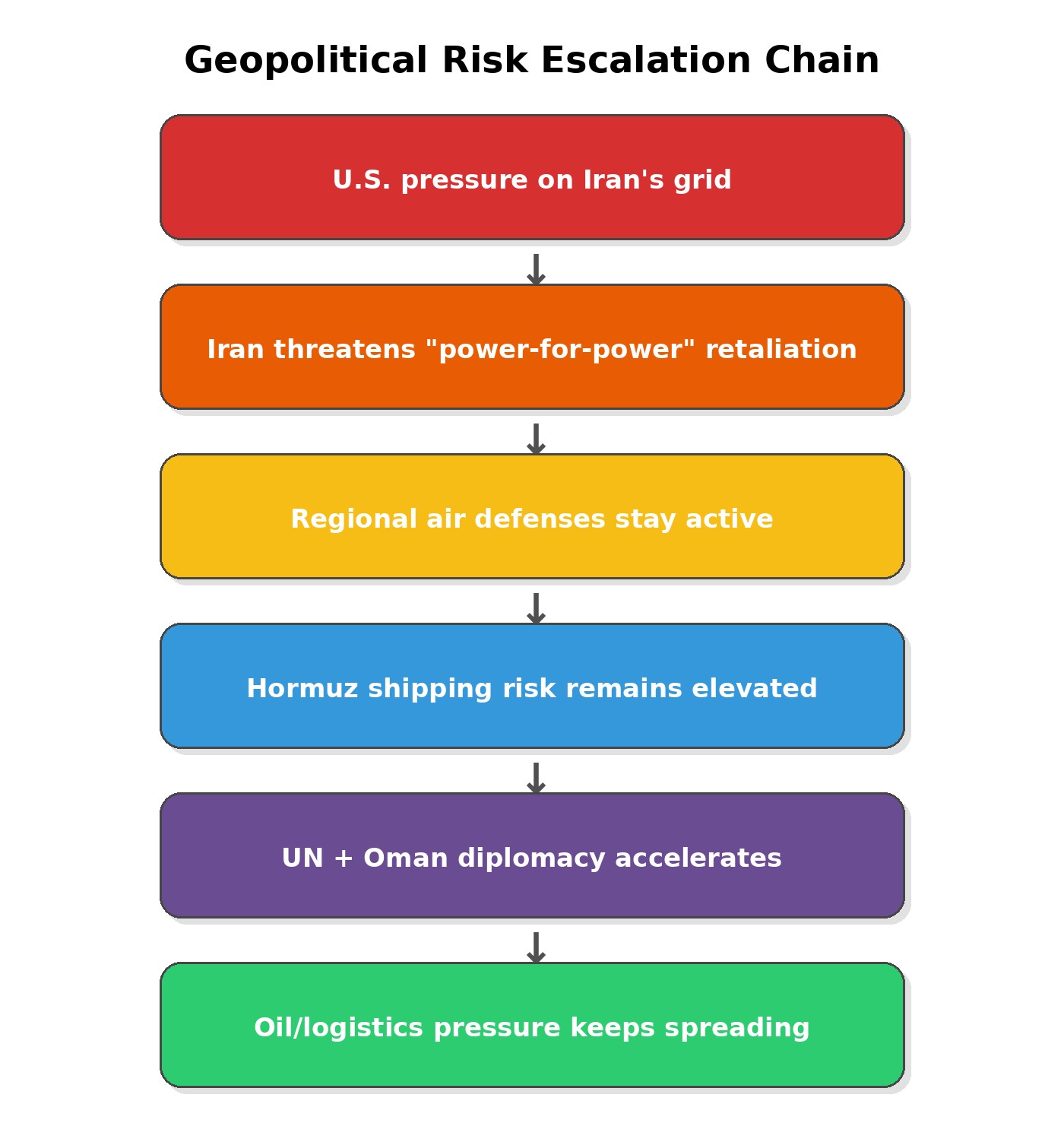
This is the clearest way to understand the current moment. The military track, the energy track, and the diplomatic track are now fully linked. Threats to electricity infrastructure are no longer just tactical battlefield messaging; they are directly connected to shipping security, Gulf state risk, and global oil flows.
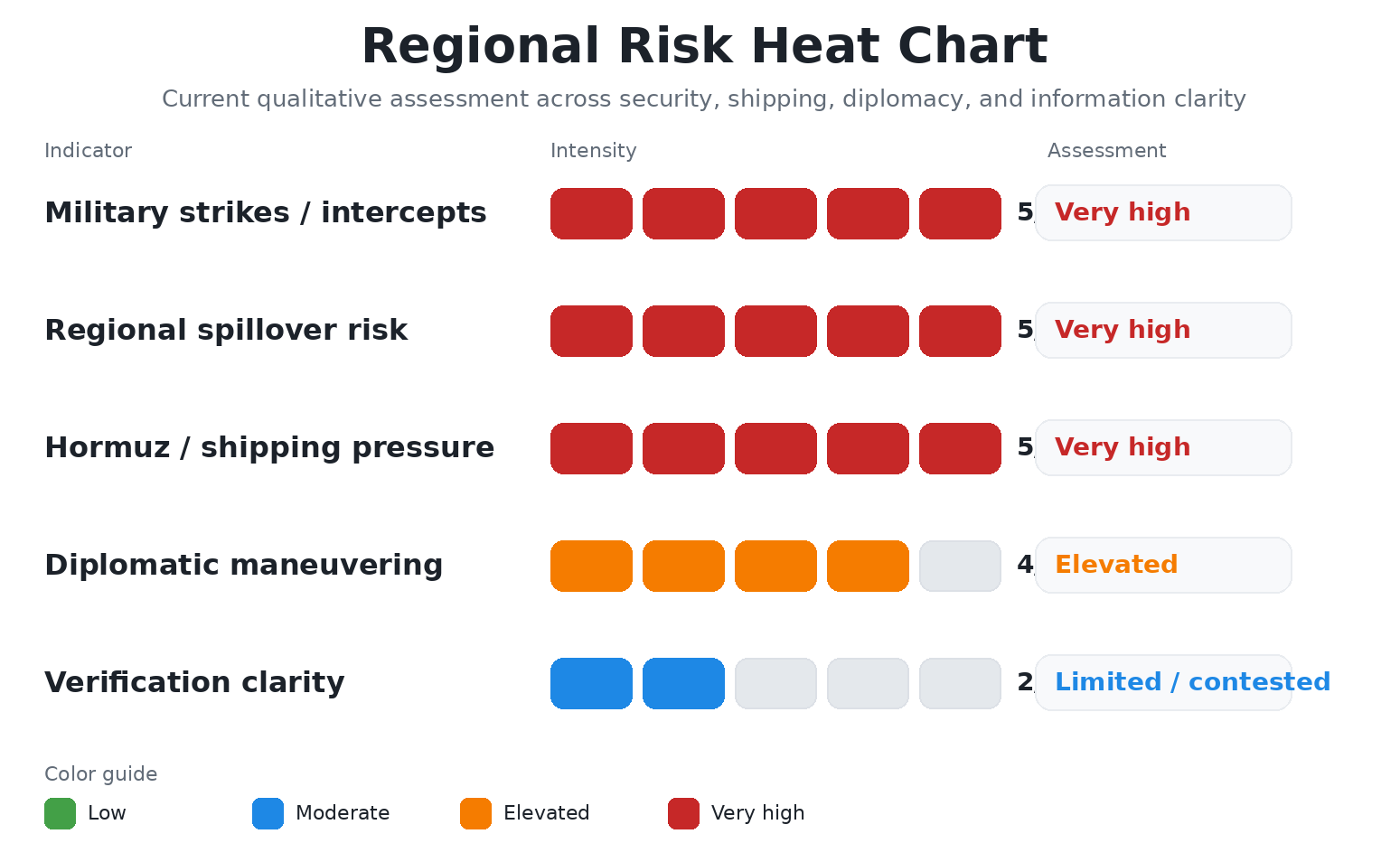
This is a qualitative editorial chart based on the past 24–30 hours. The reason verification clarity remains low is that many battlefield claims still rely on wartime statements, official narratives, or partially corroborated reporting rather than open, independently verified damage assessments.
What happened inside Iran?
Inside Iran, the most important development was the continued pattern of reported strikes and high-alert military activity, alongside continued pressure on strategic infrastructure. Reuters reported that Israel would continue pressing attacks in Iran even while Washington floated a possible diplomatic opening, underscoring that military operations and diplomatic signaling are not currently moving in sync.
One specific reported strike drew particular attention in southern Iran. Anadolu reported, citing Iranian state broadcaster IRIB, that a U.S.-Israeli strike hit a radio transmitter tower at the Persian Gulf Radio and Television Center in Bandar Abbas, killing one security staff member and injuring another. The report added that broadcasts later resumed. Bandar Abbas matters not only because it is a major port city, but because it sits on the northern shore of the Strait of Hormuz and holds strategic naval importance.
The broader pattern suggests that this war is still operating on two parallel levels inside Iran: direct military degradation and strategic signaling. Some strikes are aimed at degrading Iranian capabilities, while others appear designed to show reach, create political pressure, and widen psychological impact. That means the battlefield is not limited to bases and launch sites; communications infrastructure and symbolic targets remain exposed as well.
What happened outside Iran?
Outside Iran, the clearest confirmed regional development came from Kuwait. Anadolu reported that Kuwait’s Army General Staff said air defenses were actively intercepting “hostile” missiles and drones, warned the public that explosions might be heard due to interceptions, and said there were no immediate reports of damage or casualties. That keeps the Gulf front highly active even when the main headline focus remains on Iran itself.
This matters because the war is no longer confined to a direct U.S.-Israel-Iran exchange. The operational environment now includes air-defense activity, shipping threats, and infrastructure vulnerability across the wider Gulf. Even when individual incidents are not fully detailed in real time, the regional security posture itself is a major development: it raises the risk of debris strikes, miscalculation, and accidental escalation.
The U.S. State Department’s March 22 worldwide caution reinforces that point. It advised Americans worldwide, especially in the Middle East, to exercise increased caution, warned that U.S. diplomatic facilities — including some outside the Middle East — had been targeted, and said groups supportive of Iran could target U.S. interests overseas.
The Hormuz front is now the center of the war
The Strait of Hormuz has become the main strategic hinge of the war. Reuters reported that Iran has effectively closed the strait, through which about a fifth of global oil and liquefied natural gas flows. That transforms the conflict from a regional war into a global energy and shipping emergency.
Bahrain’s draft U.N. Security Council resolution shows just how serious that has become. Reuters reported that the text would authorize countries to use “all necessary means” to protect commercial shipping in and around the Strait of Hormuz, including through multinational naval coalitions, and would also express readiness to impose targeted sanctions. Diplomats told Reuters the resolution is unlikely to pass because Russia and China would likely veto it, but the draft itself is significant because it shows Gulf states and the United States are trying to internationalize the maritime security response.
Oman is moving on a parallel but less confrontational track. The Omani foreign ministry said Foreign Minister Sayyid Badr Albusaidi is working intensively to put in place safe-passage arrangements for the Strait of Hormuz. The ministry also quoted him as warning that the war is already causing widespread economic problems and could get much worse if it continues. In practical terms, Oman is trying to create a de-escalation mechanism while Bahrain and its partners are exploring a harder U.N.-backed security framework.
Diplomacy: real opening or political theater?
Diplomatically, the last 24–30 hours produced the most contradictory messaging of the current phase. Trump presented the situation as one where real progress may be possible, saying there had been productive conversations and delaying planned strikes on Iran’s grid for five days. Reuters also reported that he said Steve Witkoff and Jared Kushner had spoken with a top Iranian official.
Iran’s parliament speaker, Mohammad Baqer Qalibaf, publicly rejected that version, saying there had been no negotiations with the United States and describing the claims as fake news meant to manipulate financial and oil markets. That denial matters because it shows Tehran is not prepared — at least publicly — to validate the U.S. narrative of an emerging diplomatic off-ramp.
Still, Reuters also reported that European and regional intermediaries were relaying messages, and that Pakistan could potentially host direct talks if conditions allow. So the most accurate reading is not that diplomacy is absent, but that it remains indirect, politically sensitive, and too contested to describe as a clear negotiating breakthrough.
Energy markets and sanctions: why this still matters globally
The war’s global importance is no longer only about military headlines. Reuters reported that traders offered Iranian oil to Indian refiners at a premium to ICE Brent after Washington temporarily eased sanctions through a 30-day waiver for Iranian oil already at sea. Reuters added that Iranian crude was being offered at a premium of $6 to $8 per barrel over Brent, with India scrambling to manage supply disruption caused by the war and the Hormuz chokepoint.
That matters for three reasons. First, it shows the conflict is now shaping real cargo flows, not just futures pricing. Second, it suggests governments are already making emergency adjustments to soften the economic shock. Third, it confirms that energy security is now one of the main battlegrounds of the war — alongside air power and missile defense.
What is happening now?
Right now, the war appears to be in a fragile dual-track phase. Militarily, threats remain active, regional defenses remain engaged, and the electricity-for-electricity retaliation line has become a central escalation risk. Diplomatically, a narrow opening may exist through intermediaries, but the public messaging from Washington and Tehran still points in opposite directions. Strategically, the Strait of Hormuz remains the biggest immediate pressure point.
That means the conflict is not stabilizing yet. It is shifting into a phase where the next moves may depend less on a single strike and more on whether maritime security, electricity infrastructure, and indirect diplomacy can all be contained at the same time.
Publicly submitted reports on attacks within Iran
Published by the Telegram channels Vahid Online and Ilia
Part 1: Logged reports in the text
Monday, early morning
- The radio tower and transmitter of Bandar Abbas central station were reported to have been hit by a missile.
- 03:05 Reports said fighter aircraft were heard over Karaj, Qazvin, Isfahan, and several northern Iranian cities.
- 03:06 An explosion was heard in مهرشهر, Karaj.
- 03:07 Several explosions were heard in western Tehran.
- 03:10 Air defenses in eastern Tehran were activated.
- 03:15 In Tehran, one explosion was heard from the Nobonyad area and several more from the direction of Parchin.
- 03:15 Flash and explosion sounds were reported in the Nobonyad area.
- 03:15 A large column of smoke was seen above Nobonyad, around Langari.
- 03:25 Light associated with five explosions was seen around Sorkheh Hesar.
- 03:30 Several heavy explosions were heard in Tabriz.
- 03:55 Fighter aircraft were heard over Asadabad, Hamedan.
Monday, afternoon
- Around 14:00 A building in eastern Tehran, in the Farjam / 30-Metri-ye Malekloo area, was hit by several missiles.
- Around 14:05 A location in western Tehran, around South Chitgar, was bombed.
- 14:10 Air defenses in eastern Tehran were active, with fighter aircraft and explosions also heard.
- 14:12 Smoke was observed in northeastern Tehran.
- 14:15 Fighter aircraft were heard in several cities in Mazandaran.
- 14:16 Another explosion was heard in southeastern Tehran, around Qasr-e Firoozeh.
- 14:27 Several explosions were heard in cities across Kermanshah, Ilam, and Kurdistan provinces; at the same time, a heavy explosion was also reported around Shahr-e Rey in southern Tehran.
Monday, late afternoon and evening
- Around 15:00 A warehouse belonging to the IRGC in Maragheh, behind the city observatory, was bombed.
- 15:58 Two explosions were heard in Abyek, Qazvin.
- 15:59 Reports pointed to drone attacks around Meydan-e Sepah in eastern Tehran.
- 16:00 Fighter aircraft were heard over Karaj.
- 16:01 Air defenses in eastern Tehran remained active.
- 16:53 Several military sites around Choghadak, Bushehr, were bombed.
- Time unspecified on Monday The Bushehr meteorological building was hit in airstrikes.
- 19:12 An explosion was heard in Mehrshahr, Karaj.
- 19:33 A column of smoke was seen in Fardis, Karaj.
- 19:52 Air defense activity was reported in Bidganeh, Malard.
Tuesday, early morning
- 00:38 Several heavy explosions were heard in Tehran.
- 00:45 Several explosions were heard in Parand.
- 01:40 Citizens reported hearing an explosion; photos were received around 01:50, and one sender suggested the likely area was near Chaharrah Akhooni.
Part 2: Unverified citizen reports
Monday 23, and early Tuesday, 24 March
- 00:07 Report of aircraft movement from west to east over Sardasht.
- 00:18 One report from Tarasht says air defense fire was heard first, and about 20 minutes later, at 00:38, an explosion was heard.
- Roughly 00:35 to 00:40, there was a major cluster of citizen reports describing one or more loud explosions across Tehran. Reported areas included:
- West Tehran: Ekbatan, Punak, Kashani, Shahrak-e Gharb, Marzdaran, Tarasht, Sattarkhan, Tehransar, Kon
- Central and North Tehran: Yousef Abad, Tavanir, Amirabad, Seyyed Khandan, Jolfa, Sohrevardi, Mirdamad, Jordan, Valenjak, Saadat Abad, Zafaraniyeh, Niavaran, Lavizan, Darrous, Dowlat Street
- East Tehran: Heravi, Hossein Abad, Narmak, Shahrzad Boulevard, Pirouzi, Hakimiyeh
- South and Southwest Tehran: Nazi Abad, Shahr-e Rey, Baghershahr, Zamzam, Qaleh Morghi, Sehrah Azari, Khalazir, Yaft Abad, Moniriyeh
- Many of those messages mention windows shaking, a single very loud blast, and in some cases, two close explosions.
- A few messages refer to the sound of drones or a whistling drone sound before the explosion.
- One report says there was a power outage in Shahr-e Rey after the blast.
- Several messages stress that the same single blast around 00:38 was heard across a very wide area of Tehran, and even as far as Lavasan.
- 12:14 One citizen's message refers to the sounds of fighter aircraft around Malayer.
- 12:35 to 12:40, another cluster of reports described explosions heard in Tehran, including Zafaraniyeh, Punak, Sattarkhan, Ekbatan, Heravi, Shahrak-e Gharb, Seyyed Khandan, Valenjak, Narmak, Shahr-e Rey, Marzdaran, southern Tehran, and Imam Hossein area.
- 12:47 Reports also came in from the Tajrish area and Yaft Abad.
Short takeaway
- In the logged material, there are three main time clusters: early Monday morning, Monday afternoon, and early Tuesday morning.
- In the unverified citizen messages, the dominant cluster is around 00:35–00:40 on Tuesday, where many reports from across Tehran point to roughly the same moment.
- A large share of the citizen messages are overlapping and repetitive; they are more useful for mapping the geographic spread of the sound than for pinpointing an exact strike location.
--------------
Sources: Reuters; Foreign Ministry of Oman; U.S. Department of State; Anadolu Agency
Comments