 English
 پارسی


Executive Summary
Both sides made stark public statements. The United States said it was prepared to curtail any Iranian attacks, while Iran’s IRGC warned it would target U.S. businesses in the region from April 1. Regional and global reactions included Persian Gulf states downing incoming drones and missiles and condemning Iran’s strikes, Indonesia pressing the United Nations over killed peacekeepers, and European officials voicing solidarity with Persian Gulf states and calling for de-escalation. Analysts note the war remains in a high-intensity phase, with civilian infrastructure under growing pressure, energy markets under strain, and diplomatic efforts still without a breakthrough.
Current Situation and Timeline in the Last 24 Hours
Current Status
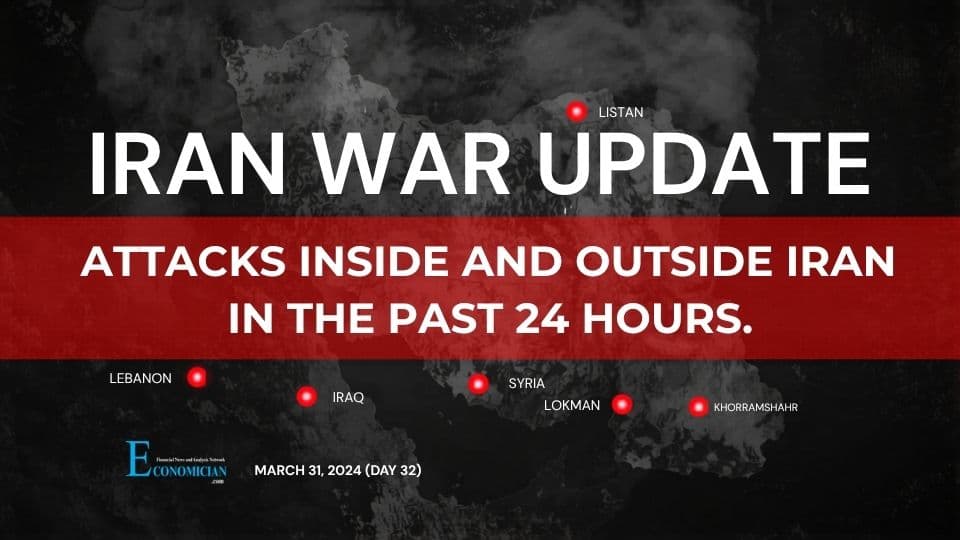
Iran remains under heavy bombardment by U.S. and Israeli air strikes targeting military and infrastructure sites. Power outages continued in Tehran and Karaj. Iran launched retaliatory ballistic missiles and drones at Israel and Persian Gulf Arab countries, including Kuwait and the UAE. The conflict shows no sign of abating. Missile exchanges and local skirmishes in Lebanon and Gaza also continued.
Key Timeline
- 2026-03-30 07:38: Iranian state media confirmed that IRGC Navy Commander Admiral Alireza Tangsiri died following severe injuries sustained in an Israeli airstrike.
- 2026-03-30 19:06: A White House official said the U.S. military was prepared to curtail any Iranian attacks after IRGC threats to U.S. companies.
- 2026-03-30 21:00: Pakistan’s Foreign Minister Ishaq Dar said Islamabad was ready to host and facilitate meaningful talks between the United States and Iran.
- 2026-03-31 00:00: Overnight reports cited explosions in Tehran, Karaj, Shiraz, Qom, Abadan, and Tabriz, with Iranian media noting strikes on power and industrial sites.
- 2026-03-31 01:00: Iranian energy officials reported shrapnel damage to the Alborz power grid, causing several hours of blackout in parts of Tehran and Karaj.
- 2026-03-31 07:38: U.S. sources confirmed Admiral Tangsiri’s death from Monday’s strike.
- 2026-03-31 10:00: Analysts noted continued Iranian missile and drone barrages against Israel and Persian Gulf targets, while Israel also carried out fresh strikes on Iranian infrastructure.
- 2026-03-31 19:02: Reuters reported that the White House reiterated U.S. readiness to stop any Iranian attack.
Attacks Inside Iran in the Last 24 Hours
Targers
- Tehran and Karaj
Security sources reported explosions and extensive damage to the electricity infrastructure. The Alborz grid was hit by missile fragments, causing a multi-hour blackout in parts of Tehran and Karaj. The targets appeared to include power substations and possibly defense research facilities. No casualty figures were available. Attribution was to U.S.-Israeli airstrikes, while Iran’s government blamed Israeli drones and missiles.
- Shiraz
Witnesses reported several blasts in early morning strikes on the city. Iranian state media gave few details, but observers said the strikes likely hit military technology sites, including facilities linked to the local Electronics Industries complex, which had been targeted before.
- Qom
Officials reported at least one strike near Qom, which remains both a religious and military center. Details on damage or casualties were not specified. State-linked reporting referred to the location as a defense site with unspecified impact.
- Abadan
Iranian media and observers reported explosions near the Abadan oil refinery. Separately, Persian Gulf officials reported that Iran struck Kuwait’s power and desalination plant on Monday, killing one Indian worker and wounding 10, describing it as a retaliatory attack. That broader context underscored the importance of oil-related infrastructure in the current escalation.
- Tabriz
A missile strike set fire to a unit of the Tabriz Petrochemical plant on Monday. Fars News later said the blaze was completely contained and that there were no deaths. This followed earlier strikes in recent days on Iranian chemical and missile-related facilities.
- Other Affected Cities
Karaj, Shiraz, Qom, Abadan, and Tabriz were all named by regional reporting as locations attacked in the last 24 hours. In each case, the targets were described as military or dual-use, including oil storage, defense factories, and infrastructure sites. Iran blamed Israel for the strikes. Israel said it was targeting military infrastructure across Iran, although independent verification remained limited.
Weapons and Damage Assessment
For the incidents above, the weapon types were believed to be air-launched missiles or drones fired by Israeli and possibly U.S. aircraft. Some open-source analysts pointed to Israeli F-35s and U.S. B-2s operating in the region. Casualties inside Iran from these latest strikes had not been independently confirmed. Iranian reports said damage was minimal or that there were no deaths at most sites. The wider month-long conflict, however, had already produced much higher casualty totals.
Attacks and Incidents Outside Iran in the Last 24 Hours
Israel
Iran fired ballistic missiles and drones into Israel overnight. One strike hit the Haifa Bazan oil refinery, causing a large fire. Israeli authorities said most threats were intercepted, but one rocket reportedly hit a civilian area near Beit Shemesh, injuring a 10-year-old girl. In response, Israel conducted fresh air strikes on Iranian military sites in Tehran and the Isfahan region.
Persian Gulf States
In Kuwait, an Iranian drone or missile struck a power-and-water plant, killing one worker and wounding 10 soldiers, according to state-run KUNA. Kuwait condemned what it called sinful Iranian aggression and reported intercepting several incoming drones.
Saudi Arabia said its air defenses intercepted five Iranian missiles targeting the Kingdom’s Eastern oil province.
In waters near Dubai, the Kuwaiti tanker Al Salmi caught fire after what was described as an apparent Iranian drone strike. Authorities later said the blaze had been extinguished.
Other Theaters
Attacks in Iraq and Syria continued at a lower informational tempo, including reports of Iran-backed militia rocket fire at U.S. bases, though U.S. forces reported no new casualties. Airstrikes tied to the wider war were also reported in Lebanon and Gaza, reflecting the broader regional battlefield.
Operational Meaning
Iran’s actions outside its borders appeared aimed at pressuring Israel, demonstrating regional reach, and raising the political cost for Persian Gulf states hosting U.S. forces. The main weapon types included ballistic missiles, rockets, and attack drones. Outcomes included damage to oil and power infrastructure, some civilian and soldier injuries, and a rising regional alert level.
Targeted Assassinations in the Last 24 Hours
The most notable targeted killing was Rear Admiral Alireza Tangsiri, commander of Iran’s IRGC Navy. Iran’s Revolutionary Guards confirmed on March 30 that he died of wounds sustained in an Israeli airstrike. U.S. officials privately confirmed the strike and said it killed Tangsiri. There was strong evidence that an Israeli drone or missile hit Tangsiri’s convoy or compound in southern Iran during day 28 or 29, although Israeli authorities did not publicly comment.
Tangsiri was a key figure overseeing missile forces in the Strait of Hormuz, and his death was seen as a major blow to Iran’s naval command structure.
Official Statements in the Last 24 Hours
Iranian Government and IRGC
The IRGC said it would target U.S. companies in the region as of April 1 in retaliation for attacks on Iran.
Iranian Foreign Ministry spokesman Esmail Baghaei called U.S. demands excessive, unrealistic, and irrational, rejecting reported terms for ending hostilities.
Iranian Parliament Speaker Mohammad Bagher Ghalibaf warned that U.S. forces would be set on fire if they invaded Iran. These statements signaled a hardline resolve, with no formal ceasefire mechanism announced.
Israeli Government
Prime Minister Benjamin Netanyahu said Iran was in a state of collapse and argued that Israel had taken down high-value targets deep inside Iranian territory. The IDF said it was striking military infrastructure across Tehran and Isfahan provinces. Israeli defense officials also confirmed the killing of Iran’s top naval commander and framed it as a self-defense action.
United States
The White House said the U.S. military was prepared to curtail any attacks by Iran. National Security spokesperson Karoline Leavitt said President Donald Trump might ask Persian Gulf states to help pay for the costs of the war. Trump also reiterated that he wanted Iran to reopen the Strait of Hormuz or face strikes on Kharg Island and additional oil infrastructure.
Regional Governments
Persian Gulf States
Kuwait, the UAE, and Saudi Arabia strongly condemned Iran’s attacks on their territory. Kuwait described the strike on its plant as sinful aggression. Saudi Arabia stressed its right to self-defense after intercepting incoming missiles. Persian Gulf states remained aligned in denouncing Iranian attacks on civilian and energy targets.
Pakistan
Pakistan’s Foreign Minister Ishaq Dar said Islamabad was preparing to host meaningful talks between the United States and Iran. The statement followed meetings with officials from Saudi Arabia, Türkiye, and Egypt and signaled Pakistan’s intention to play a mediation role.
International Organizations
United Nations
France called for an emergency UN Security Council session after three UN peacekeepers were killed in southern Lebanon. UN officials, including Antonio Guterres and Jean-Pierre Lacroix, condemned attacks on peacekeepers and said such incidents may amount to war crimes.
European Union
European officials said the EU stood in solidarity with Persian Gulf states facing Iranian airstrikes and drone attacks. The bloc repeated calls for de-escalation and said it was ready to support mediation efforts.
Human Rights and NGOs
Human Rights Watch reported that Iran was intensifying the recruitment of children for the war. No global organization formally endorsed either side’s strikes as lawful beyond general references to proportionality and international law.
International Reaction and Diplomacy
Persian Gulf Region
Kuwait confirmed that an Indian worker was killed in the Iranian strike on its power facility. Kuwait, the UAE, and Saudi Arabia activated civil defense measures, including warnings, alerts, and air defense operations. These states also reinforced security postures and held emergency meetings.
United Nations and Broader International Response
The UN Security Council held an emergency session after three Indonesian UN peacekeepers were killed in southern Lebanon in related fighting. Indonesia demanded a swift, thorough, and transparent investigation and pushed for UN action. The UN Secretary-General described the attacks on peacekeepers as grave violations of international law.
U.S. Military Deployment
The Pentagon was reported to be sending thousands of additional troops, including airborne and Marine units, to the region as a precaution and to support possible operations. The 82nd Airborne and other units were placed on heightened alert. No ground combat operation had yet been reported.
Diplomatic Moves
Pakistan, reportedly working alongside China, continued efforts to broker U.S.-Iran dialogue, but no date had been set. Iraq and Oman also offered to host talks if conditions allowed. Several European states and China offered good offices for deconfliction. No sanctions relief or ceasefire agreement emerged over the last day.
Economic and Maritime Pressure
Brent crude rose to around $115.93 a barrel as of 00:00 GMT on Monday. Insurance rates for shipping in the Persian Gulf climbed sharply. The FAA issued flight advisories for airlines operating in the Middle East. Coalition naval forces and regional coast guards remained on alert near the Strait of Hormuz and Bab-el-Mandeb, but no new maritime blockade was reported over the last 24 hours.
Geopolitical Analysis
Analysts warned that the war was intensifying across multiple fronts with no clear diplomatic off-ramp. The apparent aim of Israel and the United States remained the degradation of Iran’s military and technological core, including nuclear and drone-related programs. Iran, in turn, appeared to be broadening the battlefield by targeting Israeli infrastructure and Persian Gulf energy assets to raise international pressure and strengthen domestic resolve.
Escalation risks remained high. A misfired missile or broader proxy activation could draw in additional actors, including Persian Gulf states, NATO members, or larger external powers. The killing of Iran’s top naval commander suggested Israel was willing to target senior command personnel, raising the risk of retaliation at a higher level. Persian Gulf Arab states feared being dragged deeper into the conflict and appeared to be coordinating more closely with Washington.
Possible next steps included continued missile and drone exchanges, additional strikes on strategic Iranian infrastructure, and growing asymmetric activity by Iran through proxies, shipping disruption, sabotage, or cyberattacks. The pressure on energy markets was likely to continue. In the absence of a breakthrough in diplomacy, the risk of a wider confrontation remained substantial.
Major Incidents in the Last 24 Hours,
Mar 30 01:10Z — Tehran (Tochal-Velenjak area):
- Actor(s): Israel, suspected.
- Target: Defense R&D site, described as the Kian Pars hall.
- Weapons: Air-launched missile.
- Casualties/Damage: Building damaged; 0 reported killed in media accounts.
- Source: Iran International eyewitness reporting dated March 28.
Mar 30 18:30Z — Tehran/Karaj (Alborz):
- Actor(s): Israel/U.S., as claimed.
- Target: Power transmission grid.
- Weapons: Ballistic missile debris.
- Casualties/Damage: Multi-hour power cut; 0 reported killed.
- Source: Iranian Energy Ministry reporting carried by Iran International.
Mar 30 — Tabriz, East Azerbaijan:
- Actor(s): Israel, as claimed.
- Target: Petrochemical complex.
- Weapons: Air-to-surface missile.
- Casualties/Damage: Fire broke out; 0 killed reported after containment.
- Source: Al Jazeera.
Mar 30 — Abadan, Khuzestan:
- Actor(s): Unclear; Iran blamed Israel.
- Target: Oil refinery area.
- Weapons: Airstrike using missiles.
- Casualties/Damage: Infrastructure hit; casualties unreported.
- Source: Al Jazeera.
Mar 30 — Qom:
- Actor(s): Unclear.
- Target: IRGC-related facility, unspecified.
- Weapons: Airstrike using missiles.
- Casualties/Damage: Damage unspecified.
- Source: Al Jazeera.
Mar 30 07:30Z — Arak (Central Iran):
- Actor(s): Israel.
- Target: Heavy-water reactor at Khondab.
- Weapons: Airstrike, exact weapon unspecified.
- Casualties/Damage: Reactor knocked offline.
- Source: IAEA-linked reporting and Reuters-linked reporting referenced in the original report.
Mar 30 08:00Z — Haifa, Israel:
- Actor(s): Iran, including IRGC/Quds-linked attribution in reporting.
- Target: Bazan oil refinery.
- Weapons: Ballistic missile.
- Casualties/Damage: Fire at refinery; 0 publicly reported injuries in the cited material.
- Source: DAWN analysis.
Mar 30 08:15Z — Haifa region (Shefaram):
- Actor(s): Iran.
- Target: Civilian area.
- Weapons: Ballistic missile.
- Casualties/Damage: One civilian, a girl, was injured.
- Source: AP.
Mar 30 11:15Z — Kuwait (Al-Jabriyah):
- Actor(s): Iran.
- Target: Power and desalination plant.
- Weapons: Ballistic missile.
- Casualties/Damage: One worker killed and 10 soldiers wounded.
- Source: AP/KUNA, as cited in the original report.
Mar 30 23:30Z — Dubai Port:
- Actor(s): Iran.
- Target: Kuwaiti crude tanker Al Salmi.
- Weapons: Naval drone.
- Casualties/Damage: Tanker fire later extinguished; 0 casualties reported.
- Source: RFE/RL.
Notes on the Incident List
All times above are approximate. Actor attribution follows official statements or credible reporting cited in the original report. Where casualty or damage figures were not specified, they are kept as unspecified.
24-Hour Timeline
- 2026-03-30T07:38: Iran confirmed that IRGC Navy chief Alireza Tangsiri was killed in an Israeli strike.
- 2026-03-30T19:06: The White House said the U.S. military was prepared to thwart any Iranian attacks.
- 2026-03-30T21:00: Pakistan said it was ready to host talks between Washington and Tehran.
- 2026-03-31T00:00: Explosions were reported in Tehran, Karaj, Shiraz, Abadan, Qom, and Tabriz.
- 2026-03-31T01:00: The Alborz power grid was hit, causing blackout conditions in parts of Tehran and Karaj.
- 2026-03-31T07:00: The Arak heavy-water reactor was reported to have been knocked offline by strikes.
- 2026-03-31T08:00: The United States was reported to be deploying additional special forces and Marines to the region.
- 2026-03-31T12:00: Iran launched missiles toward Israel and the Persian Gulf, while oil prices remained elevated.
Targets Attacked in Iran Citizen Reports:
Citizen Reports from Vahid Online and Ilian
In the past 24 hours, reports gathered from the monitored Telegram channels Vahid Online and Iliaen pointed to a broad wave of attacks, explosions, fires, and military activity across multiple locations in Iran, alongside at least one reported attack outside Iran. The reports include official claims, eyewitness accounts, post-strike images, and descriptions of damage to military, security, and infrastructure-linked sites.
Key Takeaways
- A wide range of targets inside Iran were reportedly hit during the latest 24-hour period.
- Reported targets included missile-related positions, air-defense systems, security facilities, police infrastructure, militia-linked locations, and suspected logistics sites.
- Multiple reports centered on Tehran, Isfahan, Shiraz, Bushehr, Hormozgan, and other provinces.
- An official Israeli military claim stated that more than 120 strikes had been carried out against Iranian military-related assets.
- Outside Iran, a reported strike linked to the broader confrontation involved a large oil tanker near Dubai.
Main Report: Targets Reported Inside Iran
1) Tehran
Several reports pointed to direct or indirect attacks on security and defense-related sites in Tehran.
Reported targets and incidents:
- A Basij base on Ferdows Boulevard in western Tehran was reported as struck and damaged.
- Police Station 123 in Niavaran was shown in before-and-after imagery indicating heavy damage.
- A reported air-defense position on a rooftop in Tehran was shown being hit by a drone.
- Additional reports indicated air-defense activation in Tehran before or during the strike wave.
- Security forces were also reported in Saadat Abad / Kaj Square, suggesting elevated internal security deployment after the attacks.
Why it matters:
These reports suggest that the pressure was not limited to remote military infrastructure and may have reached security and defensive nodes in the capital itself.
2) Isfahan
Isfahan appeared to be one of the most important target zones in the reported strike cycle.
Reported targets and incidents:
- Missile-related positions around Isfahan, including areas near Mount Soffeh and Badr military airport, were described as heavily hit.
- An ammunition depot in Isfahan was reported to have exploded around 2:00 a.m.
- Multiple reports described strong explosions, fire, and visible damage in and around the city.
- Images were also shared describing missile positions near Isfahan being hit.
Why it matters:
Isfahan is strategically sensitive because of its military-industrial relevance. Repeated references to missile-related facilities and ammunition storage suggest the strikes were aimed at degrading offensive capability.
3) Natanz Area
The Natanz area was mentioned in unverified incoming reports.
Reported targets and incidents:
- A heavy explosion was reported around 21:17 near Targhrood, a location associated in the reporting flow with the broader Natanz area.
- The report described intense blast sound and shaking of windows.
Why it matters:
Even though these messages were described as unverified, any report tied to the Natanz area immediately draws attention because of the site’s strategic profile.
4) Shiraz and Surrounding Areas
Shiraz and nearby mountain areas featured in repeated reports.
Reported targets and incidents:
- A loud explosion near Shiraz was reported in the late afternoon.
- A later post mentioned three successive explosions around the mountains near Shiraz, with smoke visible.
- Additional citizen reports referenced an attack near Shiraz Airborne.
- Some unverified reports also linked strike claims to seminary-linked and dock-related points in the broader Shiraz discussion flow.
Why it matters:
The repeated mentions of Shiraz and nearby military-related areas suggest the strikes were not limited to one isolated location and may have included both urban-edge and defense-linked points.
5) Bushehr
Bushehr appeared in both direct and indirect strike-related reports.
Reported targets and incidents:
- An explosion near the Iran Marine Industrial Company (Sadra) was reported around 17:27.
- Separate unverified messages said fighter jets were heard over Bushehr and that two explosions occurred.
Why it matters:
Bushehr has clear strategic sensitivity due to its coastal and industrial profile. Reports tied to marine and logistics-linked sites are especially important in any escalation cycle.
6) Hormozgan and Coastal Areas
The coastal south also featured in the reporting.
Reported targets and incidents:
- An explosion in Sirik County was reported in the early morning.
- A fishing pier on Sirik Island was later said to be on fire.
- Additional reporting suggested disruption or strike-related activity along the southern coastal belt.
Why it matters:
Coastal and maritime points matter because they connect to shipping, logistics, military movement, and broader Persian Gulf risk.
7) Qazvin
Qazvin appeared in a cluster of unverified incoming messages.
Reported targets and incidents:
- Multiple successive explosions were reported in Qazvin around 21:24.
- Some messages suggested the strikes may have involved drones rather than jets.
Why it matters:
Even if unverified, clustered reports of repeated explosions across separate provinces strengthen the picture of a geographically broad strike wave.
8) Lordegan, Shahrekord, Khorramabad, Andimeshk, Nasimshahr, Izadshahr, and Shahinshahr
A broad set of locations appeared in incoming citizen reports tied to the same time window.
Reported targets and incidents:
- Lordegan: fighter jets heard overhead.
- Shahrekord: multiple aircraft or bombers reported crossing the sky.
- Khorramabad: jets reportedly passing through.
- Andimeshk / Nasimshahr / Izadshahr / Shahinshahr: explosions or heavy military air movement described.
- Several of these reports clustered around the period of roughly 21:00 to 21:25.
Why it matters:
Taken together, these accounts suggest the operation was perceived across a wide part of the country, even where exact targets were not confirmed.
Timeline Snapshot
Early Morning / Overnight
- Explosion and fire reports in Sirik County and Sirik Island
- Later reporting tied to missile-site and depot damage in Isfahan
Afternoon / Late Afternoon
- Explosion reported near Shiraz
- Explosion reported near Sadra / Bushehr
Evening Strike Window
- Large cluster of reports around 21:00–21:25
- Explosions or jet activity reported in:
- Isfahan
- Qazvin
- Lordegan
- Shahrekord
- Khorramabad
- Natanz-area vicinity
- Other locations mentioned in citizen messages
Following Morning
- Post-strike imagery and damage descriptions circulated for:
- Basij base in Tehran
- Police Station 123 Niavaran
- Air-defense position in Tehran
- Additional damaged sites in and around key provinces
What the Pattern Suggests
The overall pattern in the reporting suggests a multi-target, multi-region strike cycle rather than one isolated attack. The reported targets point to several operational priorities:
- Reducing missile-launch capability
- Damaging weapons-related production or storage
- Hitting air-defense systems
- Putting pressure on internal security infrastructure
- Extending pressure to maritime or logistics-linked points
At the same time, the reported tanker attack outside Iran indicates that the confrontation may be spilling beyond Iranian territory into the broader Persian Gulf security environment.
Reported Attack Outside Iran
Large Oil Tanker Near Dubai
The reporting also included one notable development outside Iran.
Reported target and incident:
- A large crude oil tanker near Dubai was reportedly targeted.
- The reporting attributed the attack to Iran-linked action in the context of the wider confrontation.
Why it matters:
An attack near Dubai carries broader implications for shipping risk, insurance costs, oil-market volatility, and Persian Gulf security.
Official Military Statement
One of the most important elements of the reporting flow was an official Israeli military claim.
Main points from the statement:
- The Israeli military said it had conducted more than 120 attacks in the previous 24 hours.
- The stated targets included:
- Ballistic missile launch platforms
- Weapons production facilities
- Air-defense systems
- The statement also emphasized continued efforts to degrade Iran’s offensive capabilities.
Why it matters:
This official framing aligns with many of the local reports mentioning missile infrastructure, security facilities, and air-defense positions.
Important Note on Verification
Not every incoming message in the monitored channels was independently verified. The report includes a mix of:
- Official military claims
- Post-strike images
- Eyewitness accounts
- Unverified citizen messages
Where the original reporting clearly framed a message as unverified, that uncertainty should be kept in mind.
Conclusion
The past 24 hours brought a significant escalation in reported attacks tied to Iran and the surrounding region. Inside Iran, the reported targets ranged from missile-related facilities and ammunition depots to Basij-linked sites, police infrastructure, air-defense positions, and maritime-linked points. Outside Iran, the reported targeting of a large oil tanker near Dubai added a wider regional dimension.
The breadth of locations, the timing concentration around the evening strike window, and the official claim of more than 120 attacks all point to a major coordinated phase in the confrontation.
FAQ
1. What happened in the past 24 hours?
Strikes continued across several Iranian cities, including Tehran, Karaj, Shiraz, Qom, Abadan, Tabriz, and Arak. Iran responded with missile and drone attacks on Israel and Persian Gulf targets.
2. What targets were hit inside Iran?
The reported targets included power infrastructure, petrochemical and refinery-related facilities, defense-linked sites, and the Khondab heavy-water reactor.
3. What happened outside Iran?
Iranian attacks were reported against Israel, Kuwait, and areas near the Persian Gulf, including the Haifa refinery, a site in Kuwait, and a tanker fire near Dubai.
4. Was there any targeted assassination?
Yes. Rear Admiral Alireza Tangsiri, commander of Iran’s IRGC Navy, was confirmed killed after an Israeli strike.
5. What did officials say?
Iran warned of retaliation, Israel said it was targeting military infrastructure, and the United States said it was ready to stop further Iranian attacks.
6. Is there any sign of de-escalation?
No clear sign of de-escalation was reported. Military exchanges continued, and no ceasefire breakthrough was announced.
-------------------------------
Verification and Source Framework
This report relied on a mix of Reuters, AP, Al Jazeera, Iran International, DAWN, RFE/RL, KUNA, Iranian state media, and IAEA-linked reporting. Where details such as casualties, target descriptions, or attribution remained unclear, they were described as unspecified.
Israel said its strikes targeted military infrastructure. Iran often described the same attacks as aggression against civilian or civilian-adjacent facilities. Casualty counts inside Iran in the latest 24-hour period remained incomplete and were not independently verified in several cases. The death of Admiral Tangsiri, however, was confirmed by both Iranian and U.S. sources.
Comments