 English
 پارسی


Executive Summary
Multiple high-impact escalations and market-moving policy moves were reported during the twenty-four to thirty-six hours spanning March 20–21, 2026 (UTC), which most major trackers describe as Day 22 of the conflict that began on February 28, 2026.
The most consequential operational development was Iran’s reported first use of long‑range ballistic missiles (around 4,000 km range)—two launches aimed at Diego Garcia—which Israeli officials framed as materially expanding the geographic risk envelope to include parts of Europe.
On the nuclear front, Iranian officials and Iranian media reported another strike on the Natanz enrichment complex with no radiological release detected, while international monitoring bodies said they were looking into the reports and reiterated calls for restraint around nuclear facilities.
Regionally, Israel reported renewed strikes tied to missile-production and missile‑storage infrastructure around the Tehran area, while Iran’s retaliatory fire was reported to have hit near Dimona, injuring a child severely and injuring “dozens” more according to Israel’s emergency medical service.
Strategically, the United States sent mixed signals: the President publicly floated “winding down” operations while simultaneously expanding deployment capacity in-theater (Marine expeditionary forces; carrier rotations) and pursuing extensive energy‑market interventions (sanctions waivers for Iranian oil at sea and large-scale Strategic Petroleum Reserve lending).
Diplomatically, G7 foreign ministers warned they were ready to act to protect energy supplies and maritime routes; the UN Secretary‑General publicly raised the possibility of UN involvement in a plan to reduce attacks and protect maritime passage; and Saudi Arabia escalated a bilateral rupture by ordering Iranian embassy staff—including the military attaché—to depart.
Markets reflected a “systemic shock” framing: Brent settled at about $112/bbl (highest settlement since mid‑2022 per Reuters), European gas volatility was described as extreme, and war‑risk maritime insurance capacity was explicitly expanded via a dedicated facility associated with a U.S. government-backed reinsurance plan.
Major Events
Confidence framework for events and casualties
This report labels each key incident with a confidence level:
- Confirmed: Directly attributed to an official statement or a clearly identified authoritative body (government, emergency service, UN agency) with no obvious contradiction in the same time window.
- Probable: Reported by major media citing officials or multiple credible sources; still limited by battlefield access, fog-of-war, or attribution uncertainty.
- Unverified: Reported primarily by a single party, state-affiliated media, or an adversary’s claim without independent corroboration in the available record.
Timeline of Major Events
All timestamps below are UTC. When the true “time of occurrence” is unclear, the timestamp reflects the time of publication/official statement and is marked as such.
March 20 (publication-time anchors capturing events occurring the same day)
- March 20 ~00:00–23:59 (occurrence window; reported later): Israel reported two large waves of air strikes on Tehran and central Iran, targeting weapons production facilities and sites storing ballistic‑missile launchers/components; Iran was reported to have launched multiple missile waves toward Israel (sirens in Tel Aviv and Jerusalem; a fragment reportedly landed near Jerusalem’s Old City with no injuries reported).
- March 20 (occurrence window; reported later): Kuwait’s state oil firm reported multiple drone attacks on the Mina Al‑Ahmadi refinery, setting some units alight.
- March 20, 14:29 (report time): Reuters reported deployment preparations of thousands of additional U.S. Marines and sailors to the Middle East, including a U.S. amphibious assault ship and associated MEU, with no decision announced on ground operations inside Iran.
- March 20, 17:12 (report time): Reuters reported a dedicated maritime war‑risk insurance facility becoming available for Hormuz transits, led by a major insurer in a U.S. government-backed maritime reinsurance plan.
- March 20, 22:32 (report time): Reuters reported the U.S. lent 45.2 million barrels from the Strategic Petroleum Reserve as the first batch of a larger plan coordinated with a broader IEA-aligned release effort.
- March 20, 23:09 (report time): Reuters reported a 30‑day U.S. sanctions waiver permitting sale/delivery of Iranian oil already “at sea,” with U.S. officials describing it as a price‑stabilization move during the war.
March 21 (publication-time anchors capturing events occurring the same day)
- March 21, 00:28 (report time): Israel reported it was striking Hezbollah targets in Beirut, following evacuation warnings for multiple neighborhoods; no immediate casualty report was available in the initial dispatch.
- March 21, 01:44 (report time): Reuters reported Iran’s foreign minister, in an interview with Kyodo, said Iran was ready to let Japan‑related vessels transit Hormuz under certain conditions; Japan did not immediately confirm the specifics in Reuters’ outreach.
- March 21, 04:40 (report time; events described as earlier the same day): Israeli military chief Eyal Zamir said Iran launched two long‑range ballistic missiles toward Diego Garcia; U.S. leadership simultaneously signaled possible “winding down” while urging other states to shoulder Hormuz policing.
- March 21 (morning; reported as “Saturday morning”): Iranian media (Tasnim and others) reported Natanz was targeted again, with no radioactive leaks reported; the nuclear watchdog said it was investigating.
- March 21 (reported same day): Iran’s missile fire was reported to have struck Dimona, badly wounding a child and injuring “dozens,” per Israel’s ambulance service; Israel is widely reported to maintain nuclear opacity around the nearby reactor area.
- March 21, 06:10 (report time): Reuters reported the EU urged member states to adjust gas storage targets and refill strategy after extreme volatility tied to energy‑infrastructure strikes.
- March 21, 06:58 (report time): Reuters published the G7 foreign ministers’ statement on safeguarding maritime routes and energy supplies, condemning attacks against civilians and infrastructure.
- March 21, 09:09 (report time): Reuters reported Saudi Arabia ordered Iranian embassy staff—including the military attaché—to leave within 24 hours, citing continued attacks on Saudi territory.
Timeline chart of major events
Major developments across March 20–21, 2026 (UTC) in the widely reported "Day 22" window
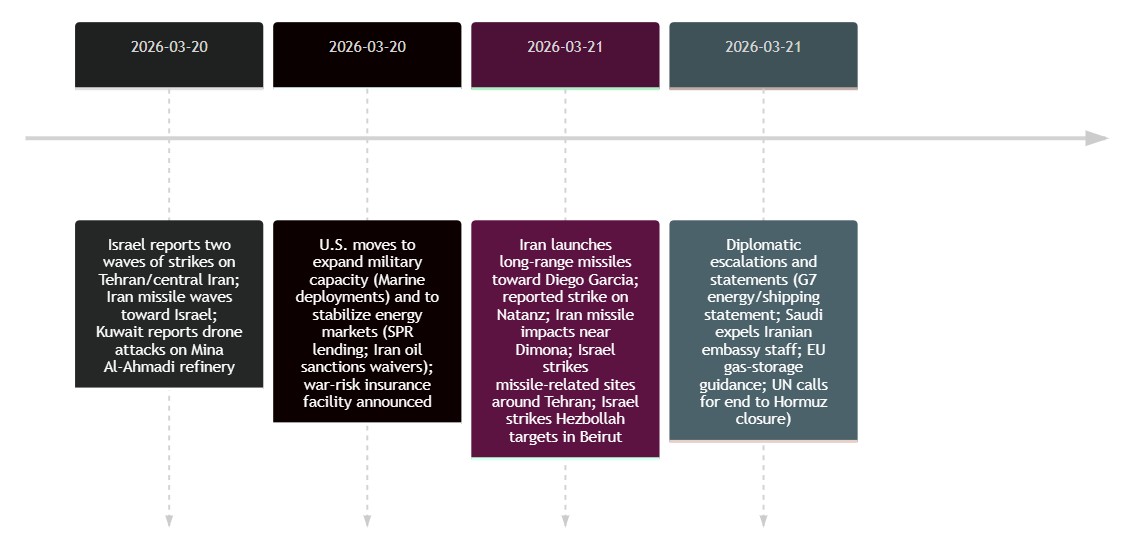
This chart is synthesized directly from the time-stamped reporting and official statements cited in the timeline section.
Strikes, Targets, and Casualty Assessment
Key operational patterns observed in this window
The Day Twenty‑Two window shows a pronounced bidirectional escalation pattern: Israel-focused strikes on missile and weapons‑production infrastructure (Tehran region and central Iran) paired with Iran’s expanding retaliatory envelope (including long‑range missiles aimed at Diego Garcia and continued missile/drone activity across Israel and parts of the Gulf).
Nuclear‑adjacent incidents and risk signaling
Iranian authorities and Iranian media reported an attack on Natanz with claims of no radiation leak and no danger to nearby residents, while the international nuclear watchdog indicated it was investigating and reiterated the hazard of military actions around nuclear facilities.
A notable dispute in attribution surfaced: Reuters reported Israel said it was unaware of the Natanz strike, while Iranian statements and media attributed it to U.S.-Israeli forces; the U.S. position in the cited reporting was not presented as a public confirmation for this specific incident.
Casualty verification constraints
Casualty and damage verification remains asymmetric: Israeli emergency services provide faster public casualty tallies for impacts in Israel, while independent verification inside Iran is constrained by access, competing narratives, and the heavy reliance on Iranian state/semi-official outlets for near-real-time reporting on impacts at sensitive sites.
Summary of reported strikes and impacts
Mar 20 (reported)
Incident/target: Air strikes in two waves on weapons-production and missile-related storage
- Alleged perpetrator: Israel (military statement)
- Time window (UTC): Mar 20 (reported)
- Location (city/facility): Tehran & “central Iran” (weapons production, ballistic missile components)
- Damage assessment (as reported): Targeted weapons production and missile launcher/component sites; detailed BDA not provided
- Casualties (killed/injured): Not specified
- Confidence: Probable
Incident/target: Missile waves; fragment impact near Old City
- Alleged perpetrator: Iran (police report on fragment)
- Time window (UTC): Mar 20 (reported)
- Location (city/facility): Jerusalem (fragment landed outside Old City); broader missile waves toward Tel Aviv/Jerusalem
- Damage assessment (as reported): Fragment impact documented; broader interception activity reported
- Casualties (killed/injured): No injuries reported (Jerusalem fragment)
- Confidence: Probable
Incident/target: Multiple drone attacks on the refinery
- Alleged perpetrator: Iran (attribution in reporting)
- Time window (UTC): Mar 20 (reported)
- Location (city/facility): Kuwait — Mina Al-Ahmadi refinery
- Damage assessment (as reported): Some units set alight; operational impact not fully quantified
- Casualties (killed/injured): Not specified
- Confidence: Probable
Mar 21 00:28 (report time)
Incident/target: Strikes following evacuation warning
- Alleged perpetrator: Israel
- Time window (UTC): Mar 21 00:28 (report time)
- Location (city/facility): Beirut (southern suburbs; Hezbollah targets)
- Damage assessment (as reported): Initial dispatch reports strikes; casualty reporting not immediate
- Casualties (killed/injured): No immediate reports (initial)
- Confidence: Probable
Mar 21 (reported; “first time”)
Incident/target: Long-range missile launches toward Diego Garcia
- Alleged perpetrator: Iran (as assessed by Israeli military chief)
- Time window (UTC): Mar 21 (reported; “first time”)
- Location (city/facility): Diego Garcia (U.S.-UK base)
- Damage assessment (as reported): Reported launch of two long-range ballistic missiles; intercept/failure details not in Reuters text
- Casualties (killed/injured): Not specified
- Confidence: Probable
Mar 21 morning (reported)
Incident/target: Strike on Natanz enrichment facility (no radiation leak reported)
- Alleged perpetrator: Reported as U.S.-Israeli (Iranian media/official claims)
- Time window (UTC): Mar 21 morning (reported)
- Location (city/facility): Natanz enrichment complex
- Damage assessment (as reported): “Targeted”; no radiation leak reported; extent of physical damage not detailed in initial claims; watchdog investigating
- Casualties (killed/injured): Not specified
- Confidence: Probable / contested attribution
Mar 21 (reported)
Incident/target: Missile impact in the Dimona area
- Alleged perpetrator: Iran
- Time window (UTC): Mar 21 (reported)
- Location (city/facility): Dimona (near nuclear reactor area)
- Damage assessment (as reported): Missile strike reported; context of nuclear proximity noted
- Casualties (killed/injured): Child badly wounded; “dozens” injured
- Confidence: Confirmed (injury count approximate)
Incident/target: Strikes on missile production sites; residential impact
- Alleged perpetrator: Israel (strikes)
- Time window (UTC): Mar 21 (reported)
- Location (city/facility): Around Tehran; Ramsar (residential building)
- Damage assessment (as reported): Missile production sites attacked; residential building strike reported
- Casualties (killed / injured): 3 killed (family) / injuries not specified
- Confidence: Probable
Incident/target: Strikes reported on the passenger terminal and the ship near the key oil-export hub
- Alleged perpetrator: Unclear (reported “strikes” in Iranian media)
- Time window (UTC): Mar 21 (reported)
- Location (city/facility): Bushehr passenger terminal; Kharg Island (empty passenger ship nearby)
- Damage assessment (as reported): Reported hits; scope and effect on oil export function not quantified
- Casualties (killed/injured): Not specified
- Confidence: Unverified
Incident/target: Drones fired at U.S. bases used for staging (claim)
- Alleged perpetrator: Iran (claim)
- Time window (UTC): Mar 21 (reported)
- Location (city/facility): U.S. bases in the UAE and Kuwait
- Damage assessment (as reported): Drone attacks claimed; confirmation not in cited dispatch
- Casualties (killed/injured): Not specified
- Confidence: Unverified
Diplomatic and Military Posture Developments
United States posture and stated objectives
The U.S. President publicly suggested the U.S. was nearing objectives and considering “winding down,” while pushing other nations to assume responsibility for policing Hormuz. Simultaneously, Reuters and other reporting described U.S. force posture expansion through additional Marine deployments and carrier rotations, and cited Pentagon-wide operational scale claims (e.g., cumulative strikes against large numbers of targets).
On the economic-security axis, U.S. officials explicitly framed sanctions waivers for Iranian oil already at sea as a tool to tame oil prices during the conflict, while separately executing large-scale Strategic Petroleum Reserve lending/swaps coordinated alongside an International Energy Agency-aligned drawdown plan.
Israeli posture and messaging
Israel’s defense leadership signaled expanded operations focused on degrading Iran’s strategic capabilities, while Israeli reporting emphasized strikes against ballistic missile production sites and sites storing missile launchers/components.
Iranian positions and diplomatic outreach
Iranian senior officials used outreach to major Asian energy consumers as both crisis management and signaling: Iran’s foreign minister told Kyodo Iran was ready to facilitate passage of Japan-related vessels through Hormuz, and Iran’s president communicated to India that ending the war required cessation of “U.S.-Israeli aggression,” while India emphasized shipping safety and infrastructure protection.
United Nations and multilateral responses
The UN Secretary‑General publicly called for an end to Iran’s closure of Hormuz and suggested UN participation in a plan to protect the waterway and de-escalate attacks.
At the maritime-security operational level, the UN shipping agency reported steps toward a safe corridor framework for evacuating merchant ships and highlighted the scale of seafarers “stuck” in the Gulf, alongside documented vessel incidents and seafarer deaths.
Europe and allied-group diplomacy
G7 foreign ministers issued a coordinated statement emphasizing maritime-route security and stable energy supply, condemning attacks against civilians and energy infrastructure.
In parallel, EU-level energy policy coordination reportedly shifted to flexibility: Reuters reported guidance to lower near-term storage targets and refill strategy amid price spikes and expected infrastructure repair timelines.
Key state reactions: Russia, China, Turkey, Gulf states
Russia’s President signaled political solidarity with Tehran in a formal message, while reiterating that the partnership lacks a mutual defense clause and that Moscow does not want Iran to obtain a nuclear weapon (as framed in Reuters’ report).
China’s foreign ministry said China would provide emergency humanitarian assistance to multiple affected countries and called for a ceasefire and de-escalation.
Turkey’s President warned the war must stop before the region is “thrown into the fire,” stated Ankara was engaging all sides, and Reuters reported NATO interceptions of missiles headed toward southern Turkey and subsequent defense reinforcement.
Among Gulf states, Saudi Arabia escalated diplomatic pressure by ordering Iranian embassy staff to leave and warned that continued attacks would have significant consequences; this followed broader Gulf exposure to missile/drone activity in the war’s reported regionalization.
Markets, Shipping, and Energy System Impacts
Oil and gas pricing
Reuters reported Brent May futures settled around $112.19/bbl on March 20 (the highest settlement since July 2022), citing the combined effect of supply disruption fears, Iraqi force majeure on foreign-operated fields, and escalating regional hostilities.
Reuters also described European gas prices surging sharply (reported up to 35% in the cited window) with the EU discussing demand and storage-management measures in response.
Shipping disruption and insurance mechanics
Commercial shipping through Hormuz was described as near-standstill in UN maritime reporting, with the IMO discussing a safe corridor framework and warning flag states about unnecessary risk exposure.
A major market-structure response emerged via war-risk insurance: Reuters reported a dedicated facility for war-risk hull/liability/cargo coverage for Hormuz transits, connected to a U.S. government-backed maritime reinsurance plan, aimed at restoring commercial movement under specified conditions.
U.S. market interventions: sanctions waivers and strategic reserves
Reuters reported the U.S. issued a 30-day waiver to allow the sale/delivery of Iranian oil already at sea (officially framed as introducing roughly “140 million barrels” into global markets), while also lending tens of millions of barrels from the Strategic Petroleum Reserve under swaps requiring oil payback with premiums.
Equity-market transmission
Market coverage in major financial media described broad risk-off moves tied to the Iran war and energy spikes, with large-cap U.S. indices declining on March 20 amid rising oil and geopolitical risk.
Humanitarian Situation and Data Gaps
Humanitarian conditions and protection warnings
The International Committee of the Red Cross issued a statement from its head of delegation in Iran describing severe strain on civilians, disruption of daily life in Tehran, and reminders that international humanitarian law requires protection of civilians, medical services, and humanitarian personnel.
The World Health Organization reported evacuations of hospitals, verified attacks on healthcare, and stated Iran’s health system remained functional but under heavy load, with significant death/injury counts reported as of mid-March and risks such as toxic smoke exposure (“black rain”) being monitored.
WHO also released emergency funds for health responses in neighboring countries affected by spillover and displacement dynamics.
Displacement and refugee-system strain
UNHCR operational reporting during March described large-scale displacement pressures across the region and continued border monitoring/protection modalities under security constraints.
Data gaps, conflicting claims, and explicit assumptions
Attribution disputes are acute around sensitive targets: reporting on the Natanz strike highlights competing narratives (Iranian statements and Iranian media attribution versus reported Israeli non-acknowledgment in the same window, with the U.S. not publicly confirming in the cited items).
Battle-damage assessments (BDA) for infrastructure inside Iran are frequently incomplete in near-real-time reporting, with “no radiation leak” statements more common than detailed structural or operational impact disclosures for nuclear facilities.
Casualty precision varies by geography. Israeli impacts are often accompanied by emergency service tallies, while casualty reporting inside Iran is more dependent on Iranian media, statements from domestic institutions, or later-stage international verification.
Comments