 English
 پارسی


Executive Summary
Over this window, the most consequential, well-sourced developments cluster into five threads:
- First, Iranian authorities and international monitors continued to dispute core death/arrest totals and accountability narratives. A UN Office of the High Commissioner for Human Rights press release dated February 20 records UN experts saying Iranian authorities have acknowledged 3,117 deaths and around 3,000 arrests, while human rights organizations estimate figures “in the tens of thousands,” and emphasizes that the true scale remains hard to determine amid restrictions.
- Second, the internal security environment remains tight, with UN experts describing continued internet restrictions (sixth week), limited “full” access for state-approved users, and reported street checks including phone searches for protest-related content.
- Third, student activity and memorialization surged as focal points of contention. A detailed Human Rights Activists News Agency bulletin posted February 20 reports seven protest-linked arrestees in Taleqan (Alborz Province) whose detention locations remain unknown. In parallel, opposition/outlet live reporting on February 21 described multiple campus gatherings in Tehran (including Sharif and Amirkabir) with confrontations involving Basij-affiliated groups; independent verification of specific videos remains limited, but the pattern is consistent with broader reporting on heightened campus security.
- Fourth, diaspora mobilization remained active, led rhetorically by Reza Pahlavi/Prince Pahlavi’s camp: an official statement dated February 20 frames “Global Day of Action” gatherings as peaceful and urges continued organized pressure on host-country decision-makers.
- Fifth, geopolitical escalation risks increased, driven less by new protest triggers than by high-stakes U.S.–Iran nuclear bargaining under coercive pressure. Reuters reporting on February 20 describes Iran preparing a counterproposal within days, while Donald Trump said he was considering limited strikes; the same reporting notes Iranian Foreign Minister Abbas Araqchi’s assertion that Iran published a list of those killed, and it records large discrepancies between official figures and civil-society estimates.
Scope and Methodology
This report treats “Lion and Sun” as an umbrella label for the current anti-government unrest and its diaspora-linked political symbolism, while noting that mainstream reporting frequently uses “Lion and Sun” in describing related symbols and mobilization.
Evidence was prioritized in this order:
- Primary / official: government statements and advisories (e.g., Serbia MFA guidance; Swedish foreign minister call; EU spokesperson remarks), and UN mechanisms (OHCHR press releases).
- Major international outlets with established verification processes (Reuters, AP, NPR, FT).
- Human rights organizations and structured reporting (HRANA; Amnesty), with explicit attribution and date-stamping because figures evolve and may be difficult to independently confirm during connectivity restrictions.
- Social media signals, only when (a) echoed by multiple outlets or (b) explicitly verified by a major outlet; otherwise flagged as unverified/uncorroborated.
A key constraint is that UN experts explicitly describe the continuing internet/telecom restrictions as obstructing verification and enabling information voids filled by forced-confession narratives and unverified reports.
Source comparison
The UN Office of the High Commissioner for Human Rights (Category: Primary (UN mechanism)) is strongest for officially dated statements, synthesis of allegations, and framing of verification constraints. Its key limitation in this context is that it does not itself “audit” casualty tallies and instead relies on available information and interlocutors.
Reuters (Category: Major international outlet) is strongest for time-stamped geopolitical decision-making and cross-sourcing from multiple capitals. Its key limitation here is limited direct access inside Iran, and it may repeat figures it cannot verify.
The Associated Press (Category: Major international outlet) is strongest for human-level reporting and verification of some user-generated content. Its key limitations are that coverage can be snapshot-based, and many claims remain difficult to confirm independently.
NPR (Category: Major outlet) is strongest for context on mourning rituals and intimidation dynamics. Its key limitation is that it often relies on sourced interviews and widely circulated posts when access is limited.
The Human Rights Activists News Agency (Category: Monitoring / NGO-media) is strongest for named arrest cases, structured listings, and a documentation focus. Its key limitations are that coverage may be incomplete, and verification inside Iran is constrained by communications limits.
Amnesty International (Category: NGO) is strongest for legal-risk analysis (including death penalty cases) and due process concerns. Its key limitations are that it may not provide exhaustive case lists and relies on documentation channels.
The Reza Pahlavi official site (Category: Primary (opposition figure)) is strongest for direct diaspora messaging and mobilization framing. Its key limitation is that it is an advocacy source (not neutral) and does not independently verify inside-Iran events.
Timeline and Event Log
The table below compiles time-stamped, source-visible events within the forty-eight hour window. An “hourly” reconstruction is not feasible from open reporting because (a) many events are not reported with precise times and (b) Iranian communications limits reduce real-time documentation.
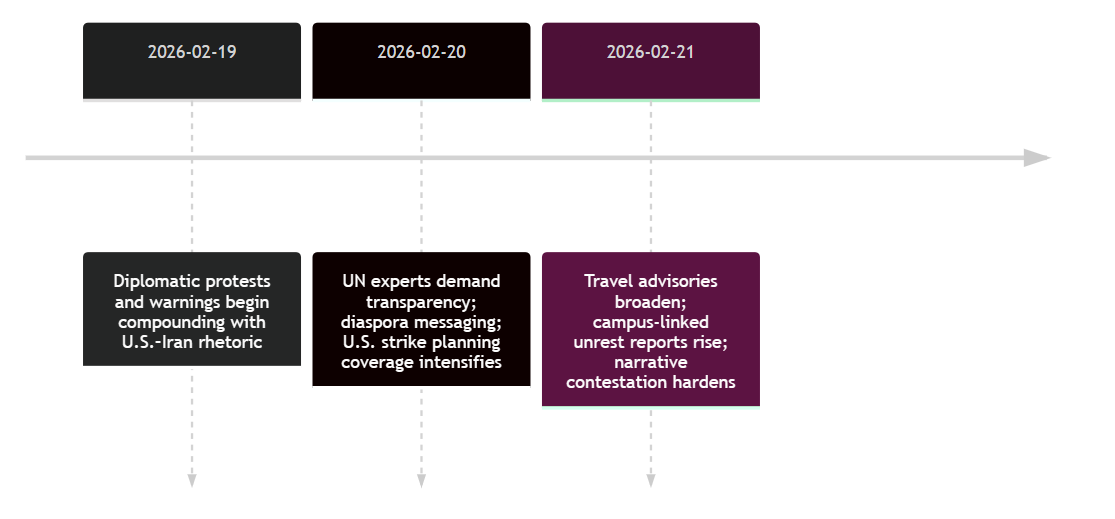
Forty-eight hour timeline
Feb 19, evening: Iran summons/disputes with European counterparts linked to diaspora mobilization (details vary by country and outlet). Domain: Geopolitics / diaspora spillover. Confidence: Medium.
Feb 20: United Nations experts call for disclosure of detainees’ fates and a halt to executions/death sentences linked to protests; note discrepancy between official and grassroots figures and continuing connectivity restrictions. Domain: Inside Iran / legal-human rights. Confidence: High.
Feb 20: Human Rights Activists News Agency (HRANA) posts that seven protest-linked arrestees were detained in Taleqan (Alborz Province); detention locations unknown; charges not specified. Domain: Inside Iran / arrests. Confidence: Medium-High.
Feb 20: Event: Reza Pahlavi statement frames “Global Day of Action” gatherings and urges organized pressure on host-country policymakers. Domain: Diaspora. Confidence: High.
Feb 20: Reuters reports Iran preparing a counterproposal after Geneva talks; Donald Trump says he is considering limited strikes; notes disputed death toll claims and HRANA death documentation figures. Domain: Geopolitics + protest-linked rhetoric. Confidence: High.
Feb 20: Reuters exclusive says U.S. planning options reportedly include targeting individuals and potentially pursuing leadership change; Iran warns of decisive response if attacked; notes a Russia-linked naval drill. Domain: Military posture / escalation. Confidence: Medium-High.
Feb 20: NPR reports authorities cracking down on mourning ceremonies and intimidating families seeking “fortieth day” memorials (chehelom). Domain: Inside Iran / humanitarian-social. Confidence: Medium-High.
Feb 21: Serbia issues an official advisory urging its citizens to leave Iran “as soon as possible” due to heightened tension/security deterioration risk. Domain: Regional response / consular. Confidence: High.
Feb 21: Sweden’s foreign minister along with Australia, Japan, Germany, and several European countries urges citizens to leave Iran; says MFA cannot assist evacuation; notes air/border exits still possible. Domain: Regional response / consular. Confidence: High.
Feb 21: Reports of campus protests and clashes in Tehran universities (Sharif University of Technology, Amirkabir University of Technology) involving Basij-affiliated groups; based on outlet-received videos and “circulating online” material. Domain: Inside Iran / protests. Confidence: Medium.
Developments Inside Iran
The inside-Iran picture in this window is best described as post-crackdown volatility: large-scale street mobilization is harder to observe and verify in real time, while memorial rituals, campus space, and arrests/legal actions are prominent flashpoints.
Protests, memorials, and campus activity
Independent and opposition-aligned reporting indicates that the first day of the new academic term saw renewed student gatherings in Tehran, including confrontations at Sharif University and street spillover near Amirkabir University, with reported detentions and blocked exits. These reports rely on videos “received” by the outlet; verification status is therefore partial (corroboration by multiple outlets exists, but full independent verification is not available in open sources).
Separately, major-outlet reporting continues to underscore the political role of chehelom mourning ceremonies and rooftop chanting as “lower-signature” forms of resistance after the January violence; AP describes memorial gatherings turning into protests and notes the difficulty of gauging shifts in support for opposition leadership from exile.
NPR reporting on February 20 highlights intimidation and disruption around mourning ceremonies, portraying them as a current target of state pressure.
Arrests, detention opacity, and executions
UN experts emphasize uncertainty over the fate and whereabouts of many detainees and warn that lack of transparency fuels unverified claims of secret executions and burial sites; they also cite reports of families being unable to locate relatives across hospitals, detention, and forensic institutes.
Within this window, HRANA reported seven named individuals detained in Taleqan after January protests, with detention locations still unknown and no charges reported as of its February 20 post—an example of granular arrest documentation but also of the information gap around custody status.
On death-penalty risk, Amnesty International stated on February 20 that at least eight individuals had been sentenced to death in February and that at least thirty individuals in total were facing death-penalty risk in protest-linked cases, including minors among those at risk. UN experts simultaneously urged Iran to halt death sentences and executions tied to the protests.
HRANA also posted (February 20) a separate note on executions of at least nine prisoners on murder/drug charges across multiple prisons, adding that these executions had not been officially announced as of its report; this item is not framed as protest-linked but is relevant to the broader climate of coercion and penal severity.
Casualty and arrest figures
The most authoritative “known” count in this window is the Iranian authorities’ acknowledged figure relayed through UN experts: 3,117 deaths and approximately 3,000 arrests. UN experts explicitly state that grassroots estimates are far higher and that the true scale is currently impossible to determine.
Reuters reporting embeds several competing figures (official, NGO, and political statements) and explicitly flags at least one high-end claim (32,000) as not immediately verifiable.
Casualty and arrest counts table (with attribution)
Iranian authorities (as relayed by UN experts): Deaths reported: 3,117. Arrests/detentions reported: ~3,000. Notes on scope and verification: UN experts present this as the official acknowledged figure; they stress the true scale is unclear and discrepancies persist. Confidence: High for “official claim,” Low for “true value”.
Human rights orgs (aggregate characterization by UN experts): Deaths reported: Unspecified (“tens of thousands”). Arrests/detentions reported: Unspecified (“tens of thousands”). Notes on scope and verification: UN experts describe higher estimates without endorsing a precise number. Confidence: Medium (existence of higher estimates), Low (precision).
HRANA figures (via Reuters): Deaths reported: 7,114 verified; ~11,700 under review. Arrests/detentions reported: Unspecified in that Reuters item. Notes on scope and verification: Reuters attributes the tally to HRANA and flags verification limits; arrests were not updated in that same passage. Confidence: Medium-High (documented methodology), Medium (precision under blackout).
Amnesty focus (death-penalty risk): Deaths reported: Not a death-toll estimate. Arrests/detentions reported: 30 individuals at risk of death penalty (case-count). Notes on scope and verification: This is a legal jeopardy measure, not a measure of total detentions. Confidence: Medium-High.
HRANA case report (Taleqan): Deaths reported: Unspecified. Arrests/detentions reported: 7 named detainees. Notes on scope and verification: Micro-level case documentation; detention locations unknown. Confidence: Medium-High.
Trump claim (via Reuters): Deaths reported: 32,000. Arrests/detentions reported: Unspecified. Notes on scope and verification: Reuters notes the figures could not immediately be verified. Confidence: Low.
Communications restrictions and cyber/communications environment (inside Iran)
UN experts state that internet restrictions are in their sixth week; “full” connectivity is reserved for state-approved users, while most users face severe restriction and reliance on expensive/difficult-to-obtain VPN access. They also report street checks with mobile phone searches for protest-related content and warn that state media broadcast what are widely regarded as forced confessions.
No well-sourced, discrete new nationwide shutdown “event” inside this forty-eight hour window was confirmed in primary sources reviewed; the dominant pattern is continued constrained connectivity rather than a newly announced embargo.
Humanitarian and social impacts
Inside Iran, reporting emphasizes persistent grief and social trauma. NPR describes intimidation around mourning rituals, and AP portrays continued rooftop chanting and politically charged memorial gatherings amid fear and worsening economic stress.
The Financial Times reports acute anxiety in Tehran (including panic buying and increased demand for anxiety medication) as the population experiences combined pressure from memories of recent conflict and renewed threats of external attack; it also reiterates the gulf between official and NGO death figures.
International and Diaspora Responses
External responses over this window were shaped by two interacting crises: the internal legitimacy and human-rights fallout from the crackdown, and escalating U.S.–Iran coercive diplomacy that is now influencing consular warnings and regional military posture.
United States, escalation risk, and military posture
Reuters reporting (February 20) states that Iran’s foreign minister expected a draft counterproposal within days after Geneva talks, while Trump said he was considering a limited strike as pressure; the same reporting records U.S. military planning reaching an advanced stage and, in an “exclusive,” discusses options that could include targeting individuals and even pursuing leadership change, while acknowledging the intelligence burdens and escalatory risks.
These developments were tied rhetorically—by U.S. leadership—partly to Iran’s internal violence, with Reuters noting Trump references to protest deaths while also flagging unverifiable claims.
European Union posture
A European Commission spokesperson is quoted warning that military escalation would have “heavy repercussions” for regional stability and reaffirming EU support for diplomacy, while also urging Iran to address international concerns.
Russia and China
Reuters reports Russia urging restraint amid U.S. military movements near Iran, noting Russia’s strategic partnership treaty with Iran (without a mutual defense clause) and referencing Russian naval activity with Iran in the Gulf of Oman. Reuters also reports Sergei Lavrov warning against any new U.S. strike, advocating diplomacy and cautioning about consequences.
For China, no major, time-stamped Chinese foreign ministry press statement on the specific February twenty-to-twenty-one escalation was captured in the primary sources reviewed within this window; however, Iranian state-linked reporting says Iran’s deputy foreign minister met Russian and Chinese ambassadors in Tehran to discuss Geneva nuclear talks—evidence of ongoing Tehran–Moscow–Beijing coordination in the immediate period.
United Nations and human-rights system response
UN experts’ February 20 press release is the most central multilateral human-rights document in the window, calling for transparency, locating detainees, halting executions/death sentences linked to protests, restoring telecommunications access, and enabling independent investigations.
On the geopolitical track, Reuters reports UN spokesperson statements encouraging diplomacy amid heightened rhetoric and increased regional military activity.
Consular warnings and regional risk perception
Serbia and Sweden issued strong, near-term warnings urging citizens to leave Iran, framing the situation as highly uncertain and warning that national authorities may not be able to conduct evacuations.
These advisories operationalize the perceived “near-term” risk of escalation in a way that is observable and time-stamped, even though they do not confirm that escalation will in fact occur.
Diaspora reactions and the Prince Reza Pahlavi / Prince Pahlavi channel
A February 20 official statement by Prince Reza Pahlavi addresses “Global Day of Action” gatherings, characterizing them as peaceful and calling on diaspora communities to continue organized, disciplined advocacy directed at host-country politicians and decision-makers. The statement does not enumerate cities, attendance figures, or specific policy asks beyond sustained political pressure and support for “aid to the people of Iran.”
Separate reporting indicates diplomatic friction in Europe linked to large diaspora demonstrations earlier in the week (not inside this forty-eight hour window), including ambassador summons and political controversy around European officials’ participation; the immediate relevance is that these reverberations continue within the current window as states manage protest diplomacy.
Information, Cyber, and Misinformation
Core narrative contestation: “terrorists” vs “protesters,” and the numbers war
UN experts explicitly warn that, amid restricted verification, state media have continued broadcasting what are widely regarded as forced confessions and that protesters are being labeled “terrorists” in ways that undermine fundamental rights narratives.
In parallel, Reuters documents the collision of three number sets: (a) Iranian authorities’ claimed deaths, (b) documented NGO tallies, and (c) political statements asserting much higher totals that Reuters says could not be verified at the time of reporting. This makes death and detention counts not only a humanitarian statistic but also a strategic information domain, where claims may be weaponized to justify repression, spur foreign pressure, or shape diaspora mobilization.
Social media signals with verification status
Campus videos (Tehran universities): This signal purportedly shows chanting and confrontations involving Basij-affiliated elements, alongside claims of detentions and blocked exits. Verification status is partial: it is reported by an outlet that says it received videos, and the material is described as “circulating online,” but it is not independently verified in primary documents. Supporting.
Memorial/chehelom videos: This signal purportedly shows large gatherings and chanting, and in some cases security forces firing tear gas. Verification status is stronger for specific clips: a major outlet notes verification for particular videos dated earlier this week, which remains contextually relevant to the current mourning cycle, though not a blanket verification of all circulating claims. Supporting.
Official advisories posted via X (Sweden FM): This signal purportedly shows an official government call for citizens to leave Iran, including limits on evacuation assistance. Verification status is high, as it is an official minister statement that is reported with quotations. Supporting.
Cyber operations and internet outages
Within the reporting reviewed, the best-supported cyber/communications claims concern persistent filtering and restricted connectivity rather than a newly documented cyberattack campaign or a discrete new nationwide shutdown “toggle” inside this forty-eight hour interval. UN experts’ statement is explicit that restrictions continue to impede verification and that connectivity is stratified by state approval.
No verified attribution to specific offensive cyber operations (state or non-state hacking incidents) was identified in the primary sources above for this window; this should be treated as unspecified, not as evidence that cyber operations are absent.
Confidence assessment for key claims
UN experts statement (Feb 20): Confidence: High. Basis: United Nations experts issued a February 20 statement calling for transparency, disclosure of detainee whereabouts, halting executions/death sentences, and restoring telecommunications, grounded in a primary UN press release with a clear date and detailed language.
Official casualty/arrest line relayed by UN experts: Confidence: High (as an official-claim report), Low (as ground-truth). Basis: Iranian authorities’ acknowledged figure of 3,117 deaths and ~3,000 arrests is presented as the official line cited by UN experts; the UN experts explicitly attribute these figures to Iranian authorities and flag verification limits.
Taleqan arrests (seven named individuals): Confidence: Medium-High. Basis: Human Rights Activists News Agency (HRANA) reported seven named individuals arrested in Taleqan with unknown detention location, based on a dated post that includes names but still lacks custody confirmation/access.
Consular advisories (leave Iran ASAP): Confidence: High. Basis: Sweden and Serbia urged their citizens to leave Iran as soon as possible, grounded in official government communications reported with direct quotations / official postings.
U.S. strike planning / Trump remarks: Confidence: Medium-High. Basis: United States strike planning reportedly includes options to target individuals, and Donald Trump is reported as considering a limited strike; the basis is Reuters reporting citing U.S. officials plus direct Trump remarks, while operational details remain unspecified.
“32,000 killed” figure: Confidence: Low. Basis: Reuters reports the figure was asserted by Trump, and notes it could not be immediately verified.
Near-term Scenarios and Indicators
The near-term outlook is dominated by two coupled escalation ladders: domestic repression vs renewed mobilization, and external coercive diplomacy vs military confrontation risk.
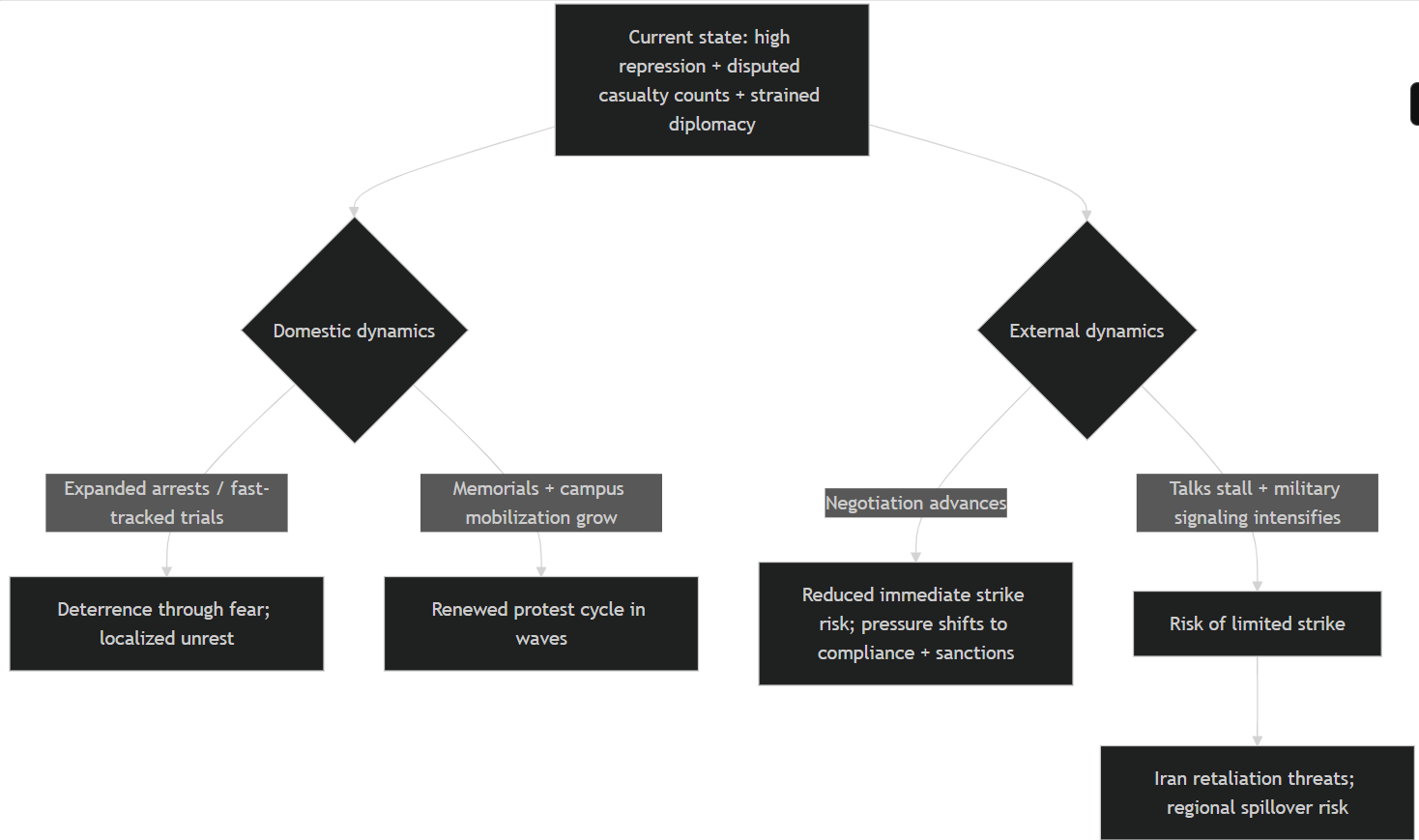
Scenarios
- Intensified internal securitization: Over the next days/weeks, this would look like more named arrests, tighter campus controls, expanded forced-confession media, and accelerated death-penalty case processing. Watch indicators include more HRANA-style name lists, more UN/NGO alerts on executions, official judiciary media releases, and reported phone-search checkpoints. Analytical confidence: Medium-High.
- “Memorial-to-protest” rebound: Over the next days/weeks, this would look like chehelom and commemorations becoming recurring mobilization sites, with campuses serving as organizing nodes. Watch indicators include verified large gatherings, repeated campus shutdowns, and consistent reporting across major outlets. Analytical confidence: Medium
- Diplomatic narrowing with reduced strike likelihood: Over the next days/weeks, this would look like Iran delivering a counterproposal, continued talks, and European Union plus United Nations emphasizing diplomacy. Watch indicators include public schedules of talks, moderated rhetoric, and fewer new travel warnings. Analytical confidence: Medium.
- Limited strike / rapid escalation: Over the next days/weeks, this would look like Donald Trump’s “considering” turning into an operational decision, Iran signaling a decisive response, and regional naval/air posture tightening. Watch indicators include additional urgent travel advisories, escalatory official statements, unusual airspace/flight restrictions, and heightened naval drill announcements. Analytical confidence: Medium (risk elevated, timing uncertain).
Comments