 English
 پارسی


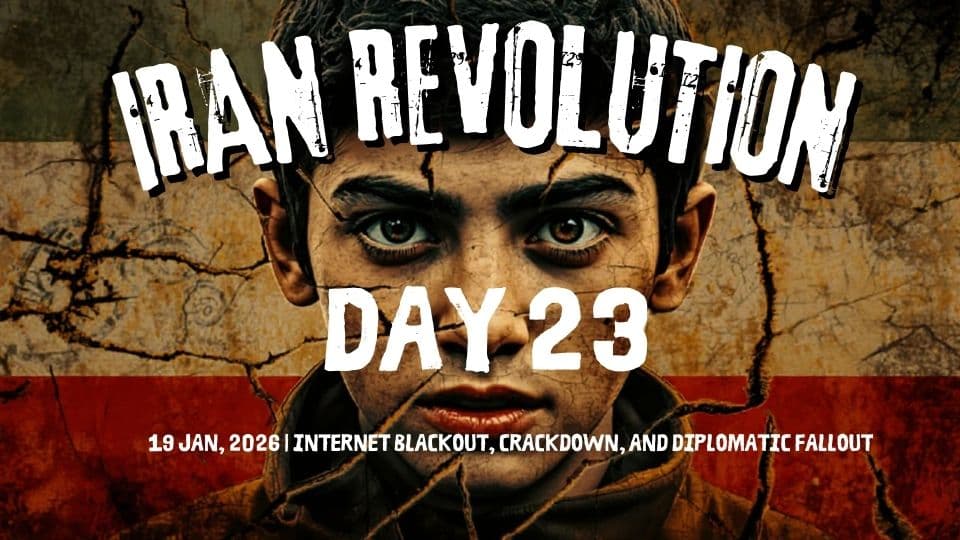
What happened inside Iran
Security pressure remained heavy across multiple provinces, with expanded checkpoints, intensified street presence, and reports of direct fire in several localities. The overall pattern was consistent with a “contain-and-deterrence” posture: saturate key urban corridors, disrupt mobility, and deter gatherings through rapid escalation.
Alongside the street posture, pressure on civil society and information channels tightened further. Iran’s Press Supervisory Board suspended the reformist daily Ham-Mihan over protest-related coverage—an additional signal that the domestic media environment is being narrowed as the authorities try to control the narrative.
Communications war:
internet blackout, satellite disruptions, and Starlink pressure
Iran’s internet shutdown—described as among the most extensive in the country’s history—continued to materially restrict public connectivity and commercial activity, with businesses reporting severe revenue shocks.
At the same time, the conflict spilled into satellite and alternative-connectivity channels. Reuters reported that Starlink has become a high-profile test case in Iran’s crackdown, with claims of jamming/spoofing efforts and heightened risk around detection of terminals.
Separately, Iranian state media-linked messaging framed recent broadcast disruptions as “signal interference” rather than a cyberattack, tying the incident to satellite operator Intelsat and describing it as a “signal war.”
Regime messaging:
“leniency” for some, harsher consequences for organizers
Authorities amplified a dual-track message: offer conditional leniency to “misled” participants while emphasizing severe penalties for leaders and instigators. International reporting highlighted the police chief’s three-day surrender ultimatum framed as compassionate treatment for those who turn themselves in.
International reaction:
Davos, Munich, and the U.N. track
Diplomatic isolation intensified in parallel with the domestic crackdown:
- World Economic Forum (Davos): WEF confirmed Iran’s foreign minister would not attend, saying it would not be “right” for Tehran to be represented amid the recent loss of civilian life.
- Munich Security Conference: Reuters reported the Munich Security Conference withdrew its invitation to Iran’s foreign minister in light of developments and the crackdown.
- U.N. Human Rights Council: Reuters reported the UNHRC will hold an emergency session on Iran following reports of “alarming violence,” with the document referencing at least 5,000 verified deaths according to Iranian authorities.
- France: Reuters quoted France’s foreign minister saying the crackdown could be the most violent in Iran’s contemporary history—an unusually stark public characterization from a senior European official.
In the political sphere, prominent voices—including Belgian MP Darya Safai—called for urgent international action, characterizing the events as a historic-scale massacre (a claim not independently verifiable under blackout conditions).
Prince Reza Pahlavi: latest messages and positioning
Prince Reza Pahlavi’s recent positioning centered on urging international pressure and appealing to security forces to stop targeting civilians. Reuters reported his call for the international community to ramp up pressure to help protesters.
His communications channels also amplified two specific themes during Day 23 coverage:
- Welcoming WEF’s decision to rescind the Davos invitation to Iran’s foreign minister.
- Promoting symbolic acts of defiance such as the raising of the Lion and Sun flag at memorial gatherings, including in Lordegan (as circulated via social media).
What to watch next
- Connectivity shift: whether the blackout transitions to a tightly filtered “internal internet” model, and whether restoration claims translate into measurable access.
- Legal escalation: speed and scale of prosecutions under the “leaders vs misled” framework and access to counsel amid reported restrictions.
- International institutional moves: outcomes of the UNHRC emergency session and follow-on mechanisms (mandates, funding, evidence preservation).
- Diplomatic platform denial: whether Davos/Munich actions trigger additional exclusions, sanctions momentum, or travel/legal risks for named officials.
Comments