 English
 پارسی


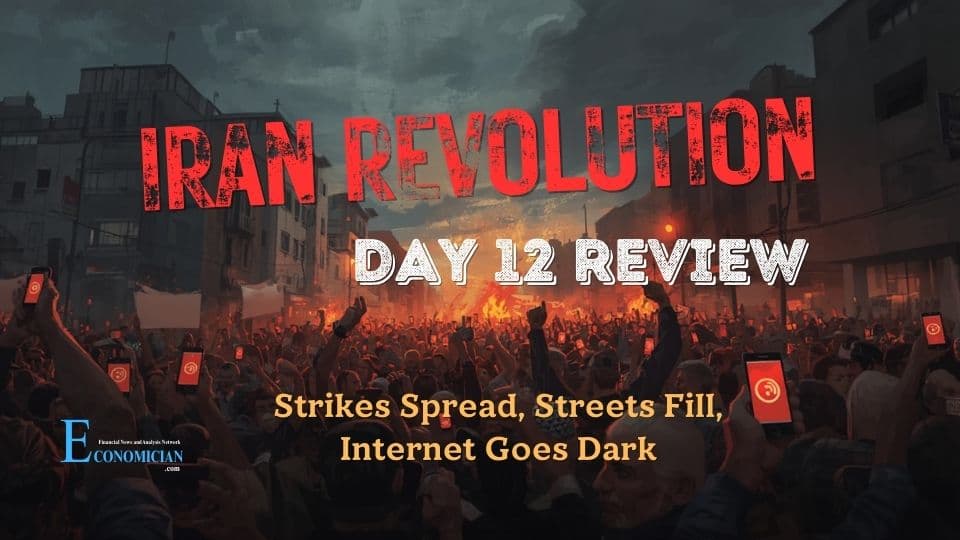
What happened on Day 12
Protest on the first day of the two-day invitation of Prince Reza Pahlavi, activity was recorded in at least 46 cities across 21 provinces, with Tehran seeing scattered gatherings across multiple neighborhoods, while many provincial centers reported street presence, chants, and localized clashes. Alongside street action, a wave of shop closures and bazaar shutdowns broadened the economic dimension of the protest movement.
A central feature of Day 12 was the regime’s effort to isolate the country digitally: monitoring groups and major infrastructure indicators showed a near-complete internet blackout, while HRANA and others also documented targeted disruption affecting IPv6 connectivity, a key layer used by modern mobile networks and many circumvention tools.
Where people came out: key locations and geographic spread
Tehran: multiple neighborhoods active; bazaar area under heavy security posture
In Tehran, reports described street presence and scattered gatherings across many districts, including Aryashahr/Sadeghieh, Narmak, Valiasr, Keshavarz Blvd, Yousef Abad, Azadi St (Eskandari), Tehranpars, Nazi Abad, Sattarkhan, Haft-Hoz, Gheytariyeh, Vanak, Punak (Esfahani Sq to Marzdaran), Kashani Blvd, Taleghani Sq, and Shahrak-e Azadi. Nighttime rooftop/home chanting was also reported in Heravi, with neighborhood-style activity noted in Saadat Abad and Jannat Abad, plus gatherings reported in Islamshahr.
HRANA also reported strikes and shop closures in/around the Tehran Grand Bazaar, alongside a security concentration around Sabzeh Meydan, Amir Kabir Street, and the metro corridor from 15 Khordad Station toward Naser Khosrow–Sabzeh Meydan.
Separately, international reporting described a large crowd forming on Ayatollah Kashani Boulevard in northwest Tehran as the evening mobilization built.
Provinces: 46-city footprint (reported on Day 12)
Across the country, protests and gatherings were reported in cities including: Sanandaj, Kermanshah, Marivan, Kamyaran, Ravansar, Sarpol-e Zahab, Saqqez, Mahabad, Paveh, Hamedan, Bukan, Isfahan, Bijar, Dehgolan, Piranshahr, Eslamabad-e Gharb, Ardabil, Ilam, Takab, Sarableh, Sarvabad, Qorveh, Lumar, Pir Bakran, Borujerd, Kerman, Kalachay, Shiraz, Abadan, Astaneh Ashrafieh, Gachsaran, Behbahan, Tabriz, Mashhad, Karaj, Babol, Dezful, Shahin Shahr, Gorgan, Ahvaz, Rasht, Damghan, Iranshahr, and Robat Karim (among others), with Tehran included as a central focal point.
Additional city tags circulating online (We could not 100% verify these clips, yet)
Alongside the above, social-media footage circulating during the night carried location tags from additional places (beyond the core HRANA list), including parts of Alborz Province (e.g., Fardis/Nazarabad) and several Khorasan localities (e.g., Quchan/Dargaz/Kashmar), as well as other towns referenced in citizen posts. These reports are harder to independently verify under blackout conditions, but they reinforced the sense of broad geographic dispersion.
Strikes and market closures: Kurdish provinces and beyond
One of Day 12’s defining signals was the widening of economic protest tactics. A general-strike push was reported across Kurdistan and other Kurdish-majority areas, with shopkeepers and merchants closing businesses in multiple towns and cities. International coverage described a strike call linked to Kurdish parties, and HRANA documented particularly strong strike participation across Kurdistan, West Azerbaijan, Kermanshah, and Ilam provinces.
The communications crackdown: internet blackout, international calls disrupted, IPv6 hit
Authorities moved aggressively to constrain information flows on Thursday night:
- Nationwide internet shutdown: Multiple outlets and monitoring indicators reported near-total loss of connectivity.
- International calls blocked: AP reported failed attempts to connect calls from abroad as Iran restricted inbound/outbound communications.
- Targeted IPv6 disruption: HRANA reported that Cloudflare Radar observed a roughly 98.5% drop in announced IPv6 addresses, with IPv6 traffic share falling from around 12% to ~1.8%, consistent with targeted interference that can degrade mobile internet, app connectivity, and many VPNs.
Casualties, arrests, and pressure tactics
HRANA’s Day 12 accounting reported:
- At least 60 additional arrests on Day 12, bringing totals to more than 2,277 detained across the first 12 days (including minors and university students).
- Death toll at 42 by the end of Day 12, including protesting civilians, minors, and security personnel/officers, while noting that injury totals remained difficult to compile under blackout conditions.
- Forced-confession broadcasts: HRANA also tracked broadcasts of forced confessions on state media over the course of the protest period.
Separately, AP reported a serious security incident earlier in the week in Chenaran (Razavi Khorasan), where an attack on a police station killed multiple people, including officials—an episode authorities pointed to as justification for a tougher posture.
Political mobilization and headline voices
Prince Reza Pahlavi’s call and its reach
Day 12 coincided with the first night of Prince Reza Pahlavi’s call for synchronized protest action. Iran International reported that his Instagram call video surpassed 80 million views by the morning of January 8, amplifying the mobilization narrative going into the evening.
Domestic and diaspora signals
- Shirin Ebadi described the moment as the broadest strike-and-protest alignment the Islamic Republic has faced, emphasizing cross-regional solidarity.
- Sardar Azmoun, a prominent national-team footballer, posted support for the public mood and the people’s well-being, according to Iran International’s reporting.
- Outside Iran, Iranian demonstrators rallied in The Hague, voicing pro-monarchy slogans in support of the protests.
International reactions
Day 12 unfolded amid intensifying foreign commentary:
- The U.S. House Foreign Affairs Committee issued a public warning framing accountability for violent repression.
- Germany’s foreign minister Johann Wadephul condemned excessive force and urged adherence to international obligations.
- In the European political sphere, HRANA reported statements of solidarity and urgency from senior European Parliament figures.
- Swedish MEP Charlie Weimers urged the EU’s foreign-policy leadership to meet Prince Reza Pahlavi as an opposition figure.
What to watch next (Day 13)
With the first night of coordinated calls completed under blackout conditions, the next 24–48 hours center on three variables:
- Strike continuity: whether market closures broaden or become sustained in key commercial hubs.
- Connectivity posture: whether the shutdown persists, shifts into selective throttling, or expands into new technical constraints.
- Security intensity: whether arrests and force levels accelerate as authorities attempt to preempt follow-on mobilization.
Comments