 English
 پارسی


What happened on Day 11
1) Street protests expanded and stayed active into the night
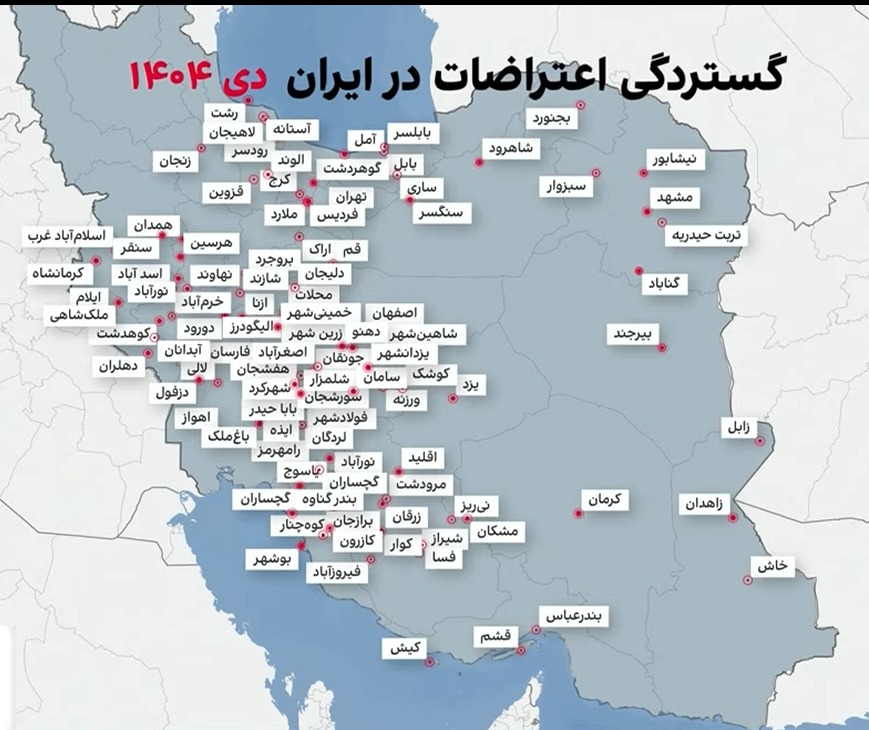
Based on circulating videos and on-the-ground reports (including material attributed to local witnesses and diaspora outlets), demonstrations continued through the evening in a wide set of cities, often featuring coordinated chants such as “Death to the dictator” and monarchist slogans. While independent verification remains uneven city-by-city, reputable tracking over the broader 11-day period indicates sustained geographic spread.
2) Tehran: tighter crowd-control around key nodes
Reports indicate heightened security pressure in parts of Tehran, with protest activity described in multiple neighborhoods. Separately, authorities restricted access to the Grand Bazaar area by suspending Line 1 metro stops at Panzdah-e Khordad station “until further notice,” a move widely interpreted as a crowd-management measure aimed at limiting inflows to the bazaar district.
3) South Pars corridor: labor action moved from grievance to solidarity
Two labor organizations reported walkouts/strike action by contract oil and gas workers in Asaluyeh and Kangan, explicitly framing the stoppage as solidarity with nationwide protests and demanding changes to contractor structures and working conditions. Reports also described security forces dispersing gatherings and using force, including direct-fire allegations in Kangan.
4) Information controls intensified
Iranian media reported severe slowdowns and, in some areas, outages affecting Tehran, Karaj, Isfahan, Shiraz, Mashhad, and Tabriz on the evening of Day 11—consistent with a broader pattern of tactical connectivity disruption during unrest.
Where protests were reported
(selected cities & localities mentioned in Day-11 feeds)
Tehran province
- Tehran: Shahrak-e Masoudieh (reported street clashes and tear gas), Shemiran/Nov-Tehran (street rally), Charsu area, Yaftabad furniture market (chants urging people to join), bazaar vicinity (access controls).
- Firuzkuh (chants reported in shared images)
Khorasan Razavi & North Khorasan
- Mashhad: crowds reported in Tabarsi-ye Shomali; additional symbolic actions reported (e.g., flag removal claims).
- Firiman: large crowd reported chanting “Reza Shah, your soul be happy.”
- Gonabad: clips described protesters entering a local seminary briefly before continuing demonstrations elsewhere.
- Nishapur: night clashes/tear gas and gunfire sounds described in circulated videos; a separate report later described the death of Akram Pirgozi (18 Dey / Jan 8) after being shot during protests and dying in hospital.
- Chenaran: protests reported in circulated images
- Ashkhaneh (Samalghan county): footage captions claimed protesters “took the governorate”
Fars province
- Shiraz: neighborhood protests reported (including Bahonar Street graffiti);
- Koh-Chenar / Chenar Shahijan: claims of symbolic action against a Soleimani statue circulated.
Zanjan province
- Abhar: tear gas use reported in shared clips.
Qazvin province
- Qazvin (Zibashahr) and Eqbaliyeh: reported street confrontations; claims of security retreat under stone-throwing.
Lorestan province
- Borujerd: repeated night demonstrations reported;
- Aligudarz: repeated gunfire claims during night unrest.
Khuzestan & Bushehr
- Abadan: reports alleged direct fire at demonstrators.
- Asaluyeh / Kangan: strike-linked gatherings and clashes as noted above.
Gilan & Ardabil
- Rasht: protests reported continuing into the night.
- Astara: night rallies reported.
Sistan & Baluchestan
- Iranshahr: Iranian outlets reported an armed attack killing a local police post commander; a group later claimed responsibility, framing it as retaliation for crackdowns.
Detentions and fatalities: what credible trackers reported
(11-day cumulative)
HRANA reported that across the first 11 days, protests were recorded in 348 locations across 111 cities and 31 provinces, with 2,217 people reported arrested or identified (including both individual and mass detentions). HRANA also reported 38 total deaths, including 34 protesters (five under 18) and four security personnel, noting that injury counts remained incomplete due to limited field access.
The eternal martyrs of the Freedom Revolution
(updated to the end of the eleventh day of nationwide protests):
- Dariush Ansari Bakhtiarvand – Fooladshahr, Isfahan – Dec 31, 2025
- Amirhesam Khodayari Fard – Kuhdasht, Lorestan – Dec 31, 2025
- Ahmad Jalil Sarghaleh – Lordegan, Chaharmahal & Bakhtiari – Jan 1, 2026
- Sajad Valamanesh Zilaei – Lordegan, Chaharmahal & Bakhtiari – Jan 1, 2026
- Shayan Asadollahi – Azna, Lorestan – Jan 1, 2026
- Vahab Mousavi – Azna, Lorestan – Jan 1, 2026
- Mostafa Fallahi (15 years old) – Azna, Lorestan – Jan 1, 2026
- Khodadad Shirvani, son of Kakaghali – Marvdasht, Fars – Jan 1, 2026
- Ahmadreza Amani – Azna, Lorestan – member of Yazd Bar Association – Jan 1, 2026
- Ahad Ebrahimpour Abdali – Nourabad, Lorestan – Jan 1, 2026
- Ali Azizi Jafarabadi – Harsin, Kermanshah – Jan 2, 2026
- Erfan Bozorgi – Marvdasht, Fars – arm-wrestling champion – Jan 2, 2026
- Mansour Mokhtari – Marvdasht, Fars – Jan 2, 2026
- Mohammadghasem Rousta – Marvdasht, Fars – Jan 2, 2026
- Amirhossein Bayat – Hamedan – Jan 2, 2026
- Farshid Mokhtari – Yazdanshahr – Jan 2, 2026
- Reza Azimzadeh – Malekshahi, Ilam – Jan 2, 2026
- Mohammad Bozoneh – Malekshahi, Ilam – Jan 3, 2026
- Faraz Aghamohammadi – Malekshahi, Ilam – Jan 3, 2026
- Mehdi Emamipour – Malekshahi, Ilam – Jan 3, 2026
- Soroush Soleimani – Hafshejan, Chaharmahal & Bakhtiari – Jan 3, 2026
- Amir Mohammad Kouhkan – futsal coach and referee – Neyriz, Fars – Jan 3, 2026
- Taha Safari (15 years old) – Azna, Lorestan – Jan 2, 2026
- Latif Karimi – Malekshahi, Ilam – Jan 3, 2026
- Mohammad Nouri (17 years old) – Qom – shot in the chest with pellets – Jan 2, 2026
- Mohammad Maqdasi – Malekshahi, Ilam – Jan 3, 2026
- Saghar Etemadi (22 years old) – Farsan – Jan 3, 2026
- Hossein Rabiei – Qom – cause of death: military grenade thrown by regime forces – Jan 2, 2026
- Akram Pirgozi – Neyshabur – shot in the abdomen – Jan 8, 2026
- Reza Kadiourian – Jafarabad, Kermanshah
- Rasoul Kadiourian – Jafarabad, Kermanshah
- Reza Moradi – Azna, Lorestan
- Reza Ghanbari – Kermanshah
International reactions and external pressure
1) U.S. political messaging hardened
U.S. political statements continued to warn Tehran against lethal force on protesters, with related messaging amplified by diaspora-facing outlets.
2) Tehran condemned U.S. remarks as “interventionist”
Iran’s Foreign Ministry condemned U.S. comments as interference and framed them as part of a long-running “maximum pressure” campaign and psychological/media warfare.
3) Regional-security signaling: “not limited to post-action response”
Separate from the protest dynamic, multiple outlets reported a Defense Council/Supreme Defense body statement indicating Iran may treat “tangible signs of threat” as sufficient to justify action—language interpreted as deterrence signaling under heightened external pressure.
Travel warnings and consular posture
(highly relevant for diaspora audiences)
Government travel advisories remained restrictive and, in several cases, emphasized departure/avoidance due to unrest, detention risk, and the potential for rapid escalation:
- United Kingdom (FCDO): advises against travel and highlights detention risk, including for dual nationals.
- Canada: advises avoiding travel and notes risks including arbitrary detention and the volatile security environment.
- Australia (Smartraveller): maintains “do not travel”/leave-if-present style guidance and warns conditions can deteriorate quickly.
What to watch on Day 12
(Thursday, January 8, 2026 / 18 Dey 1404)
1) Coordinated nighttime chanting and broader labor spillover risk
Published dataset includes multiple mobilization signals pointing toward coordinated 20:00 chanting (street or rooftop/home-based) and further strike spillover, especially if South Pars actions broaden.
2) Kurdistan: strike call as a possible force multiplier
Your dataset also references a joint Kurdish-party call for a general strike in Kurdish regions on 18 Dey, which—if realized—could shift the day’s center of gravity from street-only protest toward economic paralysis.
3) Likely state response: security saturation + connectivity pressure
Given reported Day-11 internet disruptions and transport access controls, Day 12 risk is skewed toward:
- broader throttling/outages,
- targeted restrictions around bazaars/transport hubs,
- accelerated arrests under “no-leniency” rhetoric reported by major outlets.
Verification notes
This Day-11 report combines (a) your provided on-the-ground clips/text leads and (b) corroborating reporting from major wire services and recognized incident trackers. Where specific city incidents are based primarily on circulating videos or captions, they are presented as reported/claimed rather than independently verified.
Comments