 English
 پارسی


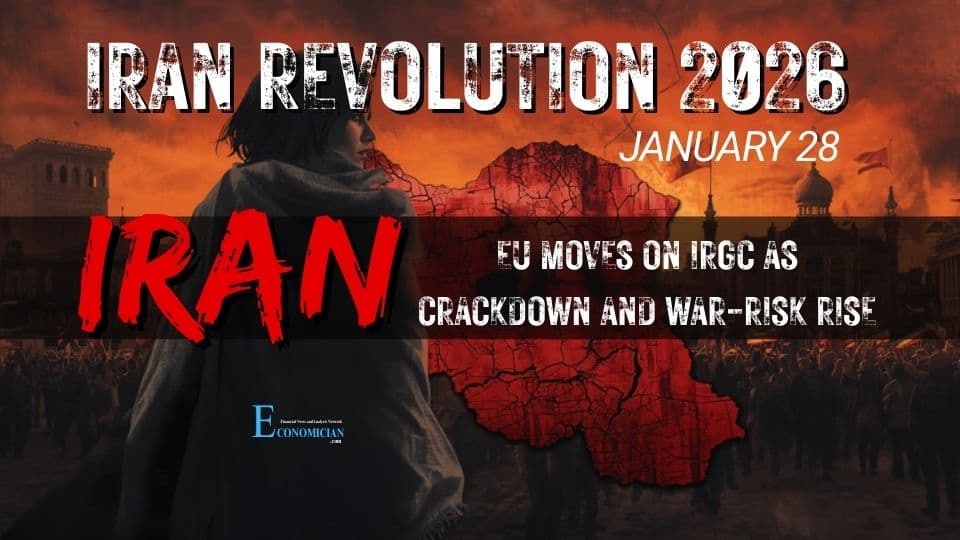
Iran Revolution 2026 — Day 32 (Wed, Jan 28, 2026) - Europe moves on IRGC as crackdown pressure and war-risk rhetoric intensify (Past 24 hours into Thu, Jan 29 ).
1) What happened inside Iran
(security, repression, information control)
- Competing casualty narratives sharpened. The government-side narrative continued to push a far lower official death toll, while independent and opposition-leaning reporting cited much higher figures. Iran International reported (citing what it described as confidential state data) that the true death toll exceeded 36,500, far above official claims.
- Pressure on families remained a central theme. In the past 24 hours, the Persian-language account of the U.S. State Department amplified allegations that families of victims are being forced to pay to receive bodies and are pressured to sign false “confessions”; Iran International also reported similar accounts of payments demanded for burial procedures and even fees to search cemetery lists.
- Execution risk messaging escalated. The U.S. State Department’s Persian account warned about the reported execution risk facing two young detainees (including a 19-year-old footballer), framing forced confessions and “disappearances” as part of a broader intimidation architecture.
- Internet restrictions stayed structurally tight. NetBlocks-style reporting continued to describe a “whitelisting” environment—more international visibility for some networks and data centers, but ordinary users still facing severe filtering and unstable access after weeks of disruption.
- Arrests and coercion cases kept surfacing. A notable example in the last 24 hours: reporting on the detention of a 27-year-old athlete (Omid Janami) following refusal to provide CCTV footage after mass-call days, underscoring the use of surveillance material and “non-cooperation” as enforcement triggers.
2) International reactions
(EU, U.S., UN) — condemnation hardens
- EU moved from debate to action. On Jan 29, EU foreign ministers approved new sanctions tied to the crackdown and signaled political momentum toward designating the IRGC as a terrorist organization—a major policy step requiring unanimity.
- France publicly backed the IRGC listing and framed Iran’s repression as intolerable, while also pointing to targeted measures such as asset freezes and travel bans for those linked to repression.
- European Parliament pressure went public. EP President Roberta Metsola posted that Europe has a “historic opportunity” and “moral duty” to designate the IRGC, emphasizing that the move is not symbolic.
- German chancellor rhetoric sharpened. Friedrich Merz reiterated that Tehran’s leadership’s “days are numbered,” explicitly tying that judgment to reliance on violence and terror against its own population.
- UN human-rights alarm stayed focused on executions. UN Special Rapporteur Mai Sato highlighted execution risk in at least one high-profile case and described the death penalty as a tool of fear—language consistent with broader concerns about using capital punishment to suppress dissent.
- U.S. State Department broadened the rights frame. Alongside family-coercion allegations, U.S. messaging emphasized intensified pressure on religious minorities, particularly Baha’is, as part of a recurring pattern of scapegoating during crackdowns.
3) Military/geopolitical backdrop
deterrence talk rises, “Hormuz” returns to the table
- Washington–Tehran messaging hardened. Reuters reported Trump weighing measures while warning Tehran amid the crackdown; Iran’s foreign minister framed Iran as ready to respond to aggression while also signaling a “fair” nuclear deal could be welcomed if it guarantees no nuclear weapons.
- EU’s IRGC move intersected with broader security concerns, including Iran’s regional posture and support networks—explicitly part of the EU political argument for tougher designation.
- Hormuz closure threats re-entered the discourse. Reporting highlighted statements attributed to senior IRGC Navy leadership suggesting Iran could block the Strait of Hormuz in war, explicitly linking the threat to global energy shock risk.
- U.S. force posture signals were reinforced in public discussion. Multiple outlets cited Secretary of State Marco Rubio describing 30–40k U.S. personnel at 8–9 bases in the region and the logic of retaining a “preemptive” option if an attack is imminent.
- OSINT aviation indicators increased. The War Zone reported on an RC-135 Rivet Joint landing at Al Udeid (Qatar), consistent with heightened ISR activity around the region. (Treat as open-source reporting, not official confirmation.)
- Israel–Saudi consultations were reported. Axios said senior Israeli and Saudi security officials traveled to the U.S. to discuss Iran-related scenarios—Israel focused on target intelligence; Saudi Arabia reportedly emphasizing de-escalation and mediation to avoid regional war.
- Iranian hardline deterrence lines stayed explicit on social media. Ali Shamkhani posted that any strike would be treated as war and threatened rapid, comprehensive retaliation, including against Tel Aviv and supporters of an attacker.
4) Opposition and political signaling
Internal splits and external lobbying
- Prince Reza Pahlavi’s diplomacy in Europe remained active. He described meeting the chair of the European Parliament’s Security & Defence Committee and argued a “free Iran” would reduce proxy-war spillovers, hostage-taking risk, and enable normal trade ties.
- In an interview with The Jerusalem Post, Prince Reza Pahlavi called for stronger global action against the IRGC and presented the uprising as directly relevant to international security, not only domestic Iranian politics.
- Narrative warfare: alleged IRGC-linked media guidance surfaced. Reporting described a leaked Tasnim “strategic center” memo advocating a line to portray Prince Reza Pahlavi as unstable and an “enemy tool,” illustrating the regime’s effort to fragment opposition legitimacy.
- Mir-Hossein Mousavi re-entered the field rhetorically. He urged armed forces to put weapons down, condemned the crackdown, rejected foreign military intervention, and proposed a constitutional referendum under a broad democratic front.
- A joint statement by activists/prisoners framed the killings as crimes against humanity, pressing political currents to clearly break from the regime.
5) Economic/market pulse
(what the last 24 hours signaled)
- FX stress stayed headline-level. Regional and international reporting continued to reflect sharp depreciation pressure in Iran’s currency market (with local trackers citing levels consistent with severe loss of confidence).
- Energy risk premium watch: Hormuz rhetoric + elevated U.S. posture + EU escalation (IRGC designation) is the mix most likely to feed into shipping insurance, freight rates, and crude risk premium—even without a confirmed kinetic event, because the tail risk is being repriced in narratives and deployments.
6) What to watch next (next 24–72 hours)
- EU implementation details: exact scope of sanctions (names/entities) and whether the IRGC designation reaches full unanimity and legal follow-through.
- Execution pipeline signals: any verified scheduling of executions or credible intervention outcomes.
- Connectivity regime: whether “whitelisting” becomes durable infrastructure vs. partial normalization.
- Hormuz/ISR tempo: more ISR flight patterns and naval signaling could precede either de-escalation talks or contingency planning.
Sources (selected): Reuters, Axios, UN OHCHR reporting via Special Rapporteur statements, EU/EP public posts, NetBlocks reporting, and cited media reporting including Iran International and major outlets.
Comments