 English
 پارسی


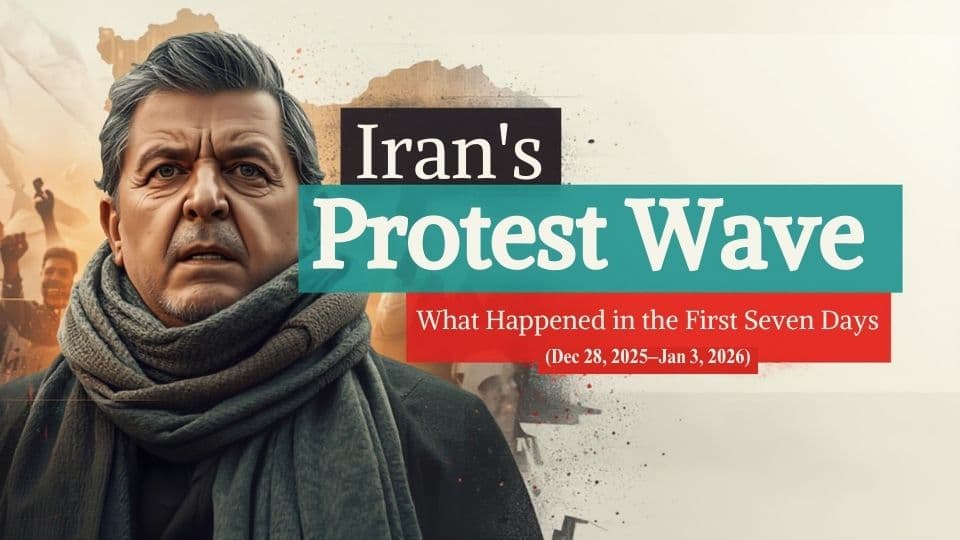
Key verified datapoints from week one
- Rial level: Reuters reported the open market rial at about 1,390,000 per USD during the initial shock period.
- Inflation pressure: Reuters cited 48.6% y/y inflation (October), reinforcing the purchasing-power squeeze.
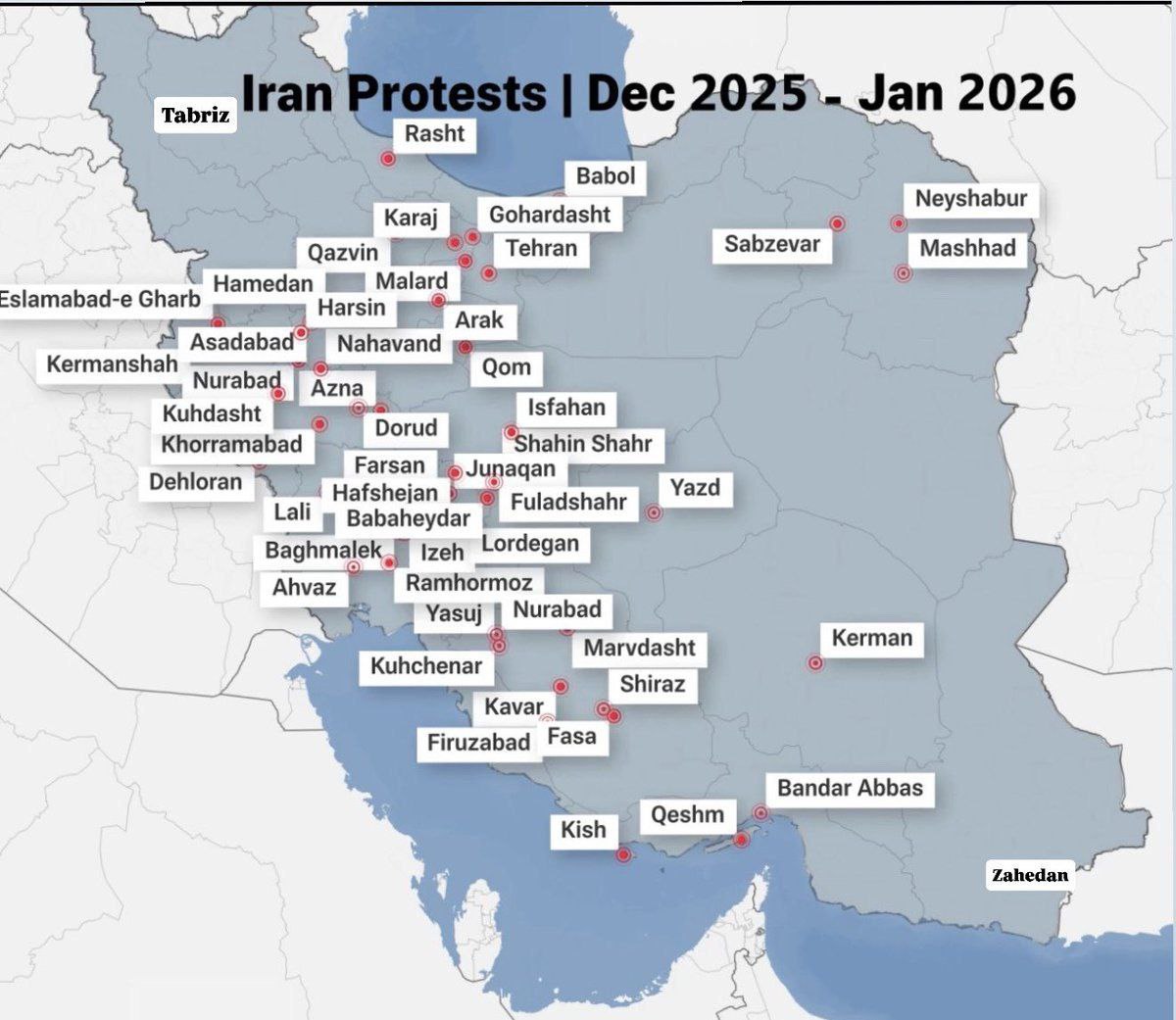
- Scale and footprint (HRANA): HRANA documented protests/strikes/gatherings in 174 locations, across 60 cities in 25 provinces, with 582 arrests and 15 deaths over the first seven days.
- Supreme Leader’s stance: AP reported Ayatollah Ali Khamenei’s first public comments framing unrest as distinct from “rioting,” warning that those he labels “rioters” must be “put in their place.”
- EU reaction: The EU said it was “concerned” by reports of deaths and violence and urged “maximum restraint,” while calling for the release of those detained for peaceful protest.
1) The trigger: a currency shock that turned into a cost-of-living backlash
Week one’s catalyst was straightforward: a fast-moving FX depreciation hitting an economy already living with high inflation and weak confidence. Reuters described the rial’s slide to record lows on the open market amid mounting frustration over prices and living standards.
That currency shock matters in Iran because it transmits rapidly—directly and indirectly—into import costs, supply chains, and household inflation expectations. The result, in week one, was a classic “confidence break”: economic pain became visible in the street, and the street’s reaction then fed back into perceived policy credibility.
2) How it spread: from bazaars to universities, and from Tehran to dozens of cities
Early reporting emphasized bazaar merchants and shop closures as an initial organizing channel—an economically potent mechanism because it disrupts local commerce and signals breadth beyond a narrow activist base. AP noted protests were occurring in major cities including Tehran, Isfahan, Shiraz, and Mashhad as the rial hit record lows.
By the end of the first week, HRANA’s tracking suggested a much wider geographic footprint and meaningful campus participation, including student protest activity across multiple universities.
This shift—commercial shutdowns plus student mobilization—typically indicates a protest wave is no longer only a price protest; it is also a legitimacy protest.
3) State response: heavier security posture, arrests, and allegations of forced confessions
Across week one, the security response hardened. AP reported at least 15 deaths, with authorities signaling tougher action following Khamenei’s remarks.
HRANA additionally reported hundreds of arrests and raised concerns about an increase in teenage detentions and the broadcasting of forced confessions—a pattern associated with deterrence-by-example and narrative control.
Separately, information controls became part of the operating environment. Al Jazeera reported Iran urged the UN to respond to Trump’s “reckless” threats and described the broader climate around the protests—where access constraints can complicate real-time verification and reporting.
4) Policy moves under pressure: central bank reshuffle and FX-regime messaging
Central bank governor replaced
A key week-one inflection was the leadership change at the central bank. Reuters reported that Central Bank Governor Mohammad Reza Farzin resigned as the crisis intensified, with state media indicating Abdolnaser Hemmati would replace him.
The Financial Times reported Hemmati’s appointment and described accompanying steps such as public holidays and shifting university instruction—officially linked to weather/energy constraints but widely viewed in context as tools to manage public space.
Ending subsidized FX handouts (policy signaling)
Iran International reported President Masoud Pezeshkian said the government would stop distributing a heavily subsidized exchange rate, criticizing the system for rent-seeking and weak household protection despite major fiscal cost.
If credibly implemented, reducing multi-rate distortions can improve allocation over time—but transitions are often volatile in the short run (repricing, enforcement shocks, and potential inflation pass-through).
Subsidy/e-voucher narrative
Published news also referenced a proposed expanded e-voucher (“kalaberg”) approach tied to removing preferential FX and paying household support through credit mechanisms. Public reporting broadly supports the direction of subsidy distribution reform tied to preferential FX changes, though the exact parameters you shared (per-capita amounts, phase sequencing, store counts) should be treated as program details “as reported,” pending official publication in a primary government document.
5) The international layer: restraint calls, UN letters, and escalating rhetoric
International responses in week one did not change facts on the ground, but they shaped the diplomatic narrative around legitimacy, human rights, and external interference.
- European Union: The EU urged restraint and emphasized rights to expression and peaceful assembly, including calls to release those detained for peaceful protest.
- UN escalation (Tehran’s posture): Al Jazeera reported Iran urged the UN to respond after Trump’s intervention rhetoric.
The strategic effect is less about immediate enforcement and more about raising the reputational and diplomatic cost of escalation—while also giving Tehran a platform to amplify its “foreign interference” framing.
6) What week one implies for the economy and near-term risk
Week one’s macro signal is not subtle: political risk premia are rising at the same time the economy is absorbing a currency shock and policy credibility is being tested.
Three channels matter most for early-2026 macro forecasts:
- Domestic demand drag: Bazaar shutdowns and widespread disruption risk a near-term hit to consumption and commerce. (Even brief closures can damage small business cashflow and local supply.)
- FX-to-inflation pass-through: A weaker rial—if persistent—raises import costs and pricing uncertainty, making stabilization harder without painful policy tightening or rationing.
- Policy credibility vs. coercion: A central bank reshuffle and FX-regime rhetoric can calm markets only if execution is believable. Conversely, a heavier coercive posture can reduce the space for flexible economic policy if the state prioritizes control over stabilization.
What to watch in week two
- Strike durability: Whether bazaar closures recur on set days (and whether other sectors coordinate).
- Campus momentum: Continuation or decline of student protests—often a key amplifier for nationwide mobilization (monitor for verified university-level closures, disciplinary actions, or detentions).
- Internet and information controls: Any confirmed broad throttling, targeted outages, or platform restrictions.
- FX regime execution: Concrete steps on preferential FX removal, enforcement, and banking-sector discipline; watch for secondary-market spikes if import pricing reprices.
- Fatality/arrest trajectory: Whether detention numbers and casualty reports accelerate (and how quickly official narratives harden).
Confirmed Names of People Killed During the First Week of Protests in Iran
- Taha Safari — A 15-year-old student killed during the Azna protests. He was originally from the village of Palangari in Kamfirozi County, Fars Province, and lived with his mother in the city of Azna.
- Amir Mohammad Kohkan — A futsal coach and referee from Neyriz, Fars Province.
- Hossein Rabiei — Killed by a grenade blast in Qom.
- Ahmad Reza Amani — A member of the Yazd Bar Association, killed by direct fire from security forces during protests in Azna on January 1, 1404.
- Farez Agha Mohammadi — Malekshahi County, Ilam Province.
- Mohammad Bezooneh — Malekshahi County, Ilam Province.
- Mehdi Imampour — Malekshahi County, Ilam Province.
- Mehdi Samavati — Killed in Fasa, Fars Province.
- Dariush Ansari Bakhtiarvand — A protesting citizen living in Foladshahr.
- Amir Hossam Khodayarifard — Kohdasht County, Lorestan Province.
- Mostafa Fallahi — A 15-year-old killed after being shot by security forces in Azna, Lorestan Province.
- Vahab Mousavi — Killed in Azna, Lorestan Province.
- Khodadad Shirvani — Son of Kakaqli, killed in Marvdasht, Fars Province.
- Shayan Asadollahi — Killed in Azna, Lorestan Province.
- Saghar Etemadi — 22, killed in Farsan.
Comments