 English
 پارسی


What happened on Day 9
1) Street protests persisted across multiple cities (nightly cadence, localized flashpoints).
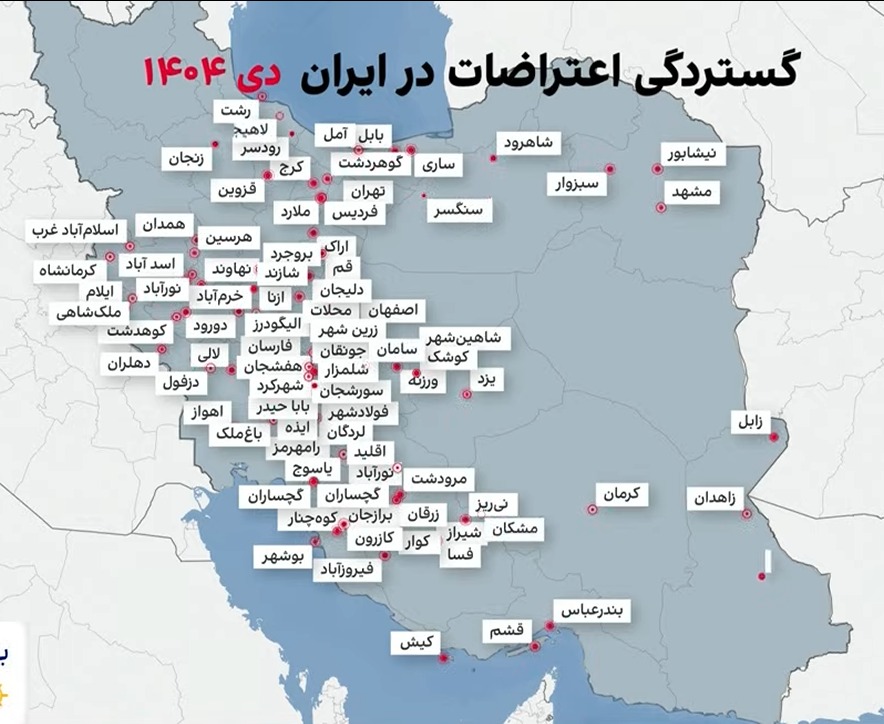
Persian-language reporting described protest activity and anti-regime slogans in locations including Tehran (Haft-Hoz, Dardasht), Sari, Khomeini-Shahr, Shazand (Arak), Sanandaj, Yasuj, Sonqor, and Mashhad (car-horn protests). The common pattern was short, mobile gatherings and chants—often escalating from economic grievances to direct leadership-targeting slogans.
2) University mobilization remained a key node, with arrests reported.
Videos showed Birjand University students marching and chanting; accompanying reporting said security forces entered the campus and detained students, including action linked to dormitory areas.
3) The crackdown narrative hardened—mass arrests, intimidation, and selective enforcement.
Beyond aggregate arrest figures, day-level reporting highlighted family-targeted arrests/raids in certain towns and pressure tactics against activists (threatening calls, account/SIM disruptions), consistent with a strategy aimed at deterrence and disruption of organizing.
4) Connectivity restrictions were acknowledged as protests continued.
Iran’s communications minister Sattar Hashemi publicly framed internet restrictions and outages as conditional (not “permanent”), tied to “security” considerations, while multiple outlets documented disruptions during the protest period.
5) Economic stress stayed at the center of the political crisis.
International outlets linked the protest wave to inflation and currency collapse pressures, including the resignation/replacement of the central bank governor amid a sharply weaker rial.
LIVE COVERAGE UPDATE
6) International messaging intensified (restraint calls + deterrence signaling).
The UN Secretary-General, via his spokesperson, said he is following events “with concern” and is “deeply saddened” by reported deaths and injuries, urging protection of peaceful assembly.
Separately, Israel’s Channel Kan reporting (carried by The Times of Israel) said Netanyahu relayed a message to Tehran via Putin that Israel does not intend to attack “at this time,” while warning publicly that any Iranian attack would have grave consequences—aimed at reducing miscalculation risk during heightened regional tension.
What is going on (assessment)
A protest-to-crackdown spiral is becoming the defining structure.
The movement is no longer only “cost-of-living” in its public messaging; it is increasingly explicitly anti-regime in slogans and demands, while the state response is shifting toward preemptive detentions, visible street deployment (motorized units), and information control.
The economic channel is acting as the accelerant.
Currency stress, inflation, and perceived policy failure are feeding a legitimacy challenge. The central-bank leadership change is a signal of pressure inside the system, but it does not by itself resolve the underlying drivers (sanctions constraints, inflation psychology, FX scarcity, and governance credibility).
Selective internet disruption is a key operational lever.
Official framing suggests restrictions will remain a flexible tool—tightened or eased depending on street conditions—implying continued volatility for communications, payments, and retail activity during peak protest windows.
Market impact (how this transmits)
- Iran FX / inflation expectations: Protest intensity + policy uncertainty typically widens the risk premium; leadership changes at the central bank can stabilize briefly but may not anchor expectations without credible FX/price measures.
- Local commerce and supply chains: Strikes/closures (when they occur) and connectivity disruption can hit transaction flow, deliveries, and small-business cash conversion—especially in large urban centers.
- Regional risk premium: Even de-escalatory messages (via Russia) coexist with deterrence language, keeping tail risks elevated for the broader region’s geopolitics and energy pricing sensitivity.
Protests as mapped by region
Comments