 English
 پارسی


Executive summary
Over the past 72 hours, the “Iranian national revolution” has entered a campus-centered phase, with sustained student mobilization across major universities in Tehran and other cities, confronting increasingly forceful state suppression. Reuters and the Associated Press report multi-day rallies, clashes with pro-regime groups including the Basij, and overtly political slogans—some explicitly endorsing exiled opposition figure Reza Pahlavi.
In parallel, Iran–U.S. tensions have tightened into a single crisis loop linking domestic repression, nuclear diplomacy, and military signaling. Negotiations are scheduled to resume in Geneva on Thursday (Feb. 26), with Abbas Araqchi leading the Iranian delegation and Reuters reporting a U.S. team including Steve Witkoff and Jared Kushner.
Washington has simultaneously expanded force posture near Iran at a scale described by the Washington Post as 150+ aircraft deployed to European and Middle Eastern bases, while Israel has received a rare deployment of at least 12 U.S. F‑22 stealth fighters as reported by Israel’s broadcaster KAN and corroborated in open-source flight-tracking described by The Times of Israel.
Human-rights reporting has shifted from “protest casualties” to “post-crackdown governance”: Human Rights Watch describes a “tsunami” of arbitrary arrests and enforced disappearances since Dec. 28, and UN experts have urged Iran to disclose detainees’ fates and halt protest-related executions. Specific high-profile cases now illustrate the pattern: Japan says a Japanese citizen has been detained in Tehran since Jan. 20 (reported by Radio Farda as an NHK bureau chief), and Iran International reports a detained retired Iranian soldier, Rahim Biniyaz, is at risk of a death sentence.
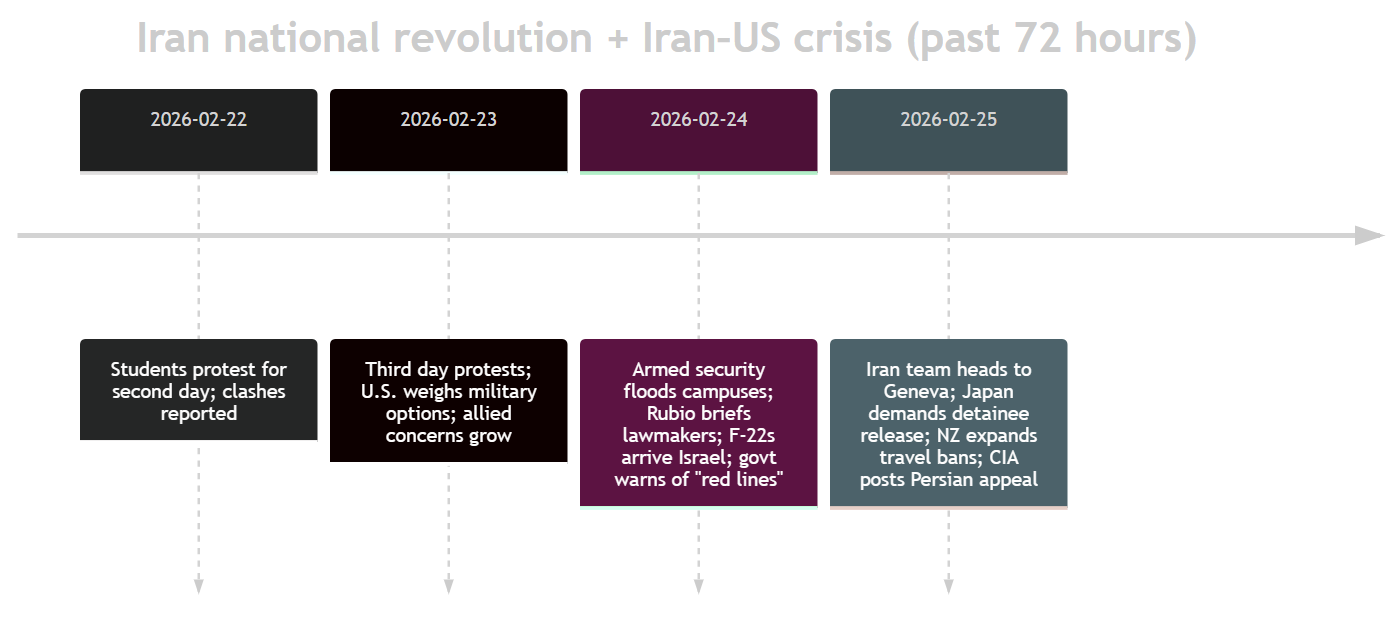
Past 72 hours timeline
- Sun, Feb 22:
Inside Iran, Reuters reported a second day of student protests and clashes at universities, while state TV framed the unrest as the work of “infiltrators” and showed injuries allegedly caused by rock-throwing. Outside Iran, diaspora mobilisation continued to build on earlier February “day of action” organizing, with monitoring groups noting ongoing coordination attempts. On the diplomacy and military front, U.S. posture continued to build, while Geneva talks were publicly anticipated for Feb 26.
- Mon, Feb 23:
Inside Iran, Reuters reported a third day of campus protests, including flags burned in Tehran, while broader public anxiety intensified as the U.S. began withdrawing some personnel from Beirut and weighed possible strike options. Outside Iran, UK-based Iranian protest networks amplified calls to proscribe the IRGC and close diplomatic missions, while diaspora media reported growing concerns over intimidation. In terms of diplomacy and military posture, the Washington Post reported that Joint Chiefs chairman Dan Caine warned of the risks of an Iran campaign, including constraints related to munitions and allied support.
- Tue, Feb 24:
Inside Iran, the Guardian reported that armed and plainclothes forces “flooded” universities, in-person classes were curtailed, and clashes broke out with Basij members at campuses including Tehran’s science and technology institutions. AFP also reported that Iran’s spokeswoman said protests are allowed, but “red lines” must not be crossed. Outside Iran, a London march of about 1,500 people (according to UK press) called for the closure of the Iranian embassy, and protesters urged the designation of the IRGC. On diplomacy and military posture, Rubio briefed top U.S. lawmakers (the Gang of Eight) as Trump toughened rhetoric, while the U.S. reportedly sent 12 F-22s to Israel.
- Wed, Feb 25:
Inside Iran, Iran International reported a fifth day of student protests, alongside new solidarity statements by labor and civil society groups and continued pressure on detainees. Outside Iran, Japan publicly demanded the release of a detained citizen, travel advisories expanded, and New Zealand announced broader travel bans on Iranian officials tied to repression. On the diplomacy and military side, Reuters reported that the Iranian negotiating team headed to Geneva, while U.S. posture remained at its “largest in decades” according to AP’s framing, and the CIA issued a rare Persian-language appeal for secure contact.
Mermaid timeline chart
Developments inside Iran
Campus protests become the movement’s organizing backbone
The dominant domestic event of the past 72 hours is the sustained wave of student demonstrations as universities reopened, with Reuters, AP, and the Guardian describing multi-campus rallies, clashes with pro-government groups, and increasingly explicit regime-change messaging.
Key locations and incidents repeatedly cited across reputable reporting include:
- Sharif University of Technology: Reuters and the Guardian describe confrontations with Basij and injuries among students; protest slogans included denunciations of the Supreme Leader and pro-Pahlavi chants.
- University of Tehran: The Guardian reports armed vehicles positioned outside; widespread moves to virtual learning and denial of entry to previously identified protesters.
- Al-Zahra University: Reuters and the Guardian describe protests and burning of flags; reporting notes symbolic actions aimed at delegitimizing the post‑1979 order.
- Shahid Beheshti University: Iran International and other outlets cite attacks by Basij/pro-regime groups and a heavy security footprint.
- Mashhad: Reuters and the Guardian report demonstrations extending beyond Tehran; Iran International describes continuing mobilization in the city’s institutions.
Multiple outlets emphasize that the protests remain largely “campus-contained” for now, but are politically radicalized compared to late-2025 price protests: slogans like “Death to the dictator” and pro–lion-and-sun symbolism are part of the reported repertoire.
Government response: “red lines,” prosecutorial oversight, and virtual lockdown
Iran’s first formal messaging during this phase has leaned on conditional permissiveness. AFP quotes government spokeswoman Fatemeh Mohajerani as saying students have the right to protest but must “understand the red lines,” with “sanctities and the flag” offered as examples.
Al Jazeera adds a judicial dimension: it reports that some students have already been suspended and that the prosecutor general’s office is overseeing cases, signaling a shift from ad hoc security responses to centralized legal containment.
Operationally, the Guardian and the Wall Street Journal describe a hybrid containment strategy:
- massing armed/plainclothes forces on campuses,
- restricting entry based on prior identification,
- shifting much of higher education to online instruction to deny gathering space,
- and relying on pro-regime counter-mobilization (Basij-linked) to provoke or delegitimize protesters.
The direction of travel is consistent with the state’s post-January objective: prevent protest “memorial cycles” (chehelom commemorations) from spilling into general strikes or street demonstrations—an echo of how memorial mobilization accelerated the 1979 revolution, as AP has noted in broader context reporting.
Detentions, due-process risks, and emblematic cases
The post-crackdown landscape is now defined by arrests, missing detainees, and death-penalty exposure.
System-level assessments
- Human Rights Watch says Iranian security agencies have carried out mass arbitrary arrests, including of children, and describes torture and enforced disappearances after January’s killings.
- Office of the High Commissioner for Human Rights reports UN experts urging Iran to disclose detainees’ whereabouts, halt protest-related executions, and address enforced disappearances and missing persons.
Emblematic cases in the past 72 hours
- Japanese journalist detention (NHK): Iran International reports that a senior director and bureau chief of NHK in Tehran was transferred to Evin Prison and held in Ward 7. Japan’s government confirmed a Japanese citizen detained since Jan. 20 and demanded swift release, while noting lack of in-person consular access.
- Death-sentence risk for Rahim Biniyaz: Iran International reports that the detained retired army member is at risk of a death sentence after pro-protest messaging and organizing, including a period of enforced disappearance and transfer to Kermanshah.
Civil society and labor: solidarity statements harden the moral frame
Despite heavy repression, civil society actors are publicly aligning with student protests.
- A nationwide truckers’ organization, Union of Truckers and Drivers Associations across Iran, issued a statement supporting student protests and declaring it would not forgive violence and assault against students by security forces.
- Teachers’ civil society groups echoed this stance: Iran International reports statements warning that student repression fuels “hatred” and social fragmentation.
- A key Sunni cleric, Molavi Abdulhamid, warned that ignoring public demands pushes Iran into deeper crises, framing “Dey” (January) as the cost of failing to hear the people’s voice.
Taken together, these signals indicate the student protests are not being isolated as “youth unrest” but are increasingly treated as a national moral issue—an important dynamic if labor strike capacity re-emerges.
Diaspora activity and Prince Reza Pahlavi
Diaspora demonstrations in the past days
Outside Iran, recent demonstrations have concentrated on diplomatic isolation of Tehran and IRGC proscription.
In central London, UK outlets reported around 1,500 people marching to call on the UK government to close Iran’s embassy and proscribe the IRGC.
In the Washington, D.C. area, U.S. local reporting described Iranian Americans rallying near the U.S. Capitol to honor those killed and demand stronger policy responses, reflecting a continuing pattern of diaspora “memorial protest.”
Reza Pahlavi’s statements and positioning during the campus phase
In the past 72 hours, Reza Pahlavi’s messaging has focused on validating students as the spearpoint of a national struggle and linking that struggle to international pressure.
- On X, he addressed students directly, framing the reopening of universities as a national cry and praising their role in the freedom struggle.
- On his official Telegram channel, he posted repeated calls for unity, participation in memorial ceremonies, and continued struggle “until victory,” while also thanking diaspora participants in the February “global day of action.”
- The same channel included an English-language statement describing a meeting with Ukraine’s president and “mutual support” for liberation struggles—an effort to situate Iran’s movement within broader anti-authoritarian solidarity narratives.
His positioning is reinforced by reporting from Iran International and others that groups of Iranian students and art students have issued statements of support for him and adopted lion-and-sun symbolism.
International visibility and controversy
A Washington Post report highlights an emerging U.S. information-space controversy: critics accuse Voice of America’s Persian service of discouraging mention of Pahlavi during coverage of the protests, sparking internal and diaspora backlash.
Separately, Reuters reporting from mid-February quotes Pahlavi urging U.S. military intervention to accelerate regime collapse—views that remain divisive among Iranians and international observers, and which now intersect with an escalating U.S. force posture.
International reactions and the diplomacy–military nexus
Geneva talks: what is known about participants and the bargaining space
Reuters reports the third round of talks is set for Thursday in Geneva, with Iran led by Araqchi and the U.S. side including Witkoff and Kushner.
Araqchi has framed the moment as a “historic opportunity” for an unprecedented deal, while Iran’s deputy foreign minister, Majid Takht‑Ravanchi, has said Iran is ready to take necessary steps to reach agreement quickly.
Reuters also outlines the most concrete reported Iranian bargaining concept in this window: Iran may consider exporting part of its enriched uranium stockpile, diluting the remainder, and joining a regional enrichment consortium if the U.S. recognizes Iran’s right to peaceful enrichment and lifts sanctions.
AP coverage underscores the fragility: Iran’s leadership rejects Trump’s rhetorical framing, warns of retaliation against U.S. bases if attacked, and compares some U.S. messaging to propaganda—while still saying “honorable diplomacy” is possible.
U.S. officials and lawmakers: converging on coercive diplomacy
The past 72 hours produced an unusually tight alignment between U.S. diplomatic briefings, presidential rhetoric, and congressional signaling.
- Marco Rubio delivered a classified briefing to senior lawmakers (“Gang of Eight”) hours before Trump’s State of the Union, per the Guardian, amid reporting that John Ratcliffe also participated in Iran-focused briefings.
- Donald Trump has publicly insisted Iran wants a deal but must explicitly commit to never obtaining nuclear weapons; CBS reports him pressing for those “secret words” in his State of the Union context.
- Senator Dave McCormick said Trump issued Tehran an ultimatum and suggested further military force if Iran does not respond; he described tightening the “noose” to force responsible behavior.
- Representative Don Bacon warned that a nuclear-armed Iran would threaten the U.S. and allies and cited IRGC-linked killings of Americans through proxy warfare.
- Senator Tom Cotton has argued Iran must accept U.S. demands or face bombing, reflecting a maximalist strain persistent among Republicans.
- The official Senate Republicans X account warned Iran’s leaders not to repeat past mistakes and highlighted consequences of pursuing nuclear weapons.
Implication: The U.S. message architecture now resembles “coercive diplomacy with escalating credibility”: classified briefings to align elites, public deadlines and rhetorical hardening, and visible force movements to reduce Iran’s belief that Washington is bluffing.
Other international reactions
International responses in the past 72 hours have clustered into three baskets: (a) deterrence/sanctions, (b) de-escalation diplomacy, (c) citizen protection.
- European Union: The Council published a statement (Feb. 23) noting alignment by multiple countries with EU restrictive measures relating to Iran’s military support for Russia and armed groups in the Middle East and Red Sea region, reflecting continuing sanctions expansion.
- United Kingdom: The UK government announced sanctions earlier in February targeting Iranian officials and institutions tied to repression; diaspora marches are pushing London toward additional steps such as IRGC proscription.
- China: Beijing called for restraint and warned escalation serves no one’s interests; China’s Foreign Ministry transcript shows the statement was prompted by questions about a possible U.S. strike and Iranian retaliation threats.
- Russia: Reuters reports Russian officials have urged restraint amid U.S. buildup (with Russia maintaining contact with Iran) while other Russian foreign-ministry statements warn about broader nuclear escalation dynamics globally.
- Japan: Tokyo demanded swift release of its detained citizen in Tehran; this has become a test case for Iran’s detention diplomacy amid rising crisis.
- New Zealand: Wellington expanded targeted travel bans to 98 individuals, citing human-rights violations in Iran, in an official foreign ministry statement dated Feb. 25.
- Travel advisories: Reuters reports multiple states urging citizens to leave Iran or the region, indicating widening expectations of military escalation risk.
Military movements and OSINT
U.S. force posture: aircraft surge and carrier convergence
The Washington Post, using public flight-tracking and satellite imagery, reports the U.S. moved over 150 aircraft into Europe and the Middle East after the Feb. 17 breakdown of earlier diplomacy, describing it as the largest buildup since before the 2003 Iraq war.
Both AP and other reporting describe a carrier-centered posture involving the USS Gerald R. Ford and USS Abraham Lincoln (and their air wings) alongside heightened aerial refueling, surveillance, and command-and-control assets.
Two operational details matter for short-term risk assessment:
- Forward basing vs. standoff: Reporting suggests many U.S. assets are positioned at bases that improve strike reach while trying to reduce vulnerability to Iranian missiles.
- Alliance friction: The Wall Street Journal and Washington Post reporting indicate concerns over limited allied support or restrictions on using regional facilities for offensive operations—an important constraint on strike planning.
F‑22 deployment to Israel: confirmation and OSINT corroboration
In one of the clearest “credible OSINT” episodes of the week:
- Anadolu, citing Israel’s public broadcaster KAN, reports that 12 U.S. F‑22 stealth fighter jets landed at an Israeli air base on Tuesday.
- The Times of Israel reports the same deployment, stating the jets had been temporarily based at RAF Lakenheath in the UK and that open-source flight tracking and spotters observed them departing and transiting to Israel; it includes imagery attributed to aircraft spotters.
This placement increases the credibility of near-term strike contingency readiness because F‑22s are scarce air-superiority platforms typically deployed only when the U.S. anticipates high-end threats or needs assured air dominance.
Iranian military and political response signals
Iran’s response is two-track: rhetorical deterrence and organizational preparation.
Reuters reports veteran powerbroker Ali Shamkhani has re-emerged centrally in Iran’s “war room” as secretary of a newly created Defence Council, vowing severe retaliation if the U.S. strikes.
Inside the IRGC, Iranian state-linked outlets report a leadership change: Mohammad Hosseini was appointed to command the elite Saberin special forces brigade—an internal-security capable unit with a history of protest suppression, according to analytical profiles.
Interpretation (inference): These moves suggest Iran is preparing simultaneously for (a) internal unrest containment if protests broaden, and (b) rapid escalation management if U.S.–Israel military action begins. This dual readiness increases the risk that domestic protest flashpoints and external-strike triggers could interact unpredictably.
Scenarios, risks, and monitoring indicators
Likely short-term scenarios
Scenario: Last-chance interim deal framework
Geneva produces an interim formula (e.g., partial uranium export/dilution plus sanctions relief sequencing) that allows Trump to pause strikes while maintaining “maximum pressure.” Student protests continue but face intensified legal repression.
Scenario: Talks stall; limited U.S. strikes
If Trump concludes Iran will not accept core constraints (especially over enrichment), the current force posture enables a limited strike campaign. Iran retaliates against regional bases and/or via proxies—raising spillover risk across the Gulf and Israel. Reuters reporting indicates U.S. officials expect Iranian retaliation and have discussed broad target sets, raising escalation uncertainty.
Scenario: Domestic expansion via labor action
If campus protest aligns with labor (truckers, teachers, bazaar networks), the movement could shift from symbolic to economically disruptive action. The state could respond with mass detentions and rapid trials, increasing execution risk and international sanctions pressure.
Scenario: Severe internal crackdown decouples diplomacy from legitimacy
Iran could “freeze” campuses via long-term online instruction and mass arrests, attempting to reduce visible unrest ahead of Geneva while bargaining for sanctions relief. This deepens legitimacy crisis and could increase defections over time, but may suppress street-level momentum in the short term.
Recommended monitoring indicators
Campus protests:
- The key indicators to watch are the extent of virtual closures, any reported dorm raids, whether unrest spreads beyond campuses into the streets, and whether cross-university coordinating statements begin to emerge. This matters because it helps show whether the movement is remaining relatively contained within universities or shifting into a broader phase.
Repression / legal risk: Watch for new death sentences, prosecutor-general involvement, the detention of journalists or foreign nationals, and any follow-up actions by the UN/OHCHR. These signals matter because they indicate the regime’s balance between confidence and fear, while also increasing the likelihood of international pressure and response.
Labor mobilization:
- The main indicators here are strike calls by truckers or teachers and tangible evidence of shutdowns in key commercial areas. This matters because labor action represents the most plausible pathway toward economically disruptive pressure that could become genuinely threatening to the regime.
Diplomacy:
- The important indicators are confirmation of the Geneva agenda, any official statement on enrichment red lines, and signs of
Omani mediation.
- These matter because they help determine whether military options remain imminent or whether diplomacy is still holding the field.
OSINT / force posture:
- Watch for additional stealth deployments, tanker sortie tempo, carrier positioning, any movement of U.S. embassy staff in the region, and changes in Israeli civil defense posture. These indicators matter because they provide some of the clearest near-real-time clues about escalation risk.
Iran internal security:
- The main indicators are IRGC leadership changes, reported deployments of special units, and public messaging from security elites. These matter because they can signal whether the system is focused on internal stabilization or is instead preparing for greater turbulence ahead.
Notes on sourcing and verification limits
Reporting from within Iran remains difficult to independently verify due to restrictions on press access, surveillance, and intermittent communications constraints. UN reporting explicitly notes the challenge of verification and lack of access in the wake of January’s violence, which is why this report prioritizes convergent accounts from Reuters, AP, and other high-credibility outlets, supplemented by primary statements and reputable Persian-language reporting.
Comments