 English
 پارسی


IEA Oil Market Report Signals Historic Supply Shock and Weaker Demand Outlook
The International Energy Agency’s March 2026 Oil Market Report is not a routine monthly update. It is effectively a crisis assessment of a market hit by an abrupt geopolitical shock. The IEA says the war in the Middle East has created the largest supply disruption in the history of the global oil market, with crude and oil-product flows through the Strait of Hormuz collapsing from about 20 million barrels per day before the war to only a trickle. In response, producers around the Persian Gulf have cut total oil production by at least 10 million barrels per day, and the IEA warns that losses could deepen if shipping does not resume quickly.
A Sharp Reversal from the February Outlook
That is a dramatic reversal from the IEA’s February baseline. Just one month ago, the agency expected global oil demand growth of 850 kb/d in 2026 and global supply growth of 2.4 mb/d, with output rising to 108.6 mb/d and growth roughly evenly split between non-OPEC+ and OPEC+ producers. In March, that outlook has been rewritten by war risk, infrastructure attacks, and the near-halt of tanker traffic through the Strait of Hormuz. The IEA now expects global oil demand growth of only 640 kb/d in 2026, down 210 kb/d from last month, while average 2026 supply growth is cut to 1.1 mb/d, with non-OPEC+ producers accounting for the entire increase.
Supply Shock: Deep Output Losses and Regional Disruption
The most immediate shock is on the supply side. The IEA projects that global oil supply will plunge by 8 mb/d in March, with Middle East curtailments only partly offset by higher output from Kazakhstan and Russia after earlier disruptions. It also estimates that current crude production is being curtailed by at least 8 mb/d, with another 2 mb/d of condensates and NGLs shut in. The largest supply reductions are concentrated in Iraq, Qatar, Kuwait, the UAE, and Saudi Arabia, precisely the producers most exposed to the Strait chokepoint.
Demand Under Pressure: Flight Cuts, LPG Disruptions, and Petrochemical Strain
The demand side is weakening as well, though for different reasons. The IEA says widespread flight cancellations across the Middle East and major disruption to LPG supplies will reduce global oil demand by around 1 mb/d during March and April relative to previous estimates. That demand hit is showing up first in jet fuel, but the damage goes beyond aviation. Lower LPG and naphtha availability is already forcing some petrochemical plants to curb polymer production, while higher oil prices and a weaker macro backdrop are beginning to weigh on broader consumption across products. In other words, the market is not just losing barrels of supply; it is also seeing a simultaneous hit to activity and product demand.
Refining Stress and Product Market Tightness
Refining is now a second major fault line. According to the IEA, the conflict has severely disrupted product markets because export flows through the Strait are near a standstill. Producers in the region exported roughly 3.3 mb/d of refined products and 1.5 mb/d of LPG in 2025, and those channels are now badly impaired. The agency says more than 3 mb/d of refining capacity has already shut, while more than 4 mb/d is at risk as storage fills up and export outlets disappear. That matters because product markets can tighten even faster than crude markets when refineries go offline. The IEA specifically warns that diesel and jet fuel are particularly vulnerable if Middle East losses persist, since the rest of the world has limited flexibility to replace those barrels quickly.
Global Oil Inventories: The Market’s Temporary Buffer
One reason the system has not tipped into outright panic is that inventories were already elevated before the shock. The IEA says global observed oil stocks reached 8.21 billion barrels in January, the highest level since February 2021. Roughly half of those stocks are in OECD countries, while Chinese crude stocks account for 15% and oil on water for 25%. That buffer helps explain why policymakers moved quickly to release emergency supplies rather than wait for physical shortages to emerge. On 11 March 2026, IEA member countries unanimously agreed to make 400 million barrels of emergency reserves available to the market. The agency says member countries hold more than 1.2 billion barrels in emergency stockpiles, plus another 600 million barrels of industry stocks held under government obligation.
Emergency Stock Release: A Stop-Gap, Not a Solution
Still, the IEA is explicit that the stock release is a buffer, not a cure. The agency says the coordinated release is a significant and welcome stopgap, but the real determinant of market direction is whether safe, insured shipping through the Strait of Hormuz can resume. If the maritime bottleneck persists, inventories can buy time, but they cannot fully replace normal trade flows through one of the world’s most critical oil transit chokepoints. That is why the March report reads less like a balance-sheet adjustment and more like a warning about logistics, security, and physical market fragmentation.
Oil Price Reaction: Brent Spike and Renewed Volatility
Price action reflects that shift. The IEA says oil prices have swung violently since the 28 February outbreak of hostilities. Brent futures briefly traded within a whisker of $120/bbl before easing back to around $92/bbl at the time of writing, still about $20/bbl higher for the month. The message is straightforward: the market is pricing not only lost production, but also transport risk, refining losses, product tightness, and the possibility that the disruption lasts longer than emergency stocks can comfortably offset.
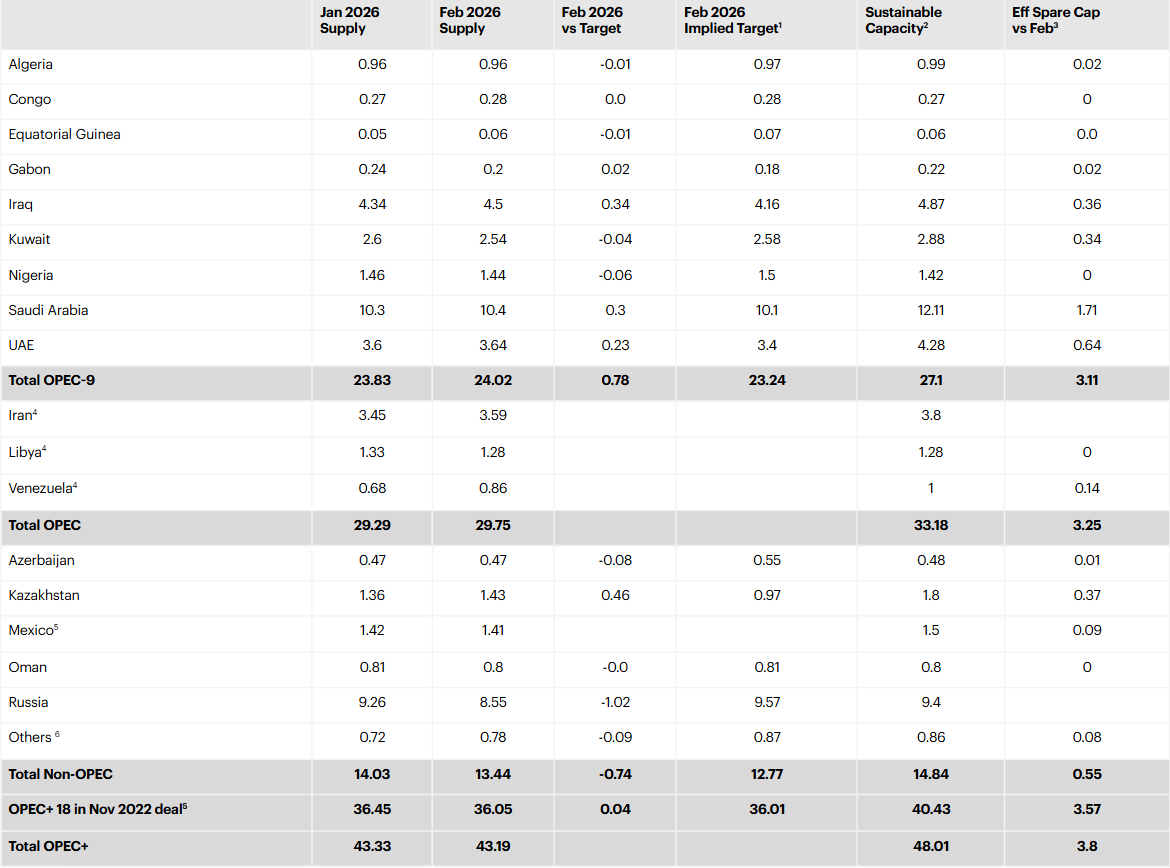
There is also an important structural implication for OPEC+. In the February supply table published by the IEA, total OPEC+ sustainable spare capacity stood at about 3.8 mb/d, with a large share concentrated in Saudi Arabia, the UAE, Iraq and Kuwait. On paper, that looks like a cushion. In practice, the March report implies that spare capacity is far less useful when the producers holding it are themselves constrained by attacks, storage saturation, refinery shutdowns, or blocked export routes. Put differently, this is not a classic price spike caused by low theoretical capacity; it is a disruption in the ability to move and market barrels. That distinction is critical for traders, because it means headline spare capacity figures may offer less reassurance than usual.
Macro Implications and the Near-Term Oil Market Outlook
For the broader macro and market outlook, the March IEA report shifts the oil narrative from “adequately supplied with downside price pressure” to “logistically constrained, risk-premium heavy, and highly path-dependent.” In February, the agency still saw supply growth comfortably exceeding demand growth and inventories building. In March, supply growth is slashed, demand growth is downgraded, product markets are strained, and policy intervention has already begun through emergency reserve releases. That combination points to continued volatility rather than a clean trend. Much will depend on whether shipping lanes reopen, whether further energy infrastructure is damaged, and whether the economic hit from higher oil prices starts to bite harder into global consumption.
Bottom line
The IEA’s March 2026 Oil Market Report is a watershed update. It portrays a market facing an exceptional physical disruption, a weaker demand trajectory, serious product-market stress, and rising dependence on strategic inventories. The headline takeaway is simple: this is no longer a story about normal OPEC+ management or incremental supply-demand rebalancing. It is now a story about war, maritime chokepoints, emergency stock releases, and whether the global oil system can keep barrels moving through the Strait of Hormuz.
FAQ
What is the main message of the IEA’s March 2026 Oil Market Report?
The IEA says the oil market has shifted into crisis mode because of a historic supply disruption tied to the Middle East conflict.
Why is the Strait of Hormuz central to the report?
Because crude and product flows through the strait fell from around 20 mb/d before the war to a trickle, sharply tightening physical supply.
Did the IEA lower its oil demand outlook?
Yes. The IEA cut its 2026 global oil demand growth forecast to 640 kb/d, down 210 kb/d from the previous month.
What emergency action did IEA member countries take?
On 11 March 2026, IEA member countries agreed to make 400 million barrels of emergency oil reserves available to the market.
Is the stock release a full solution?
No. The IEA’s position is that emergency reserves can cushion the shock, but the bigger issue is whether safe shipping through the Strait of Hormuz can resume.
Comments