 English
 پارسی


IEA June 2026 Oil Market Report: Demand Falls, Supply Risks Ease, and 2027 Surplus Fears Grow
The International Energy Agency’s June 2026 Oil Market Report presents one of the most important turning points for the global oil market this year. Published on June 17, 2026, the report reflects the severe disruption caused by the Middle East conflict, the near-closure of the Strait of Hormuz, the collapse in Persian Gulf supply flows, and the sharp adjustment in global oil demand.
The IEA now expects global oil demand to decline by 1.1 million barrels per day in 2026, a major downgrade from its May forecast. At the same time, global oil supply is expected to fall by 3.9 million barrels per day this year before rebounding sharply in 2027 if Persian Gulf exports recover.
The report also highlights a major shift in market sentiment. Oil prices, which surged earlier in the conflict, fell sharply in May and early June as markets priced in the possibility of a preliminary agreement between the United States and Iran. However, inventories remain under severe pressure, and the market is still exposed to operational, political, and logistical risks.
Short Overview
The IEA’s June 2026 Oil Market Report shows a global oil market moving from extreme supply fear toward cautious recovery expectations. The agency forecasts a 1.1 mb/d decline in global oil demand in 2026, mainly because of high fuel prices, reduced product availability, weaker economic activity, and demand-saving measures.
Global oil supply is expected to fall by 3.9 mb/d to 102.4 mb/d in 2026, while refinery crude runs are forecast to contract by 2 mb/d. Inventories remain one of the most serious concerns, with global observed oil stocks drawing by 143 million barrels in May alone.
The IEA’s first look at 2027 suggests a strong rebound in supply, with global oil output expected to rise by 8 mb/d to 110.3 mb/d. This could create a significant surplus if demand recovery remains modest.
Key Findings from the IEA June 2026 Oil Market Report
Global Oil Demand: A Sharp Downgrade for 2026
The most important change in the June report is the IEA’s much weaker demand outlook. Global oil demand is now forecast to decline by 1.1 mb/d year-on-year in 2026.
This is a 700 kb/d downgrade compared with the May report. The agency points to a severe fall in second-quarter deliveries, which declined by around 5 mb/d year-on-year due to high prices, lower fuel availability, and disruptions in refined product markets.
The weakness is no longer limited to one sector or region. Earlier in the crisis, aviation and petrochemicals were among the most affected areas. By June, the impact had spread more broadly across products and economies.
China and Japan were among the most visibly affected importers, with crude imports reportedly falling by around 40%, equal to nearly 6 mb/d combined. This reflects both lower refinery runs and supply chain stress across Asia.
2027 Demand Rebound Expected, But Still Modest
The IEA expects global oil demand to recover in 2027, rising by about 2 mb/d to around 105.3 mb/d. This rebound is based on three assumptions:
- First, oil trade flows gradually normalize.
- Second, crude and product prices decline from crisis highs.
- Third, the global economic outlook improves after the shock of 2026.
However, the IEA’s projected 2027 demand rebound is still smaller than the expected supply recovery. This difference is central to the agency’s warning that the market could shift from shortage to surplus next year.
Global Oil Supply: 2026 Losses, 2027 Recovery
The IEA expects global oil supply to fall by 3.9 mb/d to 102.4 mb/d in 2026. In May, global output declined to 94.5 mb/d, down 600 kb/d month-on-month and 13.6 mb/d below pre-conflict levels.
The sharp decline reflects the severe disruption to Persian Gulf exports and the near-closure of the Strait of Hormuz. Although the preliminary US–Iran agreement could pave the way for a gradual reopening, the IEA warns that recovery will not be immediate.
The main obstacles include:
- Demining of shipping lanes
- Unresolved transit arrangements
- Damaged infrastructure
- Political uncertainty
- Logistical delays in restoring normal trade flows
For 2027, the IEA expects a strong rebound. Global oil supply is forecast to rise by 8 mb/d to 110.3 mb/d as Persian Gulf exports recover and non-OPEC+ producers continue to increase output.
Strait of Hormuz and the US–Iran Agreement
The June report places heavy emphasis on the preliminary agreement between the United States and Iran. The deal could allow the reopening of the Strait of Hormuz and the lifting of restrictions on Iranian oil traffic.
The market reaction was immediate. Oil prices fell to their lowest levels since early March as traders began pricing in a possible recovery in Persian Gulf exports.
Shipments through the Strait had already started rising in early June, moving from a May low of 9.6 mb/d to around 12 mb/d. However, the IEA makes it clear that a full recovery will take time.
Even if the agreement holds, the Strait must be made safe for regular commercial traffic, and supply chains need time to normalize. This means the short-term market remains vulnerable despite the improvement in sentiment.
Refinery Runs: Asia and the Middle East Face the Steepest Cuts
Refinery crude throughputs are forecast to contract by 2 mb/d in 2026, bringing total runs to around 82 mb/d. The second quarter saw a particularly sharp decline, with crude runs falling by 4.7 mb/d year-on-year.
The steepest reductions were seen across:
- China
- The Middle East
- Eurasia
- Non-OECD Asia
The disruption in crude availability directly affected refined product markets. Lower refinery runs reduced the supply of fuels such as diesel, gasoline, jet fuel, and petrochemical feedstocks.
For 2027, refinery runs are expected to rebound by 3.1 mb/d as crude supplies normalize and trade flows recover.
Inventories: Global Stocks Continue to Fall at Record Pace
Inventories remain one of the biggest risks in the IEA’s June report. Global observed oil inventories fell by 143 million barrels in May, equal to a draw of about 4.6 mb/d.
This was a sharp acceleration from April’s draw of 74 million barrels. Since the beginning of the Persian Gulf conflict, global observed oil stocks have fallen at an average pace of 3.8 mb/d.
The pressure is especially serious in government-held inventories. OECD government oil stocks have fallen by 163 million barrels since the start of the conflict, reaching their lowest level since December 1990.
This means the global oil system has less room to absorb further shocks. Even with demand falling, the supply disruption has been severe enough to drain inventories rapidly.
Oil Prices: From Crisis Highs to Peace-Deal Discount
Oil prices moved sharply lower between May and mid-June. North Sea Dated crude fell by more than $40 per barrel to around $82 per barrel.
The decline was driven by three main factors:
- First, demand weakened more than expected.
- Second, Persian Gulf exports improved slightly in early June.
- Third, markets started pricing in the possibility of a US–Iran peace deal.
However, the IEA notes that prices remained around $20 per barrel higher than at the start of the year, meaning the market still carries a significant geopolitical risk premium.
IEA June 2026 Report Compared with the May 2026 Report
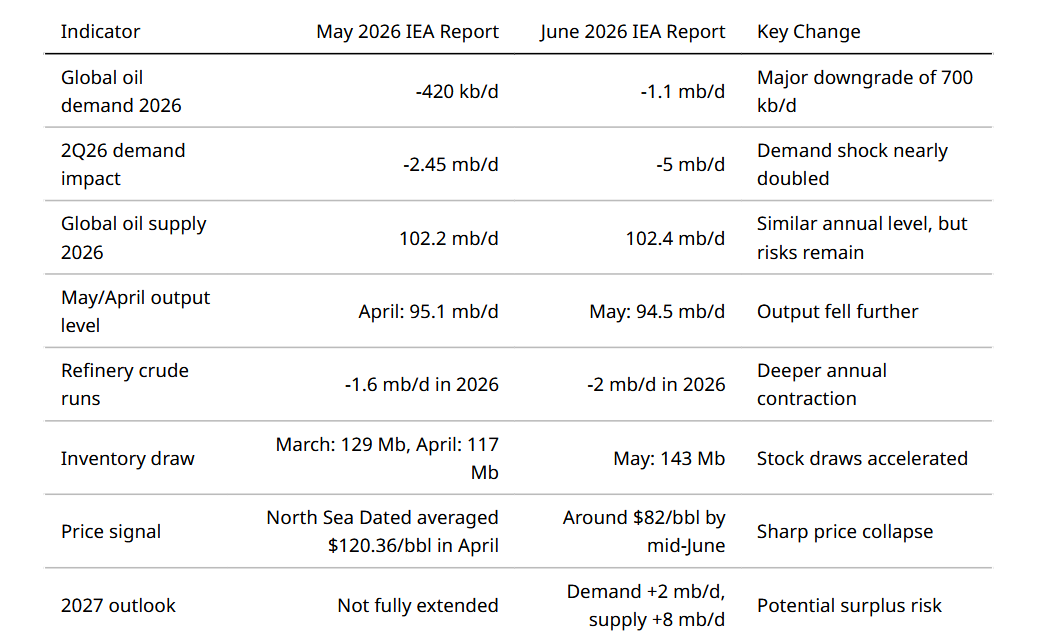
The June report is more bearish on demand, slightly more constructive on future supply recovery, and more explicit about the risk of a 2027 surplus.
Main Difference from May: Demand Damage Is Deeper
The biggest difference between the May and June reports is the scale of demand destruction. In May, the IEA expected global oil demand to fall by 420 kb/d in 2026. By June, that decline had deepened to 1.1 mb/d.
This shows that the impact of the conflict moved beyond immediate supply disruptions and began affecting end-user consumption, refinery activity, transport demand, and broader economic activity.
Second Difference: 2027 Surplus Risk Appears
The June report introduces the IEA’s first look at 2027. The agency expects global oil demand to grow by around 2 mb/d, but supply could rise by around 8 mb/d.
This creates a possible market overhang in 2027. If supply recovers faster than demand, the market could shift from shortage to surplus, allowing inventories to rebuild but also putting downward pressure on prices.
IEA vs OPEC June 2026 Report
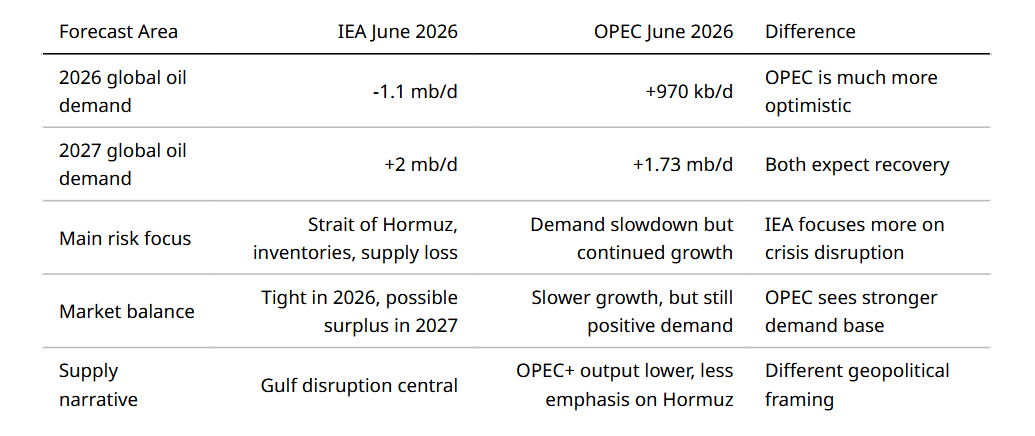
OPEC’s June 2026 Monthly Oil Market Report presents a more optimistic view of demand than the IEA. While the IEA expects global oil demand to fall by 1.1 mb/d in 2026, OPEC still expects demand to grow by around 970 kb/d.
Why OPEC Is More Optimistic
OPEC’s forecast assumes that demand weakness in 2026 is temporary and that non-OECD economies, especially China, India, and other Asian markets, will continue to support global oil consumption.
OPEC did lower its 2026 demand growth forecast from 1.17 mb/d to 970 kb/d, but it still expects positive demand growth. This contrasts sharply with both the IEA and EIA, which now expect global demand to decline in 2026.
OPEC also raised its 2027 demand growth forecast to 1.73 mb/d, showing confidence in a recovery once trade routes and regional logistics normalize.
IEA vs EIA June 2026 STEO
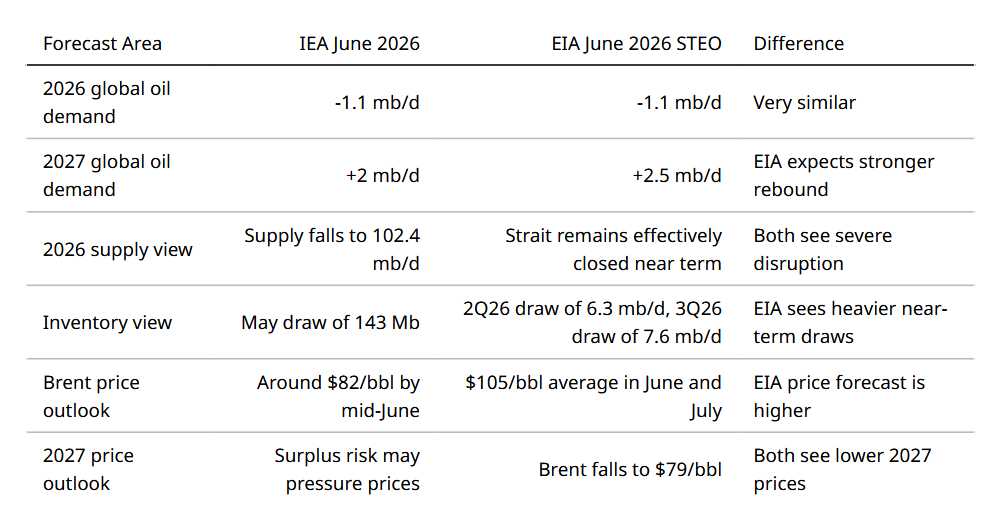
The EIA’s June 2026 Short-Term Energy Outlook is much closer to the IEA’s view than OPEC’s. Both the IEA and EIA expect global oil demand to decline by around 1.1 mb/d in 2026.
However, there are some differences in price expectations and the timing of supply recovery.
Why the IEA and EIA Are More Bearish than OPEC
The IEA and EIA both give greater weight to the impact of the Strait of Hormuz disruption. They see high prices, fuel shortages, and government demand-saving measures directly reducing consumption.
OPEC, by contrast, still expects non-OECD demand growth to remain strong enough to keep global demand positive in 2026.
This divergence matters for traders and policymakers. If the IEA and EIA are correct, the 2026 market is experiencing both supply destruction and demand destruction. If OPEC is correct, demand remains more resilient than the market currently fears.
Market Implications
- 1. Oil Prices May Stay Volatile
The price decline to around $82/bbl reflects peace-deal optimism, but the market remains fragile. Any delay in reopening the Strait of Hormuz, removing mines, restoring exports, or finalizing transit agreements could quickly rebuild the risk premium.
- 2. Inventories Are the Main Short-Term Risk
Even though demand is falling, inventories are being drawn down rapidly. Low government and commercial stocks reduce the market’s ability to absorb another supply shock.
- 3. Refining Margins Could Remain Supported
Lower refinery runs in Asia and the Middle East may continue to support refined product cracks, especially for diesel, jet fuel, and middle distillates.
- 4. 2027 Could Bring Oversupply
If Persian Gulf exports recover and non-OPEC+ output continues rising, supply growth could outpace demand recovery in 2027. This could create downward pressure on oil prices and allow countries to rebuild strategic petroleum reserves.
- 5. OPEC+ Strategy Becomes More Important
If the market moves from shortage to surplus, OPEC+ may face pressure to manage output more carefully. The group’s response will be critical for price stability in 2027.
Conclusion
The IEA June 2026 Oil Market Report shows a global oil market at a critical transition point. The 2026 outlook remains tight because of severe supply disruptions, record inventory draws, and reduced refinery activity. However, the sharp fall in prices shows that markets are already looking ahead to a possible recovery in Persian Gulf exports following the preliminary US–Iran agreement.
The biggest message from the report is that demand damage has become much deeper than previously expected. The IEA now forecasts global oil demand to fall by 1.1 mb/d in 2026, aligning closely with the EIA but sharply contrasting with OPEC’s expectation of continued growth.
Looking ahead, the main risk may shift from shortage in 2026 to surplus in 2027. If supply rebounds by 8 mb/d while demand grows by only 2 mb/d, the global oil market could move into a significant overhang. That would help rebuild depleted inventories but could also pressure prices lower.
For oil traders, refiners, policymakers, and energy investors, the key variables to watch are the US–Iran agreement, the reopening of the Strait of Hormuz, the pace of Persian Gulf export recovery, global inventory levels, and OPEC+ production strategy.
FAQ
What is the main message of the IEA June 2026 Oil Market Report?
The main message is that global oil demand is falling more sharply than previously expected, while supply remains disrupted by the Middle East conflict and the Strait of Hormuz crisis. However, the IEA also warns that supply could rebound strongly in 2027, creating a possible surplus.
How much does the IEA expect global oil demand to fall in 2026?
The IEA expects global oil demand to decline by 1.1 million barrels per day in 2026. This is a major downgrade from the May report, which forecast a smaller decline of 420,000 barrels per day.
Why did the IEA downgrade its 2026 oil demand forecast?
The IEA downgraded its demand forecast because of higher fuel prices, reduced fuel availability, weaker economic activity, lower refinery runs, and government demand-saving measures caused by the Middle East conflict and disruptions around the Strait of Hormuz.
What does the IEA expect for global oil supply in 2026?
The IEA expects global oil supply to fall by 3.9 million barrels per day to 102.4 million barrels per day in 2026. Supply losses are mainly linked to Persian Gulf production disruptions and constrained exports through the Strait of Hormuz.
What is the IEA’s forecast for 2027?
The IEA expects oil demand to grow by around 2 million barrels per day in 2027, while global oil supply could rise by around 8 million barrels per day to 110.3 million barrels per day. This could create a significant market surplus.
How does the IEA forecast compare with OPEC’s June 2026 report?
The IEA is much more bearish on demand. It expects global oil demand to decline by 1.1 mb/d in 2026, while OPEC still expects demand to grow by around 970 kb/d. OPEC is more optimistic about non-OECD demand, especially in Asia.
How does the IEA forecast compare with the EIA June 2026 STEO?
The IEA and EIA are closely aligned on demand. Both expect global oil demand to fall by around 1.1 mb/d in 2026. However, the EIA expects a stronger demand rebound in 2027 and has a higher near-term Brent price forecast.
Why did oil prices fall in May and June 2026?
Oil prices fell because markets started pricing in a possible US–Iran agreement, improved Persian Gulf exports in early June, weaker demand, and expectations that the Strait of Hormuz could gradually reopen.
What is the biggest risk for the oil market now?
The biggest short-term risk is that inventories continue to fall while supply recovery remains slow. The biggest medium-term risk is that supply rebounds faster than demand in 2027, creating a surplus.
What should oil traders watch after the IEA June 2026 report?
Oil traders should monitor the US–Iran agreement, the reopening of the Strait of Hormuz, Persian Gulf export flows, global inventory levels, refinery runs in Asia, Brent and WTI spreads, and OPEC+ production decisions.
Comments