 English
 پارسی


Executive Summary
The 4th session of China’s 14th National People’s Congress (NPC) met at the Great Hall of the People in Beijing from March 5–12, 2026. Top leaders (President Xi Jinping, Premier Li Qiang, et al.) attended, and deputies adopted a broad economic, social, and legislative agenda. Premier Li delivered the Government Work Report, setting a modest GDP growth target of 4.5–5.0% for 2026. Delegates examined the draft outline of the 15th Five-Year Plan (2026–2030), budget reports, and several landmark bills – notably an Ecological Environmental Code, an Ethnic Unity and Progress law, and a National Development Planning law. By session’s end, all major items were approved by overwhelming majorities (no notable dissent was reported). The session also approved central and local budgets (deficit ~4% of GDP, 30 trillion yuan spending) and endorsed key security and social policies. State media hailed the session’s emphasis on stability and long-term planning, while international outlets focused on the downgraded growth target, advanced technology plans, and Xi-era priorities. Expert commentary noted the session’s reinforcement of centralized planning and its long-run implications for China’s economy and governance.
Session Dates, Location, and Agenda
The 14th NPC’s 4th annual session convened on Thursday, March 5, 2026, and closed on Thursday, March 12, 2026, in Beijing’s Great Hall of the People. At the preparatory meeting (Mar 4), a 167-member presidium was elected (Li Hongzhong as secretary-general) and the 11‑item agenda was adopted. Key agenda items included:
- Government Work Report (delivered by Premier Li Qiang).
- 15th Five-Year Plan outline (2026–2030).
- 2025 Plan report and 2026 economic plan (draft plan for 2026).
- 2025 budget execution and 2026 budgets (central and local).
- Draft Ecological Environmental Code (bill by NPCSC).
- Draft Law on Promoting Ethnic Unity and Progress.
- Draft Law on National Development Planning.
- NPC Standing Committee work report (2025).
- Supreme People’s Court work report (2025).
- Supreme People’s Procuratorate work report (2025).
- Legislative cleanup report (NPCSC report on law revision).
Three full plenary meetings were scheduled. The opening plenary (Mar 5) featured Li Qiang’s report and presentation of drafts for the FYP and budgets. The second plenary (Mar 9) heard NPCSC, Supreme Court, and Procuratorate reports and debated the law cleanup report. The closing plenary (Mar 12) took votes on all agenda items and formally adopted the documents (see below).
Major Laws, Resolutions, and Decisions Adopted
All principal agenda proposals were approved, as expected, by wide margins (official voting tallies are not publicly detailed). Major outcomes included:
- 15th Five-Year Plan (2026–2030): The draft outline was examined and formally adopted, setting long-range development goals.
- Economic and Social Plans: The 2025 national plan implementation report and the 2026 draft plan were approved (ensuring continuity into the new planning period).
- Budget Resolutions: Deputies approved a resolution on the 2025 budget execution and on the 2026 central and local budgets. Fiscal measures reiterated the targets in Li Qiang’s report: a ~4% deficit-to-GDP ratio and record public spending (≈30 trillion yuan).
- Ecological Environmental Code: The NPC enacted China’s first Environmental Code, consolidating pollution-control and climate policies into one law. (The draft had been a major focus, reflecting Xi Jinping’s “ecological civilization” initiative.)
- Law on Promoting Ethnic Unity and Progress: Deputies passed a new law to codify Xi-era ethnic minority policy and “Chinese nation unity” principles. NPCObserver notes this entrenches Party directives in statute.
- Law on National Development Planning: The session enacted a law formalizing the five-year planning process, including the role of CPC policies (first such law).
- Personnel and Appointments: The only major personnel change was the removal of Wang Xiangxi as Emergency Management Minister (earlier voted by the NPCSC on Feb 26). (Wang has been replaced by a new appointee via NPCSC.) No other top leadership shifts were announced.
In addition, NPC delegates adopted resolutions to approve the Government Work Report and to endorse all drafted bills and reports (the customary formality at closing). All measures passed overwhelmingly, with the meeting confirming that 2,878 deputies were eligible and 2,760 present, well above quorum.
Economic Targets and Fiscal/Budgetary Measures
Premier Li Qiang’s report (Mar 5) set this year’s GDP growth target at 4.5–5.0%, down from the prior “around 5%” target (AP notes this is the lowest since 1991). Other key 2026 targets included ≥12 million new urban jobs, ~2% consumer inflation, and grain output ~700 million tons. Li also vowed an annual ~3.8% cut in carbon intensity, aiming to “drive green development”. Government bond issuance was expanded: ultra-long-term bonds of ~1.3 trillion yuan and local government bonds of 4.4 trillion yuan were approved for 2026. A set of social and reform initiatives (e.g., urban household registration reforms, support for the private sector, rural revitalization) was highlighted, but budget details on these are summarized rather than itemized.
On fiscal policy, Li affirmed a “proactive” fiscal stance. The deficit-to-GDP ratio was pegged at ~4.0%, with a total general‐budget outlay of 30 trillion yuan (a record high). Banking and credit policies remain “accommodative,” with continuing RRR cuts and interest-rate adjustments. (International media stressed the absence of big stimulus beyond these levels.) Notably, State media underscored a pledge to raise R&D spending by at least 7% annually (averaged over 2026–30); Li’s report implies ~10% R&D growth in 2026 as China races to own core technologies.
Foreign Policy and National Security Statements
Although the session’s focus was domestic, speeches contained important security messaging. Premier Li’s report reaffirmed “China’s overall national security concept” and pledged to strengthen “military training and combat readiness.” The defense budget was raised by 7% in 2026, reaching ~1.9 trillion yuan. In Taiwan, Li “stressed that Beijing will ‘resolutely fight against’ separatist forces”, a slightly tougher tone than past wording. (No new cross-Strait measures were detailed beyond reiteration of the PRC’s position.) The reports also echoed Xi’s emphasis on “security” broadly (though no new white papers were issued). In foreign policy, NPC delegates unanimously passed a resolution “supporting [Xi Jinping’s] foreign policy decisions,” and heard updates on Hong Kong/Macau work; however, these were routine with no major changes announced.
Major Speeches and Policy Implications
- Premier Li Qiang (Mar 5 opening) – Li emphasized economic steadiness amidst global uncertainties. He noted that China had “met its 5% GDP target last year” only through a record export boom. Key quotes included: “What we achieved in 2025 was indeed hard won”, underscoring past challenges. His report’s policy signals stressed innovation and technology: pledging breakthroughs in AI, quantum, biotech, and other “future industries”, and an “AI+” action plan (Reuters noted “AI” appears 50+ times in the 2030 plan). Li also promised more support for private enterprise and social welfare (e.g., pension, healthcare). Overall, Li’s speech was uncontroversial, with all targets framed as “while striving to do better in practice”.
- NPCSC Chairman Zhao Leji – Zhao delivered the NPCSC work report at the 2nd plenary. He reviewed 2025 achievements (40 draft laws reviewed, 24 passed, etc.) and warned that “work still has gaps” that deputies should scrutinize. Zhao explicitly previewed the session’s key items, noting it would “review and approve the 15th FYP…, deliberate the draft Environmental Code, draft Law on Promoting Ethnic Unity…, and draft Law on National Development Planning”. (This echoed the published agenda.) At closing, Zhao praised the session’s orderly conduct and called for greater legislative quality next year. His rhetoric underscored that all new legislation must align with “Xi Jinping Thought” and Party directives.
No Chinese dissidents or independent candidates spoke. Unlike past NPCs, there was no televised press conference by Premier Li or speeches by other ministers. Reporting focused on stage-managed highlights.
Voting Outcomes and Dissent
All items on the agenda were adopted “with the vast majority of votes in favor.” Official media did not report any votes against or abstentions on major motions, implying near-unanimity (the NPC traditionally votes 100% for Party-backed legislation). Attendance was 2,760 of 2,878 deputies (2,118 men, 642 women), meeting constitutional quorum. (Participation by Hong Kong and Macau deputies was noted; in contrast to earlier sessions, there were no reports of walkouts or objections.) China’s state broadcaster (CCTV) announced the final resolutions in a brief closing ceremony, and the Presidium gaveled the session closed on the afternoon of March 12.
Media Coverage: State vs International
Chinese state media (Xinhua, People’s Daily, CCTV, Global Times, etc.) uniformly framed the session as a “blueprint for high-quality development” and “smooth transition into the 15th Five-Year Plan era.” Xinhua headlines stressed continuity and Party leadership: e.g., “NPC opens session, Xi leads anthem” or “NPC to adopt 15th FYP, key laws” (state outlets cited the official agenda). Global Times (CPC tabloid) praised the “predictability and stability” of China’s long-term planning. Coverage highlighted Li’s modest growth target and tech agenda, often quoting China’s achievements: “manufacturing world leader for 16 years,” etc.
By contrast, the international press honed in on signs of economic caution and geopolitical intent. Reuters emphasized the 4.5–5% GDP target and steady fiscal policy, noting this “opens the door” for structural rebalancing. It underlined China’s push for tech self-reliance and the 7% defense increase. AP and SCMP explicitly pointed out that 4.5–5% is “the lowest target since 1991, framing it as evidence of market weakness (e.g., a housing slump). The Wall Street Journal and Bloomberg ran similar takes, and Reuters also flagged Xi’s absence from some discussions (e.g., Xi did not attend all panel deliberations). Notably, foreign outlets picked up Zhao’s pledge to “fight” Taiwanese separatists (AP) as a hard-line statement. The Guardian and Financial Times focused on the shift to innovation and consumption in the 5-year plan, quoting Western analysts who see China using the next five years to counter US tech competition and lower tariffs.
In summary, state media treated the NPC session as a familiar success, while international media offered a more skeptical read on growth prospects and strategic implications.
Expert and Academic Commentary
Domestic experts (often quoted in state media) praised the session’s emphasis on “institutions and the Party’s leadership.” For example, a People’s Congress deputy told Global Times that the planning law and innovation policies will help “new quality productive forces” emerge. Peking University economist Cao Heping noted that the “two sessions” chart a long-term blueprint, adding predictability globally. NPCObserver’s independent analysts pointed out that the new Planning Law effectively enshrines CPC Five-Year Plans in statute, reinforcing the Party’s role in economic guidance.
Foreign specialists saw mixed implications. Some IMF and World Bank analysts welcomed the modest growth target and focus on consumption as realistic for structural reform, while others warned that near-term growth pressures (real estate and youth unemployment) may remain acute. Defense experts noted that the 7% military budget rise is on trend, but combined with the announced removal of top generals (Zhang Youxia, He Weidong), it signals Xi’s ongoing military shakeup. Human rights scholars were largely silent (the NPC does not publicly debate rights issues); however, some Western observers raised concerns about the Ethnic Unity Law, which critics say could further restrict minority rights.
Overall, commentators agree that the session cements Xi Jinping’s priorities (“common prosperity,” tech leadership, security) into law. In the short term, the outcomes provide policy continuity and broad targets. Long term, the major implication is institutionalizing the Party’s policy framework – for example, the Planning Law and strengthened legislative oversight (via the cleanup report) deepen top-down planning. This suggests future NPC sessions will continue to rubber-stamp core CPC policy with little resistance, as the legislative process shifts from being a check-and-balance to a formal endorsement of Central decisions.
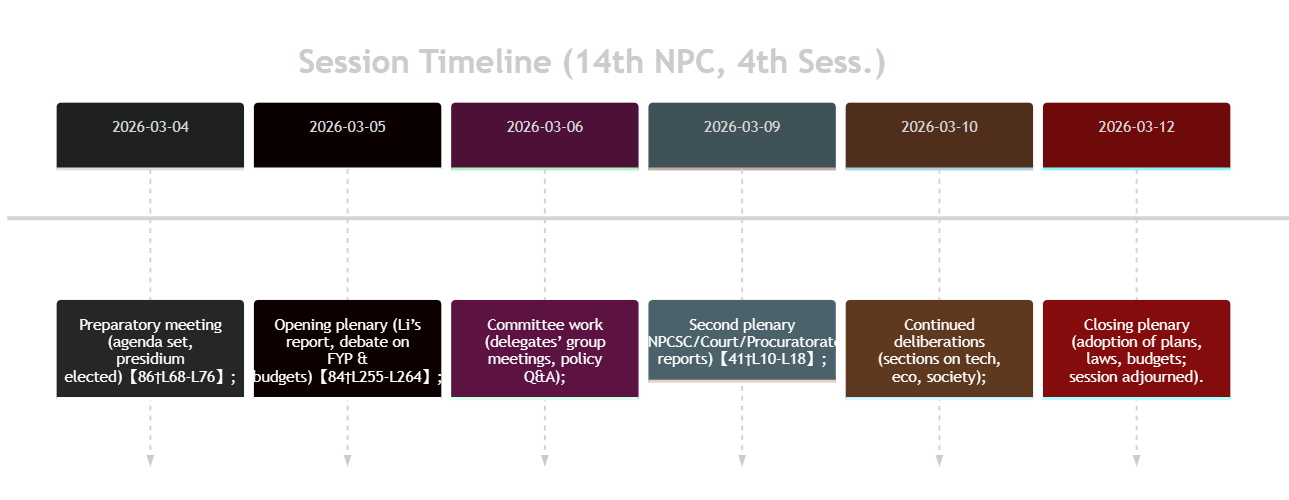
Timeline of Key Events (March 2026)
- Mar 4 (Wed): Preparatory Meeting. Presidium elected (Li Hongzhong as SG). Agenda and schedules finalized. Spokesman announces 11 agenda items.
- Mar 5 (Thu): Opening Plenary. NPC session opened (Xi Jinping present; national anthem sung). Premier Li Qiang delivered the Government Work Report, setting economic targets. Deputies submitted new bills (Env. Code, Ethnic Law, Planning Law) for first reading. The draft 15th FYP and 2026 budgets were presented. Press conferences by ministers and “deputies’ corridors” interviews are held in the evening.
- Mar 6–8: Committee Meetings and Bilaterals. Deputies split into groups (by sector/region) to discuss agenda items. Specialized press briefings (e.g., on the economy, technology, and Hong Kong) and small meetings took place. (No plenary.)
- Mar 9 (Mon): Second Plenary. NPCSC Chairman Zhao Leji reported on NPC Standing Committee work (2025) and oversaw deliberation of NPCSC, Supreme Court, and Procuratorate reports. Deputies reviewed the legislative cleanup report. Premier Li participated in consultations (no press talk).
- Mar 10 (Tue): Further Deliberations. Deputies continued group discussions (economy, technology focus). A second round of “deputies’ corridors” interviews covered topics like carbon targets. (Some sources report that an NPC delegation met visiting international parliamentarians on this day.)
- Mar 12 (Thu): Closing Plenary. Final plenary meeting. The draft 15th FYP outline was formally approved; budgets (2025 exec and 2026 draft) were adopted; and the three draft laws (Environmental Code, Ethnic Unity Law, Planning Law) were passed and signed by the President. A resolution approving the Government Work Report was adopted. NPCSC Vice-Chairman Zhang Yesui presided (Zhao ill). The session was adjourned after unanimous votes.
Government Work Report: The draft/proposed measure was the annual Government Work Report, and it was approved via a resolution at the closing plenary.
15th Five-Year Plan (2026–30) outline: The proposed measure was the outline for the 15th Five-Year Plan (2026–30), and it was approved into law, with the “Outline” adopted.
2025 National Plan execution report: This item was the report on execution of the 2025 National Plan, and it was noted/approved as part of the plan work reports.
2026 Economic Development Plan (draft): The draft 2026 Economic Development Plan was approved as part of the broader planning process.
2025 budget execution & 2026 budgets: The report on 2025 budget execution and the 2026 budgets was adopted, covering both central and local budgets.
Ecological Environmental Code (draft bill): The draft Ecological Environmental Code was enacted as law.
Law on Promoting Ethnic Unity (draft): The Law on Promoting Ethnic Unity was enacted as law.
Law on National Development Planning (draft): The Law on National Development Planning was enacted as law.
NPCSC 2025 Work Report (draft): The NPC Standing Committee 2025 Work Report was reviewed/approved and filed.
Supreme Court 2025 Report (draft): The Supreme People’s Court 2025 Report was reviewed/approved and filed.
Supreme Procuratorate 2025 Report: The Supreme People’s Procuratorate 2025 Report was reviewed/approved and filed.
Legislative Cleanup Report (NPCSC): The Legislative Cleanup Report was deliberated, with a decision to approve recommended deletions.
Removal of Wang Xiangxi (order signed): The removal of Wang Xiangxi was enforced after the NPCSC had voted to dismiss, and the order was signed.
Comments