 English
 پارسی


Federal Reserve Holds Rates Steady in June 2026 as Inflation Outlook Rises Sharply
The Federal Reserve kept interest rates unchanged at its June 16–17, 2026 policy meeting. Still, the broader message from the Federal Open Market Committee was more hawkish than the unchanged rate decision suggested. The FOMC maintained the federal funds target range at 3.50%–3.75%, while the updated Summary of Economic Projections showed a sharp upward revision to inflation and a higher projected policy-rate path.
The decision itself was widely expected. However, the combination of elevated inflation, resilient economic activity, stable labor-market conditions, and a higher dot plot changed the market narrative. Instead of focusing on future rate cuts, investors shifted attention toward whether the Fed may need to keep policy restrictive for longer or even raise rates again later in 2026.
Short Overview
The Federal Reserve’s June 2026 meeting delivered a hawkish hold. Rates were left unchanged, but the Fed’s updated projections showed higher inflation and a higher expected federal funds rate for 2026.
The key points were:
- The federal funds target range remained at 3.50%–3.75%.
- The FOMC statement was approved by a 12–0 vote.
- The Fed said economic activity is expanding at a solid pace.
- The labor market remains broadly stable, with job gains keeping pace with the workforce.
- Inflation remains above the Fed’s 2% target.
- The 2026 PCE inflation forecast rose to 3.6%, compared with 2.7% in the March projections.
- The 2026 Core PCE inflation forecast rose to 3.3%, compared with 2.7% in March.
- The projected 2026 federal funds rate rose to 3.8%, compared with 3.4% in March.
Markets interpreted the release as hawkish, supporting the U.S. dollar and Treasury yields while putting pressure on Wall Street and gold.
Fed Keeps Interest Rates Unchanged at 3.50%–3.75%
The Federal Open Market Committee decided to maintain the target range for the federal funds rate at 3.50%–3.75%. This decision keeps monetary policy in restrictive territory as the Fed continues to focus on bringing inflation back toward its 2% target.
The statement was notably short and direct. It emphasized that the Fed remains committed to its dual mandate, but the language placed strong weight on price stability. The Committee also reaffirmed its policy of maintaining ample reserves in the banking system.
The vote was 12–0, which is important because it showed a more unified Committee than the previous meeting. In April, the FOMC had several dissents, including one policymaker who preferred a rate cut and others who opposed the inclusion of an easing bias in the statement.
Economic Assessment: Growth Remains Solid, Inflation Still Elevated
The Fed described U.S. economic activity as expanding at a solid pace, despite elevated uncertainty linked partly to the conflict in the Middle East. The statement also highlighted strong productivity growth and capital investment, suggesting that the Fed does not see the economy as weak enough to justify a policy shift toward rate cuts.
The labor-market assessment was also relatively stable. Job gains have kept pace with the workforce, and the unemployment rate has changed little. This means the Fed still sees employment conditions as strong enough to tolerate restrictive monetary policy.
Inflation remains the central concern. The Fed said inflation is still elevated relative to its 2% objective, partly reflecting supply shocks that have driven price increases in certain sectors, including energy. The final message was clear: the Committee said it will deliver price stability.
Implementation Note: Key Policy Tools Remain Unchanged
The implementation note confirmed that the Fed kept its operational policy settings unchanged.
The interest rate paid on reserve balances was maintained at 3.65%, effective June 18, 2026. The Open Market Desk at the Federal Reserve Bank of New York was directed to conduct open market operations as needed to maintain the federal funds rate within the 3.50%–3.75% target range.
The Fed also maintained the standing overnight repurchase agreement rate at 3.75%, while the overnight reverse repurchase agreement offering rate stayed at 3.50%, with a per-counterparty limit of $160 billion per day.
On the balance-sheet side, the Fed said it will roll over all principal payments from its Treasury holdings and reinvest principal payments from agency securities into Treasury bills. The implementation note also said the Fed may increase System Open Market Account holdings through Treasury bill purchases, and if needed, other Treasury securities with remaining maturities of three years or less, when appropriate, to maintain ample reserves.
Summary of Economic Projections: Inflation Forecasts Move Sharply Higher
The most important part of the June 2026 FOMC package was the Summary of Economic Projections. The updated forecasts showed that Fed officials now expect stronger inflation pressure and a higher policy-rate path than they did in March.
The median projection for real GDP growth in 2026 was revised down slightly to 2.2%, from 2.4% in March. The unemployment-rate forecast improved slightly to 4.3%, from 4.4% in March. This mix suggests that the Fed sees slightly slower growth but not a materially weaker labor market.
The inflation revisions were much more important. The median forecast for PCE inflation in 2026 rose to 3.6%, compared with 2.7% in March. Core PCE inflation was revised up to 3.3%, also from 2.7% in March. These are large changes and explain why the market interpreted the release as hawkish.
The policy-rate projection also moved higher. The median projected federal funds rate for the end of 2026 rose to 3.8%, compared with 3.4% in March. Since the current target range is 3.50%–3.75%, this projection suggests that policymakers see less room for rate cuts and more risk that rates may need to remain high or move slightly higher.
Key Projection Changes: June 2026 vs March 2026
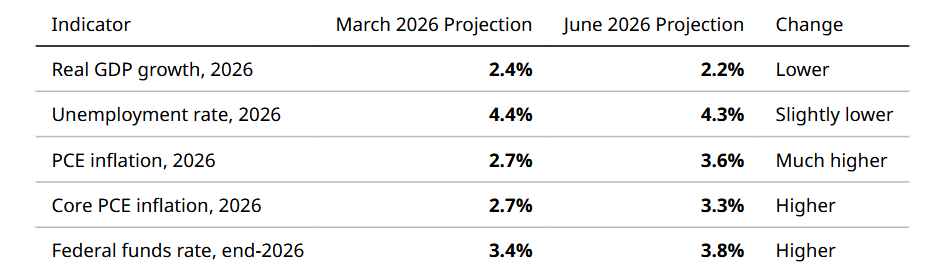
The most important message from this table is that inflation expectations rose sharply, while the unemployment outlook did not deteriorate. That is a hawkish combination because it gives the Fed less reason to cut rates and more reason to keep monetary policy restrictive.
Dot Plot: The Fed Moves Away From Rate-Cut Expectations
The June dot plot showed a major change in the internal policy debate. Market reports indicated that nearly half of Fed policymakers now see at least one rate hike in 2026, compared with the March projections, when no policymaker expected a rate increase.
This is a major shift. Earlier in the year, markets were still asking when the Fed might begin cutting rates. After the June meeting, the question became whether inflation risk could force the Fed to raise rates again.
This does not mean a rate hike is guaranteed. It means the Fed has moved away from a clear easing bias. The Committee appears more focused on preventing inflation from becoming persistent than on preparing markets for lower rates.
Comparison With the Previous FOMC Statement
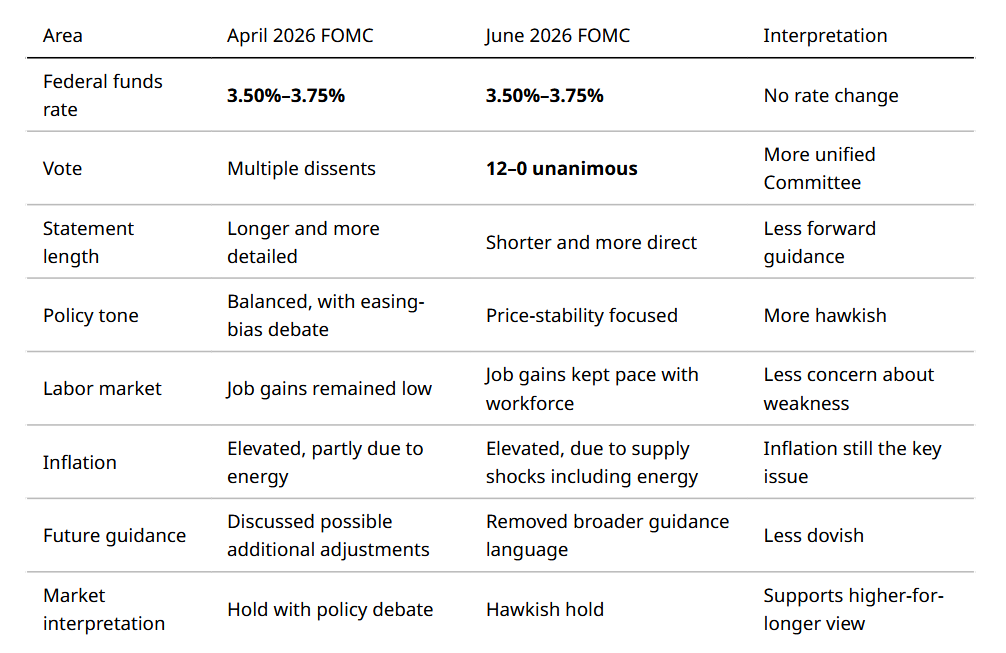
Compared with the April 29, 2026 FOMC statement, the June statement was shorter, more direct, and more focused on price stability.
In April, the Fed also kept rates unchanged at 3.50%–3.75%, but the statement included more language about incoming data, the evolving outlook, and the balance of risks. It also said the Committee would consider the extent and timing of additional adjustments to the federal funds rate.
The April statement had a more balanced tone. It recognized inflation risks but also referred to the risks on both sides of the Fed’s dual mandate. It also included notable disagreement among policymakers. Stephen Miran preferred a 25-basis-point rate cut, while Beth Hammack, Neel Kashkari, and Lorie Logan supported holding rates steady but opposed the easing-bias language.
The June statement removed much of that forward-looking guidance and instead focused on the current policy decision, solid economic activity, stable labor conditions, elevated inflation, and the commitment to price stability. The vote was unanimous, which suggests that the Committee moved toward a more unified position.
Main Differences Between April and June
Market Reactions: Dollar and Yields Rise, Stocks Face Pressure
Financial markets reacted to the June FOMC release as a hawkish hold. The unchanged rate decision was not the surprise; the surprise came from the higher inflation forecasts and the higher projected policy-rate path.
The U.S. dollar strengthened after the release because a higher expected Fed rate path increases the relative yield appeal of dollar-denominated assets. Treasury yields also moved higher as investors priced in a greater chance that the Fed could keep rates elevated or even raise them again later this year.
U.S. stocks moved modestly lower, reflecting valuation pressure from higher discount rates. When markets expect higher interest rates for longer, equity valuations can come under pressure, especially in growth-sensitive sectors.
Gold faced a more difficult environment after the release. A stronger U.S. dollar and higher real-rate expectations usually reduce the appeal of non-yielding assets such as gold. However, geopolitical uncertainty and energy-market risks may still provide some defensive support.
Market Impact by Asset Class
U.S. Dollar: Bullish
The June FOMC release is supportive for the U.S. dollar. The Fed’s inflation forecast moved higher, the projected policy-rate path increased, and the market reduced expectations for rate cuts. This combination generally supports dollar demand.
Market Sentiment: Buy / Bullish
Reason: Higher expected interest rates support the dollar against lower-yielding currencies.
Wall Street: Neutral to Bearish
The stock market reaction was more cautious. A resilient economy is positive for earnings, but higher rates are negative for valuations. The result is a mixed but slightly negative setup for equities.
Market Sentiment: Neutral to Sell
Reason: Strong growth helps earnings, but higher-for-longer rates pressure valuations.
Treasury Yields: Bullish for Yields, Bearish for Short-Term Bonds
Treasury yields moved higher as the market priced a more hawkish Fed path. Short-term yields are especially sensitive to Fed policy expectations, so the front end of the yield curve may remain under pressure if inflation data stays firm.
Market Sentiment: Higher yields
Reason: A higher dot plot and persistent inflation support higher rate expectations.
Gold: Neutral to Bearish
Gold may remain supported by geopolitical risk, but the Fed’s hawkish projections are a short-term headwind. Higher yields and a stronger dollar usually reduce demand for gold.
Market Sentiment: Neutral to Sell
Reason: Higher real-rate expectations and a stronger dollar limit upside.
Oil and Energy: Important for Fed Policy
Energy prices are now directly connected to the Fed’s inflation outlook. The statement specifically referred to supply shocks and energy-related price increases. This means oil-market volatility may continue to influence monetary-policy expectations.
Market Sentiment: Volatility risk remains high
Reason: Energy shocks can feed inflation expectations and affect the Fed’s policy path.
What This Means for Traders and Investors
The June 2026 FOMC meeting changed the market conversation. The Fed did not raise rates, but it also did not give markets a dovish signal. Instead, it delivered a message that inflation remains too high and the economy is strong enough to handle restrictive policy.
For traders, this means inflation data, energy prices, labor-market indicators, and Fed speeches will remain highly important. If inflation stays elevated, markets may price a higher probability of another rate hike. If inflation cools quickly, the market may begin to reduce hawkish expectations.
For investors, the key issue is the balance between resilient growth and tighter financial conditions. Strong economic activity can support corporate earnings, but higher interest rates can weigh on equity valuations, credit conditions, and risk appetite.
Final Conclusion
The Federal Reserve’s June 17, 2026 decision should be read as a hawkish hold. The FOMC kept the federal funds target range unchanged at 3.50%–3.75%, but the updated projections showed a more inflationary outlook and a higher expected rate path.
Compared with the previous FOMC statement, the June release was shorter, more unified, and more focused on price stability. The biggest change was in the projections: 2026 PCE inflation rose to 3.6%, Core PCE inflation rose to 3.3%, and the projected federal funds rate rose to 3.8%.
The market impact is clear: the release is supportive for the U.S. dollar and Treasury yields, cautious for Wall Street, and slightly negative for gold. Unless inflation data cools meaningfully, markets may continue to treat the Fed as a higher-for-longer central bank.
Overall Market View:
Bullish for USD, cautious for Wall Street, mixed for bonds, and slightly bearish for gold.
FAQ
What did the Federal Reserve decide in June 2026?
The Federal Reserve kept the federal funds target range unchanged at 3.50%–3.75% at its June 16–17, 2026 FOMC meeting.
Was the June 2026 Fed decision hawkish or dovish?
The decision was a hawkish hold. Rates were unchanged, but inflation forecasts and the projected policy-rate path moved higher.
Why did markets react hawkishly to the Fed decision?
Markets focused on the updated projections. The Fed raised its 2026 PCE inflation forecast to 3.6%, Core PCE inflation to 3.3%, and the projected 2026 federal funds rate to 3.8%.
How did the June FOMC statement compare with the previous statement?
The June statement was shorter, more direct, and more focused on price stability. The previous April statement had more language about future policy adjustments and included several dissents.
What does the Fed’s June 2026 decision mean for the U.S. dollar?
The decision is generally supportive for the U.S. dollar because higher projected rates improve the dollar’s yield appeal.
What does the June 2026 Fed decision mean for Wall Street?
The decision is cautious for Wall Street. Solid growth supports earnings, but higher-for-longer interest rates can pressure stock valuations.
What does the Fed decision mean for gold?
The Fed’s hawkish projections are a short-term headwind for gold because they support the U.S. dollar and Treasury yields. However, geopolitical uncertainty may still provide defensive support.
Could the Fed raise rates again in 2026?
The updated projections increased the possibility of another rate hike in 2026. A hike is not guaranteed, but the Fed’s policy outlook is now less dovish than it was in March.
What should traders watch after the June FOMC meeting?
Traders should watch inflation data, Core PCE, CPI, labor-market reports, oil prices, Treasury yields, and Fed officials’ comments. These factors will shape expectations for the next policy move.
----------------------
Sources
Federal Reserve FOMC Statement, June 17, 2026
Federal Reserve Implementation Note, June 17, 2026
Federal Reserve Summary of Economic Projections, June 2026
Federal Reserve FOMC Statement, April 29, 2026
Reuters market reaction reports, June 17, 2026
Comments