 English
 پارسی


Short Overview
The Federal Reserve’s June 16–17, 2026 FOMC meeting delivered a clear message to markets: the U.S. central bank is not ready to cut interest rates, and inflation risks remain too strong to ignore.
The Federal Open Market Committee voted unanimously to keep the federal funds target range unchanged at 3.50%–3.75%. However, the most important part of the meeting was not the rate decision itself. The real market-moving signal came from the Fed’s updated Summary of Economic Projections, which showed higher inflation forecasts, a slightly lower near-term growth outlook, and a higher projected path for interest rates compared with the March 2026 projections.
The June projections suggest that the Fed now expects inflation to remain more persistent in 2026 and 2027, while the labor market remains relatively resilient. As a result, policymakers now see less room for monetary easing and even leave open the possibility of higher rates if inflation pressures continue.
Key Takeaways from the June 2026 Fed Economic Projections
The June 2026 projections showed a more hawkish outlook than the previous report. The Fed lowered its 2026 real GDP growth forecast but sharply raised its inflation outlook. At the same time, the projected federal funds rate path moved higher, showing that officials expect policy to remain restrictive for longer.
The median projection for real GDP growth in 2026 was revised down to 2.2%, compared with 2.4% in March. This suggests that Fed officials expect slightly slower growth this year, likely reflecting the impact of elevated interest rates, geopolitical uncertainty, and tighter financial conditions.
However, the labor market outlook improved slightly. The median unemployment rate forecast for 2026 was lowered to 4.3% from 4.4% in March. This indicates that Fed officials still see the U.S. labor market as stable, even as inflation remains above target.
The biggest change came from inflation. The median forecast for PCE inflation in 2026 jumped to 3.6%, up sharply from 2.7% in the March projection. Core PCE inflation was also revised higher to 3.3%, compared with 2.7% previously. These revisions show that policymakers now expect price pressures to remain stronger and more persistent than they believed three months earlier.
The Fed’s projected federal funds rate also moved higher. The median forecast for the federal funds rate at the end of 2026 rose to 3.8%, compared with 3.4% in March. For 2027, the median rate projection increased to 3.6%, up from 3.1%. This means Fed officials are now signaling fewer rate cuts, a longer period of restrictive policy, and a more cautious approach toward easing.
Fed June 2026 Projections vs March 2026 Projections
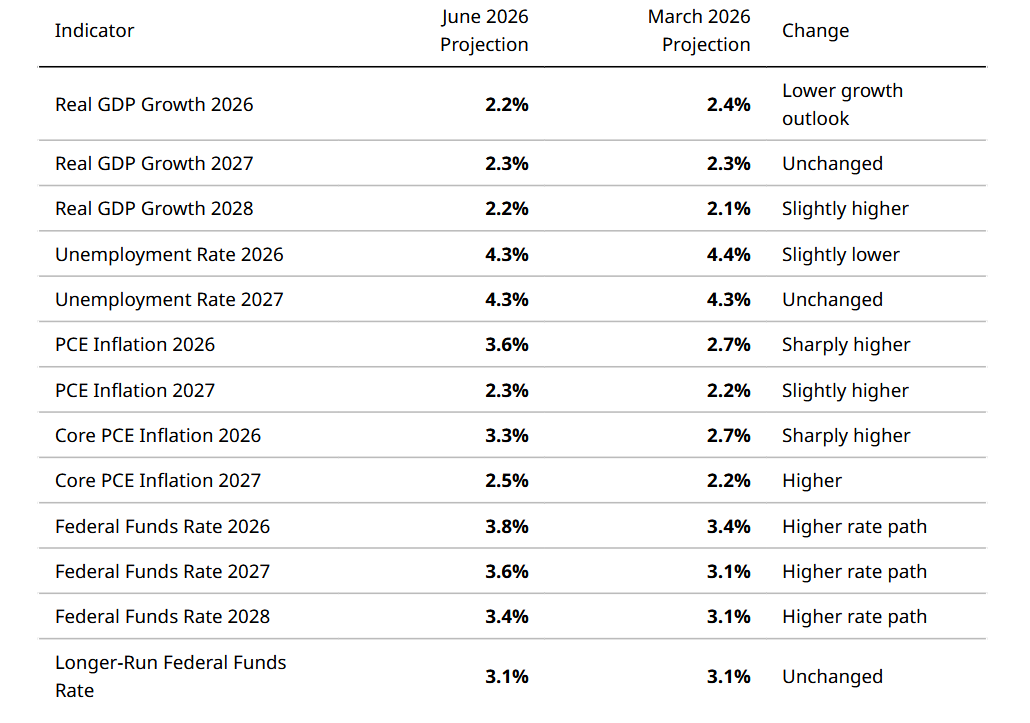
GDP Outlook: Fed Sees Slightly Slower Growth in 2026
The Fed’s new projections show that officials expect the U.S. economy to grow more slowly in 2026 than previously expected. The median real GDP growth forecast was revised down to 2.2%, compared with 2.4% in the March report.
This downgrade suggests that the Fed sees some cooling in economic momentum. Higher interest rates, weaker consumer sensitivity to borrowing costs, and global uncertainty may be limiting stronger expansion. However, the growth outlook remains far from recessionary. A 2.2% growth forecast still points to a solid U.S. economy.
For 2027, the Fed kept its growth forecast unchanged at 2.3%. For 2028, the projection was slightly raised to 2.2%, compared with 2.1% in March. The longer-run growth estimate remained at 2.0%, showing that Fed officials still believe the U.S. economy’s sustainable trend growth rate is close to 2%.
Labor Market Outlook: Unemployment Forecast Improves Slightly
The labor market remains one of the strongest parts of the Fed’s outlook. The median unemployment rate forecast for 2026 was revised down to 4.3%, from 4.4% in March. For 2027, the forecast stayed at 4.3%, while the 2028 and longer-run projections remained near 4.2%.
This shows that the Fed does not expect a major deterioration in employment conditions, even with rates staying elevated. The June FOMC statement also emphasized that job gains have kept pace with labor-force growth and that the unemployment rate has changed little.
For markets, this is important because a strong labor market gives the Fed more room to keep rates high. If unemployment were rising sharply, markets would expect faster rate cuts. But with labor conditions still stable, the Fed can remain focused on inflation control.
Inflation Outlook: The Most Important Shift in the June 2026 Report
Inflation was the most important part of the June 2026 economic projections. The Fed sharply raised its PCE inflation forecast for 2026 to 3.6%, up from 2.7% in March. This is a major upward revision and signals that policymakers are increasingly concerned about persistent price pressures.
The Fed also raised its core PCE inflation forecast to 3.3%, compared with 2.7% in March. Core inflation excludes food and energy and is often watched closely by the Fed because it can provide a clearer view of underlying price trends.
The rise in both headline and core inflation forecasts means the Fed sees inflation pressure as broader and more durable than previously expected. The FOMC statement noted that inflation remains elevated relative to the Fed’s 2% target, partly reflecting supply shocks and price increases in sectors such as energy.
The Fed still expects inflation to move back toward target over time. PCE inflation is projected at 2.3% in 2027 and 2.0% in 2028. But the near-term jump in inflation projections reduces the chance of rate cuts and increases the risk that policy will remain restrictive for longer.
Federal Funds Rate Outlook: Fed Signals Higher-for-Longer Policy
The June projections showed a clear upward shift in the Fed’s expected interest-rate path. The median federal funds rate forecast for 2026 rose to 3.8%, compared with 3.4% in March. For 2027, the median projection increased to 3.6%, up from 3.1%.
This is a hawkish signal. It suggests that Fed officials now expect fewer rate cuts than previously projected. In fact, the updated dot plot shows that a significant number of policymakers believe at least one rate hike could be appropriate if inflation remains too high.
The longer-run federal funds rate projection stayed at 3.1%, which means the Fed’s estimate of the neutral policy rate did not change. However, the near-term path moved higher, showing that officials believe current inflation conditions require a more restrictive stance.
For financial markets, this is the key message: the Fed is not preparing for quick easing. The central bank is signaling that rates may need to stay high until there is stronger evidence that inflation is moving sustainably back toward 2%.
What Changed Compared with the Previous Fed Report?
Compared with the March 2026 projections, the June report was clearly more hawkish. The main changes were higher inflation, a stronger labor market forecast, and a higher projected interest-rate path.
In March, the Fed expected inflation to moderate more quickly. By June, that confidence had weakened. The 2026 PCE inflation forecast rose by 0.9 percentage points, from 2.7% to 3.6%. Core PCE inflation also increased by 0.6 percentage points, from 2.7% to 3.3%.
At the same time, unemployment expectations improved slightly. This combination matters because it creates a difficult policy environment: inflation is higher, but the labor market remains strong enough that the Fed does not need to rush into rate cuts.
The projected federal funds rate path also changed meaningfully. In March, the median projection showed a 2026 federal funds rate of 3.4%. In June, that moved up to 3.8%. This shift suggests that the Fed now sees less room to ease and may even consider tightening again if inflation fails to cool.
Market Reactions to the June 2026 Fed Projections
Markets reacted cautiously to the June FOMC decision and projections. The decision to keep interest rates unchanged was widely expected, so the market reaction was driven more by the updated dot plot and inflation forecasts than by the rate decision itself.
Bond Market Reaction
U.S. Treasury yields moved higher after the Fed released its projections. The 10-year U.S. Treasury yield hovered near 4.46%, as investors priced in a more restrictive interest-rate outlook. The rise in yields reflected the market’s reaction to higher inflation forecasts and the possibility that some Fed officials may support a rate hike later in 2026.
Higher Treasury yields suggest that bond investors are adjusting to a higher-for-longer Fed scenario. If inflation remains elevated, the Fed may delay cuts or keep policy tight for longer than markets previously expected.
Stock Market Reaction
U.S. equities were relatively cautious after the announcement. The rate hold itself was not a surprise, but the higher inflation projections and higher federal funds rate path created pressure on risk sentiment.
Growth stocks, technology shares, and other rate-sensitive sectors could face volatility if Treasury yields continue rising. Higher yields reduce the present value of future earnings and can make bonds more attractive compared with equities.
However, the Fed’s growth outlook is still solid, and the labor market remains resilient. This limits recession fears and may prevent a deeper equity selloff unless inflation continues to surprise higher.
U.S. Dollar Reaction
The U.S. dollar received support from the Fed’s hawkish projections. A higher-for-longer rate path generally supports the dollar because it increases the relative yield advantage of U.S. assets.
However, the dollar’s reaction was not extreme because markets had already expected the Fed to keep rates unchanged. The next major move in the dollar will likely depend on upcoming inflation data, labor-market reports, and whether Fed officials continue to push back against rate-cut expectations.
Gold Market Reaction
Gold may face mixed pressure from the June Fed projections. On one hand, higher Treasury yields and a stronger dollar usually create downside pressure for gold. On the other hand, elevated inflation and geopolitical uncertainty can support safe-haven demand.
If markets focus mainly on higher real yields, gold could struggle. But if inflation concerns or geopolitical risks dominate sentiment, gold may remain supported despite the Fed’s hawkish stance.
Oil and Energy Market Reaction
Energy prices are important in the June 2026 projections because the Fed specifically linked some inflation pressure to supply shocks and rising prices in certain sectors, including energy. If oil prices remain elevated, headline inflation may stay above target for longer, making it harder for the Fed to cut rates.
This creates a direct connection between energy markets and monetary policy. Higher oil prices can keep inflation expectations elevated, which may force the Fed to maintain restrictive policy even if growth slows.
What the June 2026 Fed Projections Mean for Traders and Investors
The June 2026 Fed projections point to a more complicated market environment. The economy remains solid, but inflation is too high. The labor market is stable, but interest rates may stay restrictive. This combination can create volatility across stocks, bonds, currencies, commodities, and crypto.
For stock investors, the key risk is higher yields. If Treasury yields rise further, valuation pressure could return, especially in growth and technology sectors. Defensive sectors and companies with strong cash flows may perform better in a higher-rate environment.
For bond investors, the Fed’s hawkish shift means rate-cut expectations may need to be reduced. Short-term yields could remain supported, while longer-term yields may stay volatile depending on inflation and growth data.
For currency traders, the U.S. dollar may remain supported as long as the Fed’s rate path stays above other major central banks. However, the dollar could weaken if inflation cools quickly and markets start pricing rate cuts again.
For gold traders, the outlook depends on the balance between inflation risk and real yields. Higher inflation can support gold, but higher real yields and a stronger dollar can limit upside potential.
For oil traders, the key issue is whether energy prices continue feeding into inflation. If oil prices remain high, they may reinforce the Fed’s higher-for-longer stance.
Conclusion
The Federal Reserve’s June 2026 economic projections delivered a hawkish message to markets. While the FOMC kept interest rates unchanged at 3.50%–3.75%, the updated projections showed a clear shift toward higher inflation expectations and a higher policy-rate path.
Compared with the March report, the June projections showed lower 2026 GDP growth, slightly better unemployment expectations, sharply higher inflation forecasts, and a higher expected federal funds rate through 2028.
The main message is clear: the Fed is not ready to ease policy quickly. Inflation remains above the 2% target, and the labor market is strong enough to allow the central bank to remain patient. For markets, this means the higher-for-longer theme is back in focus.
The next major drivers will be upcoming inflation data, labor-market reports, energy prices, and Fed communication. Unless inflation cools meaningfully, rate-cut expectations may remain under pressure, Treasury yields may stay elevated, and markets may continue to trade cautiously around Fed policy signals.
FAQ
What did the Federal Reserve decide in June 2026?
The Federal Reserve kept the federal funds target range unchanged at 3.50%–3.75% at the June 16–17, 2026 FOMC meeting.
Why were the June 2026 Fed projections important?
The projections were important because they showed a more hawkish outlook than the previous March report. The Fed raised its inflation forecasts and increased its projected path for interest rates.
What was the Fed’s 2026 GDP forecast in June?
The Fed lowered its 2026 real GDP growth forecast to 2.2%, down from 2.4% in the March 2026 projections.
What was the Fed’s 2026 inflation forecast?
The Fed raised its 2026 PCE inflation forecast to 3.6%, compared with 2.7% in March. Core PCE inflation was revised up to 3.3%.
Did the Fed signal rate cuts in 2026?
The June projections suggested fewer rate cuts than previously expected. The median federal funds rate forecast for 2026 rose to 3.8%, compared with 3.4% in March.
How did markets react to the June 2026 Fed projections?
Treasury yields moved higher as investors reacted to the Fed’s higher inflation forecasts and higher projected rate path. The U.S. dollar received support, while equities traded cautiously.
What does higher-for-longer mean for markets?
Higher-for-longer means the Fed may keep interest rates elevated for an extended period. This can support the U.S. dollar and Treasury yields but may create pressure on stocks, gold, and rate-sensitive assets.
What is the main takeaway from the June 2026 FOMC projections?
The main takeaway is that inflation remains the Fed’s biggest concern. Even though growth is still solid and the labor market remains stable, the Fed is not ready to cut rates quickly.
----------------------------------------
Source
Federal Reserve Board and Federal Open Market Committee, Summary of Economic Projections, June 16–17, 2026 FOMC Meeting.
Comments