 English
 پارسی


Short Overview
The Bank of Japan took another major step toward monetary policy normalization at its June 16, 2026 Monetary Policy Meeting, raising the short-term policy interest rate to around 1.0% from around 0.75%. The decision was made by a 7–1 majority vote, with one board member opposing the move due to concerns about downside risks to production and employment.
Alongside the rate increase, the BoJ raised the interest rate on its complementary deposit facility to 1.0% and increased the basic loan rate under the complementary lending facility to 1.25%. The central bank also confirmed its plan to gradually reduce outright purchases of Japanese Government Bonds, lowering monthly JGB purchases by about ¥200 billion each quarter until the January–March 2027 quarter.
The BoJ’s message was clear: inflation risks remain important, especially because of higher crude oil prices and rising inflation expectations, but Japan’s economy still needs supportive financial conditions. As a result, the central bank is moving carefully, tightening policy while maintaining a flexible and accommodative stance.
Main Policy Decision: BoJ Raises Short-Term Rate to Around 1.0%
The most important decision from the June 2026 meeting was the change in the guideline for money market operations. The BoJ decided to encourage the uncollateralized overnight call rate to remain at around 1.0%.
This move represents a further shift away from the ultra-loose monetary policy that defined Japan for many years. The increase also confirms that the BoJ now sees Japan’s inflation trend and wage-price dynamics as strong enough to justify a higher policy rate.
The decision was approved by a 7–1 majority. The voting result shows that most board members supported another step toward normalization, but there was still concern within the board about economic risks.
Key Rate Changes
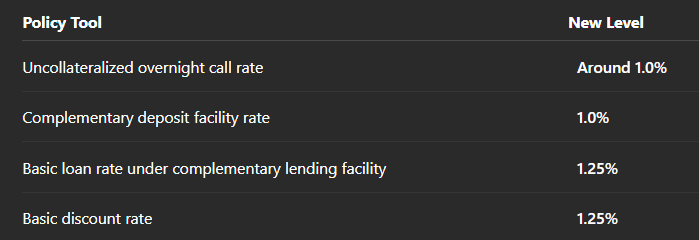
The BoJ said the new policy rate and the new facility rates would become effective on June 17, 2026.
Why Did the BoJ Raise Rates?
The Bank of Japan explained that Japan’s economy has continued to recover moderately, although some weakness remains. The recovery has been supported by high corporate profits, an improving labor market, and better income conditions. However, the central bank also acknowledged that higher crude oil prices, linked partly to the situation in the Middle East, have created pressure on economic activity.
The BoJ’s main concern is not only current inflation, but also the risk that underlying inflation could move above the 2% price stability target. Although core CPI had recently moved below 2% due to government energy measures, the central bank warned that price pressures from higher crude oil prices were passing through quickly in business-to-business transactions.
The BoJ also said that medium- to long-term inflation expectations have continued to rise. This is important because if households and firms expect inflation to stay higher, companies may continue raising prices and workers may continue demanding higher wages. This could make inflation more persistent.
In simple terms, the BoJ raised rates because it believes Japan’s economy is still growing, inflation expectations are rising, and the risk of inflation moving above target has increased.
Economic Outlook: Moderate Growth, but Slower Momentum
The BoJ described Japan’s economy as being in a moderate recovery, but with visible signs of weakness in some areas. Exports and industrial production have been broadly flat, while housing investment has been declining. However, business fixed investment has continued to increase moderately, supported by high corporate profits and strong global demand related to artificial intelligence.
Private consumption remains relatively resilient because employment and income conditions have improved. However, household sentiment remains weak, which means consumer spending may not accelerate strongly without further support from wage growth and lower energy costs.
The BoJ expects Japan’s economic growth to decelerate in the near term because higher crude oil prices are likely to reduce corporate profits and weaken households’ real income. However, the economy is still expected to continue growing moderately, helped by government measures, accommodative financial conditions, and high corporate profitability.
Over time, the central bank expects growth to strengthen again as the negative effects of high oil prices fade and the income-to-spending cycle improves.
Inflation Outlook: CPI Expected to Move Clearly Above 2%
The inflation outlook was one of the strongest reasons behind the BoJ’s decision. The central bank said Japan’s CPI, excluding fresh food, had recently slowed to around 1.5%, mainly because of government measures to reduce the household burden from higher energy prices.
However, the BoJ expects inflation to accelerate again. Higher crude oil prices are expected to push up energy and goods prices, while companies continue passing wage increases into selling prices.
The BoJ expects the year-on-year rate of increase in CPI, excluding fresh food, to move clearly above 2% before gradually declining back toward the 2% target as the effects of high oil prices fade.
Underlying CPI inflation is expected to rise gradually and reach a level consistent with the BoJ’s price stability target between the second half of fiscal 2026 and fiscal 2027.
This means the BoJ believes inflation is no longer just the result of temporary cost shocks. Instead, Japan’s wage-price cycle may be becoming more durable.
JGB Purchase Plan: BoJ Continues Balance Sheet Normalization
The second major decision was related to the BoJ’s purchases of Japanese Government Bonds. The central bank confirmed that long-term interest rates should, in principle, be formed in financial markets. At the same time, the BoJ said its JGB purchases should remain predictable and flexible enough to support market stability.
The BoJ decided to reduce its planned monthly JGB purchases by about ¥200 billion each calendar quarter until the January–March 2027 quarter. From April 2027 onward, monthly purchases will be around ¥2 trillion.
Planned Monthly JGB Purchases
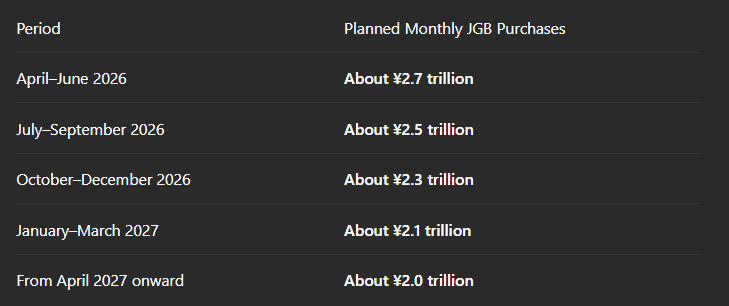
This is an important part of Japan’s monetary policy normalization. For years, the BoJ was a dominant buyer in the JGB market. Reducing purchases gradually allows the central bank to shrink its influence without causing sudden disruption in bond yields.
BoJ’s JGB Holdings Expected to Decline Sharply
The BoJ’s projections show that its JGB holdings could decline significantly over the next several years if monthly purchases remain at around ¥2 trillion from April 2027 onward.
The central bank expects its JGB holdings to decline to around ¥480 trillion by end-March 2027, representing about a 17% reduction from the end-June 2024 level. By end-March 2030, holdings could fall to around ¥350–¥370 trillion, representing roughly a 36–39% reduction compared with the pre-reduction level.
Expected BoJ JGB Holdings
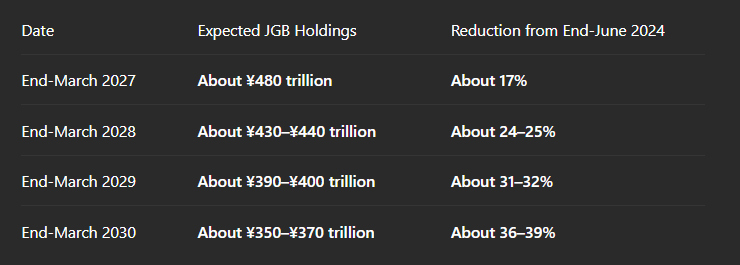
This gradual reduction supports the BoJ’s broader strategy: tighten monetary conditions without creating instability in the bond market.
Policy Dissent: Internal Debate Remains Important
The June 2026 meeting showed that the BoJ board is not fully united on every issue.
Board member Asada Toichiro opposed the rate hike. He argued that downside risks to production and employment from the Middle East situation were greater than upside risks to prices. In his view, the BoJ should have maintained the previous money market operations guideline.
On the JGB purchase plan, Tamura Naoki dissented. He believed long-term interest rates should be determined more fully by the market and proposed a longer reduction path, with monthly JGB purchases reduced by about ¥200 billion each quarter until January–March 2028. His proposal was rejected by majority vote.
These dissents show the policy challenge facing the BoJ. Some members are worried about inflation staying too high, while others are concerned that faster tightening could hurt production, employment, and financial stability.
Forward Guidance: More Rate Hikes Are Possible
The BoJ made it clear that additional rate hikes remain possible. The central bank said it will continue to raise the policy interest rate and adjust the degree of monetary accommodation depending on developments in economic activity, prices, and financial conditions.
However, the timing and pace of future adjustments will depend on incoming data. The BoJ will closely monitor the future course of the Middle East situation, its impact on Japan’s economy and prices, and the likelihood of achieving the baseline outlook.
This means the BoJ is not committing to a fixed hiking path. Instead, it is keeping a data-dependent approach. If inflation expectations continue rising and underlying inflation remains firm, further rate hikes could follow. If geopolitical risks weaken growth or financial markets become unstable, the BoJ may move more slowly.
Market Implications: Yen, JGB Yields, Japanese Stocks
The June 2026 decision has important implications for Japanese financial markets.
Japanese Yen
A higher BoJ policy rate is generally supportive for the Japanese yen because it reduces the interest-rate gap between Japan and other major economies. However, the yen’s reaction will also depend on U.S. Treasury yields, global risk sentiment, oil prices, and expectations for future BoJ hikes.
If investors believe the BoJ will continue raising rates, the yen could gain further support. But if the market sees the rate hike as cautious or already priced in, the yen’s upside may be limited.
Japanese Government Bonds
The gradual reduction in JGB purchases increases the role of market forces in determining long-term Japanese yields. This could place upward pressure on JGB yields over time, especially if inflation remains above target and investors expect more BoJ tightening.
However, the BoJ has also made clear that it will respond to a rapid rise in long-term interest rates. This should reduce the risk of disorderly moves in the JGB market.
Japanese Equities
For Japanese stocks, the impact is mixed. Higher rates can pressure equity valuations, especially for growth and rate-sensitive sectors. However, the BoJ’s confidence in the economy, strong corporate profits, and AI-related investment demand may continue to support selected sectors.
Banks and insurers could benefit from a higher interest-rate environment, while exporters may face pressure if the yen strengthens significantly.
What Makes This BoJ Decision Important?
This meeting is important because it confirms that the BoJ is no longer operating in a purely defensive policy environment. The central bank now appears more confident that Japan’s economy can handle higher rates, even though risks remain.
The rate hike to 1.0% is symbolically significant. Japan spent decades with extremely low or negative rates, so the move reflects a bigger structural change in the country’s inflation and wage environment.
At the same time, the BoJ is trying to avoid a policy shock. Its JGB purchase reduction plan is gradual, predictable, and flexible. The central bank wants to normalize monetary policy, but not at the cost of destabilizing bond markets or undermining the economic recovery.
Conclusion
The Bank of Japan’s June 2026 meeting marked another important step in Japan’s monetary policy normalization. The BoJ raised the short-term policy rate to around 1.0%, increased the complementary deposit facility rate to 1.0%, and lifted the basic loan rate to 1.25%.
The central bank justified the decision by pointing to Japan’s moderate economic recovery, tight labor market, rising inflation expectations, and the risk that underlying inflation could move above the 2% target. However, the BoJ also acknowledged that higher crude oil prices and Middle East risks could weigh on growth.
At the same time, the BoJ confirmed a gradual reduction in monthly JGB purchases, moving from around ¥2.7 trillion in April–June 2026 to around ¥2.0 trillion from April 2027 onward. This plan supports market functioning while giving the central bank enough flexibility to respond to volatility.
Overall, the June 2026 decision shows a cautious but clear normalization path. The BoJ is likely to continue raising rates if inflation remains firm, but future moves will depend heavily on economic data, inflation expectations, oil prices, the yen, and financial market stability.
FAQ
What did the Bank of Japan decide in June 2026?
The Bank of Japan raised its short-term policy interest rate to around 1.0% and confirmed a plan to gradually reduce its monthly purchases of Japanese Government Bonds.
What was the previous BoJ policy rate before the June 2026 meeting?
Before the June 2026 decision, the BoJ’s short-term policy rate was around 0.75%. The June decision raised it to around 1.0%.
Why did the BoJ raise interest rates?
The BoJ raised rates because Japan’s economy continued to recover moderately, inflation expectations were rising, and the central bank saw a risk that underlying CPI inflation could move above its 2% price stability target.
What is the BoJ’s inflation target?
The Bank of Japan’s inflation target is 2%, measured as a sustainable and stable rate of consumer price inflation.
What did the BoJ say about Japan’s economy?
The BoJ said Japan’s economy has recovered moderately, supported by high corporate profits, improved employment and income conditions, and accommodative financial conditions. However, it also noted weakness in some areas due to higher crude oil prices and geopolitical risks.
What is the BoJ’s plan for JGB purchases?
The BoJ will reduce monthly JGB purchases by about ¥200 billion each calendar quarter until January–March 2027. From April 2027 onward, monthly JGB purchases will be around ¥2 trillion.
How much will the BoJ buy in Japanese Government Bonds from April 2027?
From April 2027 onward, the BoJ plans to buy around ¥2 trillion of Japanese Government Bonds per month.
What happens if Japanese bond yields rise too quickly?
The BoJ said it is prepared to respond quickly if long-term interest rates rise rapidly. It may increase JGB purchases, conduct fixed-rate purchase operations, or use funds-supplying operations to support market stability.
What does the BoJ decision mean for the Japanese yen?
The rate hike is generally supportive for the Japanese yen because higher Japanese interest rates can reduce the yield gap with other major economies. However, the yen’s direction will also depend on U.S. yields, global risk sentiment, oil prices, and expectations for future BoJ policy.
Will the BoJ raise rates again in 2026?
The BoJ signaled that further rate hikes are possible, but the timing and pace will depend on economic activity, inflation, financial conditions, and geopolitical risks.
What are the main risks for Japan’s economy after the June 2026 BoJ meeting?
The main risks include higher crude oil prices, the Middle East situation, foreign exchange market movements, global AI-related demand, weak household sentiment, and possible instability in the JGB market.
Why is the June 2026 BoJ meeting important?
The meeting is important because it confirms Japan’s ongoing shift away from ultra-loose monetary policy. The rate hike to 1.0% and the reduction in JGB purchases show that the BoJ is gradually normalizing policy while trying to avoid financial market disruption.
Comments