translate English
 پارسی
English
Englishپارسی
English
Englishپارسی EnglishپارسیEnglishپارسی
A historical deep-dive into Iran’s student movement—from the Constitutional era and Student Day (16 Azar/1953) to the 1979 Revolution, the Cultural Revolution, 18 Tir 1999, the 2009 Green Movement, and the Mahsa (Woman, Life, Freedom) uprising. It also explains the recent campus shift toward national symbols—including burning the Islamic Republic flag, raising the Lion and Sun flag, and calling to restore pre-1979 university names—showing how Iran’s universities remain a frontline of political identity and change.
A deeper look at Iran’s ongoing protest movement and revolutionary unrest, this update covers the latest developments inside the country, the key events of the past 72 hours, the regime’s continuing crackdown, and the broader social and economic pressures driving public anger. It also examines international reactions, Prince Reza Pahlavi’s latest statements, the newest developments in the Geneva nuclear talks, fresh travel warnings issued by foreign governments, and the military scenarios now shaping the risk of escalation and possible wider war.
A fresh wave of Jeffrey Epstein–related releases has shifted the story from “who’s named” to how the records are being published—millions of pages, thousands of videos, and hundreds of thousands of images, alongside ongoing redactions and takedowns after victim-identifying information surfaced. This post breaks down the newest flashpoints: claims and denials tied to political figures, accelerating UK scrutiny around Prince Andrew, and the money trail—especially the Morocco palace purchase attempt and New York real-estate links—while highlighting what’s verified in official releases versus what remains contested, incomplete, or unproven.
A 72-hour deep-dive into Iran’s Lion & Sun national revolution: student-led protests spreading across major campuses, the regime’s tightening “red lines,” arrests and high-profile detainee cases, and a widening solidarity front from labor and civil society. The update also tracks diaspora mobilization, Prince Reza Pahlavi’s latest messaging, and the fast-moving Iran–US crisis loop—with Geneva nuclear talks resuming as Washington’s military posture surges and regional escalation risks rise.
This report reviews developments tied to the “Lion and Sun” Revolution over the past forty-eight hours, anchored to Europe time, February 21, 2026, coverage window begins February 19, 2026. Sourcing is constrained by ongoing telecommunications restrictions inside Iran and uneven access for independent observers.
The latest minutes from the January 27–28 FOMC meeting (released February 18) show a committee that is comfortable staying on hold after last year’s easing—but increasingly explicit that the next move is not predetermined. Policymakers broadly described the economy as still expanding at a solid pace, a labor market that is cool but stabilizing, and inflation that is still somewhat elevated, with the inflation story complicated by tariff-driven core goods pressure and data distortions linked to the government shutdown.
Iran remains at a historic crossroads. As of February 19, nationwide protests continue to reshape the political and social landscape following January’s deadly crackdown. Forty-day memorials have reignited dissent, while authorities intensify security measures and internet restrictions. At the same time, nuclear negotiations remain fragile, U.S. and allied military deployments expand across the region, and Russia warns against escalation. With diplomacy under pressure and tensions rising, the coming days could prove decisive.
Over the past 48 hours the “Iran revolution” has entered a new phase. Massive diaspora rallies have energised the opposition and brought global attention to the regime’s brutality. At the same time, Tehran has demonstrated both military defiance and a cautious willingness to negotiate. The coming days will test whether international pressure, economic strain and persistent protests can compel meaningful change. For now, the movement’s resilience and the regime’s harsh response suggest a protracted struggle ahead.
Over the last 48 hours, Iran’s revolution narrative split into two fast lanes: mass diaspora mobilization—led by Munich—and intensified repression inside Iran, including death-penalty escalation and renewed digital control. Rooftop chants signaled continued domestic resistance even as authorities tighten surveillance and information choke points. International pressure rose in parallel, with heightened U.S. military signaling, sanctions talk, and nuclear diplomacy returning to Geneva.
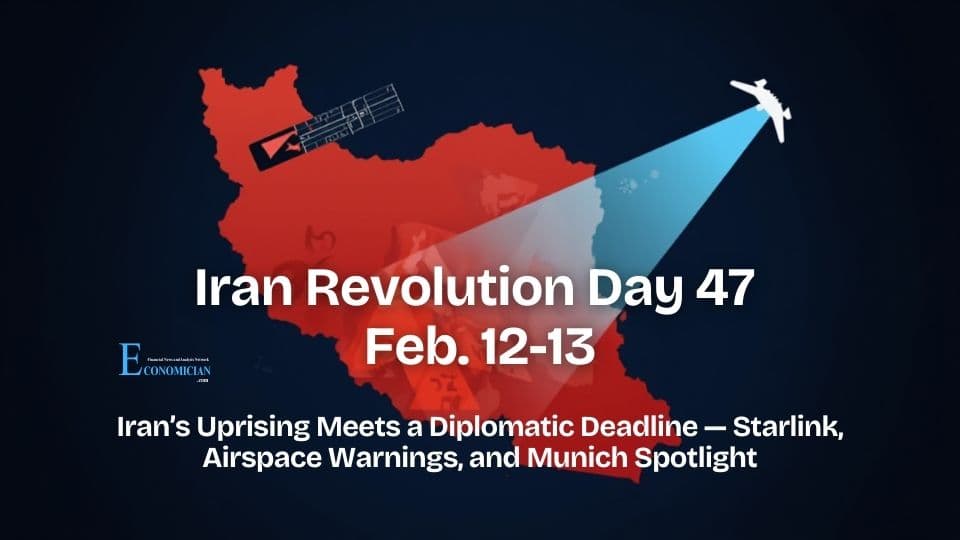
Day 47 of Iran’s uprising comes into focus through three fronts: a battle over connectivity amid renewed internet restrictions and reports of Starlink terminals entering the country, a sharper military-deterrence backdrop with the USS Gerald R. Ford moving toward the Middle East, and growing internationalization of the Iran file at the Munich Security Conference. This deep-dive tracks what happened in the last 24–48 hours, what’s unfolding now, key global reactions (Europe’s airspace risk warning included), and the signals markets and policymakers are watching next.
This post is a document-based fact-check built to reduce noise around a highly emotional topic. I’m not asking you to “trust a narrative”—I’m separating what the publicly released records explicitly show (emails, institutional statements, dated documents) from what is inference, conjecture, or viral extrapolation. Where a claim is strong, I point to the type of evidence that would be required to validate it (e.g., a specific file/page/line in the DOJ releases and independent corroboration). The goal is simple: keep the discussion anchored in verifiable sources, flag what remains unproven, and make it easier for readers to distinguish between evidence, interpretation, and propaganda framing—regardless of where they stand politically or culturally.
The OPEC Monthly Oil Market Report (February 2026) updates the market’s baseline on global oil demand growth, supply trends, and inventory dynamics, with a close read on OPEC+ policy signals and the key risks shaping crude pricing. This post distills the headline revisions, the balance sheet implications, and what to watch next across production, exports, refinery runs, and physical-market tightness.