translate English
 پارسی
English
Englishپارسی
English
Englishپارسی EnglishپارسیEnglishپارسی
Day 13 of the Iran war marked another major escalation, with new strikes across Iranian territory, attacks affecting Gulf states, and continued disruption in one of the world’s most important energy chokepoints, the Strait of Hormuz. This report examines the last 24 hours in detail, including military developments, regional spillover, global diplomatic reactions, and the economic impact on oil, shipping, and market sentiment.
The IEA’s March 2026 Oil Market Report marks a sharp turn in the global energy narrative. What looked in February like a market moving toward manageable surplus has become, in March, a crisis-driven environment defined by disrupted Strait of Hormuz flows, lower oil demand expectations, refinery stress, and the largest supply shock the IEA has ever described.

The OPEC Monthly Oil Market Report for March 2026 presents a market that remains fundamentally firm, even as macro, trade and geopolitical uncertainty continues to shape sentiment. OPEC left its major growth projections unchanged, signalling confidence in the resilience of the global economy and in oil consumption growth through both 2026 and 2027. At the same time, crude prices moved higher in February, tanker markets tightened sharply, refining margins diverged by region, and OECD commercial inventories fell month-on-month.
The war between the United States/Israel and Iran, which began on 28 February 2026, entered its twelfth day on 11 March 2026. Fighting intensified and extended beyond Iran's borders, with air raids, missile and drone attacks, and naval clashes. The Persian Gulf and Strait of Hormuz, the world’s busiest oil route, saw renewed attacks on shipping and efforts by the U.S. to neutralize Iranian minelaying. This briefing summarizes developments over the previous 24 hours and situates them within the broader conflict.
The EIA’s Short-Term Energy Outlook for March 2026 shows an energy market shaped by geopolitical oil risk, firmer near-term Brent crude prices, steady U.S. crude production, softer natural gas pricing expectations than the prior forecast, and continued growth in U.S. power demand. In this report, we break down the latest STEO and what it means for oil, gas, electricity, inventories, and the near-term outlook for traders and investors.
Day 11 of the Iran war saw the heaviest U.S.-Israeli strikes so far, fresh Iranian missile and drone attacks, rising regional spillover across the Persian Gulf, and growing pressure on energy markets and the Strait of Hormuz. This update covers the past 24 hours, including targets hit, casualties, official statements, regional reactions, and what they mean for the next phase of the conflict.
This full update covers the most important developments in the Iran war over the past 36 hours, including Israeli and US strikes across multiple targets inside Iran, Iran’s retaliatory attacks across the region, and the latest military, political, and diplomatic changes surrounding the conflict. The report also reviews key official statements, international reactions, the selection of Mojtaba Khamenei, and the broader implications of these events for the direction of the war and regional stability.
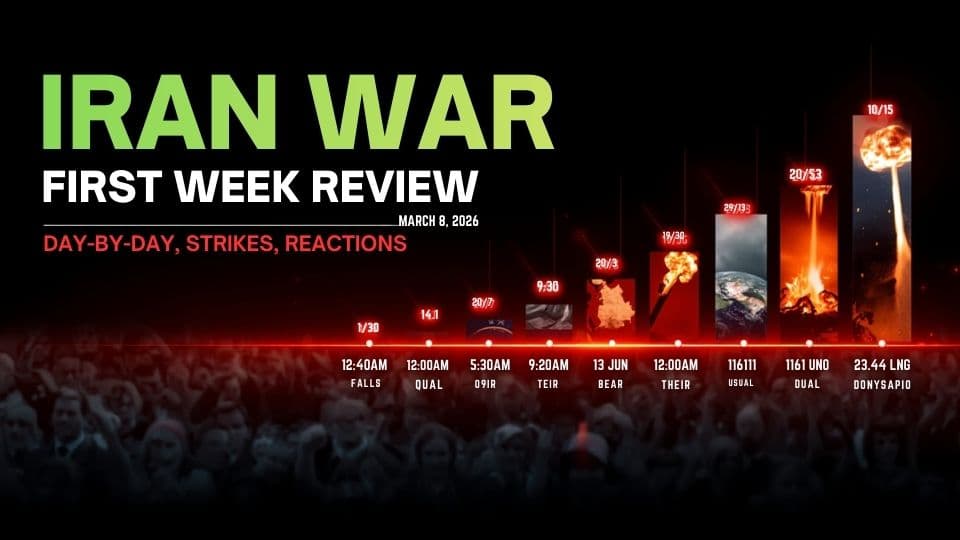
On 28 February 2026 the United States and Israel launched Operation Epic Fury and Operation Lion’s Roar, a coordinated attack on Iran. The opening salvo decapitated much of Iran’s leadership, targeted its military infrastructure and triggered widespread retaliation. By 7 March, more than 1,200 people had been killed in Iran and dozens more across the region. Below article provides a day‑by‑day summary, followed by sections on the main targets, Iranian strikes outside Iran, leadership statements, casualties among Iranian officials and international reactions.
A comprehensive Day 7 update on the Iran war, covering the most important developments from the last 48 hours: heavy U.S.-Israeli strikes across Tehran and other Iranian cities, the military and strategic sites that were targeted, Iran’s retaliatory missile and drone attacks across the region, and the expanding role of regional actors and international powers. The report also examines official statements, humanitarian damage, displacement, diplomatic reactions, and what the latest escalation may mean for the next phase of the conflict.
The Federal Reserve’s February 2026 Beige Book signals a modest, uneven expansion: activity rose in 7 of 12 districts, while more areas reported flat or declining momentum. Consumers are spending cautiously amid economic uncertainty and price sensitivity, even as manufacturing improves on stronger new orders tied to data centers and energy infrastructure. This post breaks down the report itself and what the report implies for growth, demand, credit, housing, and the near-term macro outlook.
The U.S.–Israel–Iran war has rapidly escalated into a wider regional crisis, with major strikes inside Iran, retaliatory attacks across the Persian Gulf, high-profile Iranian leadership losses, and mounting international pressure for de-escalation. This report covers the latest developments, the most important events of the past 48 hours, key targets, official statements, and the broader geopolitical and market fallout.

The Israel–US attack on Iran that began on February 28, 2026, marked the most significant direct escalation between Iran, Israel, and the United States in years. What started as a coordinated air campaign against Iranian military, nuclear, and leadership targets quickly expanded into a regional confrontation involving missile strikes, drone attacks, Gulf military bases, shipping routes, and civilian infrastructure across multiple countries. This full report explains how the Israel–US attack on Iran started, why it happened, how the fighting unfolded from the first strike until now, the casualties on all sides, which places were hit inside Iran and outside Iran, and what the conflict means at this stage.