translate English
 پارسی
English
Englishپارسی
English
Englishپارسی EnglishپارسیEnglishپارسی
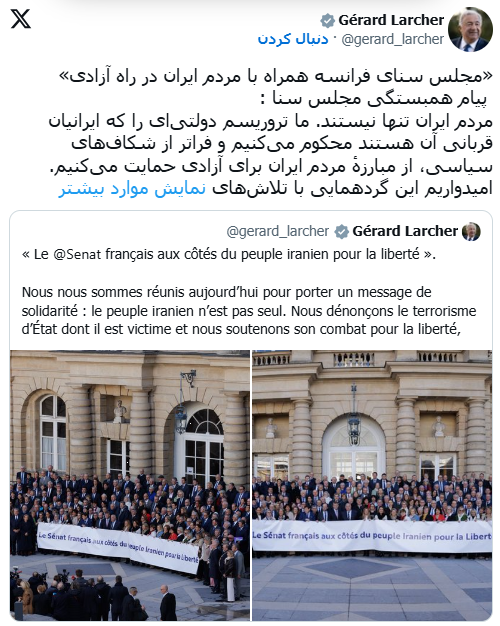
Gérard Larcher, President of the French Senate, issued a solidarity message saying Iranians “are not alone” and condemning what he described as “state terrorism” faced by the Iranian people, adding that—beyond political divides—the French Senate supports Iranians’ struggle for freedom. He expressed hope that the Senate’s collective initiative will continue and expand in resonance across Europe, encouraging other legislatures to adopt a similar stance so the message reaches women and men in Iran. Larcher also recalled that roughly two years ago the French Senate adopted a European resolution calling on France and its EU partners to place the Islamic Revolutionary Guard Corps (IRGC) on the EU terrorist list, saying “now is the time” to do so.
U.S. President Donald Trump hosted a signing ceremony for his controversial “Board of Peace” initiative on the sidelines of the World Economic Forum in Davos, describing it as a body that could become “one of the most consequential ever created.” Trump said the effort marked early steps toward a “brighter day for the Middle East and a much safer future for the world.” Some key U.S. allies reportedly expressed reservations about the initiative’s scope and legitimacy.
Market impact: Raises geopolitical risk premiums as markets assess the Board’s implications for traditional diplomatic frameworks and conflict‑region stability.
Donald Trump and Ukrainian President Volodymyr Zelenskyy held a private discussion on the margins of the forum, with both leaders signaling a shared intent to end the Russia‑Ukraine war. Trump publicly stated that the dialogue with Zelenskyy was constructive, while Zelenskyy participated in broader Davos sessions on Ukraine’s recovery and investment needs.
Market impact: May ease risk sentiments around Europe‑linked assets if markets interpret the dialogue as a step toward diplomatic progress, though uncertainty remains high.
Canadian Prime Minister Mark Carney delivered a special address at the WEF Annual Meeting, warning that the rules‑based international order is eroding amid rising great‑power rivalry. He urged middle powers like Canada to collaborate on shaping a more cooperative and resilient global system that upholds human rights, sovereignty, and sustainable development — aligning with the Spirit of Dialogue theme’s call for multilateral problem‑solving.
Market impact: Reinforces multilateralism narratives, potentially stabilizing investor confidence in frameworks that support predictable global trade and cooperation.
European Commission President Ursula von der Leyen delivered a special address at Davos emphasizing the need for European strategic autonomy amid geopolitical shocks and reaffirming the EU’s commitment to Ukraine and Arctic security (including Greenland). She stressed reforming trade, regulation, and investment policies while maintaining strong transatlantic ties — fitting into the Spirit of Dialogue focus on dialogue alongside divergent global priorities.
Market impact: May buoy European markets by reinforcing policy clarity on trade and security, and by reassuring investors about EU‑US cooperation on shared security interests.
At Davos, U.S. President Donald Trump unveiled a new international initiative dubbed the “Board of Peace,” aimed at maintaining ceasefires and envisioning post‑war futures (starting with Gaza). Trump claimed support from 59 countries, but major U.S. allies — such as the U.K., France, Norway, and Sweden — declined to participate, raising questions about its legitimacy and reach. Diplomats from countries including Saudi Arabia, Argentina and Indonesia joined, while Russia and China are reportedly deliberating involvement. Critics warn the board may undercut established norms and the UN’s role.
Market impact: Introduces diplomatic risk & uncertainty in geopolitical risk pricing, particularly in Middle East and peace‑focused development funds, as private capital digests potential new frameworks outside traditional international institutions.
At Davos 2026, Ukrainian President Volodymyr Zelensky met with U.S. President Donald Trump for an hour‑long discussion, which Trump described as productive and tied to his “Board of Peace” initiative. The meeting focused on ending the Russia‑Ukraine war and broader global conflict mediation, though details on concrete outcomes remain limited. Trump also reiterated progress on a Greenland security framework and withdrew related tariff threats. The dialogue took place amid cautious responses from European allies about U.S. geopolitical positions. China likewise rebutted Trump’s renewable energy critiques during the forum.
Market impact: May reduce geopolitical risk premiums in conflict‑sensitive assets if talks encourage diplomatic engagement; energy and defense sectors remain sensitive to evolving Ukraine war dynamics.
U.S. Q3 GDP was revised to 4.4% q/q, slightly above expectations (4.3%) and up from 3.8% previously—underscoring a stronger growth pulse. The GDP Price Index held at 3.7% q/q (in line with expectations, up from 2.1% prior), pointing to firmer economy-wide inflation pressures during the quarter. Meanwhile, GDP Sales came in at 4.5% (just below 4.6% expected, but down from 7.5%), suggesting underlying domestic demand was still strong, though less torrid than the prior print.
Market impact: Growth revision is USD- and yields-supportive at the margin, while the sticky price index keeps a hawkish inflation tone in the backdrop; net effect can be negative for long-duration assets if markets reprice “higher-for-longer.”
Ali Abdollahi, commander of Iran’s Khatam al-Anbiya Central Headquarters, said that any “aggression” against Iran would make all US bases a “legitimate” target, warning Washington it understands the consequences of any miscalculation. He added that any attack on Iran’s territory, security, or interests would promptly place US interests, bases, and “centers of influence” within reach of Iran’s armed forces, and claimed Iran’s response would be faster, more precise, and more destructive than the US and Israel “can imagine,” amid escalating war-of-words tied to renewed threats from President Donald Trump.
Israel has raised its internal alert level and boosted both defensive and offensive readiness amid growing concern that the United States could move toward military action against the Islamic Republic in the coming days, according to reporting citing Israeli security officials. Reports also say Prime Minister Benjamin Netanyahu will convene a limited security meeting on Thursday, 22 January 2026 (2 Bahman 1404) as Israel reviews potential retaliation scenarios and preparedness measures.
Marko Mihkelson, chair of the Estonian parliament’s foreign affairs committee, said the West must defend itself “not only in words but also in deeds,” arguing that a core priority is defeating Russia’s expansionism while also helping Iranians resist the “mass terror” imposed by what he described as an Islamist dictatorship. He added that Europe’s response will help define the role Europeans play in shaping a renewed global order.
The European Parliament adopted a resolution on 22 January 2026 condemning Iran’s violent repression of protesters, calling for an immediate end to violence and executions, and demanding the unconditional release of detained protesters, journalists, and human-rights defenders. The text passed 562–9 (57 abstentions) and urges the EU Council to proceed “without delay” with the full designation of the Islamic Revolutionary Guard Corps (IRGC)—including the Basij and Quds Force—as terrorist organisations, alongside expanded EU restrictive measures (asset freezes and visa bans). It also condemns Iran’s internet shutdowns and calls on the EU and member states to scale up technical and financial support for censorship-circumvention tools and protection against cyber/information manipulation, while stressing that any normalisation of ties should be contingent on genuine progress toward democracy, rule of law, and the release of political prisoners.