translate English
 پارسی
English
Englishپارسی
English
Englishپارسی EnglishپارسیEnglishپارسی
President Donald Trump warned that the U.S. would respond with “big retaliation” if European countries move to sell down trillions of dollars in American assets, saying Washington “has all the cards,” in comments reported from an interview on the sidelines of the World Economic Forum in Davos. In the same media round, Trump also questioned NATO’s value to the U.S., saying America has “never needed” the alliance, and dismissed allied contributions in Afghanistan by claiming NATO troops stayed “a little back” from the front lines—remarks that drew sharp criticism in parts of Europe.
Russia’s Vladimir Putin said Moscow is considering joining President Donald Trump’s “Board of Peace” (also referred to as a “Peace Council”) and proposed using $1 billion from Russian sovereign funds frozen in the United States as the required contribution—framing the money as support for Palestinians and Gaza reconstruction. Trump reacted positively, calling the idea “very interesting,” as the proposal surfaced alongside late-night Kremlin talks with a U.S. delegation that included Steve Witkoff, Jared Kushner, and Board-of-Peace adviser Josh Gruenbaum, ahead of further U.S.-Ukraine-Russia negotiations in Abu Dhabi; there has been no confirmed announcement that Russia has formally joined.
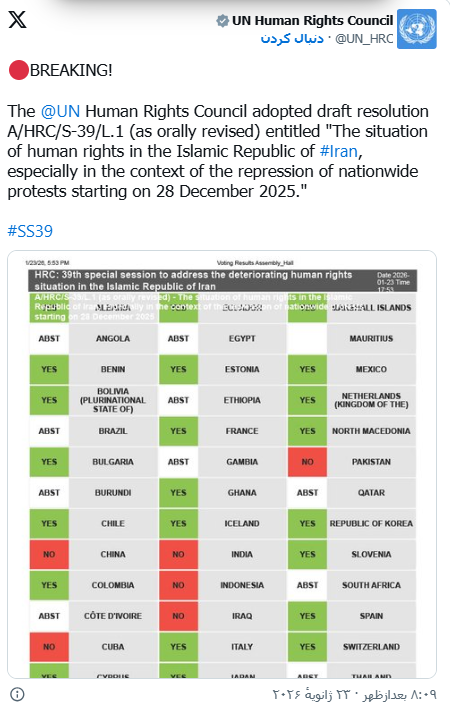
The UN Human Rights Council adopted a resolution on Friday, 23 January 2026 (3 Bahman) condemning the violent suppression of protests in Iran, passing with 25 votes in favor and seven against. Countries reported as voting against included China, Cuba, India, Indonesia, Iraq, Pakistan and Vietnam, while a cross-regional bloc supported the measure as international scrutiny of Iran’s crackdown intensifies.
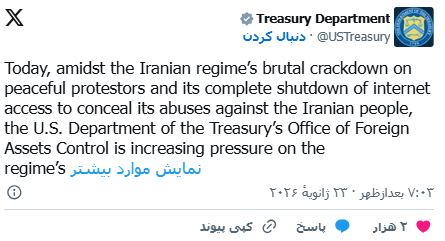
The U.S. Treasury’s Office of Foreign Assets Control (OFAC) said Friday, 3 Bahman it is increasing pressure on the Islamic Republic’s “shadow fleet,” linking the move to what it described as a brutal crackdown on peaceful protesters and a complete internet shutdown to conceal abuses. The new sanctions target nine shadow-fleet vessels and their owners or owner-companies that OFAC says moved hundreds of millions of dollars’ worth of Iranian oil and petroleum products to foreign markets; Treasury argued those revenues should belong to Iranians but are instead channeled into regional proxy groups, weapons programs, and security services. Treasury Secretary Scott Bessent said Iran is engaged in “economic self-immolation,” accelerated by President Donald Trump’s maximum-pressure campaign, and claimed Tehran’s choice to back “terrorists” over its own people has driven a collapse in the currency and living conditions, adding that the sanctions strike a key revenue stream used to fund domestic repression and that Treasury will continue tracking funds the regime allegedly moves to banks outside Iran. OFAC said the measures target Iran’s oil and petrochemical sectors.
The U.S. State Department said on Friday, 3 Bahman—following Treasury sanctions targeting eight companies and nine vessels tied to Iran’s “shadow fleet”—that Washington will take additional measures to prevent the Iranian regime from accessing resources used to suppress its people. The statement said the sanctioned entities helped transport hundreds of millions of dollars’ worth of Iranian oil and petroleum products, including LPG, thereby financing the regime and its security forces, while Iranians protest what it called catastrophic economic mismanagement. It added that Tehran continues funding foreign proxies and missiles instead of meeting basic needs, pointing to high inflation, deteriorating infrastructure, and water and power shortages, and argued the new sanctions will further restrict Iran’s oil exports via opaque and fraudulent mechanisms—limiting funds for domestic repression and malign international activities—while the U.S. continues implementing President Donald Trump’s National Security Memorandum No. 2 on maximum pressure.
Germany’s Confederation of Trade Unions (DGB) said it stands in “unconditional solidarity” with the people of Iran, describing the protests as a courageous pushback against repression, political oppression, systematic human-rights violations, authoritarian rule, and state mismanagement that has driven large parts of the population into poverty and insecurity. The union condemned what it called brutal violence against peaceful protesters, arbitrary arrests, and killings, arguing these actions show the political leadership has lost its legitimacy, and said it supports those fighting for dignity, equality, free expression, and social rights. It also warned that independent trade unions—key pillars of a democratic society—are deliberately suppressed in Iran, and called for sustained, decisive measures by Germany, the EU, and the international community, including adding the Islamic Revolutionary Guard Corps (IRGC) to the EU’s terrorist list, while stressing that the path to a free, democratic, secular Iran must be determined by Iranians themselves—peacefully, independently, and without foreign interference.
Turkey’s foreign minister Hakan Fidan said there are indications Israel is still considering an attack on Iran, warning that any such move could further destabilize the Middle East. He added that he remains hopeful alternative solutions can be found.
Reuters’ Davos wrap-up said geopolitics overshadowed much of the week and noted Russian officials—previously excluded after the Ukraine invasion—returned for discussions with U.S. delegates, alongside ongoing Ukraine-focused diplomacy and heightened transatlantic strain around Greenland and trade threats.
Market impact: Any hint of shifts in Russia–West contacts can move energy, defense, and European risk assets quickly—mostly via volatility rather than clear directional pricing.
Russia’s Kremlin said a long-term settlement requires Ukrainian forces to withdraw from the parts of the Donbas (Donetsk/Luhansk) that Kyiv still controls, calling troop withdrawal a key condition and reiterating the demand as Abu Dhabi talks get underway. The stance underscores that “territory” remains the central obstacle in negotiations, even as the U.S. pushes to formalize a new security-track process.
Market impact: Lowers odds of a quick breakthrough, keeping Europe geopolitical risk premia elevated—supportive for defense-linked names and potentially energy risk premium, with headline volatility for EUR and European rates.
Ukraine’s President Volodymyr Zelensky approved the composition of Kyiv’s delegation for U.S.–Russia–Ukraine negotiations in Abu Dhabi, appointing National Security and Defense Council Secretary Rustem Umerov to lead the team. Media reporting said the Abu Dhabi talks have now started, with territory—especially the Donbas—set to be a central agenda item across January 23–24, as Moscow reiterates that any durable settlement must include a territorial arrangement. Russia’s delegation is led by GRU chief Igor Kostyukov, underscoring the security-heavy nature of the track.
Market impact: Headline-driven risk premium catalyst—credible progress can tighten European credit spreads and support EUR/risk assets, while stalemate/escalation tends to bolster energy-war risk premia and keep defense names supported.
The UK Ministry of Defence said RAF Typhoon jets from 12 Squadron—its joint Typhoon squadron with Qatar—have deployed to the Gulf region, describing the move as “defensive” and linked to “regional tensions” under the UK–Qatar Defence Assurance Agreement and at the invitation of the Qatari government. The MoD noted 12 Squadron regularly deploys to Qatar for joint training and exercises, and separately, some of the Typhoon footage circulating online appears to be from earlier RAF material rather than this specific deployment.
The Kremlin said Russia is sending military officials from the Defence Ministry to Abu Dhabi for the U.S.–Russia–Ukraine security talks, stressing that the delegation is made up entirely of “military men” and that Moscow will not name them yet. Separate briefings indicate Russia’s side will be led by GRU chief Igor Kostyukov, as the process shifts into military-to-military working groups and follow-on sessions after recent U.S.–Russia contacts in Moscow.
Market impact: Keeps ceasefire/settlement pricing headline-driven—any perceived momentum can compress European risk premia, while a hard-line posture or lack of progress can quickly reprice EUR, energy risk premium, and defense-linked names.