translate English
 پارسی
English
Englishپارسی
English
Englishپارسی EnglishپارسیEnglishپارسی
Israeli TV Channel 13 reported that CENTCOM chief Vice Adm. Brad Cooper met on Saturday (4 Bahman) with IDF Chief of Staff Lt. Gen. Eyal Zamir and senior Israeli intelligence and operations chiefs, conveying that President Donald Trump has not made a final decision on striking Iran, but that the U.S. has completed equipment and operational preparations for a potential mission. The report said Israeli officers are calling next week “key,” and claimed Israel urged that any initial strike prioritize clearly defined military targets—especially Iran’s surface-to-surface missile capabilities—alongside broader pressure on state institutions.
The U.S. Treasury said it has sanctioned nine vessels tied to Iran’s so-called “shadow fleet,” alongside eight firms involved in shipping Iranian petroleum and petroleum products (including LNG), framing the move as part of a broader effort to disrupt revenue streams Washington says help fund repression amid a violent crackdown on protesters and an extended internet shutdown. Treasury Secretary Scott Bessent described the Iranian regime as engaged in “economic self-immolation,” arguing the sanctions hit a key channel used to generate funds.
In an interview published by the New York Post, U.S. President Donald Trump claimed the U.S. used a classified device he called the “Discombobulator” during the January 3 raid in Caracas that led to Nicolás Maduro’s capture, saying it “made their equipment not work” and prevented Russian- and Chinese-made missiles from launching. The Post and other outlets framed the remarks as potentially referring to a “sonic” or directed-energy capability, but no technical details were provided and there has been no independent public confirmation of what system—if any—was used.
The head of U.S. Central Command, Adm. Brad Cooper, arrived in Israel on Saturday for meetings with senior officials in an unannounced trip, according to The Times of Israel, which noted there was no immediate public confirmation from U.S. or Israeli authorities. The reported visit comes as regional tensions remain elevated and U.S. military assets move into the broader Middle East theater.
The two-day, U.S.-brokered Russia–Ukraine talks in Abu Dhabi have concluded without a publicly announced breakthrough, but officials on the Ukrainian and U.S. side described the discussions as “constructive” and signaled that another round could take place as soon as next week. The core sticking point remains territory, while the diplomatic track has run alongside continued Russian strikes that Kyiv says undermine the negotiations.
The U.S. State Department’s Persian-language account said the Islamic Republic’s response to Iranians’ demands for a better life—“from 1979 to today”—has not been reform or dialogue but “repression and violence.” In a further post on the “Ems” social platform, it said the crackdown on women began with harsh, overt enforcement by state forces and has continued in different forms for decades, tracing a line from mandatory hijab and street enforcement to arrests, beatings, and ultimately the death of Mahsa Amini. The account added that such violence is not an exception but part of what it described as a sustained policy that is becoming increasingly brutal.
Italy’s Corriere della Sera reported that negotiators are carrying a four-document draft package described as the core of a Trump–Zelensky deal, with one key text envisaging Ukraine yielding the remaining Ukrainian-held part of Donetsk—framed as part of a wider Donbas handover—to Russia. The report says the proposal is paired with a public-private reconstruction plan totaling about $800 billion (linked in the draft to BlackRock’s Larry Fink) and U.S. security guarantees intended to back European troops on the ground—while warning the territorial concession could be politically explosive for Zelensky and noting both the funding and Russia’s acceptance of NATO-linked guarantees remain uncertain.
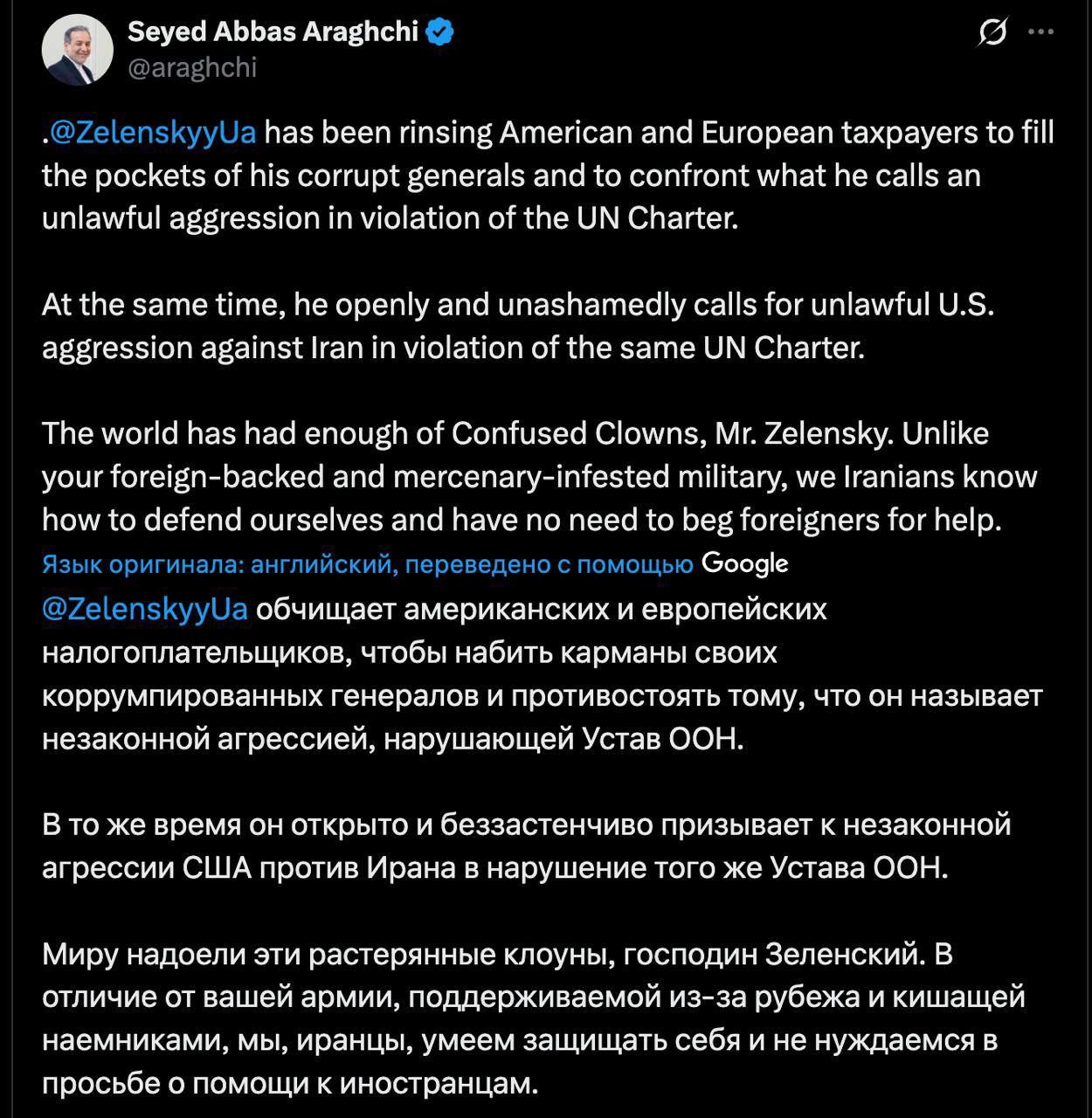
Iranian Foreign Minister Abbas Araghchi lashed out at Ukrainian President Volodymyr Zelensky after Zelensky’s World Economic Forum speech in Davos argued that Iran’s protests were “drowned in blood” and warned that if the clerical leadership survives after killing thousands, it sends a signal to “every bully” that mass violence preserves power. Araghchi responded in an English-language post on X, calling Zelensky a “confused clown,” accusing him of draining U.S. and European taxpayers while also, in Tehran’s framing, urging unlawful U.S. action against Iran—language that underscores how Iran’s crackdown is increasingly spilling into high-profile diplomatic confrontations.
The White House said talks in Abu Dhabi between the United States, Ukraine, and Russia were productive, as negotiations on ending the war move forward. Kremlin spokesman Dmitry Peskov said work on resolving the crisis is progressing and emphasized the need to implement the “Anchorage formula.” Media, citing a senior White House official, reported the negotiations will continue tomorrow, and first footage from the delegations’ meeting in the UAE has also surfaced.
A member of Ukraine’s delegation in Abu Dhabi, Rustem Umerov, said today’s meeting focused on “the parameters of ending the war and the subsequent logic of the negotiation process” aimed at moving toward a dignified and lasting peace, and confirmed that Kyiv’s talks with the United States and Russia will continue tomorrow. Umerov added that Ukraine will expand its delegation for the next round, with Chief of the General Staff Gen. Andriy Hnatov and Deputy Chief of the Defense Ministry’s Main Intelligence Directorate Lt. Gen. Vadym Skibitsky set to join.
Bloomberg reported that a Trump–NATO understanding on Greenland could grant the U.S. rights to extract minerals on the island, enable deployment of U.S. missiles, and deepen NATO’s presence—while noting the terms are linked to whether President Donald Trump follows through on his pledge to hold off on tariffs on European goods. CNN, meanwhile, reported Trump and NATO Secretary General Mark Rutte have reached an agreement “in principle,” but that the details are not yet formalized in writing; the next step would be U.S.–Denmark–Greenland talks to update the 1951 defense agreement governing the U.S. military presence, alongside measures aimed at blocking Russian and Chinese investment and expanding NATO activity in the region.
U.S. Central Command chief Adm. Brad Cooper is expected to arrive in Israel on Saturday, January 24, 2026, for talks with senior officials amid heightened regional tensions, according to Israel’s Kan public broadcaster. The same reporting says Cooper recently made a low-profile trip to Syria to assess Damascus’s adherence to its ceasefire commitments with the Syrian Democratic Forces, after meeting SDF leaders in Iraq’s Kurdistan region. Separately, Israel’s Channel 12 reported that White House adviser Jared Kushner and U.S. special envoy Steve Witkoff are also due in Israel on Saturday for meetings with Prime Minister Benjamin Netanyahu focused on Hamas and Gaza—especially efforts tied to Ran Gvili, described as the last remaining hostage in Gaza—alongside possible discussions related to Iran.