translate English
 پارسی
English
Englishپارسی
English
Englishپارسی EnglishپارسیEnglishپارسی
A statement attributed to U.S. Deputy Representative to the UN Tammy Bruce says Washington will continue “full enforcement” of reimposed UN Security Council sanctions on Iran, arguing Tehran has long prioritized funding armed groups and advancing nuclear and missile programs over meeting basic public needs. The remarks land as “snapback” measures tied to the JCPOA framework have been moving back into force—reinstating wide-ranging restrictions such as asset freezes, arms limits, and missile-related constraints—tightening the diplomatic and economic vise on Tehran at a time of heightened regional risk and international scrutiny.
Hannah Neumann, a German Member of the European Parliament and chair of Parliament’s Iran-related delegation, said in a statement that Europe is “witnessing the systematic destruction of lives in Iran,” warning that the Islamic Republic is “violently erasing an entire generation of young people.” She added that her thoughts are with Iranians and with everyone who has lost loved ones, framing the message as solidarity with victims of the crackdown and a call to keep international attention on accountability.
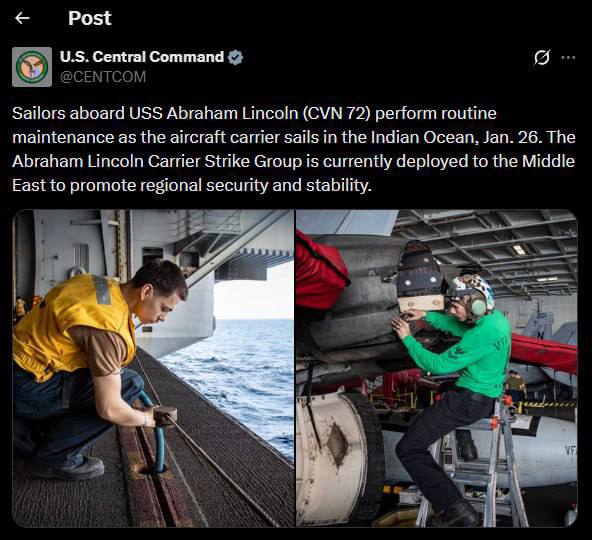
U.S. Central Command (CENTCOM) said the aircraft carrier strike group USS Abraham Lincoln is currently deployed in the Middle East to support regional security and stability, and published photos on its X account showing sailors conducting routine maintenance while the carrier was underway in the Indian Ocean on January 26. The deployment comes as Washington reinforces its regional posture amid elevated U.S.–Iran tensions, expanding U.S. options to protect forces and respond to potential escalation.
Online rumors about a China–Iran “air bridge” (claims of Chinese military transport aircraft landing in Tehran with defense cargo) remain unconfirmed by any official Chinese or Iranian statement, but they resonate because Beijing has historically been one of Tehran’s most important non-Western partners under sanctions pressure. In the late 1980s–1990s, China was a significant source of conventional arms and military-technical assistance for Iran, including systems linked to Iran’s coastal defense/anti-ship capabilities. More recently, the relationship has been anchored less in overt arms transfers and more in economic and strategic linkage: China is widely described as Iran’s largest oil customer and has maintained ties despite U.S. sanctions, while also backing diplomacy and opposing unilateral coercive measures. The 25-year cooperation framework signed in 2021 reinforced the perception of a long-horizon partnership—fueling public expectations that, in a crisis, Beijing could provide material or logistical relief even if it avoids formal confirmation.
NATO Secretary General Mark Rutte said billions of dollars’ worth of U.S.-sourced military hardware is currently flowing to Ukraine and is being paid for by Allies and Partners under NATO’s initiative framework. Separately, Ukraine has forecast donor-funded military requirements for 2026 totaling just over $60 billion, underscoring the scale of external financing Kyiv says it needs to sustain defense needs next year.
Two sources speaking to The Jerusalem Post say the U.S. still needs several more days—potentially about a week—to complete a CENTCOM force package that would enable a “significant” military option against Iran, as deployments accelerate across air, naval, and missile-defense layers. The build-up includes the aircraft carrier USS Abraham Lincoln and its strike group moving toward the theater, additional fighter aircraft reported arriving in Jordan, and further air-defense assets aimed at protecting Israeli airspace and U.S. facilities if tensions spill into wider conflict.
The U.S. Air Force said it is set to begin a multi-day readiness exercise across the Middle East aimed at demonstrating its ability to deploy, disperse, and sustain combat airpower in the region. The drill is tied to AFCENT/9th Air Force readiness concepts focused on distributing aircraft and logistics across multiple operating locations, as Washington continues broader force-posture moves amid heightened regional tensions.
At a major Iranian rally in Brussels on Sunday, 5 Bahman (Jan. 25, 2026), Bill White, the U.S. ambassador to Belgium, said Prince Reza Pahlavi has the ability to bring Iranians together for a transition period, in remarks framed as support for the protest movement’s demands.
i24News reported that U.S. force deployments in the Middle East are expected to reach, within the next few days, a level it described as sufficient for a “significant action.” The claim points to a near-term acceleration in operational readiness, signaling that Washington’s regional posture may be shifting from deterrence and reinforcement toward a configuration designed to support rapid execution if a decision is taken.
Israel’s Channel 13 reported that the coming week will be “decisive” regarding a potential U.S. attack on the Islamic Republic, as senior U.S. military and political officials travel to Tel Aviv. The broadcaster also said Israeli military officials told the CENTCOM commander that any strike should include clearly defined military targets.
Israeli security officials say they are maintaining heightened readiness amid concerns that Iran could launch a pre-emptive strike on Israel if Tehran miscalculates and assumes Washington has already decided on military action. Israel’s Channel 12 (via Mako) reported that the U.S. is reinforcing its posture in the Middle East (including major naval and air assets), and that Israel assesses a U.S. strike track as more likely than negotiations—raising the risk Iran could move first to avoid being caught off-guard. Separately, the IDF said it is prepared for “surprise scenarios” and urged the public not to amplify rumors as the situation develops.
Israel Hayom reported that Israel delivered information to Washington alleging the Islamic Republic carried out executions of detained protesters, despite President Donald Trump previously saying he had received assurances that executions of more than 800 detainees would be halted, a factor he cited in delaying a strike. Iranian officials have publicly rejected Trump’s “800 executions” claim, and the full scope of alleged executions cited in the Israeli report has not been independently verified.