translate English
 پارسی
English
Englishپارسی
English
Englishپارسی EnglishپارسیEnglishپارسی
Newt Gingrich, the former Speaker of the U.S. House of Representatives, said it is time to help the Iranian people free themselves from dictatorship. He argued that renewed “Death to America” chants by Iran’s parliamentary officials should make it clear, in his view, that Iranians need support and that the ruling system must be removed.
Geert Wilders, leader of the Netherlands’ Party for Freedom (PVV), wrote on X that “unfortunately Khamenei is still alive,” claiming that his forces are massacring “brave Iranian youth” fighting for freedom and calling the situation “completely unacceptable.” Addressing President Donald Trump, Wilders urged him to “choose Iran over Greenland,” framing Iran as the more urgent priority amid the ongoing protests and crackdown.
U.S. Secretary of State Marco Rubio held two separate calls on Sunday, 21 Dey 1404 (January 11, 2026) with Cypriot Foreign Minister Constantinos Kombos and French Foreign Minister Jean-Noël Barrot, with the State Department saying Iran’s protests were on the agenda in both conversations. In the call with Cyprus, the readout also cited discussion of U.S. counternarcotics operations in the Caribbean and shared priorities tied to Cyprus’s EU Council Presidency (January–June 2026). In the call with France, the readout said the two also discussed a recent U.S. law-enforcement operation in Venezuela and diplomatic efforts aimed at ending the Russia–Ukraine war.
Trump administration officials are scheduled to meet Danish officials on Wednesday to discuss Greenland, according to CBS News, citing diplomatic sources. The talks come amid intensifying White House signaling that Washington is weighing multiple pathways to bring the Danish territory under U.S. control—reporting that has included options ranging from financial incentives aimed at Greenlanders to more coercive measures. President Donald Trump reinforced the pressure on Sunday aboard Air Force One, saying the U.S. would get Greenland “one way or the other,” and dismissed concerns about friction with Europe and NATO.
Market impact: Limited immediate market reaction, but the risk premium is skewed toward higher geopolitical uncertainty: (1) FX: mildly supportive for USD versus European currencies on risk-off headlines; (2) Rates: modest bid for safe-haven duration if tensions escalate; (3) Defense/Arctic exposure: marginally supportive for select defense and critical-minerals narratives tied to Arctic security and supply chains.
In a video clip shared by Persian-language outlets and social media, U.S. Vice President J.D. Vance voiced support for peaceful protests in Iran, saying the Trump administration supports people seeking to secure their rights and have their voices heard, while arguing the Islamic Republic “has a lot of problems.” He added that Tehran’s “wisest” course—consistent with earlier White House messaging—would be to enter what he described as a real negotiation with the United States over what Washington expects to see regarding Iran’s nuclear program. On potential next steps, Vance said he would leave future actions to President Donald Trump, while reiterating U.S. backing for rights-seeking movements globally, including in Iran.
U.S. President Donald Trump told Republican lawmakers that failing to hold Congress in the 2026 midterms could open the door for Democrats to pursue impeachment, using the warning to press for tighter party unity behind his agenda. Speaking at a House GOP gathering at Washington’s Kennedy Center, Trump urged members to push sensitive priorities—including gender-related policies, public health, and election reforms—and to persuade voters frustrated by the cost of living to back the broader program.
Market impact: Modestly risk-negative at the margin—impeachment rhetoric raises U.S. political-noise premium and can complicate the legislative path for fiscal and regulatory priorities, which tends to support Treasuries and cap risk appetite during periods of headline escalation.
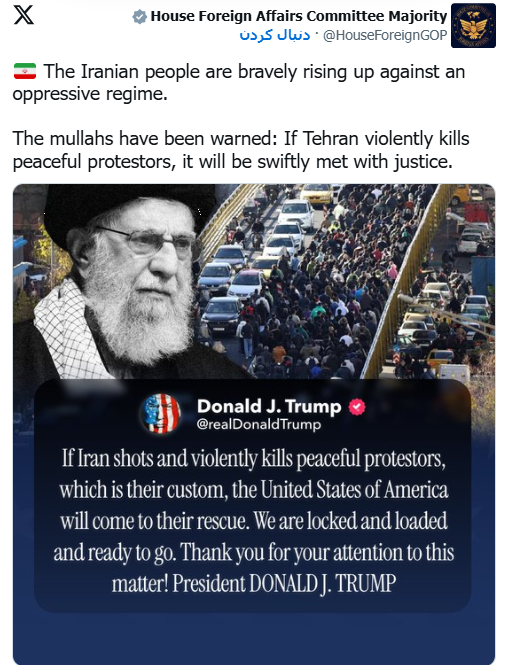
The Republican-led U.S. House Foreign Affairs Committee said on X that Iranians have “bravely” risen up against a repressive regime, and warned Iran’s clerical leadership that if Tehran “violently kills peaceful protestors,” it will be “swiftly met with justice,” framing the message as a direct deterrent tied to the government’s response to street demonstrations. X (formerly Twitter)+1
U.S. forces led by the Coast Guard have boarded and seized the Russian-flagged oil tanker Marinera (formerly Bella 1) in the North Atlantic under a U.S. federal court warrant tied to alleged sanctions violations, after the vessel previously refused boarding near Venezuela and fled across the Atlantic. Russia’s Foreign Ministry said it is monitoring the situation and argued the ship is receiving “disproportionate” attention from the U.S. and NATO relative to its “peaceful” status—adding a fresh friction point to U.S.-Russia tensions as Washington tightens enforcement against Venezuela-linked and “shadow fleet” oil movements.
Market impact: Modestly supportive for near-term oil/geopolitical risk premium and tanker/shipping insurance costs; watch for retaliation rhetoric and any escalation in maritime interdictions that could affect sanctioned-barrel logistics and North Atlantic shipping lanes.
U.S. Senator Lindsey Graham said in a Fox News appearance on Tuesday (January 6, 2026 / 16 Dey) that if Iran’s authorities continue cracking down on protesters, Donald Trump would order Supreme Leader Ali Khamenei killed, while also praising Trump as “the greatest president of all time” and telling Iranian protesters, “we support you.” The comments come amid escalating U.S.–Iran rhetoric as nationwide protests continue inside Iran.
U.S. officials have discussed offering Greenland a Compact of Free Association (COFA)—alongside options such as an outright purchase—as President Donald Trump re-energizes efforts to bring the strategically located Arctic territory into Washington’s orbit. Under COFA-style arrangements (used with Micronesia, the Marshall Islands, and Palau), the U.S. provides financial support and assumes responsibility for defense in exchange for expanded strategic access; a Greenland version would likely stop short of full U.S. sovereignty but still mark a major shift in the Denmark–Greenland–U.S. relationship. Separate reporting also suggests Washington has explored direct talks with Nuuk, effectively sidelining Copenhagen, even as Danish and Greenlandic leaders reiterate that the island is not for sale.
Market impact: A modest pickup in geopolitical risk premium around the Arctic—supportive for defense and potentially critical-minerals/rare-earth narratives, while adding headline risk for Denmark/European politics. Broader market spillover is likely limited unless rhetoric escalates into concrete policy steps (sanctions, basing changes, or treaty negotiations).
Israeli outlets, including i24NEWS, reported that President Donald Trump has given Israel a “green light” for a possible military operation against Hezbollah in Lebanon, with the Israeli military said to be prepared and Prime Minister Benjamin Netanyahu holding the final timing decision. The reporting aligns with other Israeli-media accounts that Trump told Netanyahu the U.S. would support Israeli action if Lebanon’s army fails to disarm Hezbollah—though no public confirmation from the White House was immediately evident. The report lands as Israel has already escalated its posture, launching strikes on what it described as Hezbollah and Hamas targets in Lebanon after issuing evacuation orders for several villages, amid growing U.S.-Israel pressure on Beirut to accelerate Hezbollah disarmament under the post-2024 truce framework.
Market impact: Higher short-term geopolitical risk premium—supportive for defense and selective energy plays, and potentially bid for safe havens (USD, gold) if escalation broadens. Regional FX/credit (notably ILS and Lebanon-linked risk) would be most sensitive, while global risk impact likely stays contained unless operations expand materially or trigger wider regional spillovers.
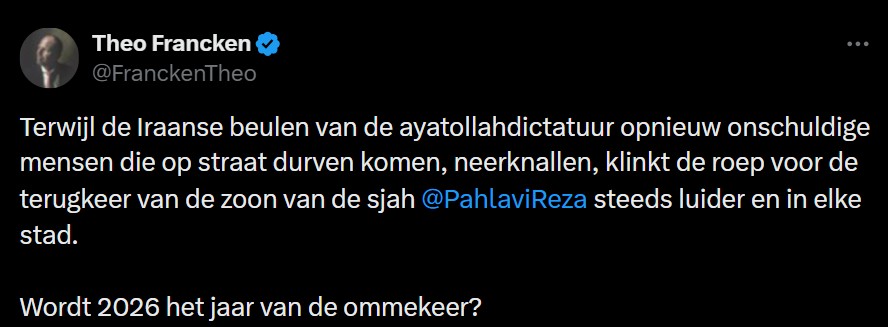
Belgian Defence and Foreign Trade Minister Theo Francken said in a recent post that as Iran’s security forces “shoot” protesters, the call for the return of the “son of the Shah” (Prince Reza Pahlavi) is “getting louder in every city,” framing 2026 as a potential turning point. Iran’s mission to the EU publicly condemned his remarks, underscoring how external political commentary is increasingly feeding into the international narrative around the protests.