translate English
 پارسی
English
Englishپارسی
English
Englishپارسی EnglishپارسیEnglishپارسی
A U.S. official confirmed that the United States is currently conducting military strikes inside Venezuela, without providing details on targets or locations. Caracas has described the action as “military aggression,” saying strikes hit multiple areas, including Caracas and nearby states, and announced emergency measures as the situation develops.
Multiple outlets reported that U.S. strikes hit targets in Caracas, including damage at Fuerte Tiuna—Venezuela’s main military complex—while videos circulating online purport to show an aerial strafing run over the base. Public, real-time confirmation of the specific “strafing” claim remains limited; coverage notes that the Pentagon has, at times, deferred detailed questions to the White House as the situation develops.
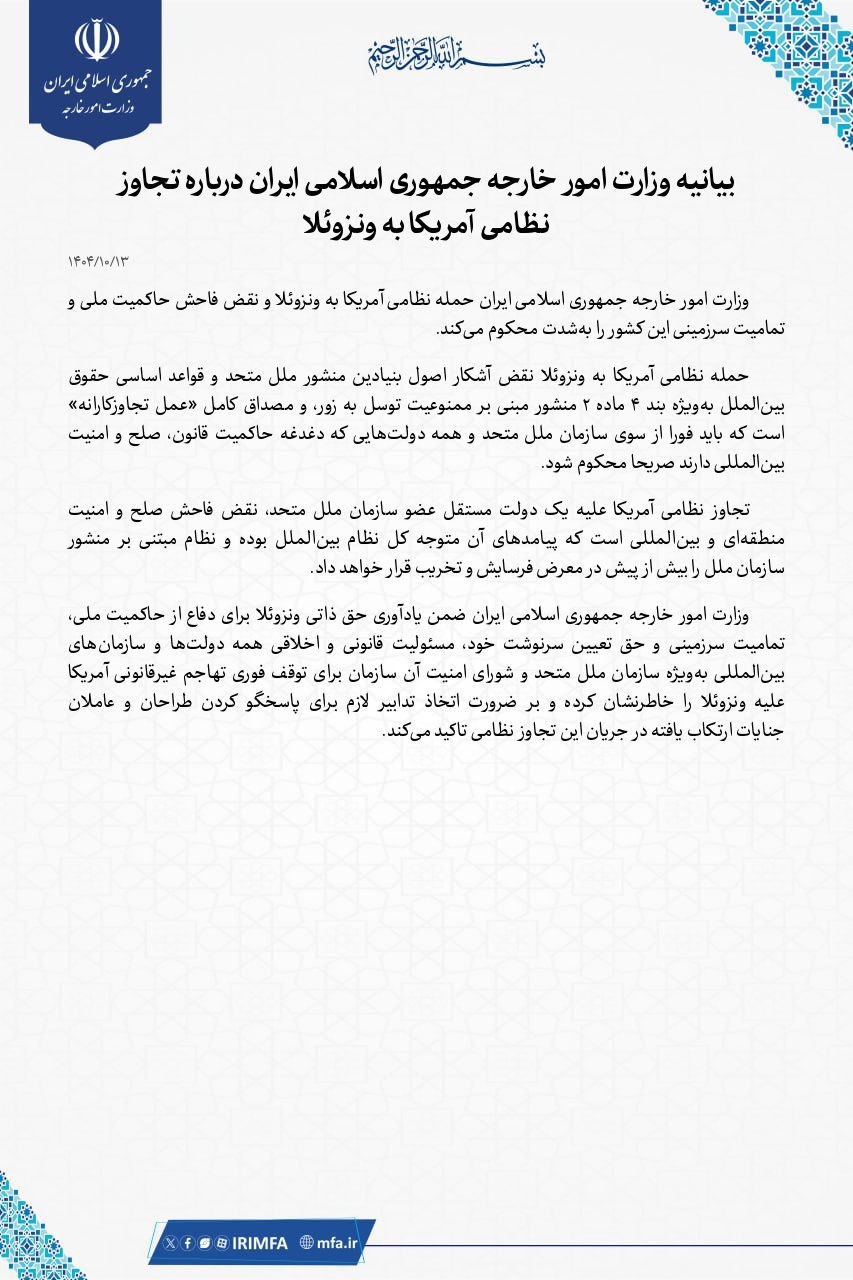
Iran’s Foreign Ministry said it “strongly condemns” the U.S. military attack on Venezuela, calling it a flagrant violation of the country’s national sovereignty and territorial integrity, as international reactions intensify following reports of U.S. strikes and Caracas’s declaration of a national emergency.
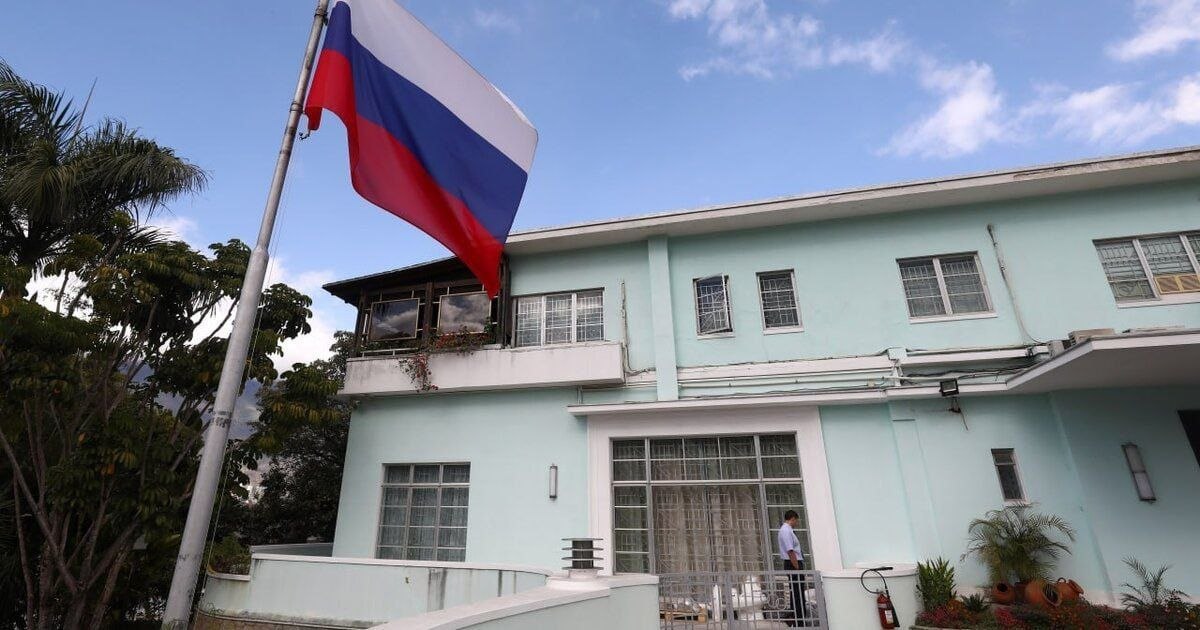
Russia’s embassy in Caracas said the building was not damaged and that “no strikes” hit the areas where the mission is located, adding that all staff are safe. The statement followed reports of U.S. strikes inside Venezuela, with Caracas also accusing Washington of attacks in the capital and several states and declaring an emergency. Separately, President Donald Trump claimed Venezuela’s President Nicolás Maduro and his wife were captured and flown out of the country—an assertion widely reported but still developing and not independently confirmed in real time.
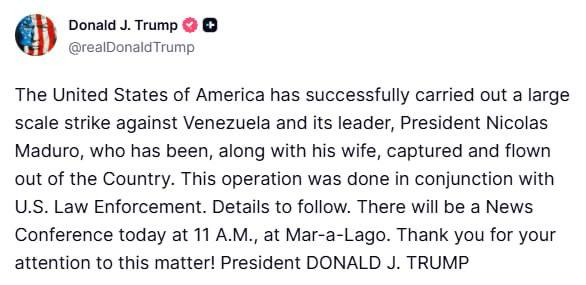
U.S. President Donald Trump said in a Truth Social post on Saturday, January 3, 2026 that the United States carried out a “large-scale strike” in Venezuela and that President Nicolás Maduro and his wife Cilia Flores were “captured and flown out of the country,” with “details to follow” and a planned 11 a.m. Mar-a-Lago news conference. Reuters and AP reported explosions and low-flying aircraft over Caracas, with parts of the capital facing power outages, while Venezuela’s government condemned the action as military aggression; the White House and Pentagon had not provided detailed public confirmation beyond Trump’s claim at the time of reporting.
A Ukrainian drone attack struck the Tuapse oil refinery in Russia’s Krasnodar region, injuring two people and sparking a fire that was quickly extinguished, according to regional authorities. The strike damaged refinery equipment, one port berth, and five residential properties, underscoring the refinery’s vulnerability despite its location roughly 350 km from Ukraine’s mainland across the Sea of Azov.
Market impact: Mildly supportive for crude prices at the margin—any disruption risk to Russian refining and Black Sea infrastructure adds a geopolitical risk premium, though limited damage caps immediate supply concerns.
U.S. President Donald Trump said the United States would strike Iran again if Tehran attempts to rebuild its nuclear programme, reinforcing persistent Middle East tensions and keeping markets alert to escalation and retaliation risk in a region central to global oil supply. The remarks add to a higher-geopolitical-risk backdrop and reduce confidence in a near-term cooling of regional security risks.
Market impact: Risk-off tilt—supportive for crude (geopolitical premium) and safe havens (gold, JPY/CHF); potentially negative for regional risk assets, with follow-through dependent on any operational developments or supply-disruption headlines.
President Vladimir Putin said Russia will revise its negotiating position after the Kremlin alleged Ukrainian long-range drones targeted an area near one of his residences, while Ukraine denied targeting Putin and called the claim a pretext to derail talks. The comments reduced expectations for near-term de-escalation and increased concern that the conflict narrative could harden into 2026. Escalation watch: Moscow flagged potential retaliation and a review of negotiation parameters.
Market impact: Risk-off—supportive for safe havens (gold, JPY/CHF) and a modest geopolitical premium in crude; negative for regional risk assets and potentially RUB if escalation rhetoric intensifies.
Weekend reports said the U.S. Coast Guard is in “active pursuit” of a sanctioned “dark fleet” vessel near Venezuela—potentially the third interception in less than two weeks—after President Donald Trump announced a “total and complete blockade” of sanctioned oil tankers entering and leaving the country. The latest vessel has been identified by maritime-risk sources as Bella 1, which U.S. officials allege is operating under a false flag as part of sanctions evasion, underscoring a broader pressure campaign on Caracas tied to accusations of narcotrafficking and escalating enforcement at sea.
Market impact: Mildly bullish for crude via a higher geopolitical risk premium and potential Venezuelan export disruptions; risk sentiment can turn more defensive if maritime actions broaden or trigger retaliation.
Safe-haven demand strengthened after weekend reporting said Israeli Prime Minister Benjamin Netanyahu is preparing to brief U.S. President Donald Trump on potential renewed action against Iran, amid concerns Tehran is rebuilding nuclear-enrichment infrastructure and accelerating its missile program. The backdrop is June’s Israel–Iran conflict, when the U.S. struck three Iranian nuclear sites and a ceasefire followed soon after. Netanyahu and Trump are set to meet in the U.S. on December 29, keeping escalation headlines a key year-end macro risk.
Market impact: Risk-off supportive for gold and other havens, while adding an upside skew to crude via a higher geopolitical risk premium; headline-driven volatility remains elevated into year-end liquidity conditions.
EU leaders agreed on Friday to borrow funds to provide a €90 billion loan to Ukraine for 2026–2027, choosing EU-backed borrowing over the more contentious idea of using frozen Russian sovereign assets. Leaders also tasked the European Commission with continuing work on a “reparations loan” linked to immobilised Russian assets, but the approach was deemed unworkable for now, largely due to Belgium’s resistance given that most of the assets are held there.
Market impact: EUR-neutral to mildly supportive on reduced intra-EU friction; the decision lowers near-term legal/retaliation tail risks around asset use, while keeping the broader “Russian assets remain frozen” policy backdrop intact.
EU leaders need to win over Belgium—where €185bn of the €210bn in frozen Russian central-bank assets held in Europe sit—by offering clear risk-sharing guarantees, so Brussels is not left liable if Russia succeeds in international court challenges tied to the Ukraine-financing plan.
Market impact: Event risk for EUR and European rates—credible guarantees support sentiment and reduce Euroclear-tail risks; lack of agreement keeps legal/retaliation uncertainty elevated.