translate English
 پارسی
English
Englishپارسی
English
Englishپارسی EnglishپارسیEnglishپارسی
During his highly anticipated meeting with Egyptian President Abdel Fattah el-Sisi in Sharm El Sheikh, former U.S. President Donald Trump opened with trademark humor, declaring that the two leaders share “great chemistry together.” Trump then couldn’t resist a jab at Hillary Clinton, recalling their first meeting years ago: “He liked me so much… he only saw her for two seconds.”
The lighthearted remark drew laughter from attendees but also underscored Trump’s penchant for mixing diplomacy with personal showmanship. The meeting marks Trump’s return to Middle East diplomacy amid talks over Gaza’s transitional governance and broader regional security coordination.
Political impact: Symbolic reaffirmation of U.S.–Egypt ties under Trump’s leadership style; adds a personal and theatrical tone to otherwise tense summit diplomacy.
Former U.S. President Donald Trump declared that Iran “can’t survive” under current U.S. sanctions, suggesting Tehran will eventually have to return to negotiations. “At some point, they will say ‘we want the sanctions off’ — we’re going to end up with peace,” Trump said during remarks on the sidelines of the Sharm El Sheikh peace summit.
He further argued that the Gaza peace deal would have been impossible without striking Iran’s nuclear program, implying that U.S. pressure on Tehran created the diplomatic conditions for recent Middle East breakthroughs. The comments highlight Trump’s intent to link his sanctions policy to broader regional stabilization efforts — a stance drawing both praise and skepticism from international observers.
Political impact: Heightens diplomatic tension with Tehran; signals that Washington’s leverage strategy remains central to Trump’s foreign policy narrative.
Egyptian President Abdel Fattah el-Sisi convened an informal roundtable with top world leaders in Sharm El Sheikh as they awaited Donald Trump’s arrival for the regional peace summit. El-Sisi was seated at the center, flanked by France’s Emmanuel Macron, UK Prime Minister Keir Starmer, U.S. envoy Mark Carney, Turkey’s Recep Tayyip Erdoğan, Italy’s Giorgia Meloni, Jordan’s King Abdullah II, and the Emir of Qatar, Sheikh Tamim bin Hamad Al Thani.
The high-level gathering underscores Egypt’s pivotal diplomatic role as a mediator between Western and Middle Eastern powers amid ongoing Gaza and regional peace negotiations. Observers say the lineup reflects both the diversity and fragility of the emerging coalition, with leaders balancing strategic interests ahead of Trump’s long-anticipated proposals.
Political impact: Reinforces Egypt’s central position in mediation; signals cautious coordination among key global and regional actors before potential U.S.-led announcements.
Egyptian President Abdel Fattah el-Sisi met with former UK Prime Minister Tony Blair in Sharm El Sheikh during ongoing diplomatic efforts to de-escalate the Gaza crisis. Blair has reportedly been tipped for a potential role as transitional Gaza governor under a Western-backed proposal — a suggestion that Palestinian leaders have strongly rejected, calling it an infringement on their sovereignty.
The meeting comes as Cairo intensifies mediation between Israel, the U.S., and regional powers to secure a ceasefire framework and humanitarian access. Blair’s possible appointment, reminiscent of his prior envoy role under the Quartet, has sparked debate over Western influence in post-conflict Gaza governance.
Market/Political impact: Heightens regional political sensitivities; signals renewed Western engagement in Middle East diplomacy but risks fueling local mistrust.
🕕 Tuesday, 24 June 2025
Russian Foreign Minister Sergey Lavrov criticized Western leaders, accusing them of inconsistency and strategic failure in their approach to global conflicts.
“Unlike us, Western so-called leaders are constantly changing their approaches,” Lavrov said.
“This reflects the failures of all their initial plans.”
He pointed to the shifting rhetoric on the Ukraine war as an example:
“First, it was ‘Russia must be strategically defeated on the battlefield,’ and later it became ‘Russia should not win in Ukraine.’”
Lavrov’s remarks come amid renewed scrutiny of Western crisis management, as geopolitical tensions expand beyond Ukraine.
🕕 Tuesday, 24 June 2025
Kremlin spokesperson Dmitry Peskov commented on the newly announced Israel–Iran ceasefire, saying:
“If Israel and Iran have indeed reached a ceasefire agreement, this can only be welcomed.”
He added that Moscow hopes the ceasefire will hold, signaling Russia’s support for de-escalation and regional stability.
🕕 Tuesday, 24 June 2025
According to the Jerusalem Post, at least five people were killed and 20 others wounded after six waves of Iranian missile attacks struck Beersheba and surrounding areas within just over an hour.
Most victims reportedly suffered limb injuries, lacerations, or panic-related trauma. Emergency services said that several people trapped under rubble have been successfully rescued.
The city remains on high alert amid fears of renewed attacks despite the ceasefire announcement.
🕕 Tuesday, 24 June 2025
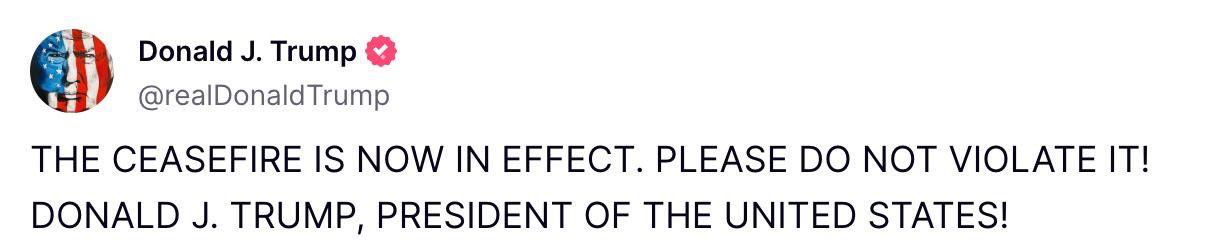
U.S. President Donald Trump has formally declared the Israel–Iran ceasefire “now in effect”, urging all parties to respect the agreement and avoid any further escalation.
“THE CEASEFIRE IS NOW IN EFFECT. Please do not VIOLATE it,” Trump posted on social media Tuesday afternoon.
While the announcement marks a turning point in efforts to restore calm in the region, it remains to be seen whether all parties will fully comply, especially amid ongoing military activity on the ground.
🗣️ Will the ceasefire hold? Or is this just a temporary pause? Share your thoughts.
🕕 Tuesday, 24 June 2025
The Israel Defense Forces (IDF) announced that Israeli fighter jets carried out a precision strike on missile launchers in western Iran, just moments before they were set to fire toward Israeli territory.
The statement did not specify the exact location, but emphasized that the strike was preemptive and intended to neutralize an imminent threat.
This comes despite the earlier announcement of a ceasefire agreement between Iran and Israel, raising questions about the stability of the fragile truce.
🕕 Tuesday, 24 June 2025
Iranian state media has officially announced that the ceasefire agreement proposed by U.S. President Donald Trump is now in effect from Iran’s side.
According to IRNA and other regional outlets, the ceasefire between Israel and Iran has now entered its “implementation phase.”
This marks the most significant diplomatic breakthrough since the recent escalation, though it remains to be seen whether both sides will maintain the truce in the coming hours.
Jerusalem—A ceasefire brokered by President Trump between Iran and Israel came into effect at 7 am Israel time today, although Israel retains a 12-hour window until 7 pm to continue strikes. The Iranian military has not yet issued an official confirmation.
• Ceasefire start: 7 am Israel time; Israel’s window ends at 7 pm.
• Iranian side: no official acknowledgment from Iran’s military.
Beersheba—Charred vehicles still stand as eerie reminders of the recent missile strike on the city’s outskirts, their frames blackened and twisted. Emergency teams continue clearing debris and inspecting nearby structures for damage.