translate English
 پارسی
English
Englishپارسی
English
Englishپارسی EnglishپارسیEnglishپارسی
Israel’s Channel 14 reported that following a White House message invoking protection for U.S. forces, reports emerged of American military aircraft operating near Iran’s airspace, including aerial refueling tankers and B-52 bombers said to have taken off from a base in Qatar. The claims have been amplified by social-media posts and flight-tracking commentary, but the details cannot be independently verified from the information provided and should be treated cautiously amid heightened regional tensions.
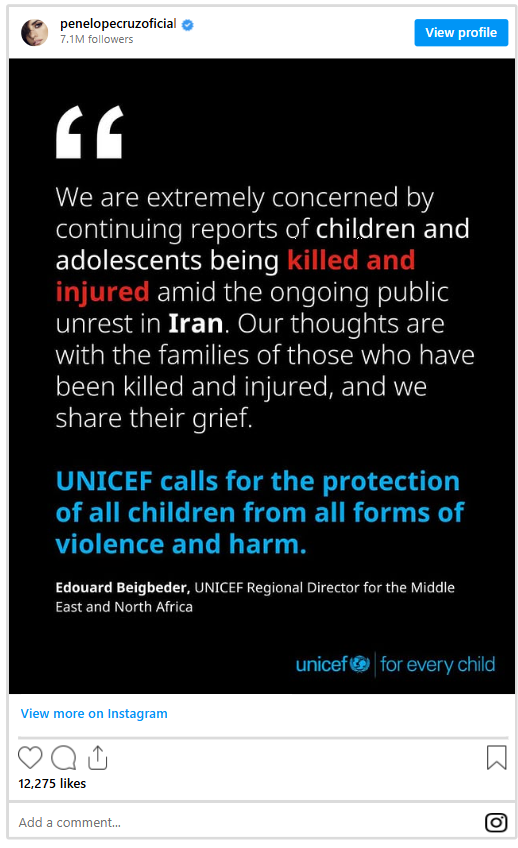
Spanish actress Penélope Cruz reacted to reports of violence against children during Iran’s protests by resharing a UNICEF message raising serious concern about allegations that children and teenagers have been killed or injured. UNICEF, a UN agency, urged that Iranian children and adolescents be protected from all forms of violence as the crackdown intensifies.
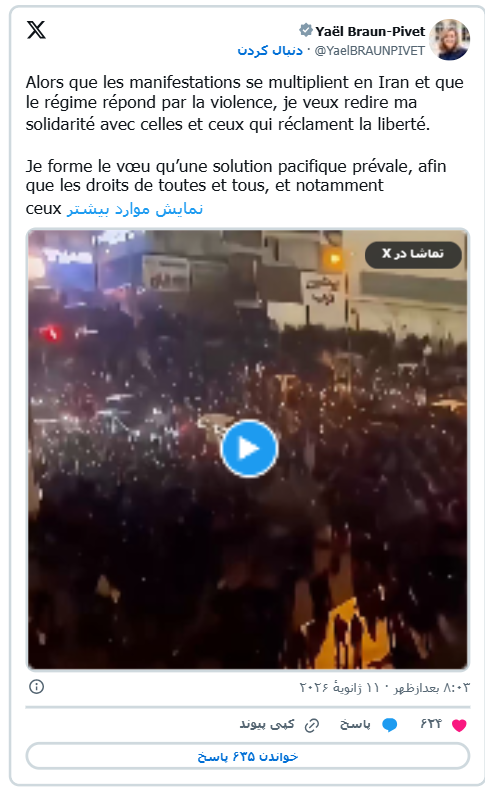
Yaël Braun-Pivet, President of France’s National Assembly, wrote on X that as protests in Iran expand and the authorities respond with violence, she wanted to reiterate her solidarity with those “seeking freedom.” Her message adds to a widening set of European political statements condemning repression and signaling public support for protesters’ demands.
U.S. officials told Politico that President Donald Trump is expected to receive a briefing on Tuesday on “some military options and many non-military options” regarding Iran. One unnamed official said the menu could range from targeted strikes inside Iran to offensive cyber operations, while emphasizing the administration wants to avoid choices that could cause broad civilian harm, favoring options more narrowly tailored toward Iranian military targets.
British media report that senior Labour figures—alongside prominent Conservatives and Reform UK voices—are calling for the UK to proscribe Iran’s Islamic Revolutionary Guard Corps (IRGC) as a terrorist organisation in solidarity with Iranian protesters. Labour peer Lord Spellar, who is described as leading the push among Labour peers, told The Telegraph that the IRGC not only terrorises its own people but runs a “terrorist and criminal network throughout the world,” as pressure builds on the UK government over whether—and how—to apply terrorism-style tools to a state-backed entity.
Swedish Member of the European Parliament Alice Teodorescu Måwe criticized what she described as left-wing silence over the suppression of Iranian protesters, writing on X that the reaction would likely be different if a comparable uprising were happening elsewhere. She argued that if people in Gaza were rising up against Hamas and many were being killed, left-leaning voices would not remain as quiet—or, she suggested, some are opportunistic and stay silent when Israel is not involved.
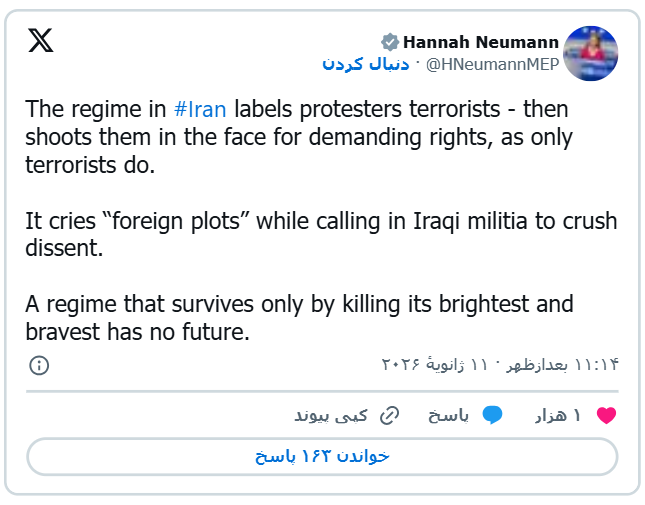
Hannah Neumann, a German member of the European Parliament and chair of the EP delegation for relations with Iran, condemned the crackdown in a post on X, saying Iranian authorities first label protesters “terrorists” and then “shoot them in the face for demanding their rights.” She also alleged that while the government claims “foreign conspiracies,” it has sought help from “Iraqi militias” to suppress dissent. Neumann concluded that a regime that survives only by killing its “brightest and bravest” citizens has no future.
Ireland’s foreign minister said on X that he is “deeply concerned” about developments in Iran and reports of the crackdown on protesters, stressing that freedom of expression, the right to peaceful assembly, and full access to information must be upheld.
Italian Foreign Minister Antonio Tajani said on X that Italy is following developments in Iran “with great concern,” adding that Rome and its European partners are engaged in intensive diplomatic efforts to reach a swift “positive solution” to the crisis—one that respects the aspirations of the Iranian people and safeguards citizens’ security.
UN Secretary-General António Guterres said he is “shocked” by reports of violence against protesters in Iran and called on Iranian authorities to exercise “maximum restraint,” according to comments conveyed by his spokesperson Stéphane Dujarric. The statement also urged officials to avoid the “unnecessary or disproportionate” use of force, as international scrutiny intensifies over the handling of ongoing demonstrations.
Reuters reported that Israeli Prime Minister Benjamin Netanyahu and U.S. Secretary of State Marco Rubio held a call focused on developments in Iran, including the possibility of U.S. intervention, as anti-government protests continue. Three Israeli sources cited by Reuters said the prospect of American action has put Israel on a heightened state of alert, reflecting concerns over potential regional spillovers and retaliatory risks.
The Jerusalem Post reported that U.S. President Donald Trump has effectively decided to help Iranian protesters, citing sources familiar with recent discussions, but that the administration has not yet settled on the “how” and the “when.” The report frames the decision as made in principle while operational details and timing remain under review.